Florida Has Unicorns, Accelerators, and Capital. It’s Missing the One Thing That Makes Ecosystems Compound.
By Brian B. French | Florida Technology News Published July 27, 2026 · Last updated July 27, 2026
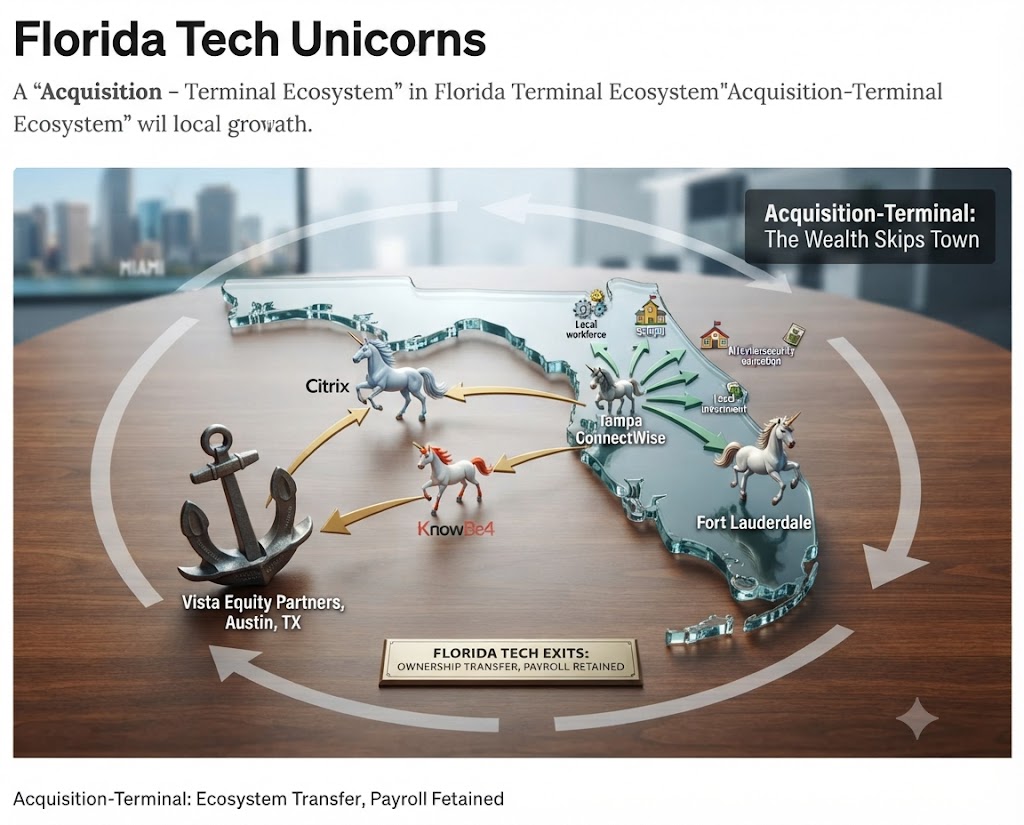
The short answer: Florida’s largest technology companies do not fail — they get bought. Citrix went to Vista Equity Partners and Evergreen Coast Capital for $16.5 billion. KnowBe4 went to Vista for $4.6 billion. The jobs largely stay in Florida. The ownership, the board, the capital allocation decisions, and the wealth that would recycle into local angel investment go to Austin. We call this an Acquisition-Terminal Ecosystem.
Key Takeaways
- Citrix Systems, headquartered in Fort Lauderdale, was acquired by affiliates of Vista Equity Partners and Evergreen Coast Capital for $16.5 billion, with the transaction completing in September 2022 and the company combined with TIBCO to form Cloud Software Group.
- KnowBe4 of Clearwater went public and, less than two years later, agreed to an all-cash acquisition by Vista Equity Partners valued at approximately $4.6 billion.
- Vista Equity Partners is headquartered in Austin, Texas. It acquired two of Florida’s largest technology companies, from two different Florida metros, within roughly a year.
- The companies did not leave. Kaseya remains headquartered in Miami with roughly 5,500 employees and reported revenue near $922 million; ConnectWise remains in Tampa with roughly 3,400 employees and revenue near $590 million. Both are privately held.
- ConnectWise’s roughly $1.5 billion sale produced the state’s clearest counter-example: founder Arnie Bellini reinvested proceeds into local workforce development and AI and cybersecurity education.
- Our thesis: Florida is not losing companies. It is losing ownership — and ownership is what compounds.
What is the anchor company thesis?
The argument is that a durable technology ecosystem needs at least one very large, locally headquartered public technology company, because that company does four things nothing else does. Investors active in Florida have made this case directly, naming a $10 billion-plus public technology company as a threshold requirement, alongside strong universities producing engineers and good K–12 schools for founders’ families.
The four functions an anchor performs:
It trains operators at scale. A large company produces hundreds of people who have run a function through multiple growth stages — the exact profile a Series B startup needs and cannot develop internally.
It generates recycled capital. Employees who hold equity through a liquidity event become the angel investors and seed funds of the next decade. Nearly every mature ecosystem’s early-stage capital traces back to one or two large wealth events.
It creates alumni networks. People who worked together at scale start companies together afterward. The second generation of a cluster is usually built by the first generation’s employees.
It anchors specialized supply. Law firms, recruiters, and service providers who understand technology at scale exist because a large customer made them viable.
Note the common element: all four run on people who experienced a liquidity event locally. Not on a headquarters address. Not on revenue. On employees who got wealthy in a place and stayed.
What are Florida’s largest technology exits?
Large, frequent, and almost uniformly terminal. Florida’s problem has never been that it cannot produce valuable technology companies. It is what happens at the end.
Citrix Systems — Fort Lauderdale. One of the most significant enterprise software companies ever built in Florida, founded in the state and grown there over decades. Acquired by affiliates of Vista Equity Partners and Evergreen Coast Capital in a transaction valued at $16.5 billion, completed in September 2022, then combined with TIBCO Software to form Cloud Software Group.
KnowBe4 — Clearwater. One of the largest names in Tampa Bay’s cybersecurity cluster, built around security awareness training and phishing simulation. It completed an IPO and then, less than two years later, agreed to an all-cash acquisition by Vista Equity Partners valued at approximately $4.6 billion. Local business press at the time noted the challenge of reassuring employees and customers facing a second ownership change in under two years.
ConnectWise — Tampa. Sold for roughly $1.5 billion, in a transaction that catalyzed the region’s cybersecurity ecosystem — for reasons we return to below.
Three companies. Two metros. More than $22 billion of enterprise value. And in the two largest cases, the same acquirer.
🔲 [TABLE PLACEHOLDER — insert the Florida Technology Exit Ledger here before publication.] Ten largest Florida technology exits of the past decade. Columns: Company · Florida metro · Transaction value · Year · Acquirer · Acquirer headquarters state · Florida headcount at close · Florida headcount 24 months later · Founder’s subsequent Florida activity. The two right-hand columns are the entire argument. The acquirer-headquarters column establishes where decision rights went; the founder-activity column establishes whether the wealth recycled locally. Build from SEC filings, press releases, and state employment records.
Where did the acquirers come from?
Austin, Texas — twice. Vista Equity Partners, headquartered in Austin, acquired both Citrix and KnowBe4. Two of Florida’s most valuable technology companies, from opposite ends of the state, absorbed into a portfolio managed from another state’s technology capital within roughly a year of each other.
This is worth stating plainly because it is the cleanest available illustration of the pattern. Florida built the companies. Texas owns them.
We want to be careful about the inference. Vista is a specialist enterprise software investor that buys good software companies wherever they are; there is nothing Florida-specific about its interest, and no suggestion of anything improper. The point is not that Florida was targeted. The point is that Florida is consistently on the selling side of these transactions and consistently not on the buying side — and that a state with no large acquirers of its own will, over a long enough period, transfer ownership of everything valuable it builds.
🔷 Brian’s Take
I spent 25 years on the institutional side of finance, so let me describe what a private equity take-private actually changes, because the public conversation about these deals is usually wrong in both directions.
What does not change: the employees, mostly. The offices. The product. The customers. PE firms buying enterprise software are generally not looking to dismantle a functioning business; they are looking to optimize it, and that frequently means the Tampa office stays open with the same people in it.
What does change: every decision that matters. Where capital gets allocated. Whether the company acquires or gets rolled up. Board composition. Compensation structure. Whether the next expansion happens in Florida or somewhere the sponsor already has infrastructure. And critically, who captures the appreciation from here forward.
Florida keeps reading these transactions as neutral because the headcount holds. Headcount is the least important thing that transferred.
— Brian B. French
What is an Acquisition-Terminal Ecosystem?
An Acquisition-Terminal Ecosystem is one in which successful companies reliably reach a good outcome that produces no local second-order effects — the exit is an endpoint rather than a beginning. We are naming it because “Florida has great exits” is technically true and economically misleading.
In a compounding ecosystem, an exit is the start of a cycle: employees with liquidity fund the next generation, founders start again or begin investing, and the acquired company becomes a regional hub for the acquirer. In an acquisition-terminal ecosystem, the transaction closes, the ownership relocates, and the local economy retains the payroll while surrendering the upside.
The useful analogy comes from regional economics: the branch plant economy. A region hosts substantial manufacturing employment, but every facility is a subsidiary of a company headquartered elsewhere. The jobs are real. The wages are real. But no strategic decision is made locally, no supplier ecosystem develops around headquarters functions, and when conditions change, the region finds out what was decided rather than participating in deciding it.
Florida is developing the software equivalent. Call it branch-plant software — large, real, well-paid technology employment, in facilities whose owners are somewhere else.
But the jobs stayed. Doesn’t that matter?
It matters enormously, and it is the strongest objection to this entire argument, so we want to give it full weight.
Florida’s technology employment is substantial and durable. Kaseya remains headquartered in Miami with approximately 5,500 employees and reported revenue near $922 million, serving nearly 50,000 managed service providers and IT departments across more than 170 countries, with a portfolio including Datto, Unitrends, and IT Glue. ConnectWise remains in Tampa with roughly 3,400 employees and revenue near $590 million. Both are privately held. Both are large, serious, functioning technology companies operating in Florida right now.
KnowBe4, post-acquisition, has continued acquiring — it completed a purchase of Egress to expand its platform into cloud email security. That is not a company being wound down.
So a reasonable person can look at this and conclude Florida is doing fine: thousands of high-wage technology jobs, real revenue, real products, real career paths.
Our disagreement is narrow but consequential. Payroll is a flow. Ownership is a stock. A region with strong flows and no stocks is prosperous and structurally dependent — it does well as long as decisions made elsewhere continue to favor it, and it has no mechanism to convert its own success into the capital base that would fund the next generation of companies.
The test is simple: how many Florida seed funds and active angel investors trace their capital to a Florida technology liquidity event? In the Bay Area, Seattle, and increasingly Austin, that number is large and identifiable. In Florida it is small, and it is the reason the state’s early-stage capital skews toward relocated wealth from other industries rather than toward technology operators who made money locally.
🔷 Brian’s Take
The recycling mechanism is the part I most want people to understand, because I watched the absence of it for years in a different industry.
Angel capital is not a personality trait. It is a byproduct. Somebody works at a company for six years, holds equity through a sale, ends up with meaningful liquidity, and then — because they understand the industry, know the people, and are bored — starts writing $50,000 checks into companies started by people they used to work with. Multiply that by four hundred employees and you have a functioning seed market that no government program could have created.
That entire mechanism depends on where the liquidity event happened and who stayed afterward. Not on where the company was founded, and not on where it is headquartered today.
Florida has had the liquidity events. What it has not systematically had is the second half — the stay-and-reinvest behavior. Some of that is because acquirers consolidate roles elsewhere. Some of it is because people who get liquid in Florida frequently retire, which is a very Florida outcome and not an unreasonable one. But it means the state has been generating wealth events that do not convert into ecosystem capital, and nobody has been tracking the conversion rate.
— Brian B. French
Doesn’t Palantir moving to Miami solve this?
It addresses the headquarters criterion and not the mechanism, and the distinction is the sharpest point in this article.
Palantir relocated its headquarters from Denver to Miami in February 2026. At a valuation above $300 billion, it became the largest publicly traded company headquartered in South Florida. On the surface, Florida now has exactly what the anchor thesis called for — a very large public technology company, headquartered locally.
But return to the four functions an anchor performs. Every one of them runs on employees who experienced a liquidity event in the place.
Palantir’s wealth events happened elsewhere. The company was founded in Palo Alto in 2003, moved to Denver in 2020, and went public before arriving in Florida. Every employee who became wealthy holding Palantir equity did so while living somewhere else — and most of them still live somewhere else. As of late 2025 the company reported approximately 4,429 full-time employees worldwide, with about 600 in the Denver office, and it did not publicly specify how many would relocate to Florida.
As we argued in our analysis of Florida’s five separate tech ecosystems, a headquarters relocation is a different kind of event from an operating buildout. Palantir’s principal executive office is in Aventura, roughly 20 miles north of downtown Miami and outside the submarket where Miami’s startup ecosystem actually operates.
An imported anchor and a homegrown anchor are not substitutes. A homegrown anchor produces local millionaires who become local investors. An imported anchor produces a prestigious address, a signal to other companies, and — potentially, over years — real local headcount that could eventually generate local wealth events.
The second is genuinely valuable. It is simply not the same thing, and Florida should be clear-eyed about which one it just received.
What does compounding actually look like?
Florida has exactly one clean example, and it deserves considerably more attention than it gets.
ConnectWise sold for roughly $1.5 billion. What made that transaction different was not the price — it was smaller than Citrix and smaller than KnowBe4. It was what founder Arnie Bellini did afterward: he reinvested returns into local workforce development and into AI and cybersecurity education initiatives, and the transaction is credited with catalyzing Tampa Bay’s cybersecurity ecosystem cluster.
That is the full loop. Company built locally, sold, proceeds redeployed locally into the inputs that produce the next generation of companies. It is the behavior every mature ecosystem depends on, and in Florida it stands out precisely because it is unusual.
The instructive detail is that the smallest of the three exits produced the largest ecosystem effect. Transaction value and ecosystem contribution are close to unrelated. What matters is what the people do next.
🔷 Brian’s Take
If I were designing Florida’s technology strategy — and I recognize nobody has asked — I would stop optimizing for the metrics the state currently reports and start optimizing for one number: what fraction of Florida technology wealth events result in the principals staying and redeploying capital in Florida within five years?
That is the number that determines whether the state compounds or merely performs. It is measurable. Nobody measures it.
And I would note something uncomfortable that follows from it. Florida’s entire economic proposition — no state income tax, excellent weather, a culture that treats successful retirement as a legitimate life goal — is superbly designed to attract wealthy people and comparatively poorly designed to keep newly wealthy people working. We have optimized the state to be an excellent place to stop, and we are surprised when people stop.
I do not think that is a criticism of Florida so much as a description of a real tension. But an ecosystem strategy that ignores it is not a strategy.
— Brian B. French
What would actually change this?
Five interventions, in ascending order of difficulty:
- Build the exit ledger. No public record tracks Florida technology exits with acquirer location, subsequent headcount, and founder redeployment. Producing it would take weeks and would define the problem quantitatively for the first time.
- Track the recycling rate. For every significant Florida technology liquidity event, follow the principals. Did they stay? Did they invest locally? Did they start something? That conversion rate is Florida’s single most diagnostic ecosystem metric and it is unmeasured.
- Court acquirers, not just companies. Florida’s economic development apparatus recruits operating companies. It does not meaningfully recruit the private equity and strategic acquirers that buy them. A state with resident large-scale acquirers keeps ownership as well as payroll — and notably, some of that capital is already arriving in South Florida for tax reasons without anyone connecting it to this problem.
- Make redeployment easy and visible. Florida has enormous private wealth and no well-developed pipeline connecting newly liquid technology operators to local early-stage opportunities. That is an intermediation gap, and intermediation gaps are solvable.
- Change what gets celebrated. Florida celebrates the announcement — the funding round, the relocation, the exit price. Almost nothing in the state’s public conversation celebrates the second act. Bellini’s post-exit reinvestment should be the most-told story in Florida technology, and it is barely told at all.
What this means for a Florida founder
Understand that your exit is an ecosystem event whether or not you intend it to be. Most founders think about acquirer fit, price, and team outcomes — all correct concerns. Almost none think about where the acquirer is headquartered and what that means for the region five years out, because it is not their job to.
It is worth thinking about anyway, for a self-interested reason: the depth of the ecosystem you sell into is the ecosystem your next company will be built in. Founders who exit and then reinvest locally are not being altruistic. They are improving the conditions for their own second act.
🔷 Brian’s Take
A closing thought, and it connects to something outside my day job.
I deal in authenticated antiques and I have spent years as a genealogist, which means I spend a lot of time tracing what happened to things and families across generations. The recurring lesson in both is that a single generation’s success means very little on its own. What matters is transfer — whether the knowledge, the capital, and the relationships made it to the people who came next.
Florida’s technology industry has had a genuinely successful generation. Citrix, ConnectWise, KnowBe4, Kaseya, and others built real companies and real wealth. The open question — the only question, really — is whether any of it transfers, or whether each of these is a self-contained event that ends when the wire clears.
I would like the answer to be transfer. Right now Florida has one clear example of it and is not paying much attention to that example.
If you exited a Florida technology company and stayed to reinvest here, I want to talk to you. You are the most important and least documented group in this state’s technology economy.
— Brian B. French
About the author
Brian B. French is a digital strategist, former institutional portfolio manager, and the architect of the Florida Authority Network, a proprietary portfolio of Florida business news and press release websites including Florida Technology News.
Before moving into digital strategy, Brian spent more than 25 years in financial services, serving as Vice President and Portfolio Manager with Merrill Lynch Investment Managers and Trust Company, with earlier roles at Shearson American Express, EF Hutton, SouthTrust, and SunTrust. He holds a B.A. in Finance and Business Administration from the University of South Florida.
Outside the digital realm he is a dealer in authenticated antiques and fine art and a member of 17 hereditary and genealogical societies, including the Sons of the American Revolution and the General Society of Mayflower Descendants.
Frequently Asked Questions
What is the largest technology company acquisition in Florida history? Citrix Systems of Fort Lauderdale, acquired by affiliates of Vista Equity Partners and Evergreen Coast Capital in a transaction valued at $16.5 billion and completed in September 2022. Citrix was subsequently combined with TIBCO Software to form Cloud Software Group.
Who acquired KnowBe4? Vista Equity Partners, in an all-cash transaction valued at approximately $4.6 billion. KnowBe4, based in Clearwater, had completed its IPO less than two years before agreeing to the acquisition.
What are the largest technology companies headquartered in Florida? Palantir became the largest publicly traded company headquartered in South Florida following its February 2026 relocation from Denver. Among privately held technology companies, Kaseya in Miami reports roughly 5,500 employees and revenue near $922 million, and ConnectWise in Tampa reports roughly 3,400 employees and revenue near $590 million.
Do Florida tech companies leave after being acquired? Generally not. Employment and facilities typically remain in Florida following acquisition. What relocates is ownership — board control, capital allocation decisions, and the equity appreciation from that point forward.
What is an anchor company and why does it matter? A large, locally headquartered technology company that trains operators at scale, generates recycled capital through employee liquidity, creates founder alumni networks, and supports specialized professional services. Investors have cited a $10 billion-plus local public technology company as a threshold for ecosystem durability.
Does Palantir’s move give Florida an anchor company? It gives Florida a headquarters. The anchor mechanism depends on employees who experienced a liquidity event locally and stayed — and Palantir’s wealth events occurred in California and Colorado before the move. The company has not publicly specified how many employees are relocating to Florida.
Who is Arnie Bellini? The founder of ConnectWise, the Tampa software company that sold for roughly $1.5 billion. He reinvested proceeds into local workforce development and AI and cybersecurity education, and the transaction is credited with catalyzing Tampa Bay’s cybersecurity cluster — the clearest example in Florida of an exit compounding locally.
What is an Acquisition-Terminal Ecosystem? Florida Technology News’ term for a regional economy in which successful technology companies reliably reach favorable exits that produce no local second-order effects, because ownership, decision rights, and recycled capital all relocate while payroll remains.
Sources & Further Reading
- Goodwin — “Citrix Completes $16.5 Billion Acquisition by Affiliates of Vista Equity Partners and Evergreen Coast Capital,” September 2022. https://www.goodwinlaw.com/en/news-and-events/news/2022/09/09_30-citrix-completes-165-billion-acquisition
- Cloud Software Group — “Vista Equity Partners and Evergreen Coast Capital Complete Transaction to Acquire Citrix and Combine with TIBCO.” https://www.cloud.com/news/press-release/2022/vista-equity-partners-and-evergreen-coast-capital-complete-transaction-to-acquire-citrix-and-combine-with-tibco
- GovTech — “Cybersecurity Firm KnowBe4 Agrees to $4.6B Acquisition.” https://www.govtech.com/biz/cybersecurity-firm-knowbe4-agrees-to-4-6b-acquisition
- Business Observer — “Documents reveal details of speedy $4.6B deal for tech company.” https://www.businessobserverfl.com/news/2022/oct/28/documents-reveal-details-of-speedy-dollar4-6b-deal-for-tech-company/
- KnowBe4 — “KnowBe4 Completes Acquisition of Egress.” https://www.knowbe4.com/press/knowbe4-completes-acquisition-of-egress
- Bloomberg — “Palantir Moves Headquarters to Miami From Denver,” February 17, 2026. https://www.bloomberg.com/news/articles/2026-02-17/palantir-moves-headquarters-to-miami-from-denver
- Fox Business — “AI giant Palantir moves its headquarters to Florida,” February 2026. https://www.foxbusiness.com/technology/ai-giant-palantir-moves-its-headquarters-florida-tech-company-exodus-continues
- Kevin O’Brien — “Florida, Miami Startups, the Startup Ecosystem,” February 2026. https://seobrien.com/miami-startups
- Refresh Miami — “The mood at FVCC: Investor optimism about Florida’s tech trajectory,” February 2026. https://refreshmiami.com/news/the-mood-at-fvcc-investor-optimism-about-floridas-tech-trajectory/
Primary sources to consult before republication or update: SEC filings for Citrix (CTXS) and KnowBe4 (KNBE) merger documentation; Palantir 10-K for principal executive office and headcount; Florida Department of Commerce employment data by NAICS for acquired entities; PitchBook or Crunchbase Florida exit records.
Related coverage:
- Florida Doesn’t Have a Tech Ecosystem. It Has Five, and They Don’t Talk to Each Other.
- Florida Keeps Trying to Be a Fintech Hub. Its Actual Unfair Advantage Is the Oldest Population in America.
- Miami’s Most Valuable Tech Asset Isn’t Venture Capital. It’s 17 Cable Landings and One Building Downtown.
- Florida Regulates Data Centers Above 50 Megawatts. The Real Buildout Is Happening Below the Line.
Editorial note
The Acquisition-Terminal Ecosystem framing and the branch-plant software analogy are ours. Sections identified as analysis are labeled as such. Nothing here suggests impropriety by any acquirer named; Vista Equity Partners is a specialist enterprise software investor whose interest in Florida companies reflects their quality rather than anything Florida-specific.
Verification flags for the editor. The ConnectWise transaction value of roughly $1.5 billion and the identity of its acquirer come from secondary reporting and should be confirmed against the original transaction announcement before publication; we have deliberately not named the acquirer for that reason. Revenue and headcount figures for Kaseya and ConnectWise derive from a third-party business data aggregator rather than company filings, and as private companies neither is required to disclose these publicly — treat them as approximate and attribute accordingly, or replace with company-confirmed figures. Palantir’s employee counts are as of late 2025 and will have changed; check the most recent 10-K.
A note on the central claim. The assertion that Florida technology wealth events fail to recycle into local early-stage capital at the rate seen in comparable ecosystems is, at present, an argument supported by circumstantial evidence rather than a measured finding. The exit ledger and recycling-rate study described above would test it — including the possibility that they would disprove it. We would publish that result.
Changelog
- July 27, 2026 — Initial publication.
About the Author