By Brian French | FloridaTechnologyNews.com | September 23, 2026
Quick Answer
AI is still early because only the first layer of buyers, the Big Tech hyperscalers, is fully spending. National governments are just starting to build sovereign AI, and most large companies are still getting their data ready to use AI in production. Infrastructure cycles like this usually take close to a decade more to mature.
Key Takeaways
- Hyperscalers are the first buyers, not the last. Their 2026 spending is historic, but it is only one layer of demand.
- Governments are a new buyer class. Sovereign AI spending is growing fast from a small base.
- Enterprise use lags the hardware. Most big companies have AI running somewhere, but few have scaled it or proven its return.
- Florida is earlier still. The state is only now writing the rules for large AI data centers.
What Does “Early Innings” Mean for AI?
“Early innings” means the investment cycle is closer to its start than its peak. The spending, adoption and payoff have not yet reached full size.
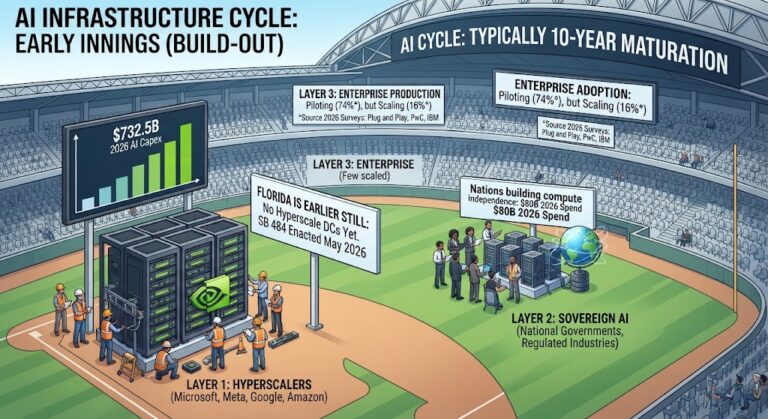
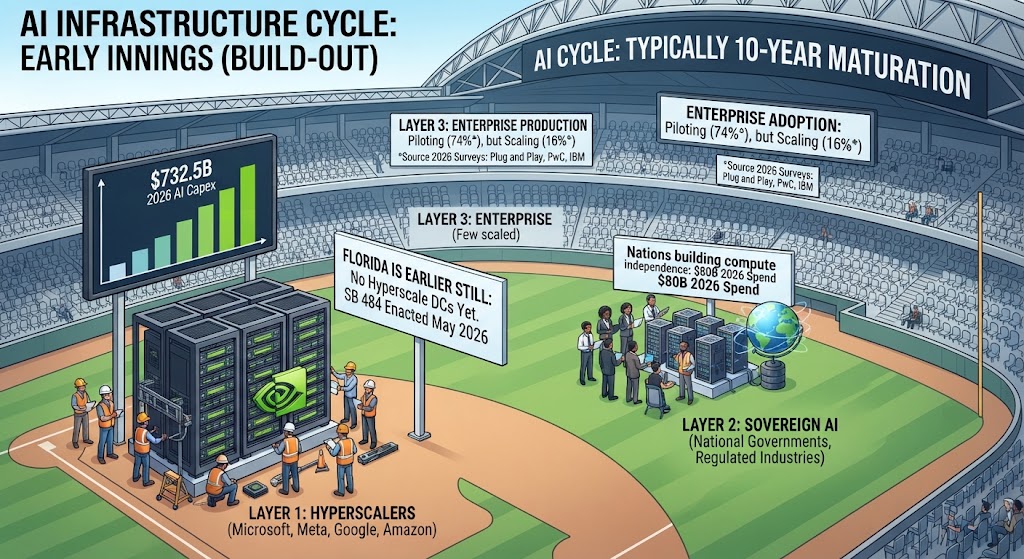
Think of a stadium. Right now the market is arguing about whether the seats will fill up. The game itself, where AI is built into how companies and governments run day to day, is nowhere near its climax.
Daily stock swings make it easy to miss this. A single bad earnings reaction for a chipmaker or cloud provider says little about where a ten-year buildout stands.
How Big Is Hyperscaler AI Spending in 2026?
The first wave of buyers is spending at a record pace. Google, Amazon, Microsoft and Meta together plan about $725 billion in 2026 capital spending, up 77% from a record $410 billion the year before.
The pace has kept surprising analysts. The four companies spent $301 billion in the first half of 2026 alone, and their updated guidance points to $732.5 billion for the full year. Looking further out, Goldman Sachs expects about $5.3 trillion of combined capex from those four companies from 2025 through 2030.
That is the part of the cycle most investors watch. But it is only one layer of demand.
Why Is Sovereign AI a New Layer of Demand?
Sovereign AI is a country’s effort to build its own AI compute, models and data storage inside its borders. The goal is technological independence, so a nation is not dependent on foreign providers for critical systems.
This creates a new class of buyers that barely existed a few years ago. Gartner forecasts worldwide sovereign cloud infrastructure spending of $80 billion in 2026, up 35.6% from 2025, and expects governments to remain the main buyers, followed by regulated industries and critical infrastructure operators.
The longer-range estimates are much larger. McKinsey estimated in December 2025 that sovereign AI could become a $600 billion opportunity by 2030. In the Gulf alone, combined Saudi, UAE and wider GCC sovereign AI commitments exceed $200 billion over the next five years.
Much of that money still flows to American suppliers. NVIDIA supplies GPUs for 45% of all sovereign infrastructure projects tracked by the Center for a New American Security, and U.S. companies appear in most projects across nearly every layer of the stack.
Why Is Enterprise AI Adoption Lagging the Hardware?
Chipmakers and cloud providers built the raw computing power first. Companies now have to audit, clean, migrate and secure their internal data before they can use that power well. That work takes years.
The gap shows up clearly in 2026 surveys:
- Plug and Play found 74% of the world’s largest enterprises run at least one AI solution in production, yet half of those companies cannot tell whether it worked.
- PwC’s January 2026 CEO survey found 56% of CEOs saw neither revenue gains nor cost cuts from AI in the prior year.
- IBM’s CEO study found just 16% of AI initiatives have scaled enterprise-wide.
Having one AI tool in production is a low bar. It does not mean AI runs across the business.
Budgets are starting to shift, though. Companies expect to invest 1.7% of annual revenue in AI in 2026, up from 0.8% in 2025. As corporate IT budgets move toward production-grade AI over the next several years, software demand should feed back into infrastructure demand. That feedback loop is how cycles like this find new legs.
The Three Layers of AI Buyers
| Buyer Layer | Who | Stage in 2026 |
|---|---|---|
| Layer 1: Hyperscalers | Microsoft, Meta, Google, Amazon | Spending at record pace |
| Layer 2: Sovereign AI | National governments, regulated industries | Early, growing fast |
| Layer 3: Enterprise production | Fortune 500 and mid-market firms | Piloting; few scaled |
What Does This Mean for Florida?
Florida sits at an even earlier point in the cycle. When Gov. Ron DeSantis signed the state’s data center law in May, Florida had no large-scale data centers.
That law now sets the ground rules. SB 484, the Florida Hyperscale Data Center Act, took effect July 1. It treats facilities using 50 MW or more at peak as large-scale, bars utilities from passing those costs to homes and small businesses, and keeps local power to deny or tighten approvals.
Local debate is heating up. Sarasota County adopted a one-year hyperscale moratorium in July, and data centers have become a campaign issue in the governor’s race, with an AI-ready Iron Mountain facility nearing completion in Miami-Dade’s Westview neighborhood.
For Florida businesses, the bigger opportunity may be Layer 3. Banks, hospitals, law firms, insurers and logistics companies across the state are the enterprises that still have to get their data ready and put AI to work.
Brian’s Take
I managed money for years, and the pattern here is familiar. Markets price the first buyer loudly and ignore the buyers still in line.
Hyperscaler spending gets the headlines. But sovereign AI is a second customer base with national security reasons to keep spending, which makes it less sensitive to quarterly returns. And enterprise adoption, the third layer, is where the real payoff has to show up. Surveys say most large companies are not there yet.
That is not a warning sign. It is what early looks like. The risk is not that the cycle ends too soon. The risk is expecting a ten-year buildout to prove itself in two.
For Florida, the takeaway is simple. The state is writing its rules before the big facilities arrive. That gives Florida companies time to focus on using AI well, not just hosting it.
Frequently Asked Questions
Is the AI boom a bubble?
Some investors worry spending is outpacing revenue. But the buildout has more buyers coming. Governments and enterprises are still early in their spending.
What is sovereign AI?
Sovereign AI is a nation building its own AI compute, models and data storage within its borders. It aims to reduce dependence on foreign technology providers.
How long do infrastructure cycles last?
Major infrastructure cycles like this one typically take close to a decade to mature. They move from buildout, to adoption, to broad payoff.
Does Florida have large AI data centers?
Not yet at hyperscale. Florida passed SB 484 in May 2026 to regulate large data centers before they arrive, and several counties are debating local limits.
Why aren’t companies seeing AI returns yet?
Most companies are still preparing data, securing systems and redesigning workflows. Many have AI in production but have not scaled it or measured its value.
Sources and Further Reading
- Gartner: Worldwide Sovereign Cloud IaaS Spending Will Total $80 Billion in 2026
- Yahoo Finance: Big Tech’s 2026 AI Capex Plans
- I/O Fund: AI Capex to Hit $1 Trillion
- CNAS: Sovereign AI Index
- Roots Analysis: Sovereign AI Infrastructure Market
- Presenc AI: Sovereign AI Infrastructure Tracker 2026
- Forbes: Most Enterprise AI Is Live. Half of Companies Can’t Prove It Works
- Axis Intelligence: Companies Using AI Statistics 2026
- AI Business Weekly: AI Adoption Statistics 2026
- WCTV: Florida Becomes One of First States to Regulate AI Data Centers
- Data Center Bans: Florida
- Local 10: AI Data Centers Become Flashpoint in Florida Governor Race
About the Author