Everyone Says Power Is Florida’s Data Center Constraint. The Permits Say It’s Water.
By Brian B. French | Florida Technology News Published July 28, 2026 · Last updated July 28, 2026
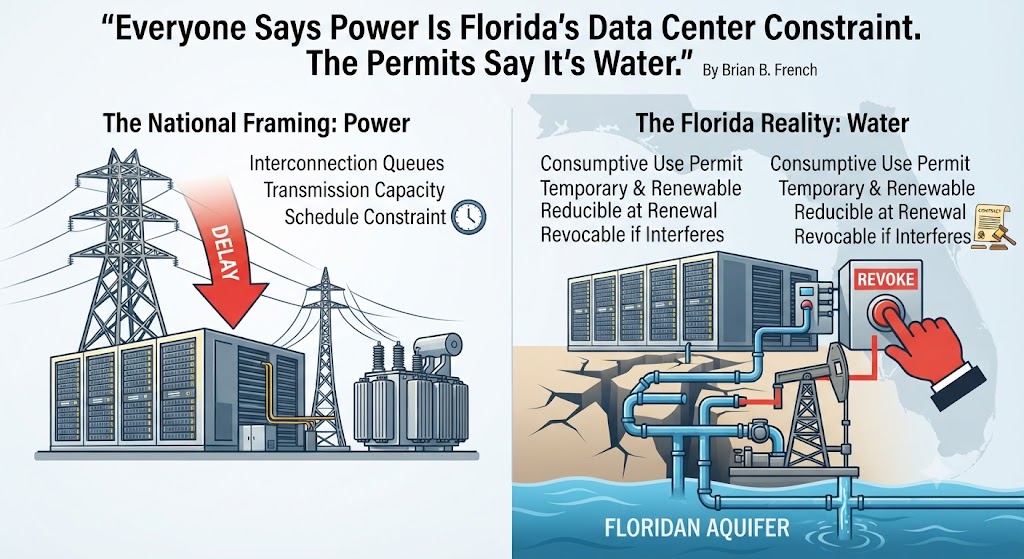
The short answer: National coverage frames data center siting as a power problem. In Florida, the approval that actually determines a project’s fate is the consumptive use permit — and unlike zoning, a water permit is temporary, renewable, reducible at renewal, and revocable if it interferes with existing users. That makes water a capital structure problem, not just an environmental one.
Key Takeaways
- Florida water withdrawals are governed by five regional water management districts under Chapter 373 of the Florida Statutes, which issue consumptive use permits authorizing specific quantities from groundwater or surface water.
- Thresholds are low. In the St. Johns River Water Management District, an individual permit is required for average annual daily withdrawal of 100,000 gallons per day or more, or withdrawal equipment with capacity of one million gallons per day or more.
- The evaluation is a three-part public interest test: is the use reasonable and beneficial under Section 373.019, will it interfere with existing legal users nearby, and is it consistent with the public interest including environmental harm, saltwater intrusion, and wetlands.
- The critical asymmetry: permit conditions state that if a permitted use interferes with legal uses existing at the time of application, the District shall revoke the permit in whole or part unless the interference is mitigated under an approved plan.
- Permits carry fixed terms and must be renewed, and districts report that reductions in authorized use frequently occur at renewal or modification.
- Our thesis: zoning approval is permanent, water approval never is — which means cooling architecture is a financing decision disguised as an engineering one.
Why does everyone say power is the constraint?
Because nationally, it usually is — and Florida imported the framing without checking whether it fit. The standard data center siting story concerns interconnection queues, transformer and turbine lead times, transmission capacity, and utility load forecasts. That framing is accurate in Northern Virginia, in Texas, in the Midwest.
It is also how Florida’s own debate has been conducted. As we reported in our examination of Florida’s 50-megawatt regulatory threshold, the state’s 2026 legislation is organized around electricity consumption, and the largest proposed projects are sited explicitly for power access — the roughly 1,100-acre Fort Meade campus in Polk County was positioned near Duke Energy’s Hines complex specifically to reach high-capacity generation.
Power matters in Florida. Nothing here disputes that.
But power constraints are scheduling problems. They delay projects, raise costs, and push timelines — and they are ultimately solved with capital and patience. Water constraints in Florida are legal problems, adjudicated through a permitting system with statutory tests, a public interest standard, and revocation authority. Those are categorically different obstacles, and the second one is the one Florida has actually built machinery to enforce.
How does Florida regulate water use?
Through five regional water management districts issuing consumptive use permits under Chapter 373 of the Florida Statutes. The districts — South Florida, St. Johns River, Southwest Florida, Northwest Florida, and Suwannee River — each administer their own rules within a common statutory framework, which means the applicable standard depends entirely on where a project sits.
A consumptive use permit authorizes the holder to withdraw a specified quantity of water from an aquifer or from surface water for reasonable-beneficial uses, with commercial and power uses among the covered categories. Permits set limits on how much may be withdrawn at each location, explicitly to protect existing residents’ water supplies, guard aquifers against saltwater intrusion, and prevent surface sources from drying up.
The evaluation applies three questions:
- Is the proposed use reasonable and beneficial as defined in Section 373.019, Florida Statutes?
- Will it interfere with other water users in the vicinity?
- Is it consistent with the public interest — including harm to the environment, saltwater intrusion, wetlands, and the movement of pollution?
Water conservation plans are required in all consumptive use permits, and districts actively encourage permittees to improve efficiency, including cost-share arrangements with large permittees on water-saving technologies.
That second and third question are where a data center application becomes genuinely difficult, and they have no analogue in the zoning process.
🔷 Brian’s Take
I have watched a lot of local government proceedings over the years, and there is a pattern I would offer to anyone trying to predict how one goes.
The objection with a number attached always beats the objection without one. “This will change the character of our community” is a real concern and it loses. “This project will withdraw 1.2 million gallons a day from the aquifer that supplies our wells” is a specific, checkable, hydrologically testable claim, and it changes the room.
Water gives opponents a number. Electricity mostly does not — the grid is abstract, the utility is a distant corporation, and rate impacts are diffuse and contested. But every person in a rural Florida county knows where their water comes from, and a meaningful share of them get it from a well.
That is why I think Florida’s data center fight is going to be decided on water regardless of what the state’s regulatory framework is nominally organized around. The framework counts megawatts. The public counts gallons.
— Brian B. French
At what point does a data center need a water permit?
Far sooner than most developers expect. In the St. Johns River Water Management District, an individual consumptive use permit is required when average annual daily withdrawal equals or exceeds 100,000 gallons per day, or when withdrawal equipment has a capacity of one million gallons per day or more. Uses below applicable thresholds may qualify for general permits by rule or fall under exemptions.
One hundred thousand gallons per day is not a large number in data center terms. A facility using evaporative cooling at meaningful scale passes it easily. Which means most water-cooled data centers of any real size in that district are in individual permitting — the pathway with the full public interest evaluation, not the administrative one.
A caution on the numbers. Thresholds and rules vary by district; the figures above are St. Johns River’s. Any developer or county evaluating a specific site needs to check the applicable district’s rules rather than generalizing from these.
A second caution, and it is the more important one. We are deliberately not publishing a gallons-per-megawatt conversion for data center water consumption. That figure varies by an order of magnitude depending on cooling architecture, climate, and how a facility trades water against electricity — and a plausible-sounding average would be repeated far beyond its accuracy. The right number is the one on a specific project’s application, and demanding it is the single most useful thing a county commissioner can do.
Why is a water permit fundamentally different from a zoning approval?
Because zoning approval is permanent and water approval never is. This is the core of the argument and it is almost entirely absent from Florida’s public debate.
When a county approves a planned unit development, that entitlement generally runs with the land. It is a durable property right. Political composition changes, opposition organizes, the project proceeds.
A consumptive use permit works differently in three specific ways.
It expires. Permits are issued for a fixed period and must be renewed before expiration to continue withdrawing water.
It shrinks. Districts report that reductions in authorized water use frequently occur during renewal or modification. One district described reducing permitted groundwater allocation from the Upper Floridan aquifer — which it characterizes as its primary and very finite source of potable water — by a substantial daily volume in a single year through this process.
It can be revoked. This is the provision that should concentrate the mind of anyone financing one of these projects. Permit limiting conditions state that a permittee’s consumptive use shall not interfere with legal uses of water existing at the time of permit application — and that if interference occurs, the District shall revoke the permit, in whole or in part, to curtail or abate that interference, unless mitigated under a District-approved plan. Parallel language applies to significant adverse hydrologic impacts on off-site land uses.
Read that as a lender would. The facility’s water supply is contingent on continued non-interference with neighbors whose wells were there first, adjudicated by a regulatory body, with revocation as the specified remedy.
🔷 Brian’s Take
Put an institutional credit lens on this and the picture changes completely.
A hyperscale data center is a twenty- to thirty-year asset, typically financed with debt of ten to fifteen years and underwritten against long-term contracted cash flows. The entire structure depends on the asset operating continuously for the full term.
Now insert a critical input that operates on a shorter permit cycle, is subject to reduction at each renewal, and carries an explicit revocation trigger if a neighbor’s well is affected. In any credit committee I ever sat in, that is not a footnote — it is a covenant discussion, a reserve requirement, and quite possibly a pricing adjustment.
I would call this a permit duration mismatch, and I do not think it is being priced. Florida’s data center conversation is being conducted by land use lawyers and utility analysts. The people who should be most interested in the revocation clause are the ones lending against these buildings, and I would be surprised if many of them have read Chapter 40 of the Florida Administrative Code.
— Brian B. French
So cooling architecture is a financing decision?
Yes — and reframing it that way explains project behavior that otherwise looks like environmental positioning.
Consider Atlas Compute’s planned campus in Fort Pierce, St. Lucie County: an initial 240 megawatts with expansion potential toward one gigawatt, built with liquid-cooled, AI-optimized infrastructure in partnership with Penguin Solutions and engineered for NVIDIA GPU environments. Its stated technical focus is advanced thermal management through closed-loop, water-free cooling systems, explicitly framed as reducing water dependency while maintaining efficiency for high-density racks.
The conventional reading is corporate environmental responsibility. The permitting reading is considerably more interesting.
A water-free closed-loop design does not merely reduce consumption. It potentially removes the project from individual consumptive use permitting altogether — which means removing the public interest test, the interference analysis, the renewal cycle, and the revocation exposure. It converts a contingent, adjudicated, politically visible dependency into a fixed capital cost paid once at construction.
Closed-loop cooling is more expensive up front and generally trades water consumption for higher electricity consumption. In most U.S. markets that trade is unattractive. In Florida — where water is the adjudicated constraint and power is a scheduling constraint — the trade may pencil for reasons that have nothing to do with sustainability reporting.
We want to be careful here. We are not claiming Atlas Compute chose its architecture for permitting reasons; we have not asked them and they have not said so. We are claiming that the permitting incentive exists, that it points strongly in this direction, and that Florida projects will increasingly converge on water-free designs whether or not anyone frames it publicly as regulatory strategy.
🔲 [TABLE PLACEHOLDER — insert the Florida Cooling & Permitting Matrix here before publication.] Five to eight proposed Florida data center projects. Columns: Project · County · Water management district · Stated cooling architecture · Projected daily water withdrawal · CUP status (none required / applied / issued / denied) · Land use approval status · Organized opposition (yes/no). Build from the five districts’ public permit databases — all of them publish application and permit records — plus county planning files. The correlation between cooling architecture and approval outcome is the finding. If projects with closed-loop designs clear faster, that is a publishable, citable result nobody has produced.
Which parts of Florida are hardest?
Water difficulty is geographic and legible in advance, which is what makes it plannable. Three categories of elevated scrutiny appear across the districts’ rules and priorities.
Designated concern areas. Districts formally delineate geographies where water availability, water quality, or anticipated demand growth create heightened resource concerns — the Northwest Florida district, for instance, maintains Areas of Resource Concern and identifies a Water Resource Caution Area covering Santa Rosa, Okaloosa, and Walton counties. Siting inside one of these designations changes the analysis before an application is filed.
Outstanding Florida Springs. Spring protection is a statutory priority, and districts explicitly connect consumptive use permitting conservation outcomes to spring protection. Projects drawing from spring-shed geology face both regulatory scrutiny and unusually well-organized public opposition.
Saltwater intrusion zones. Coastal aquifer withdrawal carries intrusion risk that permitting is designed specifically to prevent — a hard hydrological constraint rather than a discretionary one.
This has a direct implication for the Panhandle fights currently underway. Proposed developments in counties including Holmes and Washington have generated public debate, protests, and moratorium calls, with opponents raising water consumption alongside electrical infrastructure and land use. Any assessment of those projects should begin with which district they sit in and whether they fall inside a designated caution area — a question that is answerable from public documents and that we have not seen asked in the coverage so far.
What should each party actually do?
For county commissioners. Require the projected daily water withdrawal in gallons, in writing, in the application record, before the vote. Require the cooling architecture to be specified. Ask whether an individual consumptive use permit will be required, from which district, and on what timeline. A land use approval granted before the water question is answered gives away the county’s leverage on the only issue where it has genuine allies at the state level.
For developers. Model the permitting pathway before selecting the cooling architecture, not afterward. The incremental capital cost of a closed-loop design should be evaluated against the full cost of the alternative — including permit contingency, opposition, delay, and the revocation exposure that a water-dependent facility carries for its operating life.
For opponents. The water objection is the strongest available and it should be made precisely. Vague concern loses; a specific projected withdrawal figure compared against local well capacity and district thresholds is a claim the process is built to evaluate.
For lenders and investors. Read the permit limiting conditions. The revocation language is not boilerplate.
🔷 Brian’s Take
Here is what genuinely concerns me about all of this, and it connects back to something we reported earlier this year.
Florida’s water management districts evaluate each consumptive use permit against existing legal users and resource conditions. That is a sound framework for individual applications. But the districts are not, as far as I can determine, evaluating data center water demand as a category with a growth trajectory — and the state’s regulatory attention is focused on facilities above 50 megawatts while an entire tier of smaller facilities moves through county processes with no state-level visibility at all.
So you have a plausible scenario in which no single permit is problematic, every individual approval is defensible on its own record, and the aggregate arrives faster than anyone modeled. That is exactly how a resource gets over-allocated — not through one bad decision but through forty reasonable ones evaluated in isolation.
Somebody should be adding these up. Right now the districts have the data, in public databases, and nobody is summing the column.
— Brian B. French
What this means for Florida landowners
Water availability is now a component of industrial land value, and it is not yet priced into most Florida parcels. Land near high-capacity transmission has been repricing on data center demand. Land with clean water access — outside caution areas, away from spring sheds, clear of intrusion risk, with existing permitted allocation or defensible capacity — carries a second premium that most local brokers are not yet quoting.
The inverse also holds. A parcel with excellent transmission proximity and difficult water geology is a worse data center site than its power position suggests, and an owner marketing it on transmission alone may be marketing the wrong attribute.
🔷 Brian’s Take
A closing observation about how these stories get covered, including by us.
The reason nobody wrote this piece earlier is structural. Energy reporters cover power. Environmental reporters cover water. Business reporters cover deals. Land use reporters cover commission meetings. The insight here does not live inside any one of those beats — it lives in the seam where a hydrological rule becomes a credit consideration, and no newsroom is organized to staff seams.
I would encourage anyone following Florida’s data center buildout to spend an hour with the water management district permit databases. They are public, they are searchable, and they contain the most concrete available information about what these facilities actually intend to do. Almost nothing written about Florida data centers so far has drawn on them.
That is where our next reporting on this is going. If you work in consumptive use permitting at any of the five districts, or you have filed one of these applications, I would like to talk.
— Brian B. French
About the author
Brian B. French is a digital strategist, former institutional portfolio manager, and the architect of the Florida Authority Network, a proprietary portfolio of Florida business news and press release websites including Florida Technology News.
Before moving into digital strategy, Brian spent more than 25 years in financial services, serving as Vice President and Portfolio Manager with Merrill Lynch Investment Managers and Trust Company, with earlier roles at Shearson American Express, EF Hutton, SouthTrust, and SunTrust. He holds a B.A. in Finance and Business Administration from the University of South Florida.
He applies the same analytical discipline he once used for institutional portfolios to a different problem: how Florida businesses establish verifiable credibility in an AI-first search environment. Contact: [editorial contact]
Frequently Asked Questions
Do data centers need a water permit in Florida? If they withdraw water above applicable district thresholds, yes. Florida’s five water management districts issue consumptive use permits under Chapter 373 of the Florida Statutes. In the St. Johns River district, an individual permit is required at average annual daily withdrawal of 100,000 gallons per day or more, or with withdrawal capacity of one million gallons per day or more. Thresholds vary by district.
What is a consumptive use permit? A permit issued by a Florida water management district authorizing withdrawal of a specified quantity of groundwater or surface water for reasonable-beneficial uses. It sets location-specific withdrawal limits designed to protect existing water supplies, prevent saltwater intrusion, and keep surface sources from drying up.
Can a Florida water permit be revoked? Yes. Permit limiting conditions provide that if a permitted consumptive use interferes with legal uses of water existing at the time of application, the district shall revoke the permit in whole or in part to curtail or abate the interference, unless the permittee mitigates it under a district-approved plan.
How long does a Florida water use permit last? Permits are issued for a fixed term and must be renewed before expiration to continue withdrawing water. Districts report that reductions in authorized allocation frequently occur at renewal or modification.
How much water does a data center use? It varies by an order of magnitude depending on cooling architecture, climate, and the facility’s water-versus-electricity trade-off. Evaporative cooling consumes substantial water; closed-loop and water-free designs consume very little in operation while using more electricity. The meaningful figure is the projected withdrawal on a specific project’s permit application.
What is closed-loop cooling? A thermal management approach that recirculates coolant in a sealed system rather than consuming water through evaporation. Atlas Compute’s proposed Fort Pierce campus in St. Lucie County is designed around closed-loop, water-free cooling, framed as reducing water dependency while supporting high-density racks.
Which Florida water management district covers my county? Florida has five: South Florida, St. Johns River, Southwest Florida, Northwest Florida, and Suwannee River. Boundaries follow hydrological basins rather than county lines, and some counties are split between districts. Each district publishes its service area map.
What is the permit duration mismatch? Florida Technology News’ term for the gap between a data center’s asset life and financing term on one side, and the shorter, renewable, reducible, and revocable term of the consumptive use permit its cooling system depends on.
Sources & Further Reading
- South Florida Water Management District — “Consumptive Water Use Permits.” https://www.sfwmd.gov/doing-business-with-us/permits/water-use-permits
- Southwest Florida Water Management District — “Water Use Permit.” https://www.swfwmd.state.fl.us/business/epermitting/water-use-permit
- St. Johns River Water Management District — “Consumptive use permitting program enhances District’s work to protect water supply,” January 2025. https://www.sjrwmd.com/streamlines/consumptive-use-permitting-program-enhances-districts-work-to-protect-water-supply/
- Florida Administrative Code Rule 40C-2.041 — Permits Required. https://regulations.justia.com/states/florida/40/40c/chapter-40c-2/section-40c-2-041
- Florida Administrative Code Rule 40C-2.381 — Permit Limiting Conditions. https://regulations.justia.com/states/florida/40/40c/chapter-40c-2/section-40c-2-381
- Northwest Florida Water Management District — Water Use Permit Applicant Handbook. https://nwfwater.com/content/download/8605/71075/Applicant_Handbook_201504.pdf
- Blackridge Research — “Top Upcoming Data Center Projects in Florida 2026,” March 2026. https://www.blackridgeresearch.com/blog/latest-list-top-largest-upcoming-data-center-projects-florida-usa
- Washington County News — “Florida rewrites the rules for AI data centers as rural communities weigh growth against local concerns,” July 2026. https://washingtoncounty.news/2026/07/07/florida-rewrites-the-rules-for-ai-data-centers-as-rural-communities-weigh-growth-against-local-concerns/
- GovTech — “Is Florida the Next Data Center Hot Spot?” April 2026. https://www.govtech.com/artificial-intelligence/is-florida-the-next-data-center-hot-spot
Primary sources to consult before republication or update: Florida Statutes Chapter 373 and Section 373.019; Florida Administrative Code Chapters 40A-2, 40B-2, 40C-2, 40D-2, and 40E-2 for district-specific thresholds and conditions; each district’s public permit database for filed and issued consumptive use permits; district Applicant Handbooks, which supersede any secondary summary including this one.
Related coverage:
- Florida Regulates Data Centers Above 50 Megawatts. The Real Buildout Is Happening Below the Line.
- Florida’s Hurricane Problem Built the Country’s Best Resilience Engineers.
- The Space Coast Will Fly 120+ Launches in 2026. Florida Isn’t Built to Process the Data.
- Miami’s Most Valuable Tech Asset Isn’t Venture Capital. It’s 17 Cable Landings and One Building Downtown.
Editorial note
The permit duration mismatch framing and the Water Permit Thesis are ours. Sections identified as analysis are labeled as such.
This article is not legal or regulatory advice. Consumptive use permitting is governed by district-specific rules that change, contain exemptions and general-permit pathways not detailed here, and are administered case by case. Any party evaluating a specific project must work from the applicable district’s current Applicant Handbook and rules rather than from this summary.
Verification flags for the editor. The 100,000 gallons-per-day and one-million-gallon-capacity thresholds cited are St. Johns River Water Management District figures under Rule 40C-2.041 as published in a secondary legal database; confirm against the current rule text, and confirm the corresponding thresholds for the other four districts before generalizing. The reported reduction in Upper Floridan aquifer allocation appeared in truncated form in our source and the units require confirmation directly with the district. The Northwest Florida caution area counties and Areas of Resource Concern designations come from an applicant handbook edition that may not be current. We have deliberately published no gallons-per-megawatt water consumption figure; do not add one without a primary engineering source.
Changelog
- July 28, 2026 — Initial publication.
About the Author