They’re All Working Against the Same Deadline — and It Isn’t About Data Centers.
By Brian B. French | Florida Technology News Published July 29, 2026 · Last updated July 29, 2026
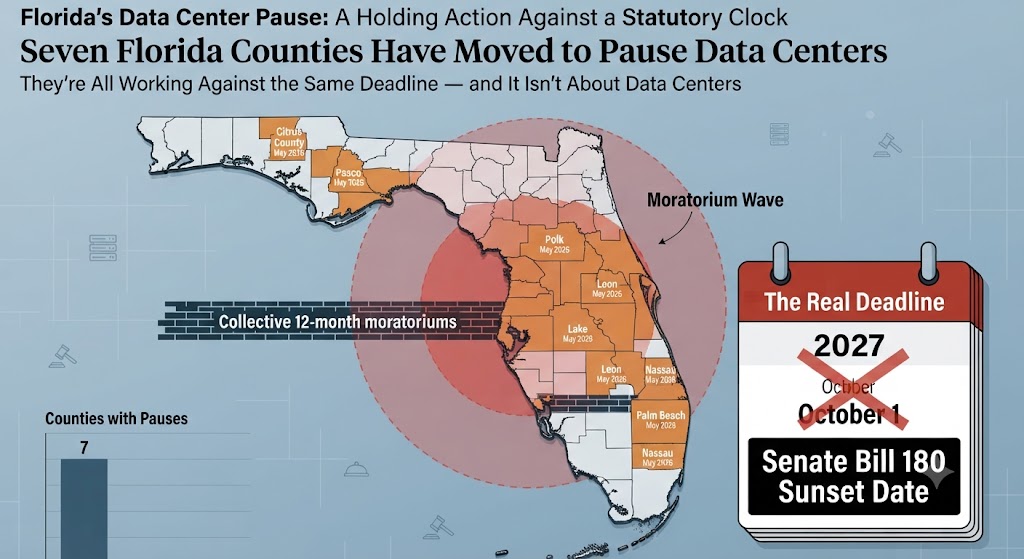
The short answer: Citrus, Pasco, Palm Beach, Nassau, Lake, Leon, and Polk have all moved toward data center pauses in 2026. The pattern nobody is reporting is why they are pauses rather than permanent zoning rules — county officials have publicly cited Senate Bill 180, which they say constrains outright bans and expires October 1, 2027. That date, not any data center application, is the real deadline on Florida’s calendar.
Key Takeaways
- Citrus County commissioners voted unanimously in May 2026 to direct staff to draft a moratorium ordinance not exceeding 12 months, covering building permits, development orders, and rezonings for data centers and associated utilities.
- Pasco County’s Planning Commission recommended a one-year pause, with the ordinance’s first reading held June 16, 2026 and a final vote anticipated in July. At the planning commission hearing, the only speaker opposing was a Fort Lauderdale-based developer seeking to build in the county.
- Palm Beach County commissioners directed staff to draft a moratorium in July 2026, expected to run up to a year or until new zoning regulations are adopted. One application filed beforehand, Central Park Commerce Center, was allowed to proceed.
- Leon County moved toward a one-year pause on large-scale facilities while the Tallahassee City Commission rejected a similar motion — with a city commissioner noting the local land code does not define data centers at all.
- Lake County Commissioner Anthony Sabatini proposed a moratorium explicitly structured to avoid an outright ban, citing Senate Bill 180, and named Citrus, Nassau, and Pasco among counties that had already acted. He put the number of large data center applications filed in Florida over the prior year at 12.
- Florida’s 2026 legislative session produced a law effective July 1 that bars electric utilities from passing data center operating costs to residential customers and grants local governments authority to adopt stricter data center regulations.
- Our thesis: Florida’s moratorium wave is a holding action against a statutory clock, and October 1, 2027 is the date that determines what Florida’s data center rules actually become.
Which Florida counties have moved to pause data centers?
At least seven have taken formal action or begun the process in 2026, and the cluster is geographically scattered rather than concentrated.
Citrus County. Commissioners voted unanimously in May 2026 to move forward with a moratorium, directing staff to draft an ordinance establishing a temporary pause not to exceed 12 months, applying to building permits, development orders, and rezonings related to data centers and associated utilities. The moratorium would not halt discussion of future projects, only approvals, while officials study impacts and develop regulations. The issue had been under review since the board’s February 10, 2026 meeting, when commissioners directed staff to prepare Land Development Code amendments establishing data center criteria. Local coverage described repeated public outbursts during the meeting and a dispute among commissioners over how the chair handled them.
Pasco County. The Planning Commission recommended a one-year pause, and commissioners held a first reading of the ordinance on June 16, 2026, with a final vote expected in July. Public support at the planning commission hearing was described as strong, with a single opposing speaker — a Fort Lauderdale-based developer pursuing a data center in the county.
Palm Beach County. Commissioners directed staff to draft a moratorium on new data center proposals in July 2026, with the ordinance expected to be finalized the following month and to remain in effect up to a year or until new zoning regulations are adopted. Mayor Sara Baxter, who initiated it, framed it as ensuring development at this scale is considered with full transparency and an understanding of long-term impacts on infrastructure, resources, and residents. An application filed before the action — Central Park Commerce Center — was permitted to continue through review.
Leon County. Moving toward a one-year moratorium on large-scale data centers, while the Tallahassee City Commission voted down a parallel motion on the grounds that existing land code was sufficient. A city commissioner disputed that directly, noting the land code does not define data centers at all while the city does have industrial zoning of the type these facilities typically occupy.
Nassau and Lake Counties. Nassau had already imposed some form of moratorium. In Lake County, Commissioner Anthony Sabatini proposed one in June 2026.
Polk County. The Fort Meade City Commission delayed final development approvals on the roughly 1,100-acre, $2.6–2.8 billion campus proposed on former phosphate mining land, as of early 2026.
How does Florida compare nationally?
Florida is participating in the national wave, not leading it. Speakers at a July 2026 legislative gathering in Orlando cited 120 jurisdictions across 38 states that have adopted temporary moratoriums, with only some Florida local governments having approved pauses.
The mechanics look similar elsewhere. In Georgia, DeKalb County extended an existing moratorium while commissioners debated whether a 12-month pause was needed for environmental health and economic study, with one commissioner warning of residential bill increases. Athens-Clarke County weighed extending a pause that began in December 2025 after roughly ten hours of public meetings dominated by water, power, and utility cost concerns. In North Carolina, the Apex Town Council moved to draft a one-year moratorium after a 300-megawatt project was withdrawn — following similar action in neighboring Chatham County, in what one industry newsletter characterized as a regional shift toward writing rules first.
That last case is the instructive one. Opposition outlasted the project that triggered it. A withdrawn application did not end the political process; it accelerated the codification of restrictions that will govern the next application.
🔷 Brian’s Take
I have spent enough time reading local government agendas to offer a practical observation: the moratorium is a procedural tell, not an outcome.
When a county passes a moratorium, the reflexive reading is that the county has rejected data centers. That is almost never what happened. What happened is that staff realized the land development code has no category for the thing being proposed, and the board bought time to write one.
The Tallahassee exchange captures this precisely — a commissioner pointing out that the code does not define data centers at all, while the industrial zoning that would host them exists. That is not an ideological dispute. That is a drafting gap.
So the useful question about any Florida county is not “did they pause?” It is “what did they write during the pause?” A twelve-month moratorium followed by a well-drafted ordinance with water disclosure requirements and load thresholds is a county that is now open for a specific kind of project. That is a considerably better outcome for a serious developer than a county with no rules and an unpredictable commission.
— Brian B. French
Why are these pauses rather than permanent rules?
Because county officials have publicly cited a state statute that they say constrains outright bans — and it has an expiration date.
This is the finding in this article, and it has appeared almost nowhere in the coverage.
In proposing Lake County’s moratorium, Commissioner Anthony Sabatini framed it explicitly around Senate Bill 180. Reporting on the proposal described the moratorium as structured to avoid violating SB 180, which an outright data center ban would, and characterized it as a temporary stop until the bill expires. Sabatini’s own framing was direct: he was not asking for an outright ban, and as the calendar approached October 1, 2027, when SB 180 expires, the county could then take up what it actually wanted to do about these facilities.
If that reading of the statute is correct — and we flag below that it requires legal verification — it reframes the entire Florida moratorium wave.
These counties are not choosing temporary measures because they prefer them. They may be choosing temporary measures because the permanent ones are, for now, legally unavailable. That would explain a pattern that otherwise looks like indecision: seven counties, all reaching for the same instrument, all with roughly 12-month durations, all describing the pause as time to study rather than as policy.
It also sets a date. October 1, 2027 becomes the moment when Florida’s local governments regain — or believe they regain — the ability to write durable, restrictive data center regulation. Every moratorium currently running expires before then. Every developer with a Florida site is operating inside a window that closes on a schedule set by a statute that has nothing to do with computing.
We want to be careful about what we are asserting. We are reporting that a sitting county commissioner publicly characterized SB 180 this way and structured policy around that characterization, and that reporting on his proposal described other Florida counties acting similarly. We are not independently asserting the statute’s scope, its application to data center land use regulation, or whether the expiration operates as described. That is a legal question requiring primary source analysis, and it is the single most important open question in Florida’s data center debate.
What did the 2026 legislature actually change?
Two things, and the second one may complicate the first.
During the 2026 session, Florida approved a law taking effect July 1 that prevents electric utilities from passing data center operating costs on to residential customers and gives local governments authority to adopt stricter regulations for data center development.
The first provision responds directly to the most potent public objection — that residential ratepayers would subsidize industrial power demand. It is a substantive answer to a real concern.
The second provision is the interesting one, because it appears to point in the opposite direction from the constraint county officials have been describing. A law granting local governments authority to adopt stricter data center regulations sits uneasily alongside a statute that officials say prevents them from adopting outright bans.
Both can be true — authority to regulate more strictly is not the same as authority to prohibit, and the two statutes may operate on different mechanisms with different scopes. But the interaction between them is precisely what determines what Florida counties can actually do between now and October 2027, and we have not seen anyone publish an analysis of it.
Separately, this is the second consecutive session in which Florida has tightened rather than expanded the framework. Legislation adopted in 2025 raised the critical IT load threshold required to qualify for the state’s data center sales tax exemption, narrowing eligibility for smaller facilities — a change legal analysts characterized as among the most significant revisions to the incentive since its creation, and part of a national pattern of states reassessing whether generous incentives still deliver proportionate public benefit.
🔷 Brian’s Take
When I managed institutional portfolios, one of the disciplines that mattered most was identifying the actual date on which a position’s risk profile changed — not the date everyone was watching, but the one embedded in a contract or a statute that nobody had read carefully.
Florida’s data center market has such a date, and I do not believe it is priced. Every conversation I see is about individual applications, individual commission votes, individual county fights. The structural question is what the regulatory environment looks like on October 2, 2027, and whether the moratoriums currently in place are a pause before permanence or a pause before nothing.
If county officials are right about the statute, then a developer holding Florida land is operating in a window, and the terms available inside that window are materially better than the terms that may exist afterward. If they are wrong about it, then seven counties have adopted temporary measures when durable ones were available all along, which is a different and equally consequential story.
Somebody needs to answer that question properly, with a lawyer and the statute text. I would read that analysis before I made any decision about Florida land.
— Brian B. French
What predicts which county moves next?
Seven observable variables, which we are publishing as a scoring methodology before publishing any scores. The reason for that sequencing is explained in the next section.
1. Filed or rumored application. The strongest single predictor. Every Florida moratorium to date followed a specific proposal or credible expectation of one. Moratoriums are reactive instruments.
2. Land development code gap. Whether the county’s code defines data centers as a use category. Tallahassee’s exchange demonstrates that codes lacking a definition create pressure for a pause, because staff have no framework to apply.
3. Water sensitivity. Whether the county sits within a water management district designated concern area, a spring shed, or a saltwater intrusion zone. As we detailed in our analysis of Florida’s consumptive use permitting system, water gives opponents a specific, checkable number — and specificity wins hearings.
4. Transmission proximity. Counties near high-capacity transmission are likelier to receive applications, which per variable one is the precondition for everything else.
5. Recent land use conflict. Counties with organized opposition infrastructure from prior fights — over mining, solar, warehousing, or residential density — have residents who already know how to work a commission calendar.
6. Commission composition and electoral calendar. Moratoriums are low-cost votes for elected officials facing constituents. Proximity to an election raises the probability meaningfully.
7. Regional demonstration effect. Sabatini explicitly cited Citrus, Nassau, and Pasco when proposing Lake County’s measure. Counties copy their neighbors, and adjacency to a county that has acted is itself a predictor.
🔲 [INDEX PLACEHOLDER — the Florida Moratorium Index, all 67 counties.] Score each county 0–3 on the seven variables above, weighted, with every input sourced to a public document. Publish the full weighting, the raw scores, and the source for each entry. Re-score quarterly with a visible changelog showing which counties moved and why. Required companion: a scored-prediction accuracy log. Each quarter, record which counties the index ranked highest and which counties actually acted. A predictive index that never reports its own hit rate is not analysis.
Why publish the methodology before the scores?
Because a ranking that names 67 counties by their likelihood of obstructing development is a consequential document, and the responsible sequence is to expose the method to criticism before the conclusions circulate.
We could produce a plausible-looking Florida county ranking today. It would be widely shared, it would be quoted, and portions of it would be wrong in ways that would be difficult to correct once repeated — because a county named as “high moratorium risk” carries that label into land negotiations, commission meetings, and site selection conversations whether or not the underlying analysis was sound.
Three commitments govern this index when it publishes:
Descriptive, not pejorative. A county moving to pause data centers is exercising ordinary land use authority in response to constituents. That is not obstruction, and the index will not characterize it as such. It is a risk variable for a developer, and a legitimate governance choice for a community. Both framings are accurate simultaneously.
Every input sourced. No score derives from impression, reputation, or a reporter’s sense of a place. Each entry links to a commission agenda, a code section, a district designation, or an election filing.
Falsifiable and audited. The index makes forward-looking claims and will publish its own accuracy record. That is uncomfortable and it is the only thing that makes a predictive model worth citing.
🔷 Brian’s Take
A word about why I am being so deliberate here, because it may look like excessive caution for a local business publication.
In asset management, publishing a rating on something has real consequences for the thing being rated. That is not a hypothetical concern — it is the entire reason ratings agencies operate under methodological disclosure requirements. When you assign a score, you change behavior, and if your method is sloppy you have changed behavior for no good reason.
A county-by-county risk index for Florida data center permitting is a rating product. It will be used by people making eight and nine figure decisions, and it will be cited by people arguing at commission meetings on both sides. Publishing one built on vibes would be indefensible, and publishing one without a public accuracy record would be worse — it would collect the authority of a quantitative product while accepting none of the accountability.
So the model goes out first, and I would genuinely like people to attack it before the numbers exist. If a planning director in one of these counties thinks a variable is wrong, that is worth more to me than the compliment of being cited.
— Brian B. French
What happens on October 1, 2027?
One of three things, and Florida should be preparing for all of them.
Scenario one: the codification wave. If county officials are correct about the statutory constraint, expect a concentrated burst of permanent data center ordinances in late 2027 — counties that spent 2026 studying, drafting, and holding hearings enacting durable regulations more or less simultaneously. That would be the single largest change to Florida’s industrial land use environment in years, and it would arrive with almost no statewide coordination.
Scenario two: the state preempts. Florida’s legislature has shown sustained interest in this area across consecutive sessions, and a statewide framework superseding local variation is a live possibility. The 2026 law granting local governments stricter regulatory authority points away from preemption; the legislature’s demonstrated appetite for the subject points toward continued involvement.
Scenario three: the wave recedes. If the projects moderate, if the ratepayer protections in the 2026 law defuse the strongest public objection, and if a few well-drafted county ordinances become templates, the urgency may simply pass. Sabatini’s reported figure — 12 large data center applications filed statewide in the prior year — is a real number but not an overwhelming one.
Our view is that scenario one is most likely and that Florida is not preparing for it. Sixty-seven counties independently drafting data center ordinances during the same twelve-month period, without a model ordinance or coordinating body, will produce a regulatory patchwork that serves nobody — not developers, not communities, and not the counties themselves.
What each party should do now
Counties. Use the pause. A moratorium that expires with no ordinance drafted has accomplished nothing except delay. Also: coordinate. A shared model ordinance developed among several counties would be more defensible, better drafted, and cheaper than 67 separate efforts.
Developers. Get the legal question answered independently rather than relying on press accounts of what a commissioner said, including this one. Then understand that entitlement timing now carries statutory risk in addition to political risk — Palm Beach’s treatment of an application filed before the moratorium demonstrates that filing date matters a great deal.
Residents and opponents. The most durable outcome is a well-written ordinance, not an indefinite pause. Pauses expire. Codes persist.
Everyone. Read the statute.
🔷 Brian’s Take
A closing thought that returns to something we flagged months ago and that still has not been resolved.
When Florida Power & Light went before regulators seeking a rate increase, an association advocating for data centers intervened, and its lawyer stated that he represented companies holding confidential agreements with FPL to explore building in the state. He did not name them.
Now set that beside what we have just described: seven counties pausing, a statutory clock running to October 2027, and a legislature that has tightened the framework in two consecutive sessions.
The public is making decisions about a buildout whose participants it cannot see, on a schedule set by a statute most people have not read, in county-by-county proceedings where each application is evaluated in isolation from every other one. Every individual piece of that is legal and ordinary. The aggregate is a substantial democratic deficit, and I do not think anyone designed it that way.
The remedy is not complicated: name the applicants, publish the aggregate, and read the statute. We intend to do the second and third. If you are a county planning director, commissioner, or attorney working on one of these ordinances, I would like to hear what you are drafting.
— Brian B. French
About the author
Brian B. French is a digital strategist, former institutional portfolio manager, and the architect of the Florida Authority Network, a proprietary portfolio of Florida business news and press release websites including Florida Technology News.
Before moving into digital strategy, Brian spent more than 25 years in financial services, serving as Vice President and Portfolio Manager with Merrill Lynch Investment Managers and Trust Company, with earlier roles at Shearson American Express, EF Hutton, SouthTrust, and SunTrust. He holds a B.A. in Finance and Business Administration from the University of South Florida.
He applies the same analytical discipline he once used for institutional portfolios to a different problem: how Florida businesses establish verifiable credibility in an AI-first search environment. Contact: [editorial contact]
Frequently Asked Questions
Which Florida counties have data center moratoriums? Citrus, Pasco, Palm Beach, Nassau, Lake, Leon, and Polk have all taken formal action or begun the process during 2026, at varying stages from staff direction through first reading to adoption. Status changes frequently; verify current standing with the individual county before relying on it.
How long do Florida data center moratoriums last? Typically up to 12 months, or until replacement zoning regulations are adopted. Citrus County’s is capped at 12 months; Palm Beach County’s is structured to run up to a year or until new regulations take effect.
Why don’t Florida counties simply ban data centers? County officials have publicly cited Senate Bill 180 as constraining outright bans, structuring temporary moratoriums as an alternative until the statute expires on October 1, 2027. This characterization comes from officials’ public statements and requires independent legal verification.
What did Florida’s 2026 data center law do? A law effective July 1, 2026 prevents electric utilities from passing data center operating costs on to residential customers and grants local governments authority to adopt stricter data center regulations. Separately, the state established guidelines for facilities consuming more than 50 megawatts.
How many data center applications have been filed in Florida? A Lake County commissioner put the figure at 12 large data center applications filed statewide over the prior year. No comprehensive public registry exists, and smaller facilities below state thresholds are not tracked centrally.
How many jurisdictions nationally have paused data centers? Speakers at a July 2026 Florida legislative gathering cited 120 jurisdictions across 38 states with temporary moratoriums in place.
Does a moratorium mean a county has rejected data centers? Usually not. In most cases the county’s land development code lacks a definition or standards for the use, and the pause creates time to draft them. The meaningful question is what ordinance emerges during the pause.
What is the Florida Moratorium Index? Florida Technology News’ forthcoming county-level scoring model estimating data center permitting risk across all 67 Florida counties, based on seven observable public variables. The methodology is published here; scores will follow with sourced inputs and a public accuracy record.
Sources & Further Reading
- Chronicle Online — “County backs pause on data centers; Temporary moratorium gives county time to gather information,” May 2026. https://www.chronicleonline.com/news/local/county-backs-pause-on-data-centers-temporary-moratorium-gives-county-time-to-gather-information/article_98795fb9-6580-5f53-97a3-10a3b68b6711.html
- GrowthSpotter — “Lake Commissioners to vote on proposed data center moratorium,” June 24, 2026. https://www.growthspotter.com/2026/06/24/lake-commissioners-to-vote-on-proposed-data-center-moratorium/
- Bay News 9 — “Pasco County commissioners to consider one-year moratorium on new data centers,” June 16, 2026. https://baynews9.com/fl/tampa/news/2026/06/16/pasco-county-commissioners-to-consider-one-year-moratorium-on-new-data-centers
- Commercial Observer — “Palm Beach County Pauses Data Center Applications,” July 2026. https://commercialobserver.com/2026/07/palm-beach-county-data-center-project-tango/
- WTXL — “Leon County moves to pause large-scale data centers; City Commission rejects similar motion,” June 11, 2026. https://www.wtxl.com/downtown-tallahassee/leon-county-moves-to-pause-large-scale-data-centers-city-commission-rejects-similar-motion
- Bay News 9 — “Florida lawmakers weigh AI data center expansion amid calls for more oversight,” July 24, 2026. https://baynews9.com/fl/tampa/news/2026/07/24/florida-lawmakers-weigh-ai-data-center-expansion-amid-calls-for-more-oversight
- Washington County News — “Florida rewrites the rules for AI data centers as rural communities weigh growth against local concerns,” July 7, 2026. https://washingtoncounty.news/2026/07/07/florida-rewrites-the-rules-for-ai-data-centers-as-rural-communities-weigh-growth-against-local-concerns/
- Data Center Watch — Briefing, March 13, 2026. https://datacenterwatch.substack.com/p/briefing-03132026
- CBS Atlanta — “DeKalb leaders extend data center moratorium as residents raise health, cost concerns.” https://www.cbsnews.com/amp/atlanta/news/dekalb-leaders-extend-data-center-moratorium-to-june-as-residents-raise-health-cost-concerns
- GovTech — “Is Florida the Next Data Center Hot Spot?” April 2026. https://www.govtech.com/artificial-intelligence/is-florida-the-next-data-center-hot-spot
Primary sources to consult before republication or update: Florida Senate Bill 180 full text, effective dates, scope, and sunset provision; the 2026 session law addressing data center cost allocation and local regulatory authority; commission agendas, minutes, and adopted ordinances for Citrus, Pasco, Palm Beach, Nassau, Lake, Leon, and Polk counties; Florida Association of Counties guidance on land development regulation authority.
Related coverage:
- Everyone Says Power Is Florida’s Data Center Constraint. The Permits Say It’s Water.
- Florida Regulates Data Centers Above 50 Megawatts. The Real Buildout Is Happening Below the Line.
- Florida’s Hurricane Problem Built the Country’s Best Resilience Engineers.
Editorial note
The Florida Moratorium Index is a forthcoming Florida Technology News product; its methodology is published above and its scores are not yet published. Sections identified as analysis are labeled as such.
This article is not legal advice. Land development regulation authority in Florida is governed by statutes and case law this summary does not attempt to analyze.
Verification flags for the editor — this article carries more than most. The central claim about Senate Bill 180 derives from a single county commissioner’s public characterization as reported by one outlet. We have not verified the statute’s text, scope, applicability to data center land use regulation, or sunset date independently. This must be confirmed against the bill text and with a Florida land use attorney before publication. If the characterization is inaccurate, the article’s central thesis fails and should be rewritten rather than corrected.
The figure of 12 large data center applications filed statewide over the prior year is Commissioner Sabatini’s, single-sourced, with no stated methodology or definition of “large.”
Moratorium statuses move quickly. Pasco’s final vote was expected in July and may have occurred; Palm Beach’s ordinance was expected to be finalized in the month following the July direction to staff. Nassau County’s status is reported secondhand via another commissioner’s remarks and should be confirmed directly. Every county listed requires verification against current commission records before publication, and this article should be re-verified before any promotion or syndication.
Changelog
- July 29, 2026 — Initial publication.
About the Author