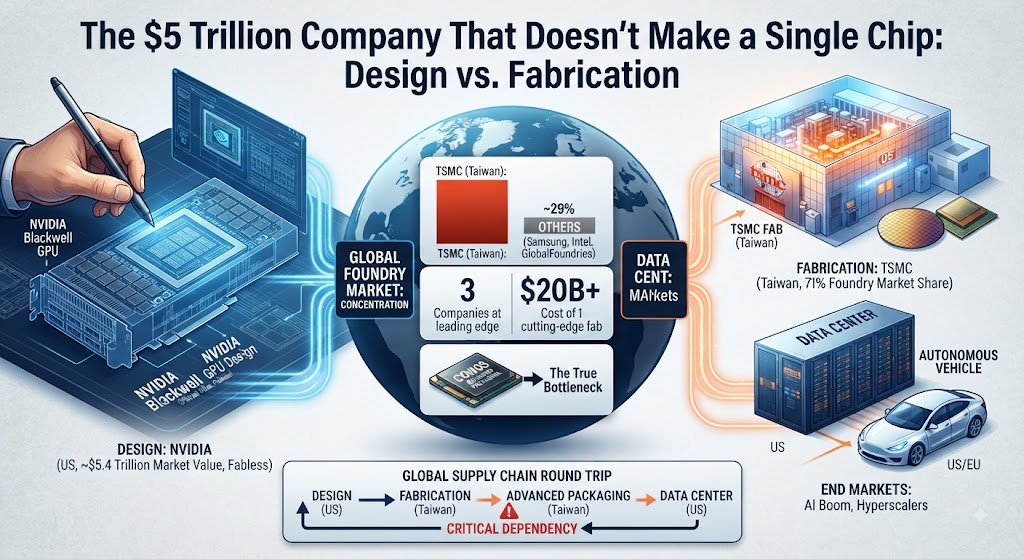
NVIDIA is the most valuable company on Earth and the beating heart of the AI boom — yet it has never manufactured one of its own semiconductors. Here is how design, not fabrication, became the most valuable thing in technology.
FloridaTechnologyNews.com · Human Insight + Tech-Intelligent Curation
NVIDIA sits at the top of the corporate world. As of this month its market value stands at roughly $5.4 trillion, making it the most valuable company on the planet — a title it has traded back and forth with Apple and Microsoft throughout 2026 after becoming, in May, the first company in history to cross the $5.5 trillion mark. Its graphics processing units, or GPUs, are the engines of the artificial intelligence revolution. Nearly every large AI model in the world, from chatbots to self-driving systems, is trained on NVIDIA hardware.
And yet here is the fact that still surprises most people: NVIDIA does not manufacture a single semiconductor. It does not own a chip factory. It does not etch silicon. What NVIDIA owns is the design — and in the modern technology economy, the design is where the value lives.
Fabless by design: what NVIDIA actually sells
NVIDIA is what the industry calls a “fabless” company — it designs chips but farms out the fabrication (“fab” is short for fabrication plant). Its crown jewels are the architecture of its GPUs — the Hopper and Blackwell families that power AI data centers — and, just as importantly, the CUDA software platform that lets developers program those GPUs. Together, the hardware design and the software ecosystem form a moat that competitors have spent years failing to cross.
Think of NVIDIA as the architect of an extraordinarily complex building. It draws every blueprint down to the nanometer. But it hands those blueprints to someone else to actually pour the concrete. In semiconductors, that someone else is a very short list of companies — and that concentration is one of the most consequential facts in the global economy.
The three companies that make the world’s most advanced chips
When people say “chips are made everywhere,” they are half right. Hundreds of factories around the world produce older, simpler chips — the kind in your microwave, your car’s window motor, or a cheap USB charger. But the leading-edge logic chips that make modern AI and smartphones possible — the most advanced, most miniaturized silicon on Earth — can realistically be manufactured by only three companies: Taiwan’s TSMC, South Korea’s Samsung, and America’s Intel.
Even among those three, the concentration is staggering. TSMC alone controls roughly 71% of the global foundry market, with Samsung near 7% and Intel’s new foundry business around 6%. And when it comes to the very best AI accelerators — NVIDIA’s included — the list effectively narrows to one. TSMC manufactures NVIDIA’s top GPUs, along with the AI chips of AMD, Google, Amazon and nearly everyone else. The reason is brutally simple economics: a single cutting-edge fab now costs more than $20 billion to build, and TSMC’s 2026 capital budget alone is around $56 billion — larger than the total annual revenue of most of its rivals.
Where NVIDIA’s GPUs are actually made
So the world’s most valuable technology company depends on factories it does not own, most of them clustered on a single island. The overwhelming majority of NVIDIA’s GPUs are fabricated in Taiwan, at TSMC’s plants in Hsinchu and Tainan. That geographic concentration is exactly why a potential conflict over Taiwan is treated as a global economic emergency, not merely a regional one.
There is now a small but symbolically huge exception. TSMC has begun producing NVIDIA’s Blackwell chips at its new fab in Arizona — the first NVIDIA GPUs made on American soil. But there is a catch that reveals just how hard reshoring really is: those Arizona-made wafers still have to be shipped back to Taiwan for the final, critical step known as advanced packaging. TSMC’s CoWoS packaging — the process that stitches a GPU together with its high-bandwidth memory — is the true bottleneck of the AI boom. Demand for it has more than doubled year over year, and it remains booked out through 2028. Making the raw silicon is only half the battle; packaging it is the other half, and America is only beginning to build that capacity.
Intel’s comeback: America bets on itself
For decades, Intel was American semiconductor manufacturing. Then it fell behind TSMC and Samsung, missed the mobile and AI waves, and watched its lead evaporate. In 2026, Intel is mounting one of the most closely watched comebacks in corporate history.
The centerpiece is a new manufacturing process called 18A — Intel’s first genuinely competitive leading-edge node in years. Its Panther Lake processors, unveiled as the company’s first AI PC platform built on 18A, debuted at CES 2026, with the Clearwater Forest server chips following. Just as important as Intel’s own products is its ambition to become a foundry — to manufacture chips for other companies, the way TSMC does. Landing marquee outside customers is the make-or-break test, and Intel is now openly courting the very design houses that once relied entirely on Asia. Its next node, 14A, is meant to close the gap for good. Whether Intel can execute is the trillion-dollar question hanging over the American chip strategy.
The CHIPS Act — and Washington’s new playbook
None of this is happening in a vacuum. The 2022 CHIPS and Science Act committed roughly $52 billion to pull semiconductor manufacturing back to American soil, worried that the country designed the world’s best chips but had let the ability to build them drift overseas. TSMC’s Arizona fabs, Intel’s expansions, and Samsung’s Texas plants all trace back in part to that push.
In 2026 the program looks very different from how it started. The Trump administration has restructured CHIPS support from no-strings grants into government equity stakes. In a landmark deal, the U.S. government converted Intel’s remaining CHIPS awards into a 9.9% ownership stake in the company — about $8.9 billion in stock, part of roughly $11.1 billion in total government investment. Commerce has since taken minority positions in a growing roster of chip and technology firms, turning taxpayer subsidies into a public stock portfolio. Supporters call it a smart way for taxpayers to share in the upside; critics warn about the government owning slices of private industry. Notably, officials have said they will not take equity in foreign-owned manufacturers like TSMC and Micron on the same terms.
The future of tech and chip production
Three forces will define the next decade of technology, and all of them run straight through the chip.
Design keeps winning — but the moat is being tested. NVIDIA’s dominance rests on more than fast silicon; it rests on CUDA and an ecosystem developers can’t easily leave. But the biggest buyers — Google, Amazon, Microsoft, Meta — are now designing their own AI chips to reduce their dependence, and AMD is closing the gap. The design layer will stay the most valuable, but the fight for it is intensifying.
Packaging is the new frontier. As shrinking transistors gets harder and more expensive, the industry is squeezing performance out of how chips are assembled — stacking silicon and memory in advanced packages. Whoever scales packaging capacity, especially outside Taiwan, holds real leverage over the AI supply chain.
Geography is destiny. The concentration of the world’s most advanced manufacturing on one island is the single largest risk in the modern economy. Reshoring to Arizona, Texas and Ohio, Intel’s foundry revival, and Washington’s equity deals are all bets to diversify that risk — but as the Arizona-to-Taiwan packaging round trip shows, rebuilding a supply chain that took 40 years to concentrate will not happen overnight.
The deepest lesson of NVIDIA’s rise is that in modern technology, the most valuable asset is not the factory — it is the idea the factory is told to build. NVIDIA proved a company can become the most valuable on Earth without owning a single fab. But its story also proves the opposite truth: without those three companies that actually make the chips, the most valuable design in the world is just a blueprint no one can build.
About FloridaTechnologyNews.com — FloridaTechnologyNews.com delivers technology news and analysis through a philosophy of “Human Insight + Tech-Intelligent Curation,” connecting the global forces reshaping technology to what they mean for Florida’s economy, businesses, and readers. It is part of the Florida Authority Network, a statewide group of more than 30 Florida news, press release, and video websites owned and managed by Brian French.
About the Author