The Silicon Chokepoint:
A deep scenario analysis of the two ways a Taiwan conflict could unfold — capture or destruction — the likely American response, the evacuation problem, the recovery timeline, and the clear winners and losers among companies and countries
Analysis by Brian French | August 2026
Powerpoint Slide Deck:
Audio Podcast:
YouTube Video:
Editor’s note: This article combines documented, sourced facts about the semiconductor industry with clearly labeled scenario analysis and informed speculation. Actual U.S. military contingency plans are classified; where this article speculates about them, it says so. All sources are listed at the end.
The Most Important 14,000 Square Miles on Earth
There is no precedent in economic history for what sits on the island of Taiwan today. Not the oil fields of the Persian Gulf in the 1970s, not the cotton ports of the American South in the 1850s. Those were commodities that other places could eventually produce. What Taiwan makes — the most advanced logic semiconductors on the planet — currently cannot be made anywhere else at scale, by anyone, at any price.
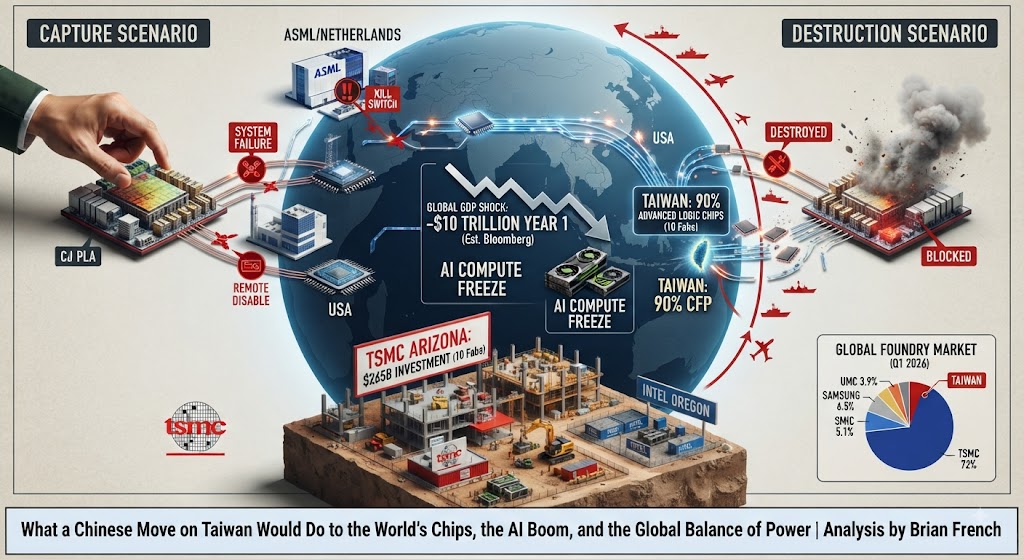
The numbers are staggering. Taiwan Semiconductor Manufacturing Company (TSMC) controlled roughly 70% of the entire global foundry market in 2025, a share that expanded to 72% by the first quarter of 2026 as AI demand accelerated. At the leading edge, the concentration is nearly total: by widely used estimates from the Boston Consulting Group, the Semiconductor Industry Association, and the Rhodium Group, Taiwan produces on the order of 90% of the world’s most advanced logic chips — the sub-10-nanometer and now sub-3-nanometer processors that power every Nvidia AI accelerator, every Apple iPhone processor, every AMD data-center CPU, and increasingly every custom AI chip designed by Google, Amazon, Microsoft, and Meta. Taiwan also produces roughly a third to half of the world’s less advanced but still essential chips — the microcontrollers in cars, appliances, industrial equipment, and medical devices.
Bloomberg Economics has modeled what a war over this island would cost: approximately $10 trillion in the first year alone, roughly 10% of global GDP — a shock larger than COVID-19 and larger than the 2008 global financial crisis. Their models estimate Taiwan’s GDP would fall about 40%, China’s about 17%, and America’s nearly 7%. Even a “mere” blockade, with no shots fired at the fabs themselves, is modeled at roughly $5 trillion in first-year global damage.
And here is the cruelest twist of timing: this vulnerability peaks at the exact moment the world has become more dependent on advanced silicon than at any point in history. The four largest American hyperscalers — Amazon, Microsoft, Alphabet, and Meta — are guiding to roughly $700–725 billion in combined capital expenditures in 2026, up about 77% from 2025’s already-record $410 billion, with Goldman Sachs projecting a combined $5.3 trillion from 2025 through 2030. The overwhelming majority of that money buys one thing: AI compute. And nearly every AI accelerator at the heart of that buildout is fabricated on TSMC silicon and assembled with TSMC’s CoWoS advanced packaging — in Taiwan.
This article examines two scenarios that keep planners in Washington, Taipei, and every corporate boardroom in Silicon Valley awake at night: a Chinese invasion aimed at capturing Taiwan’s semiconductor complex intact, and an attack that destroys it. We will walk through the likely (and openly debated) U.S. responses, the near-impossible logistics of evacuating a chip industry, where the people and assets would go, how long recovery would take, and — because markets are ruthless even in tragedy — who wins and who loses.
One correction to a common misconception before we begin, because precision matters here: Samsung does not manufacture chips in Taiwan. Samsung’s fabs are in South Korea (Hwaseong and Pyeongtaek) and in Taylor, Texas. The manufacturers actually on the island are TSMC, United Microelectronics Corporation (UMC), Powerchip (PSMC), Vanguard International Semiconductor (VIS), memory maker Micron (which runs major DRAM fabs in Taichung and Taoyuan), and the world’s largest chip packaging and test house, ASE Technology. Chip designer MediaTek is also headquartered there. Samsung would be profoundly affected by a Taiwan war — as we’ll see, it is arguably the single biggest corporate winner in some scenarios — but its factories would not be in the crosshairs.
Part I: What Taiwan Actually Makes — The Full Map of the Chokepoint
To understand the scenarios, you have to understand exactly what would be lost.
TSMC is the sun around which the entire fabless semiconductor world orbits. In 2025 it generated $122.5 billion in revenue, up 36% year over year, manufacturing 12,682 distinct products for 534 customers. Its Taiwan footprint includes the leading-edge “gigafabs” clustered in three science parks — Hsinchu (the original, including the Fab 20 complex now ramping 2nm), Taichung, and the newer Kaohsiung and Tainan sites (Fab 18, the 3nm and 5nm workhorse complex). Roughly 74% of TSMC’s revenue now comes from advanced nodes of 7nm and below, and the high-performance computing platform — essentially AI and data center — accounts for 58% of revenue. TSMC has stated it plans 13 additional leading-edge fabrication and advanced packaging facilities in Taiwan over the next several years, even as it expands in Arizona. The center of gravity is not moving; it is being copied, slowly, at enormous cost.
Just as critical, and less understood: advanced packaging. TSMC’s CoWoS (Chip-on-Wafer-on-Substrate) technology is the process that marries a GPU die to stacks of high-bandwidth memory. Every Nvidia H100, H200, B200, and GB200, and every AMD MI300-class accelerator, must pass through CoWoS or a similar process before it is a shippable product. TSMC has roughly doubled CoWoS capacity annually since 2023 and demand still outruns supply. Nearly all of that capacity is in Taiwan today; the first U.S. packaging fabs in Arizona only began early construction in 2026. A fabricated AI chip without packaging is an expensive coaster.
The rest of the island’s ecosystem: UMC (about 4% of global foundry revenue) and PSMC and VIS (just under 1% each) dominate the mature-node chips that the automotive and industrial world quietly depends on. ASE packages and tests a huge share of the world’s chips. Micron’s Taiwan fabs produce a meaningful slice of global DRAM. And beneath all of it sits an irreplaceable web of specialty chemical suppliers, gas providers, mask shops, equipment service engineers, and — most irreplaceable of all — roughly a hundred thousand of the most experienced process engineers on Earth.
Global foundry landscape for context (TrendForce, Q1 2026): TSMC 72%, Samsung 6.5%, SMIC (China) 5.1%, UMC 3.9%, GlobalFoundries 3.3%, HuaHong Group (China) 2.5%, Tower (Israel) 0.8%, Nexchip (China) 0.8%, VIS 0.8%, PSMC 0.8%. Intel’s foundry business does not yet crack the top ten.
Rhodium Group’s analysis puts the downstream exposure in dollar terms: companies in chip-dependent industries could be forced to forgo as much as $1.6 trillion in annual revenue if Taiwan were cut off, and Bloomberg Economics estimates losing Taiwan’s production would slash global supply of cutting-edge logic chips by 62% and less-advanced chips by 31% — with a war scenario in which China also halts its own exports removing another 32% of global mature-node capacity.
💼 BRIAN’S TAKE #1
I spent years as an Investment Portfolio Manager at Merrill Lynch, and the first thing you learn about concentration risk is that markets price it wrong until the day they price it catastrophically. Wall Street knows the Taiwan numbers — every TSM 10-K screams them — and yet TSMC trades like a utility with a growth kicker, and Nvidia trades like Taiwan doesn’t exist. The market is effectively assigning a near-zero probability to the scenarios in this article, not because the probability is zero, but because there’s no clean way to hedge it. When you can’t hedge a risk, institutional money tends to ignore it. That’s not analysis; that’s psychology. Remember that the top 20 customers of TSMC carry a combined market cap north of $7 trillion. Every one of those valuations contains an unpriced Taiwan option. The smartest money I know isn’t shorting anything — it’s quietly overweighting the second-source names you’ll meet later in this piece.
Part II: The Worst Possible Timing — The AI Compute Supercycle
If a Taiwan crisis had erupted in 2019, it would have been a global economic disaster. In 2026 or beyond, it would be something closer to an amputation of the digital economy’s central nervous system — because the world has spent the last three years wiring its future directly into Taiwanese silicon.
Consider what has happened to capital spending. In 2023, hyperscaler capex was notable. By 2025 it hit a record ~$410 billion. For 2026, the guidance is vertiginous: Amazon around $200 billion, Microsoft around $190 billion on a calendar basis, Alphabet raising its ceiling to as much as $205 billion, Meta at $115–145 billion after raising guidance twice, and Oracle targeting roughly $50 billion — a combined figure that crossed $700 billion and by some tallies reaches $725 billion, with analysts already projecting the group tops $1 trillion in 2027. Free cash flow at these companies is being deliberately sacrificed; Amazon’s is projected to go negative. This is the largest coordinated private capital deployment in business history, and it is a bet that AI compute will be the defining input of the next economy.
Every dollar of that bet flows through the Taiwan chokepoint at two separate points: wafer fabrication (the Nvidia GPUs, the AMD accelerators, the custom silicon — Google’s TPU, Amazon’s Trainium, Microsoft’s Maia, Meta’s MTIA — nearly all fabbed at TSMC) and advanced packaging (CoWoS). TSMC itself projected an eleven-fold increase in AI accelerator wafer shipments between 2022 and 2026, and CEO C.C. Wei has said publicly it will be a long time before the company can meet customer demand. There is no slack in this system. None.
This is what makes the present moment strategically unique. During the 2021 chip shortage — caused merely by a demand surge and some fires and freezes — average European car production fell about 13%, and Germany’s fell nearly 20%. That was a paper cut. A Taiwan interruption would sever the supply of the one input for which there is currently unlimited demand and zero substitute: leading-edge AI silicon. The hyperscalers’ $725 billion would have nowhere to go. The Stargate-class mega-datacenter projects would become empty concrete shells awaiting chips that no one on Earth could produce.
It also cuts the other way, and this is central to the deterrence debate: China’s own AI ambitions, its smartphone industry, its EV industry — all are fed substantially by Taiwanese chips too. TSMC produces an estimated 70% of the world’s smartphone chipsets and 35% of automotive microcontrollers. Beijing seizing or destroying Taiwan’s fabs would be, in economic terms, China burning down a granary that feeds its own cities. That is precisely why some strategists believe the “Silicon Shield” deters war — and why others believe it’s a shield made of glass.
💼 BRIAN’S TAKE #2
Here’s the frame I’d give a business audience: the AI buildout has turned a geopolitical risk into a balance-sheet risk for the seven largest companies in America. When Microsoft commits $190 billion a year to infrastructure whose critical component has a single point of failure in the Taiwan Strait, Microsoft has effectively written an uncovered insurance policy on peace in Asia. Same for Amazon, Google, and Meta. In my Merrill days we called this “picking up nickels in front of a steamroller” — except here the nickels are hundred-billion-dollar data centers and the steamroller is the People’s Liberation Army. The rational corporate response is exactly what you’re seeing: Microsoft putting Maia 2 on Intel’s 18A process, AWS working with Intel on custom Xeons, everyone dual-sourcing packaging. Watch what the hyperscalers do, not what they say. Their foundry diversification contracts are the most honest geopolitical risk assessment being published anywhere — more honest than any think-tank paper.
Part III: Scenario One — Invasion to Capture the Fabs Intact
The premise: China launches an amphibious and airborne invasion of Taiwan with an explicit operational goal of seizing the semiconductor complex — the Hsinchu, Taichung, and Tainan science parks — intact, along with the workforce, to absorb the crown jewels of the global chip industry into the People’s Republic.
Why Beijing might want this: A senior Chinese economist, Chen Wenling, argued publicly in 2022 that if Western sanctions were imposed on China, it “must recover Taiwan” and should seize TSMC. China’s semiconductor self-sufficiency drive — over 680 billion RMB deployed across three phases of the national “Big Fund” — has hit a wall at the leading edge because U.S. export controls deny SMIC the EUV lithography tools required below 7nm. Capturing working EUV fabs and the engineers who run them looks, on paper, like a shortcut through a decade of blockade.
Why capture would almost certainly fail — the four locks on the door:
Lock one: the machines can be turned off from Veldhoven. In May 2024, Bloomberg reported — and Taiwan’s technology minister subsequently confirmed the general capability to lawmakers — that ASML, the Dutch sole-source maker of EUV lithography machines, can remotely disable the EUV tools installed at TSMC. Each of these bus-sized, €200-million-plus machines requires constant servicing, software updates, and a supply umbilical back to the Netherlands. ASML has reassured the Dutch government it could force a shutdown; the Netherlands has run invasion simulations. A captured fab full of bricked EUV machines is a very expensive museum.
Lock two: the fabs die without their supply umbilical. A leading-edge fab is not a building; it is a continuous chemical process. It consumes ultrapure gases, photoresists, specialty chemicals (many from Japanese suppliers like Shin-Etsu, JSR, and Tokyo Ohka), spare parts from Applied Materials, Lam Research, KLA, and Tokyo Electron, and daily remote diagnostics from all of them. The Hague Centre for Strategic Studies noted that even brief interruptions in energy and materials can take fabs offline for extended periods. Under invasion conditions — with sanctions instantly severing every one of those suppliers — the fabs stop within days and degrade within weeks. China cannot resupply them; the entire toolchain is American, Dutch, and Japanese.
Lock three: the people. Perhaps 90% of what makes a 2nm fab work is tacit knowledge in the heads of engineers who have spent 20 years learning it. They cannot be conscripted into competence. The U.S. Army War College’s famous “Broken Nest” paper explicitly recommended that the U.S. and allies pre-announce refuge for Taiwan’s semiconductor workforce and build contingency plans for rapid evacuation and processing of that human capital — a recommendation we’ll return to in the U.S. response section.
Lock four: the “Broken Nest” itself. The most downloaded paper in the history of the Army War College’s journal Parameters — “Broken Nest: Deterring China from Invading Taiwan” by Jared McKinney and Peter Harris (2021) — argued that Taiwan and the U.S. should make it unmistakably credible that the fabs would be destroyed the moment an invasion is confirmed, potentially via an automatic trigger mechanism. Elbridge Colby, who went on to serve as the Pentagon’s Under Secretary of Defense for Policy, publicly asserted that destroying TSMC’s fabs in an invasion scenario was imperative and should not be left solely to Taipei’s discretion. Whatever the actual classified policy is, Beijing must now plan on the assumption that it cannot take the fabs intact. The seizure scenario has been deliberately, publicly poisoned.
Net assessment of Scenario One: Even a militarily successful invasion yields China a dead semiconductor industry within weeks — disabled tools, severed supply lines, an evacuated or resistant workforce, and possibly sabotaged cleanrooms. The world still loses Taiwan’s output (this is crucial: for the global economy, capture and destruction are nearly the same event), but China gains almost nothing technologically. The CSIS wargame series — 24 iterations of a 2026 invasion — found that in most runs the U.S., Taiwan, and Japan defeat the amphibious assault, but at staggering cost: the U.S. losing two aircraft carriers, 10–20 large surface combatants, hundreds of aircraft, and roughly 3,200 troops in three weeks; China losing ~10,000 troops, 155 aircraft, and 138 major ships. Taiwan’s economy is devastated in every scenario, victorious or not.
💼 BRIAN’S TAKE #3
The “capture” scenario is where most casual commentary goes wrong. People imagine China marching into TSMC the way a corporate raider takes over a factory. But a leading-edge fab is less like a factory and more like a living patient on life support, where the IV lines run to Amsterdam, Tokyo, and Silicon Valley. Pull the lines and the patient dies on the table. Beijing’s own planners know this — which tells you something important: if China ever moves on Taiwan, chips will not be the reason. They’ll be collateral. The invasion decision would be driven by nationalism, regime politics, or a closing military window — and the semiconductor catastrophe would simply come along for the ride. That’s actually the scariest read, because it means the Silicon Shield’s deterrent value has a ceiling. It deters an economically rational actor. History is not generous with the assumption that great powers stay economically rational.
Part IV: Scenario Two — The Fabs Are Destroyed
The premise: Whether through deliberate Chinese strikes (to deny the West its silicon advantage after concluding capture is impossible), collateral damage in a full-scale war, a Taiwanese/American “broken nest” demolition, or the slow strangulation of a blockade, Taiwan’s semiconductor production is destroyed or rendered permanently inoperable.
How it happens. It would not take much. Fabs are among the most fragile industrial facilities ever built. Vibration tolerances are measured in nanometers; a nearby missile impact — even without a direct hit — can misalign lithography tools worth billions. Sustained power loss ruins wafers in process and can contaminate entire lines. The CSIS invasion wargame opens, in essentially every iteration, with a massive Chinese missile bombardment that destroys Taiwan’s navy and air force on the ground; the science parks sit adjacent to airbases and ports that would be struck in the first hours. A blockade achieves the same end more slowly: CSIS’s follow-on “Lights Out” blockade wargame and the HCSS analysis both conclude that cutting energy and materials for even weeks would inflict long-lasting damage on production capability, with casualties in the thousands even at lower escalation levels.
The immediate global consequences (documented modeling, not speculation):
- ~$10 trillion, ~10% of global GDP, gone in year one (Bloomberg Economics war scenario) — worse than COVID, worse than 2008.
- 62% of the world’s cutting-edge logic chip supply vanishes, along with 31% of less-advanced chips; if China halts its own exports in retaliation, another 32% of mature-node capacity disappears.
- The AI buildout freezes. Existing accelerators in data centers become irreplaceable strategic assets overnight. Spot prices for installed GPU capacity go vertical. The $700B+ hyperscaler capex plans pivot from “build” to “hoard, ration, and secure.”
- Consumer electronics rationing. New iPhones, laptops, game consoles: production halts within a quarter as chip inventories (typically weeks, not months) drain.
- The auto industry relives 2021, but roughly triple the severity, per Rhodium’s comparative framing — assembly lines idle across Detroit, Bavaria, and Nagoya.
- Financial contagion. Rhodium models the dumping of over $1 trillion in foreign-held Chinese securities, trade-finance seizure, and a global credit contraction. Taiwan’s own GDP falls ~40%; the U.S. loses ~7% of GDP — roughly a $2 trillion American recession, arriving simultaneously with wartime spending.
And critically for defense: advanced chips run precision weapons, satellites, and command systems. The U.S. would be entering a great-power conflict at the exact moment its supply of the chips that feed its own defense industrial base was cut — one reason the Pentagon pushed so hard for the CHIPS Act and for TSMC Arizona.
Part V: The U.S. Response — What Washington Would Likely Do
Everything in this section that concerns actual military planning is informed speculation built on public documents, wargames, and officials’ public statements. The real plans are classified. But the public record is surprisingly rich.
Phase 0: What the U.S. is doing right now (documented)
The real American plan is visible in plain sight, and it is not primarily military. It is the pre-crisis relocation of the leading edge to American soil:
- TSMC Arizona: $265 billion committed. After the July 2026 announcement of $100 billion more, the Phoenix complex now comprises plans for ten wafer fabs, two advanced packaging facilities, and an R&D center. Fab 1 has been in volume production on N4 since Q4 2024 (making chips for Apple and Nvidia); Fab 2’s construction finished in April 2026 with 3nm volume production pulled forward to 2027; Fab 3 targets 2nm/A16 by decade’s end; four more 2nm-and-below fabs were just added. Upon completion, roughly 30% of TSMC’s 2nm-and-below capacity will sit in Arizona — an independent leading-edge cluster explicitly framed that way by the company and the state.
- Intel: 18A in production at Fab 52 in Arizona for Panther Lake, with Microsoft’s Maia 2 AI accelerator committed to 18A and AWS collaborating on custom Xeons; 14A in development as the first High-NA EUV node, with external customer decisions expected H2 2026–H1 2027. Ohio’s mega-site continues, though slowed pending customers.
- Samsung Taylor, Texas: $17B+ initial investment (backed by $6.4B in CHIPS funding, within a ~$40B program), 2nm SF2P+ production confirmed to start in 2027, with Tesla as a marquee customer and a second Taylor fab breaking ground in late 2026 for 2030 production.
- Micron (Idaho/New York buildouts), GlobalFoundries (Malta, NY), TI, Samsung Austin, and the equipment ecosystem round out a domestic base that did not exist five years ago.
- The trade lever: the 2026 U.S.–Taiwan arrangement that cut tariffs to 15% in exchange for ~$250 billion of Taiwanese investment in the U.S. shows Washington actively pulling the industry across the Pacific by policy design.
This is the actual “protection plan”: make Taiwan survivable to lose. It is perhaps 15–25% complete.
Scenario One response: defending the island (speculative synthesis)
If China invades and the U.S. intervenes — a political decision, not a certainty — the CSIS wargames sketch the likely shape: immediate, direct U.S. combat involvement (the games found no “Ukraine model” of arms-length supply is possible; Taiwan must be reinforced before hostilities or fought for directly), submarine and long-range bomber campaigns against the invasion fleet from outside China’s defensive zone, dispersal to hardened airfields in Japan and Guam, and acceptance of losses unseen since World War II. Would the U.S. put forces around the science parks specifically? Almost certainly not in a direct sense — you cannot park a carrier group in front of Hsinchu. Fab protection would be indirect: defeating the invasion, plus Patriot/air-defense coverage Taiwan already concentrates near critical infrastructure.
Simultaneously — and this is where public statements are explicit — expect activation of the denial measures: ASML’s remote disabling of EUV tools, and whatever “broken nest” demolition arrangements exist. Washington’s message to Beijing, delivered through a decade of public papers and a Pentagon policy chief on the record: you will not get the fabs either way.
Scenario Two response: the evacuation problem
How about an evacuation of all the resources? Here is where that question gets the most sobering answer, and it deserves precision.
You cannot airlift a semiconductor industry. A single EUV scanner ships in 40 freight containers on multiple 747s and takes months to install and calibrate under peacetime conditions. TSMC’s Taiwan sites hold on the order of a hundred-plus EUV systems and tens of thousands of other tools, all bolted into vibration-isolated cleanrooms. Under missile bombardment or blockade, with contested airspace (the CSIS games show U.S. transport aircraft unable to survive the Chinese defensive zone — attempts to fly units into Taiwan were destroyed in every iteration), large-scale equipment extraction is a fantasy. Anyone who tells you C-17s will be hauling lithography machines out of a war zone has never read the tolerances on a lithography machine.
What would actually be evacuated: people, and small high-value items. This is exactly what the Broken Nest authors recommended planning for — “rapid evacuation and processing” of the human capital — and it is the one part of the problem that is logistically feasible if done before hostilities begin. A realistic sequence, speculatively:
- Warning phase (weeks before conflict, if intelligence provides it): Quiet expansion of visa processing for Taiwanese semiconductor personnel and families; chartered commercial flights out of Taoyuan and Kaohsiung; corporate relocation framed as “business continuity.” TSMC already has thousands of Taiwanese engineers rotating through Arizona — the pipeline exists and would simply be opened wide. Priority manifests would target perhaps 20,000–40,000 process engineers, R&D staff, and their families — a large but achievable civil airlift, comparable in scale to historical evacuations, while airports function.
- Crisis phase: Military-assisted noncombatant evacuation (NEO) from eastern ports and airfields under whatever air cover survives — high-risk, partial, measured in thousands not tens of thousands.
- What travels with them: Process recipes, PDKs, mask data, and R&D archives — which are data, already mirrored abroad; critical photomasks; and select metrology and spare components. The intellectual property of TSMC can be saved almost completely. The physical plant cannot.
Where the assets and people would go in the U.S.:
- Phoenix, Arizona — the designated ark. Ten TSMC fabs, packaging, and R&D, plus 140,000+ semiconductor-relevant jobs already in the metro and $314B of ecosystem investment statewide. Evacuated TSMC personnel would surge Fab 2/3 ramps and accelerate the four new fabs.
- Taylor/Austin, Texas — Samsung’s cluster, plus Tesla’s fab ambitions; a natural absorber of foundry and design talent.
- Boise, Idaho and Clay, New York — Micron’s DRAM buildouts, reinforced by Micron’s own evacuated Taiwan DRAM workforce.
- Columbus (New Albany), Ohio; Chandler, Arizona; Hillsboro, Oregon — Intel sites, which in a national emergency would likely see 14A/18A expansion effectively nationalized in priority via the Defense Production Act.
- Malta, New York (GlobalFoundries) and Sherman, Texas (TI) for mature nodes.
- Allied overflow: Kumamoto, Japan (TSMC’s JASM fabs), Dresden, Germany (TSMC ESMC), and South Korea.
Expect, speculatively but confidently, the invocation of the Defense Production Act Title I (priority-rating every domestic fab’s supply chain), Title III (direct capacity investment), emergency CHIPS-style appropriations an order of magnitude beyond 2022’s $52 billion, chip rationing with defense and critical infrastructure at the front of the queue, and a wartime allocation board deciding which hyperscaler gets which GPUs — the 2020s equivalent of the War Production Board.
💼 BRIAN’S TAKE #4
Every business owner understands the difference between backing up your data and backing up your building. You can save the data; you can’t FedEx the building. That’s Taiwan in one sentence. The engineers and the recipes are the data — savable, and the U.S. is visibly pre-positioning to save them. The $265 billion Arizona complex isn’t an investment; it’s an offsite backup of civilization’s most important factory, and Washington and Taipei both know it. Here’s the tell I’d point clients to: TSMC pulled its Arizona 3nm fab forward a full year and just added four more 2nm fabs with no committed timeline — “demand contingent.” Companies don’t accelerate $100 billion commitments for fun. Somebody’s risk model changed. When the world’s most disciplined capital allocator starts sprinting, pay attention to what it’s running from, not just what it’s running toward.
Part VI: The Shutdown Math — What Loss Really Costs and How Long Recovery Takes
The immediate effect of a Taiwan shutdown
Stack the documented estimates: ~$10 trillion first-year global cost in the war case (Bloomberg), $2–5 trillion in blockade cases (Rhodium’s conservative $2T+; Bloomberg’s $5T; IEP’s $2.7T), $1.6 trillion in annual forgone downstream revenue, a 62% cut to leading-edge chip supply, a U.S. recession of roughly 7% of GDP, and a Taiwanese economic collapse of ~40%. Industries fail in sequence: AI/cloud buildouts halt in weeks; smartphones and PCs in a quarter; autos within one to two quarters; industrial, medical, and defense production degrades over the following year as inventories exhaust. Inflation in anything containing silicon — which is now everything — runs hot for years.
There is a grim nuance the models capture: the world does not fully “lose” installed base. Data centers keep running yesterday’s chips. What dies is growth — the entire forward trajectory of AI, and the replacement cycle of the electronics economy. In an era where national power is increasingly measured in training FLOPs, freezing the West’s compute growth (while China’s is also frozen) resets the race to whoever rebuilds fastest.
The recovery timeline: realistic numbers
How long to replace Taiwan’s capacity in the U.S. and allied countries? Ground truth from the current buildout: TSMC Arizona Fab 1 took roughly four years from groundbreaking to volume production in peacetime, with TSMC’s full Taiwan organization supporting it. Each gigafab-class facility costs $20–40 billion. Taiwan’s output represents on the order of 17 million 12-inch-equivalent wafers a year at TSMC alone, plus the mature-node and packaging complex.
A sober reconstruction schedule, assuming wartime urgency, DPA powers, surviving Taiwanese talent, and functioning ASML/Applied/Tokyo Electron supply chains (a big assumption — tool makers themselves would be backlogged for a decade):
- Years 0–2: Triage. Existing U.S. fabs (TSMC AZ Fab 1–2, Intel 18A, Samsung Taylor) run flat-out; perhaps 8–12% of lost leading-edge capacity replaced. Severe global rationing.
- Years 2–5: The pipeline already under construction (TSMC AZ Fabs 3–6, Taylor 2, Intel Ohio, Micron NY) comes online with evacuated Taiwanese engineering talent accelerating ramps. Perhaps 30–40% of leading-edge capacity restored; mature nodes remain the worst shortage because nobody wants to build low-margin fabs even in a crisis.
- Years 5–8: New wartime-authorized fabs (started year 1) reach volume. 60–80% restoration of leading-edge; packaging capacity finally catches up.
- Years 8–12: Full replacement of Taiwan’s 2026-era capacity — though by then the frontier has moved, and the question becomes who owns the new frontier.
Bottom line: figure five years to restore functional adequacy, roughly a decade to fully replace what Taiwan represents today. The Bloomberg/BCG-family estimates of the total capital required to fully regionalize semiconductor supply chains have historically run beyond $1 trillion, and a decade of elevated chip prices would be the tax the whole world pays.
💼 BRIAN’S TAKE #5
A decade sounds abstract, so let me make it concrete for the business reader. Ten years of constrained chips means ten years where your company’s software vendor raises prices because their cloud costs doubled; where the F-150 you order has an 18-month waitlist; where your kid’s first job out of college is in a fab in Phoenix instead of an app startup in Austin — actually, that last one might be an upgrade. The serious point: shortages don’t just raise prices, they reorder societies. The 1970s oil shocks built OPEC’s sovereign wealth, gutted Detroit, and elected new governments across the West. A silicon shock would do the same, with Phoenix, Taylor, Boise, and Columbus playing the role of the new Houstons. If I’m advising on a 10-year horizon — real estate, careers, portfolios — I want exposure to the American fab belt under every scenario, including the peaceful one. It’s the rare trade that wins if the worst happens and still wins if it doesn’t.
Part VII: Winners and Losers — Companies
Markets are amoral scorekeepers. Here is the honest ledger, ranked by clarity of outcome.
CLEAR WINNERS
1. Samsung Electronics — the biggest single corporate winner. The only company on Earth with proven, at-scale, leading-edge logic plus memory manufacturing entirely outside Taiwan (Korea and Texas). Its foundry business, a distant 6.5% today, becomes the world’s largest surviving advanced foundry overnight. Its 2nm Taylor fab, starting production in 2027 with Tesla aboard, becomes the most strategically important building in America not owned by Intel or TSMC. Its HBM4 business is already sold out. The asterisk: Korea sits 600 miles from the war, under Chinese missile range and dependent on the same sea lanes — Samsung is the biggest winner only if the conflict stays contained to the Strait.
2. Intel — Intel is transformed from a struggling turnaround story into a national survival asset. Its 18A node — already producing Panther Lake, already committed for Microsoft’s Maia 2, already drawing “inbound interest” for 18A-P from customers squeezed by TSMC’s N3 shortage even in peacetime — becomes the only leading-edge logic capacity on U.S. soil not owned by a foreign (even friendly) company. The 14A customer commitments Lip-Bu Tan is waiting on would arrive instantly and en masse; Apple, Nvidia, Qualcomm, and AMD would have no alternative. Washington (already a shareholder following the 2025 equity arrangement) would fund Ohio to completion by decree. The caveats are real: Intel’s foundry has zero committed external 14A customers today, its yields are unproven at TSMC scale, and ironically over 90% of its own Nova Lake desktop CPUs are slated for TSMC’s N2 — Intel is a Taiwan customer too. Intel wins strategically and in market cap; whether it executes is the great unknown. Verdict: massive winner in relevance and funding; execution risk remains the story.
3. SK Hynix — the quiet winner. The HBM leader, essential to every AI accelerator, fabless of Taiwan exposure, with U.S. packaging investment in Indiana. Every surviving GPU needs its memory. Same Korean-peninsula asterisk as Samsung.
4. Micron — the American memory champion. Its Taiwan DRAM fabs are a real loss, but its Idaho/New York buildout, U.S. domicile, and the memory-price supercycle that would follow make it a net winner — likely the largest memory maker with fully secure Western capacity.
5. GlobalFoundries — the mature-node savior. Nobody glamorous, everybody essential. With Taiwan’s UMC/PSMC/VIS mature capacity gone and China’s embargoed or weaponized, GF’s Malta, Vermont, Dresden, and Singapore fabs become the auto and defense industries’ lifeline. Its trusted-foundry Pentagon relationship becomes priceless.
6. Equipment and materials: Applied Materials, Lam Research, KLA, Tokyo Electron, and ASML (long-run). A decade-long, government-funded rebuild of the entire Western fab base is the largest order book in their history. ASML takes a brutal near-term hit (TSMC is its biggest customer; billions of installed machines destroyed) but sells every machine it can build for 15 years thereafter. Booby-trapped irony: ASML’s kill switch makes it a geopolitical actor as much as a vendor.
7. Defense and dual-use: Lockheed, RTX, Northrop, Anduril, Palantir — wartime demand, obviously; plus every surviving trusted-fab chip gets allocated to them first.
8. Owners of installed compute: possibly the strangest winner class — anyone holding deployed GPUs. Existing H100/B200 clusters appreciate like beachfront property after the last lot sells. CoreWeave-style GPU clouds, sovereign compute holders, and yes, the hyperscalers’ existing fleets become scarcity assets even as their growth plans die.
CLEAR LOSERS
1. TSMC — the tragic loser. Even in the best case it loses 70–85% of its physical capacity, its home, and thousands of employees; its Arizona/Japan/Dresden network survives as a remnant that would take a decade to regrow. (In the capture scenario it also loses its independence.) TSMC’s genius was making itself indispensable; its tragedy is that indispensability made its home a target.
2. Taiwan — the catastrophic loser. A 40% GDP collapse, its cities battlegrounds, its 23 million people’s future hostage. Every other entry on this list is bloodless accounting by comparison, and it’s worth saying plainly: the “winners and losers” framing that markets demand should never obscure that this scenario is first a human catastrophe.
3. Nvidia — the paradoxical loser. The most valuable company in the world has effectively one manufacturer for its flagship products and one packaging supplier: TSMC, in Taiwan. In a destruction scenario, Nvidia’s revenue engine stops for one to three years while it re-platforms onto Samsung and Intel at worse performance and yields. Its installed base appreciates; its income statement craters. Long-run it likely re-emerges dominant — designs are portable, and its CUDA moat survives — but the drawdown would be historic.
4. Apple, AMD, Qualcomm, Broadcom, MediaTek — the fabless casualty ward. Apple buys TSMC’s entire leading node every year; AMD’s CPUs and GPUs, Qualcomm’s Snapdragons, Broadcom’s custom AI ASICs (including Google’s TPUs) are overwhelmingly Taiwan-fabbed. MediaTek, headquartered in Hsinchu, could lose everything. All would fight for Samsung/Intel capacity at ration-board prices. AMD’s reported 2nm diversification toward Samsung suddenly looks prescient.
5. The hyperscalers — losers first, then state-favored survivors. Amazon, Microsoft, Google, and Meta watch $700B+ capex plans hit a wall of no supply; cloud growth stalls; AI roadmaps slip years. But their scale, custom-silicon teams, and importance to the state mean they’d sit at the allocation table, not outside it. Oracle and the neocloud pure-plays (heavily leveraged to future GPU deliveries) are more exposed.
6. China — strategic loser in every scenario it initiates. Rhodium and Bloomberg model 7–17% GDP contraction, near-total tech embargo, $1T+ capital flight, and the destruction of the very supply chains its economy runs on; the CSIS games add a shattered navy and a regime-stability crisis in the failure case. SMIC becomes the only Chinese advanced foundry, permanently capped at DUV-era nodes by embargo. Chinese national champions (Huawei aside) lose Taiwanese chips too. The only “win” condition is political — and it costs more than any political win in modern history.
7. The global auto industry, and Europe generally — chip-starved, energy-shocked, and militarily exposed with the least domestic fab capacity of any major bloc (TSMC Dresden and ESMC notwithstanding).
💼 BRIAN’S TAKE #6
Read that ledger again and notice something uncomfortable: the “winners” are mostly companies that were losing the peacetime race. Intel, Samsung Foundry, GlobalFoundries — these are the silver and bronze medalists whom the market has punished for a decade for not being TSMC. War, or even credible fear of it, is the only force that revalues second place into first. That’s why I tell people the real trade isn’t a war trade at all — it’s a probability trade. Every incremental percentage point the market assigns to a Taiwan crisis mechanically shifts value from the TSMC-dependent complex (Nvidia, Apple, AMD) toward the redundancy complex (Intel, Samsung, Micron, GF, the toolmakers). You don’t need the war to happen — I pray it never does — for that repricing to occur. The CHIPS Act, the Arizona sprint, the tariff-for-investment deals: the repricing has already started. It’s being executed by governments instead of traders, which is why it shows up in fab announcements instead of stock tickers. For now.
Part VIII: Winners and Losers — Countries, and the Recovery Strategies of Every Major Player
Countries
Winners (relative — everyone loses absolutely):
- United States: Absorbs the industry’s people, IP, and rebuild capital; Phoenix becomes the world’s semiconductor capital; the dollar system’s wartime gravity pulls in global capital. Pays for it with a ~7% GDP recession, wartime casualties in the tens of thousands (per CSIS), and a decade of scarcity. Long-run technological hegemony purchased at horrific short-run cost.
- Japan: The stealth winner. TSMC Kumamoto, Rapidus’s 2nm moonshot in Hokkaido, and the world’s dominant chip-materials industry (Shin-Etsu, JSR, TOK, Tokyo Electron) all get a decade of forced demand — if Japan escapes direct attack, which the CSIS games suggest it may not (its bases are in the fight).
- India, Singapore, Malaysia, Vietnam: Recipients of the panicked second wave of “anywhere but the Strait” diversification in assembly, test, and eventually fabrication.
- The Gulf states: Sovereign compute buyers whose existing GPU fleets and neutral positioning appreciate.
Losers:
- Taiwan (catastrophic), China (severe, self-inflicted), South Korea (winner’s assets, front-line geography — the swing case), Europe (chip-poor, growth-shocked), and the developing world, which always pays the inflation bill for great-power wars.
The full player roster and their likely recovery strategies
Foundry/fab players: TSMC (rebuild around Arizona/Kumamoto/Dresden; survival as a U.S.-centered company), Samsung Foundry (scale Taylor + Pyeongtaek to absorb refugee demand; finally win Nvidia/Apple by default), Intel Foundry (DPA-fueled 18A/14A expansion; become the national champion it always claimed to be), SMIC & HuaHong (China’s rationed domestic base, DUV-capped), GlobalFoundries (triple down on mature nodes and trusted defense supply), UMC/PSMC/VIS (survive, if at all, through overseas sites — UMC Singapore/Japan), Rapidus (Japan’s 2nm bet gets blank-check funding), Tower/TI/Infineon/STMicro/NXP (specialty and auto-chip triage), Micron/SK Hynix/Samsung Memory/Kioxia (memory rebuild in Idaho, New York, Indiana, Korea, Japan).
Hyperscalers and AI buyers: Microsoft (Maia on Intel 18A — the most Taiwan-hedged roadmap; ration Azure toward government and enterprise), Amazon/AWS (Trainium re-ported to Samsung/Intel; leverage Annapurna’s design depth), Google (TPU dual-sourcing away from Broadcom/TSMC single-path; its DeepMind chip-design AI becomes a national asset), Meta (most exposed — no cloud revenue to ration, pure consumer AI bet; likely slashes capex first), Oracle/OpenAI/Anthropic/xAI (compute-constrained model race turns into an efficiency race — algorithmic progress substitutes for FLOPs), Apple (the great loser among buyers; would fund Intel 14A and Samsung 2nm simultaneously and still ship fewer devices), Nvidia/AMD (port designs to every surviving fab; performance regresses one to two generations; pricing power partially compensates), Tesla (Samsung Taylor partnership becomes existential).
Every one of these strategies is already visible in embryo today — Microsoft’s Intel deal, AMD’s Samsung flirtation, Apple’s reported Intel sampling, TSMC’s Arizona sprint, Japan’s Rapidus, China’s Big Fund. The scenario doesn’t create the strategies; it merely executes them at 100x speed. That is perhaps the most useful analytical takeaway in this entire article: to see how the world would respond to a Taiwan war, look at what everyone is quietly doing right now to prepare for one.
💼 BRIAN’S TAKE #7
The country-level story is the one Americans should sit with. We are watching, in real time, the largest peaceful transfer of industrial capability since postwar Japan — from a small island democracy to the Arizona desert — driven by the mere shadow of a war. Whether that war ever comes, Phoenix wins, Taylor wins, Columbus wins, Boise wins. My home state of Florida, I’ll note with some professional envy, is not on that list — we chose theme parks and finance over cleanrooms, and the semiconductor century will be built in the desert Southwest and the old Rust Belt instead. There’s a lesson for every state and every business in that: strategic industries go where governments and workforces prepare decades early. Taiwan prepared in the 1980s and owned the 2020s. Arizona prepared in the 2010s and will own the 2030s. The question your region should ask is: what’s the 2040s equivalent, and are we preparing?
The Shield, the Nest, and the Clock
Weigh the two scenarios side by side and an uncomfortable symmetry emerges. For the world economy, capture and destruction are nearly identical events — either way, Taiwan’s output leaves the global supply chain, the $10 trillion bill comes due, and the decade-long rebuild begins. The difference is who holds the ruins. That symmetry is exactly what the “Broken Nest” strategists engineered: by making capture impossible (ASML’s kill switch, the supply umbilical, the evacuation planning, the demolition threats), the U.S. and its partners stripped the invasion of its technological prize, leaving Beijing only the political one — at a price the CSIS wargames tally in sunk fleets and shattered regimes on both sides.
Deterrence, then, currently rests on three legs: China’s military risk (the wargames say invasion likely fails), China’s economic self-harm (Bloomberg’s 17% GDP hit), and the poisoned prize (the fabs die either way). Three strong legs — and one clock ticking against all of them. Every year, China’s military closes gaps, its SMIC-led domestic chip base reduces its Taiwan dependence, and — the double-edged sword — America’s Arizona buildout reduces ours. A Taiwan that the U.S. can afford to lose is a Taiwan that some future Washington might choose not to fight for, and Beijing can read TSMC’s construction schedule as easily as we can. The Silicon Shield protects Taiwan best in this narrow window when the world cannot live without it. That window is roughly 2026 to the early 2030s. It is, by grim coincidence, the same window most analysts flag for maximum invasion risk.
The AI supercycle raises every stake in this equation. Seven hundred billion dollars a year of compute demand has turned Taiwan from the world’s most important industrial site into something closer to the load-bearing wall of the next economy. The rational response — the one actually underway — is to finish the backup copy in Arizona, Texas, Ohio, Idaho, Kumamoto, and Dresden as fast as concrete can cure, while praying the original never needs it. Ten fabs in Phoenix are not just an investment story. They are the physical expression of a civilization hedging the biggest single point of failure it has ever built.
The winners and losers listed above are real, and investors will position accordingly. But the final word belongs to proportion: the best trade, for every company, every country, and every portfolio in this article, is the one where deterrence holds and none of these scenarios ever runs. The second-best trade is being ready anyway. The world, to its credit and at last, is making the second-best trade at full speed.
Sources and Resources
Market share, TSMC operations, and capacity:
- TrendForce via TelecomLead — “Global Foundry Market Hits Record $47.95B in Q1 2026… TSMC Expands Share to 72%” — telecomlead.com
- Taipei Times — “TSMC nets nearly 70% of 2025 foundry market” (TrendForce data; $122.5B revenue) — taipeitimes.com
- Mark Lapedus, Semiecosystem — “TSMC Gains Foundry Share in Q1 ’26” (full top-10 foundry rankings) — marklapedus.substack.com
- The Motley Fool — “Ranked: Global Semiconductor Manufacturers by Revenue” — fool.com
- Quantumrun — “TSMC Statistics 2026” (wafer capacity, customer counts, capex, HPC mix) — quantumrun.com
TSMC Arizona and U.S. buildout: 6. TSMC — “TSMC Arizona” official site (fab-by-fab status) — tsmc.com 7. Arizona Commerce Authority — TSMC $265B announcement, July 16, 2026 — azcommerce.com 8. Nikkei via Yahoo Finance — “TSMC commits another $100 billion to Arizona” (tariff deal context; 13 Taiwan fabs) — finance.yahoo.com 9. TechTimes — “TSMC Lifts Arizona to $265 Billion… Four Fabs Target AI Packaging Bottleneck” (CoWoS analysis) — techtimes.com 10. Blackridge Research — TSMC Arizona project profile (CHIPS funding, site details) — blackridgeresearch.com
Economic modeling of conflict: 11. Bloomberg Economics — “The $10 Trillion Fight: Modeling a US-China War Over Taiwan” (Feb 2026; five scenarios; 62%/31% supply-loss estimates) — bloomberg.com 12. Bloomberg Economics (Welch, Leonard, Cousin, DiPippo, Orlik) — “Xi, Biden and the $10 Trillion Cost of War Over Taiwan” (Jan 2024) — bloomberg.com 13. Rhodium Group — “The Global Economic Disruptions from a Taiwan Conflict” (92% advanced-chip figure; $1.6T downstream; financial contagion) — rhg.com 14. Hague Centre for Strategic Studies — “The Cost of Conflict” (fab fragility under blockade) — hcss.nl 15. DIIS — “A Taiwan crisis is a China crisis” ($5T blockade estimate) — diis.dk 16. Taipei Times — “Taiwan invasion would cost China massively: US think tank” — taipeitimes.com
Military scenarios and deterrence strategy: 17. CSIS (Cancian, Cancian & Heginbotham) — “The First Battle of the Next War: Wargaming a Chinese Invasion of Taiwan” (24-iteration wargame; loss tallies) — csis.org 18. CSIS — “Lights Out? Wargaming a Chinese Blockade of Taiwan” — csis.org 19. McKinney & Harris — “Broken Nest: Deterring China from Invading Taiwan,” Parameters 51:4, U.S. Army War College (2021) 20. Tom’s Hardware — “Trump nominee favors ‘destroying TSMC’ fabs if China invades” (Elbridge Colby positions) — tomshardware.com 21. Global Taiwan Institute — “TSMC: Taiwan’s Silicon Dagger” (critique of Broken Nest) — globaltaiwan.org 22. Bloomberg / Yahoo — “ASML and TSMC can disable chip machines if China invades Taiwan” (May 2024 kill-switch reporting) — bloomberg.com 23. Bloomberg — “Taiwan Says Chip Machines Can Be Shut Off If China Invades” (minister Wu Cheng-wen confirmation) — bloomberg.com 24. Defense Priorities — “Target Taiwan: Challenges for a U.S. Intervention” — defensepriorities.org
Intel, Samsung, and the alternative fabs: 25. Intel Corp — FY2026 Annual Report risk factors (14A external-customer condition) — sec.gov 26. Tom’s Hardware — “Intel says it has two prospective customers for 14A” — tomshardware.com 27. Tom’s Hardware — “Intel CEO embraces its 18A node for external customers” — tomshardware.com 28. Electronics Weekly — “Intel Foundry: The Last Chance” (Microsoft Maia 2 on 18A; AWS custom Xeon) — electronicsweekly.com 29. Winbuzzer — “Intel’s 18A and 14A Bets Face Make-or-Break Year” (Nova Lake on TSMC N2) — winbuzzer.com 30. TrendForce — “Samsung Accelerates U.S. Expansion as Taylor Fab Targets 2027 Start” — trendforce.com 31. TechTimes — “Samsung Taylor Fab Production Confirmed for 2027: SF2P+ 2nm” — techtimes.com 32. Samsung Newsroom — Taylor, Texas fab announcement — news.samsung.com 33. PhoneArena — “U.S. awards Samsung $6.4 billion… 2nm chips” (CHIPS Act) — phonearena.com
AI compute demand: 34. CNBC — “Tech AI spending approaches $700 billion in 2026” — cnbc.com 35. Yahoo Finance / Goldman Sachs — “$725 billion 2026 hyperscaler capex; $5.3T FY25–FY30” — finance.yahoo.com 36. Futurum Group — “AI Capex 2026: The $690B Infrastructure Sprint” (incl. Oracle, Stargate) — futurumgroup.com 37. Data Center Richness — “Hyperscalers Plan $630 Billion in 2026 CapEx” (company-by-company guidance) — datacenterrichness.substack.com 38. ValueAddVC — “AI Spending Tracker 2026” — valueaddvc.com
Geopolitics and ecosystem: 39. Congressional Research Service — “Semiconductors and the CHIPS Act: The Global Context” (R47558) — congress.gov 40. IBTimes — “Samsung, SK Hynix and TSMC Battle for AI Chip Supremacy” — ibtimes.com 41. Hung-Yi Chen — “Taiwan Semiconductor Geopolitical Risk 2026” (China Big Fund, SMIC 7nm) — hungyichen.com 42. Digitimes — “Geopolitics disrupts chips — can Taiwan and South Korea cooperate?” (AMD/Samsung 2nm reporting) — digitimes.com 43. Friedrich Naumann Foundation — “When Globalisation Meets Geopolitics in the Semiconductor Supply Chain” (Japan/Rapidus/Kioxia) — freiheit.org
Additional background drawn from public reporting on TSMC, UMC, PSMC, Vanguard, ASE, Micron Taiwan operations, and the CHIPS and Science Act of 2022. All scenario-specific claims about U.S. military planning are the author’s analysis of public sources; actual contingency plans are classified.
About the Author
Brian French is a Florida-based business analyst and news writer, and the founder of the Florida Authority Network, a platform of 25+ business, legal, and wealth news and press-release websites publishing original Florida market data and analysis. A former Merrill Lynch analyst with additional experience at SunTrust and in strategic communications with BoardroomPR, Brian has published more than 1,500 articles on business, markets, and economic strategy. His work combines Wall Street analytical discipline with a journalist’s eye for the story behind the numbers — from Tampa Bay’s tech corridor to the global forces, like the one in this article, that will shape every local economy in the decade ahead. Contact: via FloridaWebsiteMarketing.com | 813-409-4683.
© 2026 Brian French / Florida Authority Network. This article is analysis and commentary, not investment advice. Scenario sections are informed speculation, clearly labeled as such, built on the public record cited above.
About the Author