By Brian B. French | Florida Technology News Published July 25, 2026 · Last updated July 25, 2026
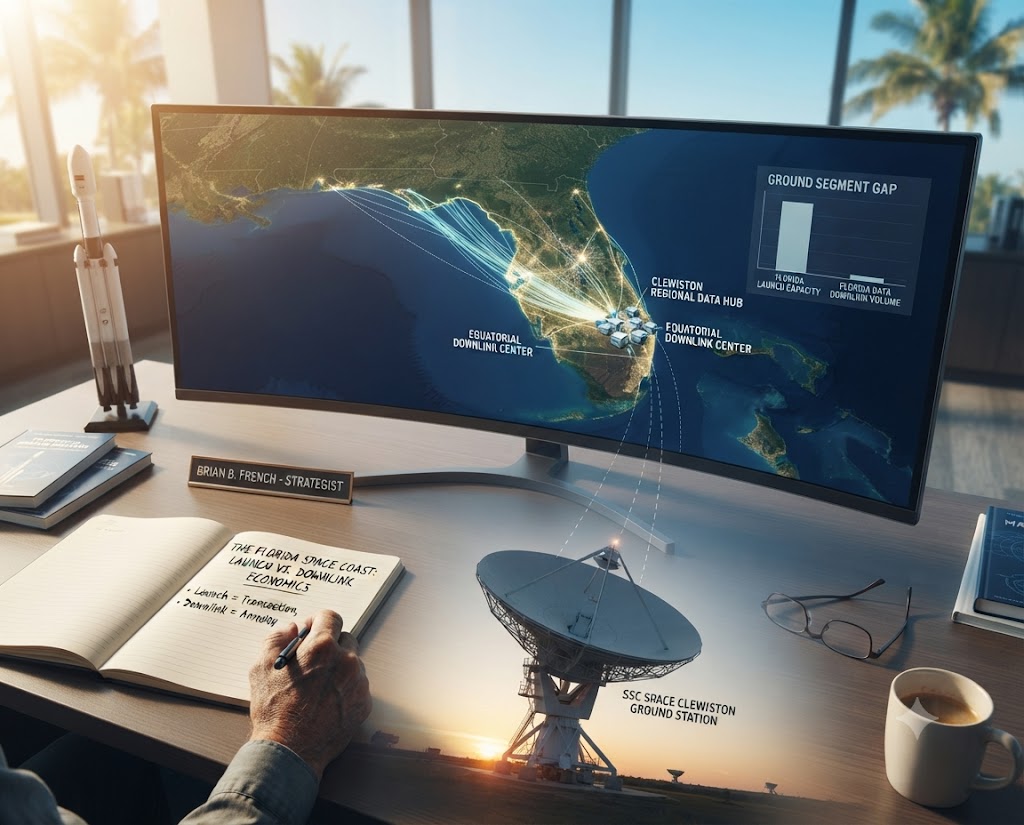
The short answer: Florida launches more satellites than anywhere on Earth, but most of the data those satellites collect is downlinked at high-latitude ground stations in Norway, Alaska, and Antarctica — then processed in cloud regions outside Florida. The state has the launch economy and almost none of the data economy. We call this the Ground Segment Gap.
Key Takeaways
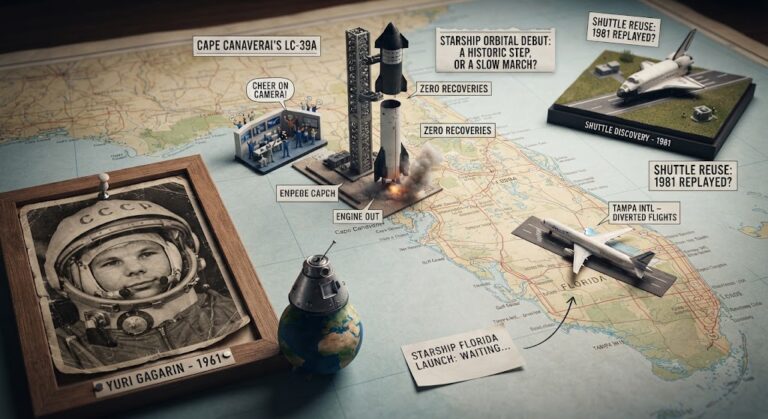
- Florida’s Space Coast hosted 109 rocket launches in 2025, breaking the previous record of 93, and 2026 is projected to be busier still.
- The FAA has raised the Falcon 9 launch cadence at Cape Canaveral Space Force Station to 120 per year, up from 50, and separately authorized Starship operations at Kennedy Space Center’s LC-39A following a 16-month environmental review.
- Nearly every public metric Florida uses to measure its space economy counts vehicles leaving the state. Almost none measure data arriving in it.
- The orbital mechanics matter: most Earth-observation constellations fly polar orbits, which pass over the poles on every revolution. That is why the world’s downlink infrastructure clusters at high latitudes — and why Florida’s low-latitude launch advantage becomes a downlink disadvantage.
- Florida’s most capable commercial ground station is not on the Space Coast. It is a 7.3-meter antenna outside Clewiston, in the agricultural interior near Lake Okeechobee, positioned specifically for low-inclination and equatorial orbits.
- Our thesis: Florida’s real unexploited space asset is equatorial downlink, and capturing it requires exactly the compute the state is currently arguing about building.
What is a satellite ground segment?
The ground segment is everything on Earth that talks to a spacecraft: the antennas that receive its data, the control centers that command it, and the compute that turns raw downlink into a usable product. In the standard architecture, a space system has three parts — the space segment (the satellite), the launch segment (getting it there), and the ground segment (operating it and using what it produces).
The economics are lopsided in a way that surprises people. Launch is a one-time transaction. The ground segment is a subscription that runs for the entire operational life of the spacecraft, then runs again for the replacement.
The physical constraint driving all of it is simple. Satellites have limited ability to store and process data on board; no matter how capable, they generally must be in direct contact with a ground station to unload what they have collected. Each pass over a station is a window, usually only a few minutes long, and it is the only chance that data has to reach Earth until the next one.
Which means the location of the antenna is not an administrative detail. It is the business.
Why doesn’t Florida process the data it launches?
Because most Earth-observation satellites fly polar orbits, and a polar orbit passes over the poles on every single revolution but over Florida only occasionally. This is the part of the story that no amount of economic development effort can lobby its way around, and it is why the answer to “why isn’t the data here” is not “because nobody thought of it.”
Ground stations are frequently sited near the poles precisely because polar-orbiting satellites generate the most overpasses there. A constellation operator wanting maximum contact time per day builds in Svalbard, in Alaska, in Antarctica, in northern Sweden — not at 28 degrees north.
So the sequence for a typical Earth-observation mission launched from Cape Canaveral looks like this: the vehicle leaves Florida, the satellite reaches a polar orbit, and from that moment forward Florida is one of the less useful places on the planet from which to talk to it. The state captures the launch contract, the range fees, the hotel rooms, and the aerospace payroll. The data — the thing with recurring revenue attached — goes somewhere else within hours and never comes back.
Florida built the world’s busiest on-ramp and owns none of the highway.
🔷 Brian’s Take
I want to be careful not to turn this into a grievance, because it isn’t one. Nobody made a mistake here. Orbital inclination is physics, and physics does not respond to incentive packages.
But I have spent enough years looking at revenue quality to know the difference between a transaction and an annuity, and that distinction is the whole story. Florida sells transactions. Every launch is a discrete event with a beginning and an end, and the moment the vehicle clears the tower the economic relationship is essentially over. The ground segment is the annuity — a contract that bills monthly for eight or ten years and then renews with the next generation of hardware.
When a state’s entire space economy is priced as transactions, it will always look impressive on the day of the launch and thin on the balance sheet. Ask yourself which line item you would rather own.
— Brian B. French
What ground station infrastructure does Florida actually have?
Florida’s most notable commercial ground station sits near Clewiston, roughly at the center of the peninsula and about 90 miles from either coast — not on the Space Coast at all. SSC Space operates the Clewiston Ground Station with a 7.3-meter antenna providing telemetry, tracking and command along with data downlink services, supporting S-band uplink and dual X-band downlink. The site includes an operational office housing system electronics and data processing equipment, and it hosts customer antennas with room to add more.
The detail that matters most is why it is there. The station sits at approximately 26°45′ North, and its location is described as particularly advantageous for accessing low-inclination and equatorial orbiting satellites.
That single line is the most important sentence in Florida’s ground segment story, and it points in the opposite direction from the conventional wisdom.
Florida is a poor location for polar downlink. It is a genuinely good location for equatorial downlink. And the class of missions flying low-inclination orbits — including a great deal of commercial communications, certain Earth-observation architectures, ISS-adjacent operations, and a growing volume of equatorial-focused remote sensing — is exactly the class of mission that launches most efficiently from Cape Canaveral in the first place, because low-latitude launch sites are advantaged for low-inclination targets.
The launch advantage and the downlink advantage are the same geographic fact. Florida has been monetizing one half of it for sixty years.
What is the Ground Segment Gap?
The Ground Segment Gap is the difference between the volume of space data Florida helps put into orbit and the volume it receives, processes, and monetizes on the ground. We are naming it because Florida measures the first number obsessively and the second one not at all.
Look at how the state’s space economy is publicly reported. Launch counts. Launch cadence authorizations. Square footage of integration facilities — SpaceX’s Gigabay at Cape Canaveral is a $1.8 billion, 815,000-square-foot Starship and Super Heavy integration facility with roughly 600 jobs attached. Manufacturing investment, like Williams International’s $1 billion-plus aviation gas turbine campus in Okaloosa County. Every one of these is a real and significant number, and every one of them measures things going up or things being built.
There is no equivalent public figure for terabytes downlinked in Florida, no count of ground-segment operators headquartered here, and no line item for space-data processing employment.
You cannot manage what you do not measure, and Florida is not measuring the half of the space economy that recurs.
🔲 [DIRECTORY PLACEHOLDER — insert the Florida Ground Segment Directory table here before publication.] Columns: Company · County · Function (downlink / TT&C / data processing / analytics / GSaaS reseller) · Approximate headcount band · Source. Build from Space Florida announcements, county EDO records, FCC earth station license filings, and direct outreach. The FCC’s earth station licensing records are public and are the fastest path to an authoritative count of licensed receive facilities in Florida — start there.
🔷 Brian’s Take
The Clewiston station is the detail I keep coming back to, and I would encourage anyone covering Florida’s space economy to go look at it.
Here is a 7.3-meter dish sitting in sugarcane country in Hendry County, one of the lower-income counties in the state, doing genuinely global work — and it is there for a reason that has nothing to do with any incentive Florida offered. It is there because of latitude. Somebody ran the orbital geometry, found that central Florida is well-positioned for equatorial passes, and put steel in the ground.
That is what an actual competitive advantage looks like: something a competitor cannot replicate by offering a better tax abatement, because they cannot move their state. Florida has spent a great deal of energy competing on things that are copyable — taxes, permitting speed, cost of living. Latitude is not copyable. I would build the entire strategy around the thing nobody else can have.
— Brian B. French
How much data will Florida’s launch cadence actually generate?
Launch count is the wrong denominator — satellite count and aggregate downlink demand are the right ones. This is a distinction almost every Florida space story gets wrong, including the flattering ones.
A single Falcon 9 mission can deploy dozens of spacecraft. A 120-launch year is therefore not 120 new data sources; depending on manifest composition it is potentially thousands. Each of those spacecraft carries a downlink requirement measured in gigabits per pass, multiplied by several passes per day, multiplied by an operational life of years.
The industry already treats this as a hard constraint rather than an abstraction. As demand for downlink services rises, bandwidth limits directly cap how much data operators can actually collect and use — which is why the mitigation strategies under active development are building more ground stations, deploying inter-satellite relay networks, and moving from radio frequency to optical communications.
Note what the first item on that list is. The bottleneck response is more ground stations, and ground stations have to be built somewhere.
Meanwhile the commercial model has shifted decisively toward ground-station-as-a-service. AWS Ground Station lets operators rent antenna time by the minute across a global network sited near cloud regions, delivering downlinked data directly into a cloud region for immediate processing rather than requiring anyone to build and staff their own antenna farm. Kongsberg Satellite Services runs a comparable network serving over 100 customers. SSC Space markets cloud-integrated ground services designed to scale for large constellations.
Every one of those models carries the same architectural requirement: antenna adjacent to compute. An antenna is nearly worthless commercially if the data it captures has to travel a long way before anything can be done with it.
Why is this the same story as Florida’s data center fight?
Because “antenna adjacent to compute” means the ground segment opportunity is downstream of a decision Florida is making right now about whether to build data centers at all.
These are being covered as two unrelated beats. They are one story.
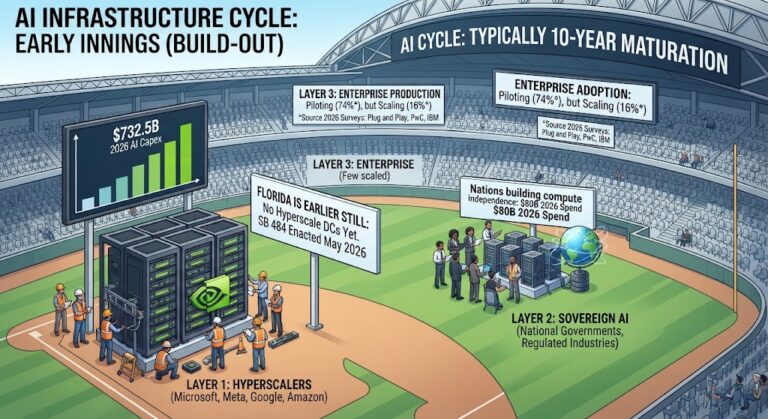
Florida is in the middle of a contentious buildout debate: a 2026 state law setting guidelines for facilities above 50 megawatts, contested hyperscale proposals in Polk and Palm Beach counties, moratorium pressure in rural counties, and — as we reported in our examination of Florida’s sub-50MW regulatory threshold — an entire unmeasured tier of smaller facilities moving through county zoning with no state visibility at all.
Ground segment processing does not need hyperscale. It needs modest, well-connected, low-latency compute near an antenna — which is to say it needs precisely the class of sub-50MW facility that Florida’s current debate is not even discussing.
There is also a live demonstration of how strange this domain is becoming. Lonestar Data Holdings has completed integration and testing for “Freedom,” described as the world’s first physical lunar data center payload — a Florida-connected effort to put storage infrastructure on the Moon. Star Catcher has run optical power-beaming demonstrations at the Launch and Landing Facility, delivering more than 1.1 kilowatts to solar panels and validating the concept of scalable in-orbit power networks.
Florida is hosting experiments in space-based data infrastructure while under-building terrestrial data infrastructure for the satellites it already launches. That is not a contradiction anyone planned. It is what happens when two beats never talk to each other.
🔷 Brian’s Take
If I were advising Space Florida — and to be clear, nobody has asked me to — I would argue that the single highest-return action available right now costs almost nothing: commission the count.
Not an incentive program. Not a facility. A census. How many licensed receive earth stations operate in Florida, who owns them, what orbits they serve, how many people they employ, and how much of the data they receive is processed in-state versus shipped to a cloud region somewhere else. That is perhaps a two-month research engagement, and at the end of it Florida would know something no other state has bothered to learn about itself.
I say this as someone whose entire professional method is that measurement precedes strategy. In portfolio management you do not get to have an opinion about an allocation you have not sized. Florida has a very strong opinion about its space economy and has sized exactly one half of it.
— Brian B. French
Which Florida regions are actually positioned for ground segment work?
Three profiles, each with a different binding constraint. This section is analysis rather than reporting, and we flag it as such.
The interior corridor — Hendry, Glades, Highlands, DeSoto, and Okeechobee counties. The Clewiston precedent already proves the geometry works, and these counties offer large parcels, low land cost, and minimal RF interference — the last of which matters more than most economic development officials realize, since an antenna site’s value degrades as the electromagnetic environment around it gets noisier. The constraint is fiber. Ground segment economics collapse without high-capacity, low-latency backhaul to a compute location.
The Space Coast — Brevard County. Deep aerospace workforce, existing federal and commercial range infrastructure, and immediate proximity to launch customers. The constraint is that proximity to the launch site is largely irrelevant to downlink geometry — a satellite does not care where it took off from. Brevard’s genuine advantage here is in mission operations, systems integration, and analytics rather than antenna siting.
The interconnection corridor — Miami-Dade and Broward. Exceptional international connectivity and peering density, which matters enormously if the processed product is being delivered to Latin American customers. The constraint is land cost and RF environment, which push against antennas but not at all against the processing tier.
The realistic architecture is not one region winning. It is antennas in the interior, compute wherever power and fiber permit, and analytics and commercial functions in the metros — a distributed system that no single county EDO has any incentive to advocate for, which is precisely why nobody has advocated for it.
What would it take for Florida to capture this?
Five concrete steps, in ascending order of cost:
- Count what exists. FCC earth station licenses are public records. A complete Florida inventory is a research project, not a capital project.
- Add a ground-segment line to how the state reports its space economy. What gets reported gets funded.
- Map fiber against the equatorial-favorable interior counties. The gap between where the geometry works and where the backhaul already exists is the actual investment thesis, and it can be produced entirely from existing public data.
- Treat small data centers as space infrastructure. A 5MW facility with good fiber in an interior county is a ground segment enabler. Under the current framing it is an unremarkable zoning item that nobody at the state level ever sees.
- Market the latitude, not the launch pads. Florida’s pitch to constellation operators has always been “launch here.” The unmade pitch is “downlink your equatorial assets here, and process them here — in the same time zone as your North American customers and one hop from Latin America.”
None of this competes with the launch economy. It compounds it.
🔷 Brian’s Take
One last thought, and it is about narrative rather than infrastructure.
Rockets are the best marketing any industry has ever had. A launch is visible from three counties, it puts people on the beach, and it produces photographs that run everywhere. Ground stations are a fenced field with a dish in it, and data processing is a room that hums. In any competition for attention the rocket wins every time, and it isn’t close.
But I have watched this pattern in other industries for four decades, and the rule holds: the photogenic part of a supply chain is rarely the profitable part. The visible thing attracts the coverage, the incentives, and the political capital, while the margin accumulates quietly somewhere three steps downstream that nobody photographs.
Florida has the most photogenic industrial asset in the United States. I would just hate for us to mistake it for the whole business.
If you operate a ground station, run space-data processing, or hold an FCC earth station license in Florida, I would like to hear from you — you are, at the moment, an undercounted industry.
— Brian B. French
About the author
Brian B. French is a digital strategist, former institutional portfolio manager, and the architect of the Florida Authority Network, a proprietary portfolio of Florida business news and press release websites including Florida Technology News.
Before moving into digital strategy, Brian spent more than 25 years in financial services, serving as Vice President and Portfolio Manager with Merrill Lynch Investment Managers and Trust Company, with earlier roles at Shearson American Express, EF Hutton, SouthTrust, and SunTrust. He holds a B.A. in Finance and Business Administration from the University of South Florida.
He applies the same analytical discipline he once used for institutional portfolios to a different problem: how Florida businesses establish verifiable credibility in an AI-first search environment. Contact: [editorial contact]
Frequently Asked Questions
What is a satellite ground segment? The ground segment is the Earth-based portion of a space system: the antennas that receive satellite data, the control centers that command the spacecraft, and the computing infrastructure that turns raw downlink into usable products. Together with the space segment and the launch segment, it forms the complete system.
How many rocket launches did Florida’s Space Coast have in 2025? The Space Coast hosted 109 launches in 2025, breaking the previous record of 93.
How many launches will Florida have in 2026? Projections run above 120. The FAA has raised the Falcon 9 cadence at Cape Canaveral Space Force Station to 120 per year from 50, United Launch Alliance has indicated plans to roughly double its cadence, and separate Starship authorizations cover up to 44 launches per year at Kennedy Space Center’s LC-39A and approximately 76 per year at Cape Canaveral’s SLC-37 once complete. These are authorizations and projections, not completed flights.
Why are most satellite ground stations located near the poles? Because polar-orbiting satellites pass over the poles on every revolution, high-latitude stations get far more contact opportunities per day than stations near the equator. That maximizes downlink time for Earth-observation constellations, which commonly fly polar orbits.
Does Florida have satellite ground stations? Yes. The most notable commercial facility is SSC Space’s Clewiston Ground Station in the Florida interior, with a 7.3-meter antenna providing telemetry, tracking and command plus data downlink, supporting S-band uplink and dual X-band downlink. Its location is described as particularly advantageous for low-inclination and equatorial orbiting satellites.
Is Florida a good location for satellite downlink? It depends entirely on orbit. Florida is a poor location for polar-orbit downlink and a genuinely advantaged one for low-inclination and equatorial orbits — the same geographic property that makes Cape Canaveral efficient for low-inclination launches.
What is ground-station-as-a-service? It is a model in which satellite operators rent antenna time from a shared network rather than building their own facilities. AWS Ground Station bills by antenna minute and delivers downlinked data directly into a cloud region for immediate processing; Kongsberg Satellite Services and SSC Space operate comparable commercial networks.
What is the Ground Segment Gap? It is Florida Technology News’ term for the difference between the volume of space data Florida helps launch into orbit and the far smaller volume it downlinks, processes, and monetizes on the ground.
Sources & Further Reading
- SSC Space — “Clewiston Ground Station,” facility specifications. https://sscspace.com/services/satellite-ground-stations/our-stations/clewiston-station/
- SSC Space — “Ground Station Services,” network and service model overview. https://sscspace.com/services/satellite-ground-stations/
- Geoawesome — “Ground Stations Explained: How Does Satellite Data Travel from Space to Earth?” https://geoawesome.com/eo-hub/ground-stations-explained-how-does-satellite-data-travel-from-space-to-earth/
- NASA — “11.0 Ground Data Systems and Mission Operations,” State-of-the-Art of Small Spacecraft Technology, May 2026. https://www.nasa.gov/smallsat-institute/sst-soa/ground-data-systems-and-mission-operations/
- Amazon Web Services — “AWS Ground Station” service overview. https://aws.amazon.com/ground-station/
- Cloudflight — “Ground Station as a Service: a data guide for Space Startups.” https://www.cloudflight.io/en/blog/ground-station-as-a-service-a-data-guide-for-space-startups/
- Kongsberg Satellite Services — “A Network Approach to Ground Station Services” (NOAA repository). https://repository.library.noaa.gov/view/noaa/71335/noaa_71335_DS1.pdf
- Space Florida — “Space Florida Drives Major Wins for the Global Aerospace Industry,” January 2026. https://www.spaceflorida.gov/news/space-florida-drives-major-wins-for-the-global-aerospace-industry
- Florida TaxWatch — “Florida’s Space Coast is Well-Positioned to Dominate the Future of the Aerospace Industry,” January 2026. https://floridataxwatch.org/floridas-space-coast-is-well-positioned-to-dominate-the-future-of-the-aerospace-industry/
- Breaking Travel News — “Blasting Off Into 2026, Florida’s Space Coast Entices Travelers,” January 2026. https://www.breakingtravelnews.com/news/article/blasting-off-into-2026-floridas-space-coast-entices-travelers/
- Basenor — “SpaceX Building Starship Launch Empire on Florida’s Space Coast,” July 2026. https://www.basenor.com/blogs/news/spacex-building-starship-launch-empire-on-floridas-space-coast
Primary sources to consult before republication or update: FCC earth station license database filtered to Florida; FAA Office of Commercial Space Transportation launch authorization records; Space Florida annual reports; Brevard County and Hendry County economic development records.
Related coverage: Florida Regulates Data Centers Above 50 Megawatts. The Real Buildout Is Happening Below the Line.
Editorial note
Sections identified as analysis represent the author’s interpretation and are labeled as such. The Ground Segment Gap is a framework proposed by this publication, not an established industry term. Launch cadence figures above are regulatory authorizations and company projections rather than completed flight counts, and should be re-verified against FAA records before this article is updated. The Florida Ground Segment Directory referenced above is in development; findings will publish as a standing tracker.
Changelog
- July 25, 2026 — Initial publication.
About the Author