Florida Regulates Data Centers Above 50 Megawatts. The Real Buildout Is Happening Below the Line.
By Brian B. French | Florida Technology News Published July 25, 2026 · Last updated July 25, 2026
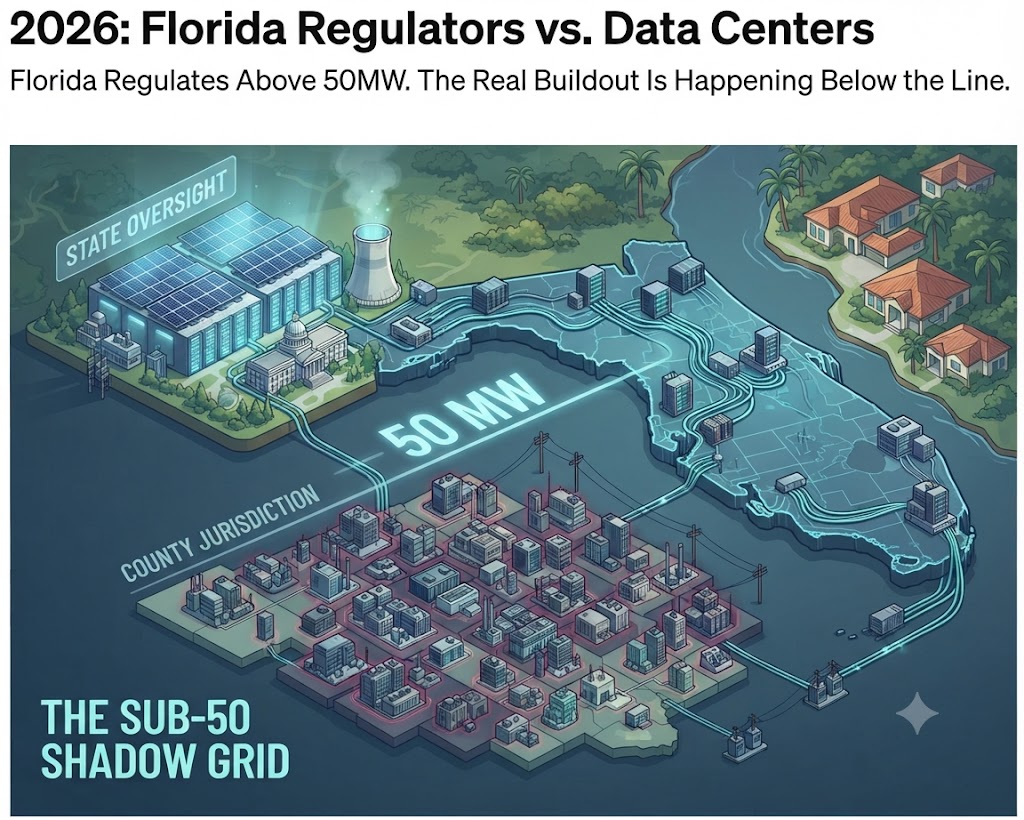
The short answer: Florida’s 2026 data center law sets statewide guidelines for facilities drawing more than 50 megawatts. Below that threshold, Florida’s 67 county commissions are effectively the only regulator — and no state agency publishes a count of how many sub-threshold facilities have been approved. That unmeasured tier is what we call the Sub-50 Shadow Grid.
Key Takeaways
- Governor Ron DeSantis signed legislation in 2026 establishing guidelines for data centers consuming more than 50 megawatts of electricity, a response to the industry’s rapidly growing energy demands.
- Facilities below 50MW fall to county-level zoning and land-use review, which varies enormously across Florida’s 67 counties and produces no centralized public record.
- Separately, 2025 legislation raised the critical IT load threshold required to qualify for Florida’s data center sales tax exemption, narrowing eligibility for smaller facilities — a change legal analysts described as among the most significant revisions to the incentive since its creation.
- The state’s largest proposed projects are stalling in public: the roughly 1,100-acre Fort Meade campus in Polk County saw final development approvals delayed by the city commission as of early 2026, and a proposed 200-acre Palm Beach County project drew organized community pushback.
- Meanwhile, small facilities are moving quietly. La Rosa Holdings contracted in 2026 to buy Osceola County land for a Tier III AI data center of up to 10,000 square feet with an estimated IT load of roughly 1,500 kW — about three percent of the state regulatory threshold.
- Our thesis: Florida’s public argument is happening at the top of the market while the volume is accumulating at the bottom, unmeasured.
What does Florida’s 2026 data center law actually cover?
Florida’s 2026 framework applies to data centers that consume more than 50 megawatts of electricity. Governor Ron DeSantis signed the legislation establishing those guidelines as part of the state’s effort to manage the industry’s escalating energy demands, and the debate over how far that oversight should extend was still active as lawmakers gathered in Orlando in late July 2026.
Fifty megawatts is a specific and consequential number. For scale: a single large hyperscale campus of the kind proposed in Polk County is measured in hundreds of megawatts to gigawatts. Atlas Compute’s planned Fort Pierce campus in St. Lucie County has been described with an initial capacity of 240MW and expansion potential toward 1GW. Those projects are unambiguously inside the framework.
But a great many facilities that a reasonable person would call a data center are not. Enterprise colocation halls, regional edge sites, telecom-adjacent facilities, university and hospital compute rooms, and the growing category of small AI inference sites all sit comfortably beneath 50MW — most of them beneath five.
For those facilities, the operative regulator is not the state. It is the county commission, applying whatever zoning code and land-use process that county happens to have.
What happens to a data center below 50 megawatts in Florida?
It is reviewed as a building, not as an energy asset. A sub-threshold facility typically moves through county planning and zoning: site plan review, a conditional use or planned unit development approval if the parcel requires it, building permits, and a utility interconnection agreement negotiated privately with the serving utility. Depending on the county and the parcel’s existing designation, some of these steps may be administrative rather than discretionary — meaning no public hearing at all.
There is no state-level registry of these facilities. There is no consolidated public reporting of their aggregate load. There is no threshold at which a county must notify the Public Service Commission that it has approved its fourth or fifth or twelfth one.
This is not a scandal. It is an ordinary consequence of how land-use regulation works in a home-rule state, and it applies to warehouses and cold storage and light manufacturing in exactly the same way. The difference is that a warehouse does not consume the electrical output of a small city, and its cumulative buildout does not reshape a utility’s load forecast.
Why would a developer deliberately build below the threshold?
Because below-threshold projects avoid state-level review, face lower community visibility, and reach revenue faster. We want to be precise about what is established and what is inference here.
What is established: Florida narrowed its data center sales tax exemption. Legislation adopted in 2025 significantly reduced eligibility for smaller facilities by requiring a substantially larger critical IT load to continue qualifying. Legal analysts characterized this as one of the most significant revisions to Florida’s data center tax policy since the incentive was created, and it reflects a national pattern of states reassessing whether generous incentives still deliver proportionate public benefit.
What follows logically: that change split the market into two economically distinct strategies. Above the new IT load floor, a developer pursues the exemption, accepts state-level scrutiny, and needs the scale to justify both. Below it, the exemption is off the table anyway — so the only remaining question is which regulatory path gets to revenue fastest. And the fastest path in Florida runs through a county planning department.
What we cannot yet quantify: how many developers are actually making that choice. That is the reporting gap this article exists to name, and it is the next thing Florida Technology News intends to measure.
🔷 Brian’s Take
I spent 25 years in institutional asset management, and if there is one pattern I watched repeat in every regulatory regime I ever operated under, it is this: draw a bright line at a number, and the market will reorganize itself just underneath that number within about eighteen months. Not because anyone is behaving badly — because the line creates a cost differential, and capital responds to cost differentials the way water responds to grade.
Fifty megawatts is a defensible place to draw a line. It captures the projects that genuinely stress a regional grid. But it also tells every developer in the state exactly where the cheap side of the fence is. I would be surprised if we do not look back in three years and find that Florida’s sub-threshold capacity grew faster in percentage terms than its hyperscale capacity did — and I would be more surprised if anyone in Tallahassee can tell you by how much, because right now nobody is counting.
— Brian B. French
What is the Sub-50 Shadow Grid?
The Sub-50 Shadow Grid is the aggregate electrical load of Florida data center facilities that individually fall below the state’s 50MW regulatory threshold and are therefore not tracked at the state level. We are coining the term because the thing needs a name before it can be discussed, and because “small data centers” understates what happens when you add them up.
The arithmetic is unglamorous and worth doing out loud. Forty facilities at an average of 8MW is 320MW — comparable to a substantial hyperscale campus, distributed across a dozen counties, approved through forty separate local processes, appearing in no single document. Nobody voted on 320MW. Forty commissions voted on individual site plans.
Consider a concrete anchor point at the small end of the range. In 2026, La Rosa Holdings Corp. announced a contract to purchase land in Osceola County in Central Florida to develop a Tier III AI data center of up to 10,000 square feet, with an estimated IT load of approximately 1,500 kW — 1.5 megawatts. That is three percent of the state threshold. It is a real facility, doing real AI and high-performance computing work, in a high-growth Central Florida corridor.
One of those changes nothing. The question is how many there are, and the honest answer today is that we do not know.
How many sub-50MW data centers has Florida approved?
No public source answers this question, which is why we are building the count ourselves.
Florida Technology News is compiling a county-by-county tally of data center, colocation, and high-density computing facility approvals below 50MW over the trailing 24 months, assembled from county planning department records and commission agendas. Methodology, county coverage, and the full sortable table will publish as a standing tracker with quarterly updates.
🔲 [TRACKER PLACEHOLDER — insert initial findings table here before publication.] Columns: County · Facility name or applicant · Approximate IT load (MW) · Approval date · Approval type (administrative / conditional use / PUD) · Source document link. A 12-county initial sample is sufficient to publish. Label it explicitly as a partial sample and commit to the expansion schedule.
Until that table exists, this article makes an argument rather than a measurement, and we want that distinction visible rather than buried.
Why does the missing count matter for Florida’s grid?
Because utility planning depends on load forecasts, and a load forecast can only include what someone reported. Florida’s grid conversation is currently organized around large, visible, contested projects — which means the planning conversation inherits the same blind spot as the news coverage.
There is a detail in the public record that deserves far more attention than it has received. When Florida Power & Light went before state regulators to request an electricity rate increase, a group called the Florida Energy for Innovation Association intervened to advocate for data centers. The group’s lawyer, D. Bruce May, said at the time that he represented companies that had signed confidential agreements with Florida Power & Light to explore building data centers in the state. He did not name them.
Sit with that. Companies whose identities are not public have agreements with Florida’s largest utility to explore projects whose locations and sizes are not public, and they were sufficiently organized to intervene in a rate case. Whatever those projects turn out to be, the public learned of their existence through a lawyer’s disclosure in a regulatory proceeding rather than through any planning document.
That is the structural problem in one sentence: in Florida’s data center buildout, the utility knows first, the county knows second, and the public knows last — if at all.
🔷 Brian’s Take
The confidential-agreement disclosure in the FPL rate case is, to me, the most important sentence anyone has published about Florida data centers, and it went by almost unremarked.
Here is why it matters practically. I have sat on the institutional side of enough negotiations to know that a confidential exploratory agreement is not a courtesy — it is a real option with real internal budget attached. Companies do not staff lawyers to intervene in a rate case over projects they are idly considering. Somebody is running numbers.
If you own land in Central Florida near high-capacity transmission, that sentence is worth more to you than every economic development press release issued this year. And if you are a county commissioner, it should tell you that the first serious data center inquiry your staff receives will probably not be the first one your utility received about your county.
— Brian B. French
Is the hyperscale fight a distraction?
No — but it is a poor proxy for the whole market. The visible projects are genuinely consequential and genuinely contested, and the contests are informative.
The Fort Meade Data Center Campus in Polk County, developed by Bohler Places LLC, would convert more than 1,100 acres of former phosphate mining land into an AI and cloud hub, backed by an estimated $2.6 to $2.8 billion and delivering somewhere between 1.9 and 4.4 million square feet across eight buildings, with development targeted for 2027–2028. It secured Planned Unit Development zoning approval and was sited near Duke Energy’s Hines complex specifically to reach high-capacity power. It also drew local opposition, and the Fort Meade City Commission delayed final development approvals as of early 2026.
In Palm Beach County, a proposed 200-acre facility referred to as Project Tango drew community pushback. Statewide, the opposition is part of a much larger pattern: speakers at the July 2026 Orlando legislative gathering cited 120 jurisdictions across 38 states that have adopted temporary moratoriums on new data center construction, with only some Florida local governments having approved pauses so far.
Rural Florida is where this is sharpest. In counties including Holmes and Washington, proposed developments have generated public debate, citizen protests, and calls for local moratoriums, with supporters pointing to billions in potential private investment and opponents raising water consumption, electrical infrastructure, land use, and the possibility that local taxpayers absorb hidden costs.
All of that is real. None of it tells you what is happening at 8MW in a county where the parcel was already zoned industrial and the site plan cleared administratively.
Why is Florida attracting this at all right now?
Because the established hubs are full and Florida’s historic deterrent is being repriced. Northern Virginia — long the center of gravity for American data center development — is saturated to the point that data centers account for roughly a quarter of that state’s power demand. The industry is spreading out, and the Southeast has absorbed much of the overflow: multiple Amazon facilities in Mississippi, and a Louisiana project described as the largest in the Western Hemisphere.
Florida has obvious advantages — business-friendly tax treatment, available land, competitive electricity — and one obvious disadvantage that industry observers have consistently named: hurricanes, and the grid disruption that follows them. That is the reason usually given for why Florida lagged despite everything in its favor. The Data Center Coalition, which represents major technology firms, has indicated that Florida now features increasingly in expansion discussions as the economics become more compelling.
Multiple analysts have described 2026 as a potential tipping point for the state. What that framing tends to miss is that a tipping point in a distributed market does not look like a single announcement. It looks like a rate of small approvals changing, quietly, across a dozen county planning departments, twelve to eighteen months before anybody writes the trend story.
🔷 Brian’s Take
I have run digital infrastructure out of Tampa Bay through more hurricane seasons than I care to count, and I want to push back on the standard framing here.
The hurricane objection is real but it is dated. It describes a era when a data center’s resilience story was mostly about the building. Modern architecture distributes risk across regions and availability zones, and the operators I talk to are less worried about a Category 4 hitting their facility than about a transformer lead time measured in years. Power availability, not power reliability, is the binding constraint in 2026.
Which is why I read the Fort Meade siting decision — right next to Duke Energy’s Hines complex — as the most honest statement of intent in the entire Florida story. They did not pick 1,100 acres of reclaimed phosphate land for the views. They picked it because it is next to the electrons. Every serious project in this state will be sited on that same logic, and if you want to know where the buildout goes next, stop reading press releases and start reading transmission maps.
— Brian B. French
What should a Florida county commissioner ask before the next vote?
Ask for the cumulative number, not the individual one. The single most useful procedural change available to any Florida county right now costs nothing and requires no state action: instruct planning staff to maintain and publish a running tally of approved data center capacity in the county, in megawatts, and to present that cumulative figure at every subsequent hearing.
Five specific questions worth putting on the record:
- What is this facility’s expected critical IT load in megawatts, and what is our county’s cumulative approved total including this project?
- What is the cooling architecture, and what is the projected annual water consumption? Closed-loop and water-free designs materially change this answer — Atlas Compute’s Fort Pierce plan, for instance, is built around closed-loop, water-free cooling explicitly framed as reducing water dependency.
- Has the applicant executed an interconnection agreement, and what did the utility say about available capacity at this location?
- What is the permanent, on-site headcount after construction ends? Construction employment and operating employment are different numbers, and press releases frequently blend them.
- Does this project qualify for the state sales tax exemption? If yes, the county should understand what state revenue is being forgone. If no, the county should understand why the applicant chose a structure that does not qualify.
None of these questions are hostile. All of them are answerable. The reason to ask them at the hearing is that they become part of the public record, which is currently the only place this information exists.
What this means if you own Florida land
Proximity to high-capacity transmission is now the single most important variable in Florida industrial land value, and it is not yet fully priced. Land near existing substations and high-voltage corridors — particularly in Polk, Osceola, St. Lucie, Citrus, and DeSoto counties, all of which have seen project activity — is being evaluated on a criterion most local brokers were not applying three years ago.
Two cautions. First, county-level receptivity varies dramatically and is changing quickly; a parcel in a county heading toward a moratorium carries a different risk profile than an identical parcel forty miles away. Second, the gap between an announced land contract and an operating facility is long, conditional, and frequently unbridged. Announcements are not projects.
🔷 Brian’s Take
A closing thought about what this story actually is.
There is a version of data center coverage that is essentially sports writing — big numbers, named opponents, a scoreboard of approvals and denials. It is genuinely engaging and I read all of it. But it systematically over-reports the contested and under-reports the routine, and the routine is where most infrastructure gets built in this country.
My working assumption, which I intend to test with actual permit records rather than defend rhetorically, is that Florida’s sub-50MW capacity is growing faster than anyone’s mental model of it, and that we will discover this in about 2028 when a utility load forecast comes in wrong and somebody goes looking for why. I would rather we find out now, county by county, while the number is still small enough to have a policy conversation about.
That is what this publication is going to spend the next two quarters doing. If you sit on a planning board, work in county permitting, or are developing one of these facilities, I want to hear from you — including if you think I have this wrong.
— Brian B. French
About the author
Brian B. French is a digital strategist, former institutional portfolio manager, and the architect of the Florida Authority Network, a proprietary portfolio of Florida business news and press release websites including Florida Technology News.
Before moving into digital strategy, Brian spent more than 25 years in financial services, serving as Vice President and Portfolio Manager with Merrill Lynch Investment Managers and Trust Company, with earlier roles at Shearson American Express, EF Hutton, SouthTrust, and SunTrust. He holds a B.A. in Finance and Business Administration from the University of South Florida.
He applies the same analytical discipline he once used for institutional portfolios to a different problem: how Florida businesses establish verifiable credibility in an AI-first search environment. Contact: [editorial contact]
Frequently Asked Questions
Does Florida regulate small data centers? Florida’s 2026 state framework applies to data centers consuming more than 50 megawatts. Facilities below that threshold are governed primarily through county-level zoning and land-use review, which varies substantially across Florida’s 67 counties.
How many megawatts is a typical data center? It ranges by orders of magnitude. Small edge and enterprise facilities run from under 2MW to roughly 10MW — La Rosa Holdings’ planned Osceola County facility is approximately 1.5MW. Hyperscale campuses are measured in hundreds of megawatts; Atlas Compute’s proposed Fort Pierce campus has been described with an initial 240MW and expansion potential toward 1GW.
Which Florida counties have the most data center activity? Publicly reported project activity has concentrated in Polk, Osceola, St. Lucie, Palm Beach, Citrus, and DeSoto counties, with additional proposals debated in rural Panhandle counties including Holmes and Washington. No comprehensive state registry exists.
Has Florida banned data centers anywhere? Some Florida local governments have approved temporary pauses, though Florida is far from the leading edge of this trend nationally — speakers at a July 2026 legislative gathering cited 120 jurisdictions across 38 states with temporary moratoriums in place.
Does Florida still offer a data center tax exemption? Yes, but eligibility narrowed. Legislation adopted in 2025 raised the critical IT load threshold required to qualify, reducing eligibility for smaller facilities. Confirm current thresholds against Florida statute before relying on them for any transaction.
Why did Florida lag other states in data center development? Industry observers have consistently cited hurricanes and resulting electrical grid disruption as the historical deterrent, despite Florida’s business-friendly tax climate and available land. That calculation appears to be shifting as established hubs like Northern Virginia — where data centers already account for roughly a quarter of state power demand — approach saturation.
What is the Sub-50 Shadow Grid? It is Florida Technology News’ term for the aggregate electrical load of Florida data center facilities that individually fall below the state’s 50MW regulatory threshold, are approved through county-level processes, and are not tracked in any centralized public record.
Sources & Further Reading
- Baynews9 — “Florida lawmakers weigh AI data center expansion amid calls for more oversight,” July 24, 2026. https://baynews9.com/fl/tampa/news/2026/07/24/florida-lawmakers-weigh-ai-data-center-expansion-amid-calls-for-more-oversight
- GovTech (Tampa Bay Times via Tribune Content Agency) — “Is Florida the Next Data Center Hot Spot?” April 2026. https://www.govtech.com/artificial-intelligence/is-florida-the-next-data-center-hot-spot
- Washington County News — “Florida rewrites the rules for AI data centers as rural communities weigh growth against local concerns,” July 7, 2026. https://washingtoncounty.news/2026/07/07/florida-rewrites-the-rules-for-ai-data-centers-as-rural-communities-weigh-growth-against-local-concerns/
- Blackridge Research — “Top Upcoming Data Center Projects in Florida 2026,” March 2026. https://www.blackridgeresearch.com/blog/latest-list-top-largest-upcoming-data-center-projects-florida-usa
- Benzinga / AOL — “La Rosa Expands Into AI Data Centers With Florida Land Deal,” 2026. https://www.aol.com/articles/exclusive-la-rosa-expands-ai-160616844.html
- Chronicle Online — “Is a data center boom coming to Florida? What the industry says,” March 2026. https://www.chronicleonline.com/news/local/is-a-data-center-boom-coming-to-florida-what-the-industry-says/article_07220c4a-b90d-561f-a801-4f7eeb72d5e5.html
- Florida Politics — Zach Colletti, “Florida must embrace data centers to lead the AI economy,” March 3, 2026. https://floridapolitics.com/archives/783262-zach-colletti-florida-must-embrace-data-centers-to-lead-the-ai-economy/
Primary sources to consult directly before republication or update: Florida Senate and House bill text for the 2025 and 2026 data center provisions; Florida Public Service Commission dockets including the FPL rate case filings; Polk County and Fort Meade City Commission agendas and minutes; Osceola, St. Lucie, and Palm Beach County planning department records.
Editorial note
Sections marked as analysis represent the author’s interpretation and are labeled as such. The Sub-50 Shadow Grid is a framework proposed by this publication, not an established regulatory category. Several facts above derive from single-source reporting published within the past 90 days and are being independently verified against primary records; corrections will be logged below.
Changelog
- July 25, 2026 — Initial publication.
About the Author