By Brian French | FloridaTechnologyNews.com | September 29, 2026
Quick Answer
Florida businesses are losing the click. Google still handles most searches, but in early 2026, 68% of Google searches ended without a click to any website, as AI-generated answers replaced the traditional list of links. Consumers now get recommendations directly from ChatGPT, Gemini, and Google’s AI Mode, and those tools recommend only a handful of businesses.
Measuring whether your business appears in those answers is very difficult, because AI responses change from one query to the next. The businesses most likely to win are the ones cited consistently across many trusted, independent sources. The Florida Authority Network’s 35 Florida news and press release sites were built for exactly that.
Key Takeaways
- Zero-click Google searches reached 68% in early 2026, up from about 45% a decade ago.
- When Google shows an AI Overview, clicks drop by nearly 60%.
- Google’s AI Mode passed 1 billion monthly users, according to Google.
- Nearly half of marketing leaders say they can’t accurately measure their brand’s visibility in AI answers.
- A single AI answer tells you almost nothing, because results vary heavily from run to run.
- Third-party mentions predict AI visibility better than backlinks.
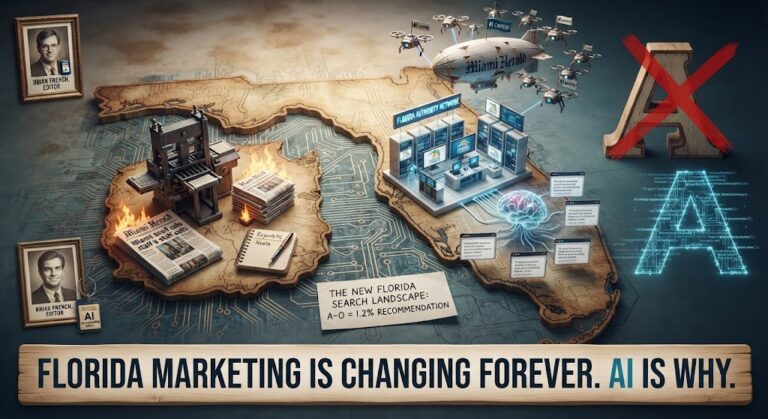
- Florida’s local news is shrinking. The Miami Herald just lost more than a third of its editorial staff.
The New Search Landscape, by the Numbers
| Metric | Figure |
|---|---|
| Google searches ending with no click | 68% |
| Zero-click searches 10 years ago | ~45% |
| Clicks lost when an AI Overview appears | ~60% |
| Google AI Mode monthly users | 1 billion+ |
| ChatGPT weekly active users | 900 million |
| Consumers who used AI to shop | 39% |
| Marketers who can’t measure AI visibility | 45% |
| Local businesses ChatGPT recommends | 1.2% |
AI Isn’t Replacing Google. It’s Replacing the Click.
The common claim that “AI is replacing Google” is wrong in an important way. Google still sends about 87.6% of all search referrals, and all four major AI chatbots combined send only 0.29%. Google is not going away.
What has changed is that Google itself has become an AI answer engine. In the first four months of 2026, 68.01% of Google searches ended without a click, the fastest increase in a decade, driven largely by AI Overviews, which now appear on more than 20% of searches and cut click-through rates by nearly 60% when they do.
The shift is still accelerating. Google said at I/O 2026 that AI Mode had passed 1 billion monthly users and that queries were more than doubling every quarter, which could drive the next decade of growth in zero-click searches. When Google’s AI Mode is active, 93% of queries end without a click.
Outside Google, AI assistants have become a mass-market habit. OpenAI reported 900 million weekly active ChatGPT users in February 2026, and estimates put ChatGPT at roughly 12% to 20% of all search-intent traffic.
For a Florida business, the practical result: if a customer asks Google or ChatGPT for “the best estate planning attorney in Tampa” or “a reliable HVAC contractor in Orlando,” they increasingly get an answer instead of a list of links. Being on page one no longer guarantees being seen. What matters is whether your business is named in the answer.
Few Businesses Get Named
AI answers are much more selective than search results. ChatGPT recommends only 1.2% of local businesses, compared with 35.9% of locations that appear in Google’s local results. An AI answer usually names three to five businesses, and there is no page two.
Being well known is not enough. In a study of 175 brands across eight AI platforms, AI correctly described what each company does 96% of the time, but 89% of those brands never appeared when the AI was asked the questions a buyer would actually ask. AI can know your business exists and still never recommend it.
The shoppers these tools send are valuable. Brands recommended by ChatGPT were 2.5 times more likely to get a site visit within seven days than competitors that weren’t named, and much of that traffic came through later branded searches rather than direct clicks.
Why AI Visibility Is So Hard to Measure
Traditional SEO had clear metrics: rankings, traffic, and click-through rates. AI visibility has no reliable equivalent.
The measurement gap is widespread. Semrush’s 2026 AI Visibility Index found that 45% of marketing leaders can’t accurately measure their brand’s visibility in AI answers, and only 9% have tools to track every relevant metric.
AI answers are inconsistent by design. SparkToro’s research found that AI tools are built to generate a different answer each time, and concluded that measuring a brand’s presence in AI answers precisely is a “fool’s errand.” Researchers studying AI visibility found that because AI outputs are random by nature, a single query gives only a noisy snapshot of a brand’s true visibility.
One answer tells you almost nothing. A 2026 study found that a single AI answer has a reliability score near 0.01 for distinguishing brands, and the brand itself explained only 1.5% of the variation in answers.
Sources change constantly. An analysis of 11.1 million AI citations found that only 6.8% of cited sources mention a brand, two-thirds of answers name no brand at all, and about 65% of sources change within two weeks.
There’s no warning system. When your Google ranking drops, Search Console tells you. When an AI tool stops mentioning your business, nothing notifies you.
What this means for Florida businesses: a marketing agency that asks ChatGPT one question and reports “you’re visible in AI” is giving you anecdote, not data. Real measurement requires running many prompts repeatedly, across several AI platforms, over time. Even then, the result is a probability, not a ranking.
Florida’s Local News Vacuum
AI tools build their answers from sources they can find and trust, and Florida’s supply of local news is shrinking. This month, layoffs at McClatchy and Lee Enterprises hit hard, and the Miami Herald lost more than one-third of its editorial staff. Nationally, the country has lost nearly 2,900 newspapers and about two-thirds of its newspaper journalists since 2005.
The vacuum is also being filled by bad actors. The Florida Trib recently investigated the South Florida Standard, an AI-driven site presented as local news that turned out to be what researchers call a “pink slime” outlet. When reporters started asking questions, the site removed staff bios and then went offline entirely. Sites like this now outnumber local daily newspapers in the United States, according to NewsGuard.
This creates both a problem and an opportunity. As legitimate Florida business coverage shrinks, AI tools have fewer credible Florida sources to draw from. Publishers that combine scale with real accountability, including named editors, verifiable sources, and genuine local focus, will be the most useful to AI systems and to readers.
What Actually Earns AI Visibility
Research from 2026 points to a consistent set of factors:
- Third-party mentions. An Ahrefs study of 75,000 brands found that brand mentions correlate with AI visibility about three times more strongly than backlinks (0.664 vs. 0.218).
- Independent editorial coverage. AI answers are built largely from articles, reviews, and comparisons published by others, not from a company’s own website. If your business isn’t in those articles, it isn’t in the answer.
- Recent content. Content updated within the last 30 days is cited 3.2 times more often.
- Specific facts. Adding specific statistics to content improved AI visibility by 41%, according to research from Princeton, Georgia Tech, and IIT Delhi.
- Consistent business information. AI answers vary by market when a business’s listings, reviews, local pages, and structured data are inconsistent.
- Volume and consistency. Brands producing 12 or more new or optimized pieces of content per month gained visibility up to 200 times faster than brands producing four.
The Florida Authority Network’s Position
The Florida Authority Network was built around these factors. Its advantages include:
| Asset | Why it matters for AI visibility |
|---|---|
| 35 Florida-focused websites | Multiple independent sources AI can cite |
| 13 city and regional business news sites | Local relevance for city-specific searches |
| ~12 industry verticals (medical, legal, real estate, finance, tech, tourism, home services) | Places businesses in industry context |
| 4 press release brands | Official announcements in several formats |
| 4 video brands | Video coverage, a category AI cites heavily |
| Structured articles with Quick Answers, FAQs, and data tables | Easy for AI to extract and cite |
| 4–5 business profiles per client with consistent name, address, and phone | Consistent business information across sites |
| Florida Business Index | A structured directory of Florida companies |
| Named human editor and sourced articles | Accountability that separates real publishers from fake sites |
| Proprietary Florida data indexes (in development) | Original data AI can’t find elsewhere |
Two layers of coverage. The network is designed to place a Florida business in two contexts: Florida business news, such as TampaBayBusinessNews.com or MiamiBusinessNews.com, and Florida industry news, such as FloridaMedicalNews.com or FloridaLawFirmNews.com. When a business appears consistently across both, AI has multiple independent sources that agree about it, which is the kind of consensus these systems rely on.
A human editor. Every article is reviewed by a human analyst. The editorial approach, which the network calls “Human Insight + Tech Intelligent Curation,” uses technology to gather and structure public data, while an editor with an investment-analysis background checks facts and adds judgment. With fake AI-driven local news sites spreading in Florida, having a named, accountable editor is part of what the network offers.
A realistic caveat. Given how inconsistent AI answers are, no publisher can guarantee that a business will appear in any particular AI response. What a publisher can do is increase the number of credible, consistent, recent sources that AI systems find when they build an answer. That is the basis of FAN’s strategy.
A Florida Business Playbook for the AI Era
- Ask the questions your customers ask. Test ChatGPT, Gemini, Perplexity, and Google AI Mode repeatedly over several weeks. Don’t draw conclusions from a single answer.
- Make your business information identical everywhere. Your website, Google Business Profile, directories, and press coverage should all show the same name, address, and phone number.
- Earn independent coverage. Press releases, business profiles, and editorial features on credible Florida sites give AI the third-party sources it relies on.
- Publish specific facts. Founding year, service areas, certifications, employee count, and concrete results are easier for AI to use than marketing language.
- Keep publishing. AI favors recent sources, so a single announcement fades quickly.
- Judge results by trends, not rankings. Look at share of mentions over time, not whether you appeared in one answer.
Brian’s Take
I spent years as an investment manager, and this shift reminds me of the move to passive investing. The old way still works, but the money has moved elsewhere. For Florida businesses, Google search still matters, but the click that used to follow it is disappearing.
The measurement problem is the part most people underestimate. Any agency or tool offering a precise AI ranking should be treated with skepticism. What you can do is build the kind of presence AI systems keep returning to: consistent, credible, current, and published in many independent places.
That is why I built the Florida Authority Network as 35 separate sites instead of one. Each city site, industry site, and press release site is an independent place for a Florida business to be documented. When AI looks for Florida business information, we want our network to be one of the sources it finds.
To discuss placing your business in the network, call 813-409-4683.
FAQ
Is AI replacing Google search?
Not exactly. Google still sends about 88% of search referrals. What’s changing is that Google now answers questions directly with AI, so 68% of searches end without a click to any website.
What is GEO?
Generative engine optimization (GEO), also called answer engine optimization (AEO), is the practice of making a business more likely to be cited or recommended in AI-generated answers.
Can I measure my business’s AI visibility?
Only approximately. AI answers change from run to run, so accurate measurement requires testing many prompts repeatedly across several platforms over time.
What makes AI recommend a business?
Mentions in independent sources, recent content, specific facts, and consistent business information across the web.
How does the Florida Authority Network help?
It publishes Florida businesses across 35 news, industry, video, and press release sites, with consistent business information and a human editor reviewing content.
Sources and Further Reading
- SparkToro — Less than one third of Google searches still send a click: https://sparktoro.com/blog/in-2026-less-than-one-third-of-google-searches-still-send-a-click/
- Search Engine Land — Zero-click searches reach 68%: https://searchengineland.com/google-zero-click-searches-2026-study-479717
- TechnologyChecker.io — Search engine referral share, September 2026: https://technologychecker.io/blog/search-engine-market-share
- Loudspeaker Marketing — AI vs. traditional search statistics: https://loudspeakermarketing.com/blog/ai-vs-traditional-search-statistics.html
- LLM Pulse — Improving brand visibility in ChatGPT: https://llmpulse.ai/blog/improve-brand-visibility-chatgpt/
- Forbes — Why your brand is invisible to AI: https://www.forbes.com/sites/lisacurtis/2026/05/23/why-your-brand-is-invisible-to-ai-and-what-to-do-about-it/
- Trustmary — AI visibility guide: https://trustmary.com/ai-visibility/
- AuthorityTech — AI recognition vs. recommendation studies: https://authoritytech.io/curated/ai-brand-recognition-recommendation-gap-three-studies-2026
- Zen Media — AI visibility tracking: https://zenmedia.com/blog/ai-visibility-tracking/
- SparkToro — AIs are highly inconsistent when recommending brands: https://sparktoro.com/blog/new-research-ais-are-highly-inconsistent-when-recommending-brands-or-products-marketers-should-take-care-when-tracking-ai-visibility/
- arXiv — Don’t Measure Once: Measuring Visibility in AI Search: https://arxiv.org/pdf/2604.07585
- Wellows — Auditing brand visibility in LLMs: https://wellows.com/blog/audit-brand-visibility-on-llms/
- Starfish — What is AI brand visibility: https://www.starfishco.com/branding/ai-brand-visibility/
- Omnia — Improving brand visibility in ChatGPT: https://www.useomnia.com/blog/how-to-improve-brand-visibility-chatgpt
- Birdeye — LLM visibility tracking tools: https://birdeye.com/blog/best-llm-visibility-tracking-tools/
- Dan Ackerman — A bloodbath for local news: https://danackerman.substack.com/p/a-bloodbath-for-local-news
- The Florida Trib — Rise and fall of an AI-driven local news outlet in South Florida: https://floridatrib.org/2026/05/14/the-rise-and-fall-of-an-ai-driven-local-news-outlet-in-south-florida/
About the Author