By Brian French | Florida Technology News | October 17, 2026
Quick Answer: A lot. Google Search Console hides the search terms behind nearly half of all clicks, and Ahrefs measured anonymized queries at 46.77% of clicks in April 2025. It also ignores Bing, ChatGPT, and other AI referrals, phone calls from Google Business Profiles, and zero-click answers. Florida businesses should treat it as one source of evidence, not the full picture.
Why Do Florida Businesses Trust Google Search Console So Much?
Quick Take
- Search Console is free, comes straight from Google, and feels authoritative.
- Most small businesses use it as their main measure of search performance.
- That trust is often misplaced, because the tool was never designed to show everything.
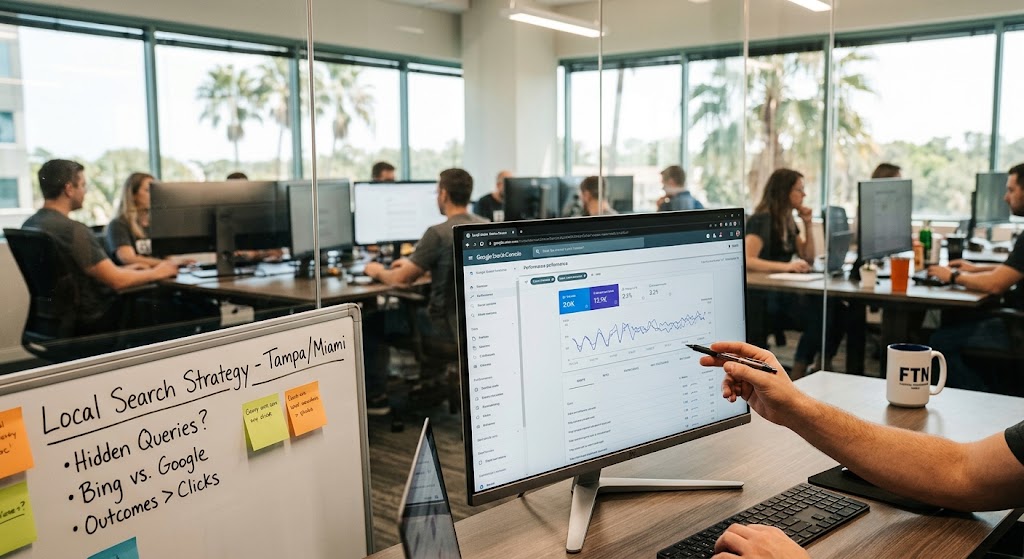
Walk into almost any small marketing agency in Tampa, Orlando, or Miami, and you will find Google Search Console open on someone’s screen. It is free. It comes directly from the company that runs nearly 90% of the world’s searches. And for many Florida business owners, it is the closest thing they have to a scoreboard for online visibility.
That trust makes sense on the surface. Search Console is first-party data. It shows the clicks, impressions, and rankings Google itself recorded.
But Search Console is not a complete record of how people find your business online. It is a filtered, limited, Google-only view. And in 2026, as more searches end in AI answers, map listings, and chatbots, the gap between what Search Console reports and what is actually happening keeps widening.
For Florida’s small businesses, many of which depend on local searches, tourism, and bilingual customers, those gaps can be especially large.
How Much Search Data Does Google Search Console Hide?
Quick Take
- Google hides the search terms behind clicks it classifies as “anonymized queries.”
- Ahrefs found anonymized queries accounted for 46.77% of clicks across nearly 900,000 properties in April 2025.
- Some individual sites see far more than half their query data hidden.
The Anonymized Query Problem
The single biggest blind spot in Search Console is what Google calls anonymized queries. Google says it withholds these search terms to protect user privacy, defining them as queries not issued by more than a few dozen users over a two-to-three-month period.
That sounds narrow. In practice, it is not.
In 2022, Ahrefs product advisor Patrick Stox studied 146,741 websites and about 9 billion clicks. He found that Google hid the search terms for 46.08% of all clicks. When Search Engine Land raised the finding with Google, the company changed its help documentation. It had previously described these as “very rare” queries. It now says simply that “some” queries are anonymized.
Ahrefs repeated the study with a much larger sample. In April 2025, across 22 billion clicks and 887,534 Search Console properties, anonymized queries made up 46.77% of clicks, slightly higher than before. The most common share of hidden clicks for an individual site fell between 45% and 80%.
| Study | Sites Analyzed | Clicks Analyzed | Share of Clicks With Hidden Queries |
|---|---|---|---|
| Ahrefs, 2022 | 146,741 | ~9 billion | 46.08% |
| Ahrefs, April 2025 | 887,534 | ~22 billion | 46.77% |
Why It Is Getting Worse
Stox has suggested that longer queries are a likely reason more data is being hidden. People increasingly search in full sentences, and AI-style searches are longer still. Google has said AI Mode queries average three times the length of traditional searches. Longer, more specific queries are less likely to be repeated by dozens of people, which makes them more likely to be anonymized.
The Florida Angle
Local searches are often exactly the kind of long, specific queries that get hidden. Consider searches such as:
- “same day AC repair Kissimmee near Osceola Parkway”
- “Spanish speaking immigration lawyer Doral”
- “boat detailing Fort Lauderdale before boat show”
- “hurricane shutter installation Cape Coral price”
Each may be valuable to a local business, yet few are repeated often enough to clear Google’s privacy threshold. A Florida contractor, attorney, or restaurant may see clicks in Search Console but never learn which specific words drove them.
What Other Data Limits Does Search Console Have?
Quick Take
- The interface exports only 1,000 rows at a time.
- Data is retained for just 16 months.
- Even Google’s unlimited export still excludes anonymized queries.
Beyond hidden queries, Search Console imposes structural limits that affect how much a business can analyze.
| Limitation | What It Means |
|---|---|
| 1,000-row export limit | The standard interface exports only 1,000 rows of data |
| API limits | A single API request returns up to 25,000 rows, with daily limits per search type |
| 16-month retention | Older data disappears unless you export it yourself |
| Bulk export excludes anonymized queries | Even the BigQuery export omits privacy-filtered terms |
| Data delay | Reports typically lag by a day or more |
| No conversions | Clicks are shown, but not calls, leads, or sales |
Google introduced a bulk data export to BigQuery in 2023, which removes the daily row limit for larger sites. But Google stated plainly that the export includes all performance data except anonymized queries. In other words, the most important gap remains even in the most complete export.
For a growing Florida business, the 16-month limit is also significant. Without exporting data regularly, a company cannot compare this hurricane season’s search trends with those from two or three years ago.
Was Search Console Data Inflated Before 2025?
Quick Take
- In September 2025, Google stopped supporting the &num=100 search parameter.
- Impressions dropped sharply across many sites, while average position appeared to improve.
- Much of the “lost” visibility was automated tool traffic, not real people.
One of the most revealing moments for Search Console came in September 2025. Around September 10, Google stopped honoring the &num=100 parameter, which had allowed rank-tracking tools and other bots to load 100 search results on a single page.
Almost immediately, many site owners saw impressions fall sharply in Search Console, especially on desktop, while their average position appeared to improve. Analysts concluded that a large share of previously reported impressions, particularly for rankings beyond the first page, had come from automated tools rather than human searchers.
This mattered for two reasons:
- Historical comparisons broke. Any report comparing impressions before and after mid-September 2025 now compares two different measurement regimes.
- It exposed a trust problem. For years, many businesses had reported Search Console impressions as evidence of visibility. Some of that visibility had never involved a real person.
Florida businesses that reported year-over-year impression trends to owners, boards, or clients should annotate September 2025 as a reporting break.
Does Search Console Show AI Overviews and AI Mode Traffic?
Quick Take
- AI Overviews and AI Mode data are counted inside the regular Web search totals.
- A new generative AI report launched on June 3, 2026, but it shows impressions only.
- It offers no clicks, no queries, and no split between AI Overviews and AI Mode.
Blended Into the Totals
For most of the AI era, Search Console offered no separate view of AI features. Google confirmed in June 2025 that AI Mode clicks, impressions, and positions count toward the regular Web search figures, with no way to filter them out.
The June 2026 AI Report
On June 3, 2026, Google launched Search Generative AI performance reports in Search Console, with separate views for Search (covering AI Overviews and AI Mode) and Discover. The reports show impressions, the pages that appeared, and device breakdowns, with data starting May 18, 2026.
It is a meaningful step, but a limited one:
| What the AI Report Shows | What It Does Not Show |
|---|---|
| Impressions in AI features | Clicks from AI features |
| Which pages appeared | Which queries triggered them |
| Device breakdown | AI Overviews vs. AI Mode separately |
| Trends since May 18, 2026 | Any data before May 18, 2026 |
The scale makes this gap important. Google has said AI Mode passed one billion monthly users in 2026, and industry reports put AI Overviews above 2.5 billion monthly users. A Florida business can now learn that its pages appeared in AI answers, but not what the user asked or whether anyone clicked through.
What Traffic Does Search Console Never See?
Quick Take
- Search Console only measures Google Search, Discover, and News.
- Bing, DuckDuckGo, ChatGPT, Perplexity, Claude, and other AI tools are invisible to it.
- Google Business Profile calls and direction requests live in a separate system.
Other Search Engines
Search Console measures Google only. StatCounter put Google’s worldwide search share at about 90% in April 2026, with Bing at about 5.1%. Bing’s share is much higher on desktop, especially in workplaces that use Windows and Microsoft Edge. For Florida businesses selling to other businesses, desktop Bing searches from office workers can be a meaningful source of leads that Search Console will never show.
AI Chatbots
AI assistants are now a separate referral channel. StatCounter data for March 2026 showed ChatGPT driving about 78% of AI chatbot referrals to websites, followed by Gemini, Perplexity, Copilot, and Claude. Overall AI referral volume is still small compared with Google Search, but it is growing quickly. None of it appears in Search Console.
Google Business Profile Activity
For local Florida businesses, this may be the largest blind spot of all. When a customer finds a business in Google Maps or the local pack and taps “call” or “directions,” that interaction is recorded in Google Business Profile performance data, not in Search Console. A Clearwater plumber may receive dozens of calls a week from Google without a single website click appearing in Search Console.
Zero-Click Searches
Many searches now end without any click at all. A user may see a business’s hours, phone number, or an AI-generated answer and act on it directly. Search Console may record an impression but no click, and it records nothing about what happened next.
Summary: What Search Console Sees and Misses
| Activity | Visible in Search Console? |
|---|---|
| Google organic clicks with common queries | Yes |
| Google organic clicks with rare or long queries | Clicks yes, queries hidden |
| AI Overview and AI Mode impressions | Yes, impressions only in new report |
| AI Overview and AI Mode clicks by query | No separate view |
| Bing, Yahoo, DuckDuckGo traffic | No |
| ChatGPT, Perplexity, Claude, Gemini app referrals | No |
| Google Business Profile calls and directions | No |
| Phone calls from search ads | No |
| Social media and email traffic | No |
| Conversions and revenue | No |
How Big Is the Blind Spot for a Typical Florida Small Business?
Quick Take
- The gap varies widely by business type.
- Local service businesses often see more activity in Business Profile than in Search Console.
- B2B firms may be undercounting Bing and AI-driven research.
There is no single number that captures the total gap, because it depends on the business. But a hypothetical example shows how quickly the unseen activity adds up.
Hypothetical example: a Tampa HVAC company in July
| Source of Customer Contact | Where It Is Recorded |
|---|---|
| 400 Google organic website clicks | Search Console (about half without query detail) |
| 250 calls from the Google Business Profile | Business Profile performance only |
| 90 direction requests | Business Profile performance only |
| 60 Bing and Yahoo clicks | Bing Webmaster Tools or analytics |
| 25 visits from ChatGPT and other AI tools | Website analytics only |
| Customers who saw hours in search and called directly | Not recorded anywhere |
These figures are illustrative, not based on a specific company.
In this example, Search Console would show only the 400 Google website clicks, and could explain the search terms behind only about half of them. The calls and visits that actually produced revenue would sit in other systems, or nowhere at all.
Different Florida businesses will see different patterns:
- Restaurants and tourism businesses in Orlando, the Keys, or the beaches often get much of their search activity through Maps, the local pack, and travel apps.
- Law firms and medical practices may see a high share of hidden queries because their searches are specific and sensitive.
- B2B and technology companies in places like Tampa’s Water Street district or Orlando’s Lake Nona may undercount Bing and AI research by decision-makers.
- Bilingual businesses in South Florida may see Spanish-language and mixed-language queries fall below Google’s privacy thresholds.
How Should Florida Businesses Measure What Search Console Misses?
Quick Take
- Combine Search Console with analytics, Business Profile, and Bing data.
- Track calls and form fills as outcomes, not just clicks.
- Export data regularly to keep more than 16 months of history.
A Practical Measurement Stack
| Tool | What It Adds |
|---|---|
| Google Search Console | Google clicks, impressions, indexing health |
| Google Business Profile performance | Local calls, directions, website clicks, search terms |
| Bing Webmaster Tools | Bing and Copilot search visibility |
| Website analytics (GA4 or alternatives) | All traffic sources, including AI referrals |
| Call tracking | Which channels produce phone leads |
| CRM or point-of-sale data | Which leads become paying customers |
| Third-party SEO tools | Estimates of hidden and competitive queries |
Steps to Take Now
- Set up Bing Webmaster Tools. It is free and shows a search channel Google ignores.
- Review Google Business Profile performance monthly. For local businesses, this may matter more than Search Console.
- Segment AI referrals in analytics. Track visits from ChatGPT, Perplexity, Gemini, and Claude separately.
- Export Search Console data. Use the API, a connector, or BigQuery to keep history beyond 16 months.
- Annotate reporting breaks. Mark September 2025 for the &num=100 change and May 2026 for the start of AI report data.
- Ask customers how they found you. A simple question at intake fills gaps no tool can close.
- Measure outcomes. Calls, booked appointments, and sales are the numbers that matter.
Is Google Search Console Still Worth Using?
Quick Take
- Yes, but for the right job.
- It is excellent for indexing, technical health, and Google-specific trends.
- It is a poor tool for measuring total visibility or business results.
None of this means Florida businesses should abandon Search Console. It remains the only source of first-party data on how Google sees a website. It is the best place to diagnose indexing problems, find pages that are losing visibility, and confirm that Google can crawl a site.
Google’s privacy rationale for anonymized queries is also legitimate. Search terms can reveal sensitive information about individuals, and some filtering is appropriate.
The problem is not the tool. It is how businesses use it. When a company treats Search Console as its complete marketing scoreboard, it ends up making decisions based on roughly half the search terms, one search engine, and no record of the calls and visits that actually pay the bills.
Brian’s Take
Google Search Console is one of the most useful free tools on the internet, and one of the most misunderstood.
The core issue is simple. Google decides what you see. It decides which queries are too rare to show, how impressions are counted, and which AI features get their own reports. When Google changed one search parameter in September 2025, millions of impressions disappeared from business reports overnight. When it finally added AI reporting in 2026, it included impressions but no clicks and no queries. Those are Google’s choices, and they shape what businesses think is happening.
For Florida businesses, the blind spots are larger than average. Our economy runs on local services, tourism, and bilingual customers. Those searches tend to be specific, local, and often end in a phone call or a map tap rather than a website click. Search Console sees a slice of that activity. Business Profile, analytics, and simple customer conversations see much more.
The smartest approach is to treat Search Console like a doctor treats a single lab test: useful, necessary, and never the whole diagnosis. Build a measurement system around outcomes, not impressions. And remember that the customers who matter most may never show up in Google’s report at all.
Frequently Asked Questions
How much data does Google Search Console hide?
Ahrefs found that anonymized queries accounted for 46.77% of clicks across nearly 900,000 Search Console properties in April 2025. For many individual sites, the hidden share falls between 45% and 80%.
Why does Google hide some Search Console queries?
Google says it withholds queries to protect user privacy, defining anonymized queries as those not issued by more than a few dozen users over a two-to-three-month period.
Does Google Search Console track AI Overviews and AI Mode?
Partly. AI feature data is included in the regular Web search totals, and a June 2026 report shows AI impressions by page and device. It does not show clicks, queries, or a split between AI Overviews and AI Mode.
Why did my Search Console impressions drop in September 2025?
Google stopped supporting the &num=100 parameter around September 10, 2025. That removed many automated impressions from rank-tracking tools, so impressions fell while average position often improved.
Does Search Console show phone calls from Google Maps?
No. Calls, direction requests, and other Google Business Profile interactions appear in Business Profile performance data, not in Search Console.
Sources and Further Reading
- Ahrefs, “Anonymized Queries Make Up Nearly Half of Google Search Console Traffic,” 2025
- Ahrefs, “Almost Half of GSC Clicks Go to Anonymous Queries – A Study by Ahrefs,” 2022
- Search Engine Land, “Google Removes Language in Help Doc Calling Hidden Search Console Query Data ‘Very Rare’”
- Search Engine Roundtable, “Google Search Console Anonymizes Tons of Queries”
- Google Search Central Blog, “A Deep Dive Into Performance Data Filtering and Limits,” October 2022
- Google Search Central Blog, “Bulk Data Export: A New and Powerful Way to Access Your Search Console Data,” February 2023
- Google Search Console Help, Exporting Data
- Windsor.ai, “Google Search Console API Guide: Fields, Limits and Real Usage Errors”
- Noble Studios, “Google Retires &num=100: What It Means for Your SEO Reporting”
- Zeo, “The Impact of &num=100 Parameter Removal on SEO Reporting”
- Google Search Central Blog, “Introducing Search Generative AI Performance Reports in Search Console,” June 2026
- PPC Land, “Google Finally Gives Search Console Its Own Generative AI Visibility Reports”
- Hartzer, “What AI Search Analytics Can and Cannot Tell You”
- StatCounter, “Google Gemini Overtakes Perplexity to Become Second Largest Source of AI Chatbot Referrals to Websites,” April 2026
About the Author