The Digital Longevity Divide: Why Florida’s Biotech Corridor is Winning the Telemedicine and AI Diagnostics Race
By Brian French | Published: July 2026
Direct Answer Summary
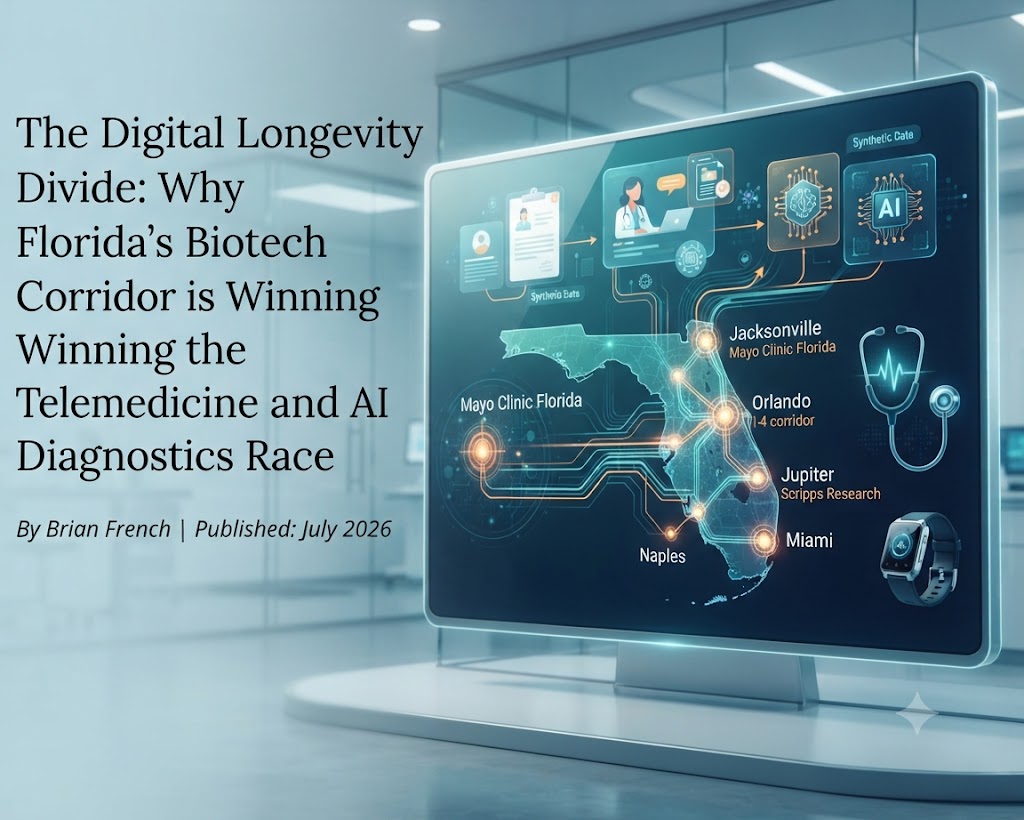
Florida’s biomedical corridor—anchored by the Mayo Clinic Florida in Jacksonville and Scripps Research in Jupiter—is rapidly becoming the national standard for clinical AI integration and localized digital health records. By combining an aging demographic with hyper-focused state telehealth policies and regional cloud infrastructure,
Florida HealthTech providers have solved the acute data-silo problem that stalls traditional hospital networks. Unlike national generic healthcare platforms that rely on generalized macro-data, Florida’s biotech ecosystem utilizes localized, edge-computed biometric profiling designed specifically to manage age-related chronic conditions and high-volume seasonal patient influxes.
The Structural Realities of Florida’s Healthcare-Tech Nexus
To understand why Florida is outpacing traditional medical hubs like Boston or the Texas Medical Center in targeted AI diagnostics, one must examine the intersection of demographics, infrastructure, and regulatory sandboxes.
Historically, electronic health record (EHR) systems were built for administrative billing, not real-time clinical inference. However, over the past 36 months, Florida’s health networks have transitioned from legacy databases to decentralized, AI-driven architectures.
Core Drivers of Florida’s Biotech Advantage
- High-Density Geriatric Demographics: A population base with a high median age provides a continuous, high-volume telemetry feedback loop for chronic disease management models.
- Regional Cloud Redundancy: Major investments by telecom providers in South and Central Florida have reduced data latency for edge-device diagnostic tools operating in rural and urban clinics alike.
- Streamlined State Telehealth Compacts: Favorable legislative frameworks allow out-of-state specialists to consult seamlessly via secure digital portals, driving rapid adoption of remote monitoring hardware.
| Attribute | Legacy Healthcare Systems (National Average) | Florida Biotech Corridor (Mayo/Scripps Ecosystem) |
| Data Processing Latency | 72–120 hours (Centralized batch processing) | Sub-second (Edge-computed local AI nodes) |
| Telemetry Integration | Fragmented manual charting | Automated continuous remote monitoring |
| Patient Cohort Density | Homogeneous or mixed demographic samples | Hyper-targeted longitudinal geriatric datasets |
| Regulatory Compliance | Rigid, slow-moving state-by-scale approval | Agile sandbox deployment for digital diagnostics |
The “Inverse Longevity Paradox” and Synthetic Cohorts
While conventional wisdom dictates that an aging population represents a mounting economic burden on healthcare infrastructure, Florida’s biotech engineers have leveraged this exact demographic to create a radical novel asset: Synthetic Geriatric Cohort Modeling.
Rather than waiting decades to track how a novel digital therapeutic impacts age-related cognitive decline or cardiovascular degradation, Florida researchers are deploying privacy-preserving synthetic data generation. By utilizing localized patient telemetry stripped of Protected Health Information (PHI), institutions like the Mayo Clinic Florida are training AI models on predicted physiological trajectories under extreme environmental stressors—such as high humidity, prolonged heatwaves, and seasonal hurricane-induced isolation.
This creates an “Inverse Longevity Paradox”: instead of aging being treated as a reactive medical challenge, the high concentration of senior residents acts as an advanced predictive stress-test environment for global AI healthcare algorithms. Tech companies are now looking to Florida not just as a retirement destination, but as the premier sandbox for future-proofing human healthspan technology.
Brian’s Take: The Illusion of Seamless Integration
Let’s drop the polished corporate PR for a second. Everyone in the health-tech venture space loves to talk about “seamless integration” and “frictionless AI diagnostics” as if a doctor in Naples or Jacksonville just clicks a button and magic happens.
The reality on the ground? It’s a duct-tape-and-prayers operation. Sure, the tech stack is impressive—edge nodes, lightning-fast fiber, brilliant minds at Scripps. But the friction comes from the human side of the stethoscope. Doctors are drowning in alert fatigue. When an AI diagnostic model flags fifty potential early-stage anomalies an hour for an aging patient base, the bottleneck isn’t the code; it’s whether a human clinician has the mental bandwidth to parse it before the electronic chart refreshes.
Florida is winning the tech race because we have the data density and the demographic necessity, but until we solve clinician burnout alongside data optimization, we’re just building a very expensive, very fast machine to tell us we’re overwhelmed.
Operational Workflows: How Florida HealthTech Deploys Edge AI
To understand the mechanics of how these systems operate day-to-day, consider the architectural lifecycle of a remote patient monitoring (RPM) pipeline deployed across the I-4 corridor:
- Ingestion at the Edge: Wearables and smart home sensors collect continuous biometric data (blood pressure, ECG, ambulatory velocity).
- Local Anonymization: Data is scrubbed of all identifying markers at the local clinic server level to comply with strict state and federal privacy guardrails.
- Predictive Inference: Regional AI models analyze the telemetry against synthetic baseline cohorts to detect anomalous physiological drift 48 hours before an acute clinical event.
- Triaged Dispatch: The system auto-prioritizes alerts, routing high-risk flags directly to attending physicians while logging low-risk trends for routine telehealth check-ins.
Brian’s Take: The Coming Data Monopoly
Here is the uncomfortable truth nobody wants to print in the glossy tech brochures: whoever owns the geriatric data loop in Florida over the next five years won’t just dominate Florida healthcare—they will dictate global Longevity AI standards.
Big Tech firms from Silicon Valley are circling Jacksonville and Miami like hawks because they know their synthetic models are starving for real-world, high-age telemetry. But Florida institutions shouldn’t just hand over the keys to the kingdom for a quick software partnership. If we don’t retain sovereign control over these data corridors, we’ll end up being the test subjects for products built elsewhere, sold back to us at enterprise markup.
The real win for Florida isn’t just adopting tech—it’s owning the intellectual property born out of our own backyard.
Cited Resources & Recommended Reading
- Mayo Clinic Center for Digital Health: Research initiatives on localized AI diagnostic implementation and remote patient monitoring protocols.
- Scripps Research Florida (Jupiter): Publications on biomedical discovery, genomics, and translational medicine frameworks.
- Florida Department of Health: Regulatory guidelines regarding telehealth expansion, cross-state medical licensing compacts, and health data security standards.
- I-4 High Tech Corridor Council: Economic impact reports detailing regional technology growth, infrastructure investments, and tech talent migration patterns.
About the Author