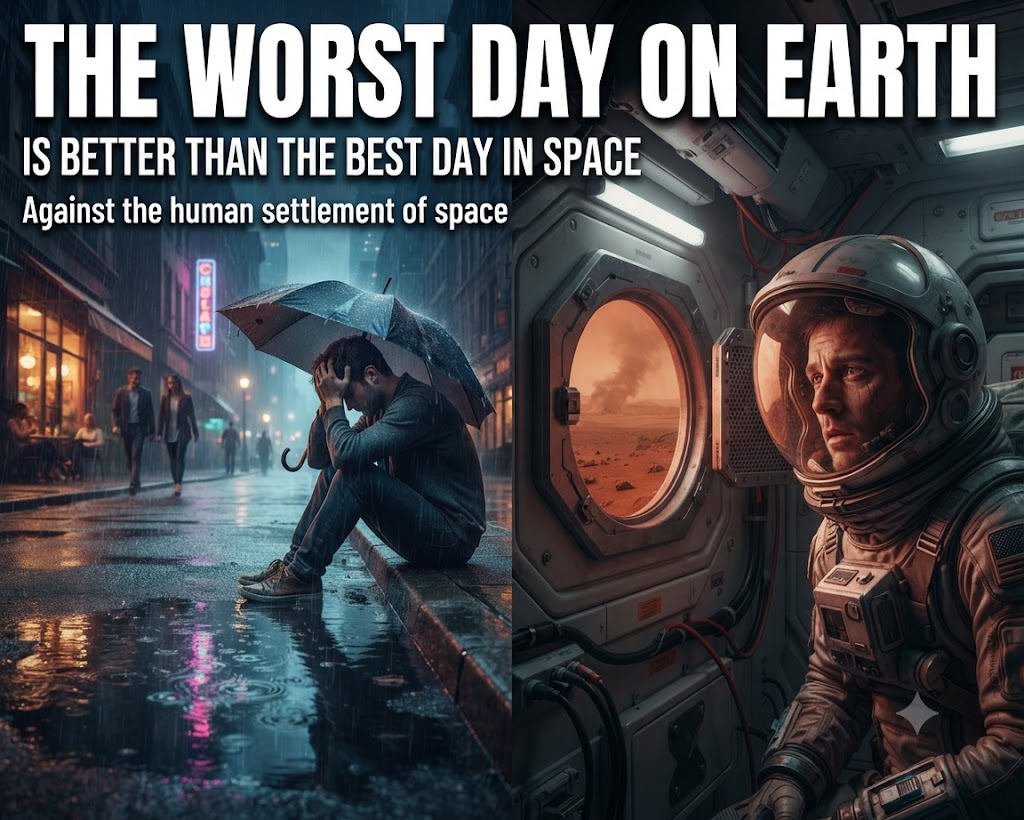
Against the human settlement of space
There is a number every astronaut knows and almost no one else does: about 0.06 atmospheres. That’s the Armstrong limit — the pressure at which water boils at human body temperature. Cross it without a suit and the saliva on your tongue begins to bubble. On Earth you’d have to climb to roughly 19 kilometers to find it. On Mars, it is the weather. The entire Martian atmosphere sits below the line at which your own body starts to vaporize itself.
This is the place we are told is humanity’s second home.
I want to be precise about the objection, because it is not an objection to space. Space is magnificent. Space telescopes are among the best things our species has ever built. Satellites gave us global communications, GPS, weather forecasting that saves tens of thousands of lives a year. Voyager is still talking. None of that is in question.
The objection is to us going. To the specific, expensive, quasi-religious conviction that human bodies belong out there, and that shipping them there constitutes progress.
Space is not indifferent to you. It is actively hostile.
We describe space as empty, which makes it sound neutral, like a large room. It isn’t neutral. Every single condition your body requires to keep functioning is absent, and most of the conditions that are present are trying to kill you.
Start with radiation. Earth’s magnetosphere and atmosphere absorb the galactic cosmic ray flux that permeates the rest of the solar system. Step outside that shield and you are standing in it. Instruments aboard the Curiosity mission measured the cruise-phase dose on the way to Mars and found that a round trip alone would deliver something on the order of half a sievert — a lifetime occupational allowance, absorbed as a commute. Cosmic rays are not X-rays; they are heavy iron nuclei moving at relativistic speed, and they punch through shielding while spraying secondary particles out the far side. Water and regolith help. Nothing available is a solution.
Then the body itself begins to come apart. Astronauts lose bone mass at roughly one to one and a half percent per month, which is osteoporosis running at ten times the terrestrial rate. Muscles atrophy. Fluid migrates upward and presses on the back of the eye — spaceflight-associated neuro-ocular syndrome, which flattens the eyeball and swells the optic disc, and which in some astronauts does not fully reverse after return.
Immune function degrades. Latent viruses reactivate. The gut microbiome shifts. Cataracts arrive early. We have a small library of countermeasures: two-plus hours of daily exercise, drug regimens, careful diet. They slow the damage. They do not stop it.
And this is what we know from low Earth orbit, still inside the magnetosphere, with a resupply ship and a return capsule and a route home measured in hours. We have essentially no data on what a third of a gravity does to a human body over decades. We have zero data on human gestation anywhere but here.
We do not know if a mammalian embryo can develop properly in Martian gravity. Nobody knows. The people confidently discussing a million-person Mars city are speaking past a hole in the science large enough to swallow the entire project.
Meanwhile the ground you’d stand on is soaked in perchlorates — chlorine salts at concentrations around half a percent by weight in the regolith, which happen to be potent thyroid toxins. The dust is fine, jagged, electrostatically clingy, and unweathered by water, so it never rounded off the way terrestrial dust did. It will get into the habitat. It will get into your lungs. Apollo astronauts complained about lunar dust after three days.
Follow the money and it stops at orbit
The “space economy” is real and it is worth several hundred billion dollars a year. Look at the composition and the argument collapses. The overwhelming majority is satellite services, ground equipment, and government budgets. It is telecommunications, Earth observation, and navigation — which is to say, it is machines in orbit pointing back at Earth, doing things for people who are standing on Earth.
Human spaceflight’s revenue, outside of government contracts, rounds to nothing. A handful of ultra-wealthy tourists on suborbital hops. Some ISS commercial research. That’s the market.
The proposed industries have been proposed for fifty years and remain proposals:
Asteroid mining. The two flagship startups — Planetary Resources and Deep Space Industries — were both absorbed or repurposed by 2019 without mining anything. The economics have a self-defeating shape: platinum-group metals are valuable because they are scarce, so the moment you land enough to justify the mission you have destroyed the price that justified it. And anything you’d want for construction is only worth extracting if there’s already a construction industry in space, which there isn’t, because there’s nothing to build for.
Helium-3. Endlessly cited lunar fuel for fusion reactors that do not exist, using a deuterium-helium-3 reaction substantially harder than the deuterium-tritium reaction we have not yet made work commercially after seventy years of trying. You would strip-mine an area the size of a country to extract grams.
Microgravity manufacturing. ZBLAN optical fiber and protein crystallography have been the promised killer apps since the Shuttle era. Decades of promise, negligible product.
Every one of these is a solution hunting for a problem, and the problem it’s actually solving is: we have already decided to go, and now we need a reason.
The lifeboat argument sinks on contact
The most serious-sounding case for settlement is insurance. Don’t keep all the eggs in one basket. Backup drive for consciousness. It sounds sober and long-horizoned, and it fails a test you can run in your head in about four seconds:
Name the catastrophe that leaves Earth less habitable than Mars.
Full-scale nuclear exchange? Earth still has breathable air, liquid water, 1g, a magnetosphere, an ozone layer, and a biosphere. Chicxulub-class asteroid impact? Same. It killed three quarters of species and the survivors include our direct ancestors. Runaway greenhouse, worst realistic case? A hot, storm-lashed, agriculturally ruined Earth is still orders of magnitude more survivable than the best square meter on Mars, which has no air, no water you can drink, no soil you can plant in, no protection from radiation, and an average temperature around minus sixty.
The correct comparison isn’t Earth-now versus Mars. It’s Earth-after-the-disaster versus Mars, and Earth wins every round, without effort, forever.
Here’s the tell. If self-sufficient closed-loop habitats in lethal environments were the goal, we would already be building them in Antarctica — which has breathable air, one gravity, no radiation problem, abundant water, and a medevac flight measured in hours.
It is enormously easier than Mars in every dimension. Nobody is doing it. Not because it’s impossible, but because nobody actually wants to live that way. The Mars enthusiast is not seeking a hard frontier; if he were, there’s one available at a thousandth the price. He’s seeking a symbol.
“Expanding human consciousness” and other things people say when the arguments run out
Notice how quickly the pitch changes register. When you press on radiation, physiology, and economics, the conversation doesn’t get more technical — it gets more spiritual. Destiny. Multiplanetary species. Expanding the light of consciousness. The next great leap.
These aren’t arguments. They’re liturgy. And they’re strangely small-minded liturgy, because consciousness has an enormous amount of expanding left to do right here.
We have mapped the surface of Mars at higher resolution than we have mapped the floor of our own ocean. We have described maybe two million of an estimated eight-plus million species and we are losing them faster than we’re naming them.
We do not understand how the immune system decides, or how anesthesia works, or how a fertilized cell becomes a body, or what most of the genome is doing, or how memory is physically stored, or why we sleep. The deep biosphere kilometers down in the crust may hold a substantial fraction of all life on Earth and we know almost nothing about it.
There is no shortage of frontier. There is only a shortage of frontiers that photograph well.
The ingratitude
This is the part that genuinely bothers me, more than the physics or the balance sheet.
Underneath the rhetoric of escape is a premise that Earth is a starting position — a nursery, a cradle, a first draft to be graduated from. Tsiolkovsky’s line about the cradle gets quoted with a kind of impatience, as if staying here were a failure of nerve.
But look at what this place actually is. A planet in a temperature band where water stays liquid across most of its surface. An oversized moon that stabilizes the axial tilt and keeps the seasons from wandering catastrophically. A molten iron core generating a magnetic field that deflects the solar wind that stripped Mars naked. Plate tectonics running a carbon-silicate cycle that has thermostatted the climate across billions of years.
An atmosphere at exactly the pressure our blood requires, buffered with inert nitrogen, oxygenated by two billion years of patient microbial work, capped by an ozone layer built from that same oxygen. Soil that is not a mineral substrate but a living community. And on top of all of it, a biosphere so dense and so old that you cannot take a breath, eat a meal, or drink a glass of water that isn’t the direct product of four billion years of other living things.
A thousand miracles, stacked, load-bearing, none of them replicable and none of them found anywhere else we have looked.
And here is the irony that should end the debate. The single most influential thing the space program ever produced was not a colony or an alloy or a mine. It was a photograph. Earthrise in 1968. The Blue Marble in 1972. We spent the equivalent of a quarter-trillion dollars going to the Moon, and the enduring cultural legacy — the thing that arguably launched the modern environmental movement — was a picture of home taken from far enough away to see it whole.
The astronauts came back and talked about the overview effect. Read what they actually said. Almost none of it is about how badly they wanted to keep going. Nearly all of it is about how fragile and singular and beloved the Earth looked from out there.
The overview effect is not an argument for leaving. It is the most expensive argument for staying that anyone has ever assembled.
Send the robots. Build the telescopes. Launch the satellites, all of them, they’re the best deal in the history of public spending. Learn everything the solar system will tell us, which is a great deal.
But the human body is a terrestrial instrument, tuned over four billion years to one specific set of conditions, and it does not travel well. The worst day you will ever have on this planet — the coldest, the sickest, the most bereaved — you will still spend it breathing free air under a sky, held down by the right amount of gravity, on a world that is trying, in its indifferent way, to keep you alive.
There is no such day anywhere else. Not one. Not ever, in all the places we can reach.
We are not in the cradle. We are home.
About the Author