Quick Answer: The Florida Institute for Human and Machine Cognition (IHMC) in Pensacola has built powered exoskeletons for 12-plus years, co-developing devices with NASA and the Gainesville startup MYOLYN, and now runs two tracks: assistive suits for people with paralysis and load-carrying suits for able-bodied workers. A December 2025 partnership with venture studio Conduit Venture Labs, a multi-year Office of Naval Research humanoid contract and a 2026 CEO transition signal that the nonprofit is moving its wearable robotics from research toward commercialization.
The Problem Nobody Wanted to Fund
For most of its history, IHMC’s exoskeleton program fought an economic argument as much as an engineering one. Peter Neuhaus, a longtime IHMC exoskeleton researcher, said in 2019 that the team constantly heard the market for lower-limb paralysis devices was too small, which kept investment and research effort far below what the field deserved. The Toyota Mobility Foundation’s Mobility Unlimited Challenge was built on the same diagnosis: no affordable, widely available technology restores full movement, and development efforts are scattered across small, fragmented markets that health systems struggle to fund.
That framing explains why a Florida nonprofit, not a venture-backed company, became one of the field’s persistent players. IHMC’s robotics team has worked on legged systems for roughly 17 years and on exoskeletons for about 12, producing four versions of its powered suits. Its early work included the X1 Mina exoskeleton developed with NASA, alongside biped robots such as M2V2 and support for the NASA Space Robotics Challenge.
A Florida Startup Partnership That Reached the Finals
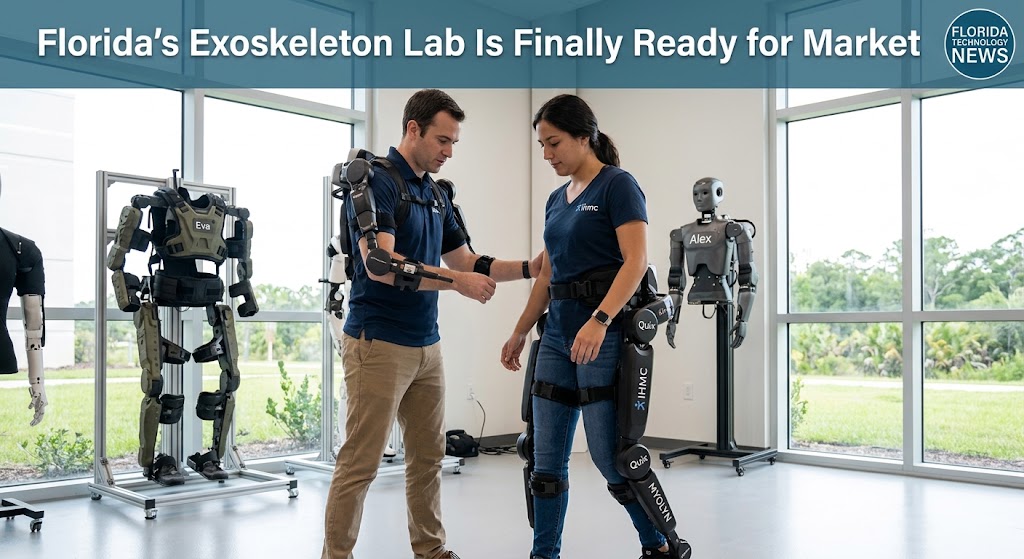
Quix, IHMC’s flagship assistive exoskeleton, was co-developed with MYOLYN, a University of Florida spinout and graduate of the UF Innovate Hub in Gainesville. The hip-knee-ankle device, with motors at all three joints and extra actuators for stability, was selected as one of five finalists from 80 entries across 28 countries in the Mobility Unlimited Challenge, earning a $500,000 development grant and a shot at the $1 million prize.
The team’s chief evaluator is also its most important user. Mark Daniel, who was paralyzed in an automobile accident more than a decade ago, has worked with IHMC since 2010 designing and testing its devices, and piloted the Mina v2 to a silver medal at the 2016 Cybathlon. Robot Report coverage from 2020 described the Quix hardware coming together in January of that year and testing through September, with the team adding elements so the device would not burden the pilot.
Two Product Tracks, One Lab
IHMC is now recruiting engineers for both assistive and augmentive wearable robotics. Job postings describe continued work on Quix alongside new augmentive platforms for able-bodied individuals, specifically to assist load carriage. The lab’s Eva exoskeleton is the flagship of that second track: a powered lower-body device that offloads the weight of heavy personal protective equipment from the user’s body to the ground while augmenting motion, aimed at radioactive waste cleanup.
The dual-track approach answers the market problem directly. Industrial and government users, from nuclear remediation sites to defense, represent a far larger buyer base than the spinal-cord-injury population alone, and the underlying control software, actuators and balance systems carry over between the two.
From Research Institute to Commercialization Engine
In December 2025 IHMC entered a strategic partnership with Conduit Venture Labs, a venture studio, to accelerate research commercialization. Then-CEO Dr. Morley Stone said pushing the frontier of human-machine teaming requires pairing world-class research with world-class commercialization, and that Conduit brings the expertise to translate breakthroughs into market outcomes.
The institute’s humanoid work is following the same path. Its robotics group demonstrated the new Alex humanoid before the Office of Naval Research, which awarded IHMC a multi-year, multi-million-dollar contract to develop a next-generation humanoid robot. Alex’s design prioritizes out-of-the-lab testing, and the institute has argued that today’s most advanced humanoids are built for structured warehouse environments rather than real-world conditions.
Leadership is changing with the mission. IHMC announced in 2026 that Stone is stepping down and that Chief Science Officer Dr. Tim Broderick will become CEO. Broderick, a surgeon and biomedical engineer who pioneered laparoscopic, robotic and telerobotic surgery, joined IHMC in 2019 after serving as a DARPA program manager, where he established five biotechnology programs. Stone had joined in 2021 from Ohio State University, where he was senior vice president for research, following a stint as chief technology officer of the Air Force Research Laboratory.
Company Snapshot
| Organization | Florida Institute for Human and Machine Cognition |
| Structure | Not-for-profit, State University System of Florida |
| Campuses | Pensacola (HQ), Ocala |
| Incoming CEO | Dr. Tim Broderick |
| Founder | Dr. Kenneth M. Ford |
| Assistive exoskeletons | X1 Mina (with NASA), Mina v2, Quix (with MYOLYN) |
| Augmentive exoskeleton | Eva (with Sandia National Laboratories, DOE-funded) |
| Commercialization partner | Conduit Venture Labs (Dec. 2025) |
| Humanoid program | Alex, Office of Naval Research contract |
Why This Matters for Florida Tech
IHMC’s board member David Bear, CEO of the Pensacola beverage distributor Lewis Bear Company, called the institute one of the lesser-known jewels of Northwest Florida’s intellectual and economic landscape when he joined in 2025. The description fits. Florida’s technology conversation is dominated by Miami capital and Tampa Bay cyber, while a Pensacola nonprofit has quietly accumulated more than a decade of wearable-robotics intellectual property, a NASA collaboration, a Gainesville startup partnership, federal energy and Navy funding, and now a venture studio to package it.
The 2023 groundbreaking on a $30 million Healthspan, Resilience and Performance complex adds human-performance research and Department of Defense-related biomedical work to the same campus, giving the institute the ability to study everything from a single molecule to teams of humans and machines. For Florida founders and investors, the signal is that IHMC’s technology transfer window is opening.
Brian’s Take
The exoskeleton story is really a story about how hard technology gets built when the market says no. IHMC survived a decade of “too small a market” by doing what a nonprofit research institute can do and a startup cannot: keep the same team, the same test pilot and the same codebase alive across four device generations while the commercial landscape caught up. The pivot to load-carriage suits for workers, plus the Conduit partnership, is the institute admitting that the buyer for its next decade is industrial and governmental, not clinical. That is the right call. The question for Florida is whether the spinouts land in Pensacola and Gainesville or get pulled to Boston and San Diego, and the Conduit deal suggests IHMC intends to keep them home.
Frequently Asked Questions
Is IHMC a company or a university? Neither. It is a not-for-profit research institute affiliated with the State University System of Florida.
Who did IHMC build Quix with? MYOLYN, a University of Florida spinout in Gainesville.
Does IHMC sell exoskeletons? Not directly. Its December 2025 partnership with Conduit Venture Labs is intended to commercialize institute research.
What is Eva? A powered lower-body exoskeleton that transfers the weight of heavy protective gear to the ground, developed with Sandia National Laboratories for nuclear cleanup work.
Who is leading IHMC now? Chief Science Officer Dr. Tim Broderick was named to succeed Dr. Morley Stone as CEO in 2026.
Sources and Further Reading
- IHMC, “IHMC partners with Conduit Venture Labs to accelerate commercialization efforts” — https://www.ihmc.us/news20251209/
- IHMC, “A Letter From Our CEO” (May 2026) — https://www.ihmc.us/news-20260521-1/
- IHMC, “Meet Alex, IHMC’s next generation humanoid robot” — https://www.ihmc.us/news20251119/
- IHMC, “Innovation in Action” — https://www.ihmc.us/innovation-in-action/
- IHMC, “Triumph grant helps seed IHMC’s vision for human performance complex” — https://www.ihmc.us/news20220415/
- IHMC, “David Bear joins IHMC Board of Directors” — https://www.ihmc.us/news20250701/
- IHMC Robotics Lab, “Quix” — https://robots.ihmc.us/quix
- IHMC Robotics Lab, “Exoskeletons for Augmenting Human Performance” — http://robots.ihmc.us/exoskeletons-for-augmenting-human-performance
- IHMC, “Exoskeleton Controls Developer” (job posting) — https://www.ihmc.us/exoskeleton-software-developer/
- IHMC, “Robotics Software Engineer” (job posting) — https://www.ihmc.us/robotics-software-engineer/
- Exoskeleton Report, “Quix Powered Exoskeleton Becomes Finalist of the Mobility Unlimited Challenge” — https://exoskeletonreport.com/2019/01/quix-powered-exoskeleton-becomes-finalist-of-the-mobility-unlimited-challenge/
- The Robot Report, “EvoWalk, Quix teams talk progress in Toyota Mobility Unlimited Challenge” — https://www.therobotreport.com/evowalk-quix-teams-progress-toyota-mobility-unlimited-challenge/
- UF Innovate, “Toyota Announces Finalists in Mobility Competition” — https://innovate.research.ufl.edu/2019/01/18/toyota-announces-finalists-in-mobility-competition
- IHMC, “Eva exoskeleton gets a real-world test run” — https://www.ihmc.us/news20241219/
- IHMC, “IHMC breaks ground on new, $30 million human performance research complex” — https://www.ihmc.us/news20230203/
About the Author