By Brian French | Florida Authority Network | November 3, 2026
Brian French is founder and publisher of the Florida Authority Network and a Florida business news analyst with more than 20 years of experience as an analyst and money manager.
Quick Answer
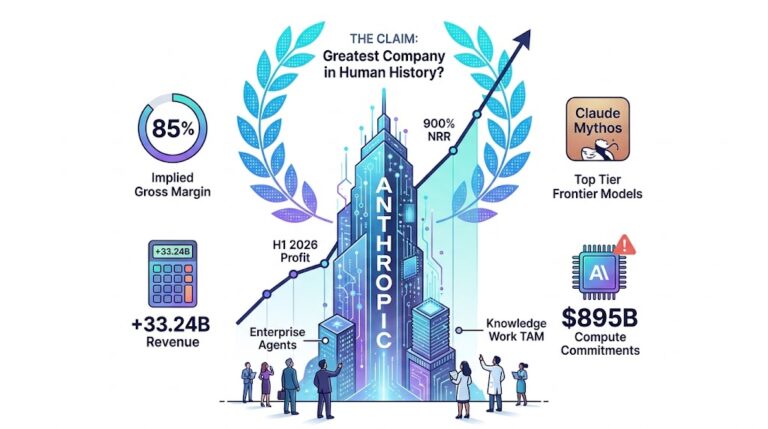
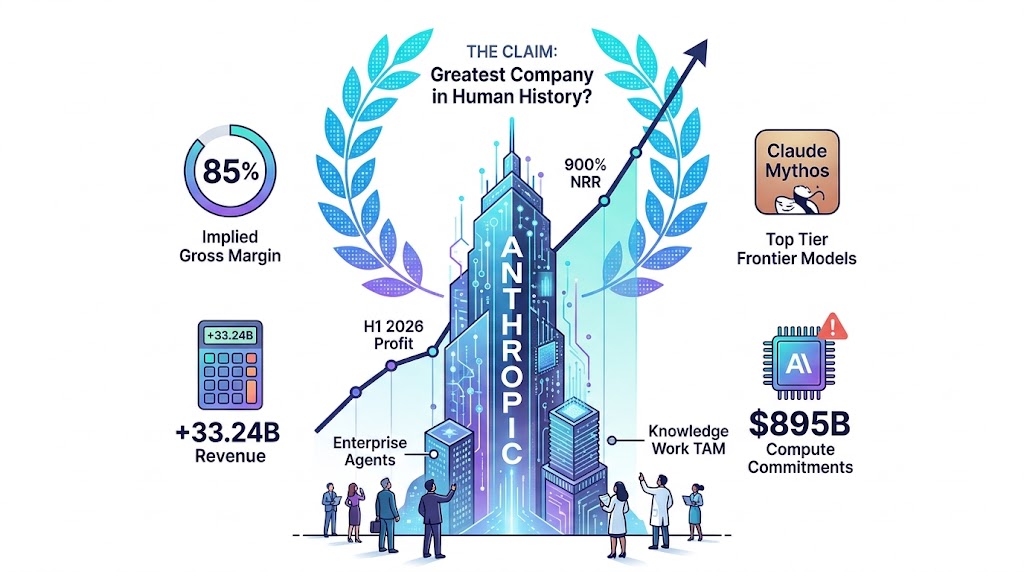
Anthropic’s amended S-1 shows $33.24 billion in revenue for the first nine months of 2026, up roughly 1,200% from a year earlier. It also shows an 85% implied gross margin, its first operating profit, and positive operating cash flow. On that record, some investors now call it the greatest company in human history. The claim rests on growth, market size and margins. The risks are $895 billion in compute commitments and slowing quarter-over-quarter growth.
The Claim That Lit Up the All-In Podcast
Anthropic’s rise has become a recurring topic on the All-In podcast, the YouTube show hosted by Chamath Palihapitiya, Jason Calacanis, David Sacks and David Friedberg. The hosts have described Anthropic as being on a generational run, and the language has grown bolder with each episode.
The biggest claim came from Sacks. On the show, the venture capitalist and U.S. government AI and crypto czar said Anthropic was on track to become the most powerful monopoly in human history, not just the most powerful company in tech. His math was simple. Anthropic was growing about 10X a year, and if it kept that up for 18 more months, he said, it would be by far the most valuable company in human history.
Not everyone on the panel agreed. Guest Brad Gerstner pushed back that it was too early to raise antitrust concerns.
Superlatives like these usually signal a bubble. In Anthropic’s case, the growth figures behind them now come from audited financials filed with the Securities and Exchange Commission. That makes the claim worth testing seriously.
What the Amended S-1 Shows
Anthropic filed an amended Form S-1 with the SEC on Monday with updated financials. The original filing covered only the first half of the year. The amendment adds the third quarter.
| Metric | Figure |
|---|---|
| Revenue, 9 months 2026 | $33.24B (up ~1,200%) |
| Revenue, Q3 2026 | ~$17B (up ~1,127%) |
| Implied gross margin, H1 2026 | ~85% (vs. ~12% in H1 2025) |
| Operating income, Q2 2026 | $974M (first profitable quarter) |
| Operating cash flow, H1 2026 | +$3.9B |
| Cash and short-term investments | $131.7B (June 30) |
| Customers spending $1M+ a year | 1,900+ |
For the nine months ended Sept. 30, revenue reached $33.24 billion, about 1,200% above the same period last year. Third-quarter revenue was roughly $17 billion, up about 1,127% year over year.
The headline net loss looks alarming but needs context. Anthropic reported a $104 billion net loss for the nine-month period, but most of it came from changes in the fair value of convertible notes and derivative liabilities. Those are accounting entries tied to its pre-IPO financing structure. They are not cash spent on running the business.
Pillar One: Growth Without Precedent
No company of this size has grown this fast. The S-1’s quarterly figures show revenue climbing from $376 million in the first quarter of 2025 to $11.555 billion in the second quarter of 2026.
The customer base is getting both wider and deeper. As of September 30, Anthropic had more than 11,900 customers spending at least $100,000 a year, more than 1,900 spending over $1 million, and about 250 spending $10 million or more.
Existing customers keep expanding their spending. The filing cites net revenue retention of approximately 900% as of September 30, 2026, a figure that excludes Claude Pro and Max subscribers. In plain terms, the average business customer from a year ago now spends about nine times as much. For comparison, elite software companies at IPO typically report 120% to 170%.
Pillar Two: A Market Measured in Trillions
The bull case on total addressable market (TAM) is simple. Anthropic is not selling software into one department. It is selling intelligence that works across every department of every company.
Its customers are mostly businesses. About 85% of revenue comes from business customers, the reverse of OpenAI’s consumer-heavy mix. Enterprise spending tends to be stickier and larger than consumer subscriptions.
Coding is the beachhead. Menlo Ventures research puts Claude’s enterprise coding share at 42% to 54%, versus 21% for OpenAI, in a category that makes up 51% of all generative AI enterprise usage. Coding is the entry point, not the ceiling. Claude is moving into finance, legal, science, security and general office work, which puts it in front of a global knowledge-work payroll that runs into the tens of trillions of dollars a year.
Customers are also using more than one product. More than half of customers spending at least $100,000 a year now use both the Claude platform and a first-party app such as Claude Code, up from about 30% at the end of last year. Cross-product adoption like this is what built the moats at Amazon and Microsoft.
Pillar Three: Profitability Arriving Early
The profitability story is the biggest surprise in the filing. Frontier AI was widely assumed to be a money-losing business for years to come.
In Q2 2026, Anthropic booked $974 million in operating income, its first profitable quarter, and operating cash flow for the half was positive $3.9 billion. Adjusted operating income for the quarter was $2.235 billion, a 19% margin.
Unit economics are improving quickly. Using the filing’s numbers, analysts derive a gross margin of about 85% for H1 2026, compared with about 12% a year earlier. One observer summed it up: Claude’s prices keep falling, but its costs are falling faster.
Margins held up into the third quarter. Anthropic has told investors its third-quarter adjusted operating margin was 11%, excluding stock-based compensation.
Pillar Four: Top-of-Class Frontier Models
Behind the financials is the product. Anthropic’s model lineup runs from Haiku for speed and cost, to Sonnet for everyday work, to Opus for complex problems. Above Opus sits the Mythos tier, Anthropic’s most capable class of models.
Independent benchmarks back up the leadership claim. Claude Mythos scored 77.8% on SWE-bench Pro, a demanding software engineering test, roughly 20 points above the next best model.
Anthropic has also shown it will hold back capability for safety reasons. Its first Mythos-class model, Claude Mythos Preview, is limited to a small group of trusted organizations through Project Glasswing. The publicly available Claude Fable 5.1 shares the same underlying model as Mythos 5.1, with added safety measures for biology, cybersecurity and AI research.
For enterprise buyers in regulated industries, that safety posture is a selling point. A bank, hospital system or defense contractor wants a vendor that can be trusted with its data and its reputation.
Future Developments That Could Make It the Best-Performing Company Ever
Several developments could extend Anthropic’s lead. None is guaranteed.
1. Compute Coming Online
Anthropic has committed about $895.4 billion in purchase and lease agreements, substantially all for compute and infrastructure. Bears see a liability. Bulls see a supply pipeline: in a market where demand exceeds supply, the company with the most capacity can serve the most customers.
2. Agents That Do the Work
Anthropic is moving from answering questions to finishing work. Claude Code handles software engineering. Claude Tag works inside team tools such as Slack. Claude Science supports research labs, and Claude Security finds and patches vulnerabilities. Each agent that replaces hours of human labor opens a larger revenue pool than software licenses ever reached.
3. Broader Mythos-Class Access
If the Mythos tier expands safely beyond its current trusted partners, Anthropic could sell its most capable models at premium prices. That would add a high-margin revenue layer on top of the existing lineup.
4. The IPO War Chest
A public listing would add capital to the $131.7 billion already on the balance sheet. That money can fund more compute, more research and more acquisitions.
5. First-Mover Transparency
OpenAI confidentially filed its prospectus in June, but executives have signaled they are aiming for a 2027 debut. Reaching public markets first lets Anthropic set the valuation benchmark for the entire sector.
The Risks the Bulls Must Answer
A trusted business publisher owes readers both sides, and the S-1 itself is candid. It includes more than 90 pages of risk factors, covering political headwinds, complex infrastructure needs, and the challenge of balancing safety with commercial goals.
Growth is decelerating. Third-quarter revenue rose about 47% from the prior quarter, a steep drop from 144% growth in Q2 and 132% in Q1. That is still extraordinary, but the 10X-a-year projection assumes the earlier pace holds.
Margins may compress. The S-1 warns that operating margins may compress in periods when large amounts of new compute come online.
Compute supply is a pressure point. Hyperscalers’ heavy AI spending is eating into their cash flow, which has investors worried that capacity may not come online fast enough to meet Anthropic’s demand.
Government risk is real. In June 2026, Anthropic suspended access to its Fable 5 and Mythos 5 models for about three weeks to comply with U.S. Department of Commerce export controls. Access was restored July 1. Policy can change quickly.
Customer concentration. The filing warns that a spending cut by its largest customers could materially hurt results unless offset elsewhere.
What It Means for Florida Business
For Florida companies, Anthropic’s filing matters in two ways.
First, it signals vendor stability. Firms in Tampa Bay, Miami and Orlando building workflows on Claude now have audited evidence that their supplier is financially durable.
Second, it shows where competition is heading. Companies that put AI agents to work in coding, customer service, legal review and finance will set the cost structure their rivals have to match.
For Florida’s large base of retirees, wealth managers and individual investors, the IPO is likely to be among the most discussed listings of the decade. Interest alone is not a reason to buy. Read the prospectus, weigh the risks, and size any position carefully.
Brian’s Take
“Greatest company in human history” is a big title, and history hands it out only in hindsight. What the S-1 proves is narrower but still remarkable: no company has paired this scale of growth with 85% gross margins and positive cash flow this early. If growth settles at a healthy rate rather than the triple-digit quarterly pace of early 2026, and if new compute arrives on schedule, the All-In crowd may well be right. The next three quarterly reports will tell us far more than any podcast headline.
Frequently Asked Questions
How much revenue did Anthropic report in its amended S-1?
Anthropic reported $33.24 billion for the nine months ended September 30, 2026, including about $17 billion in the third quarter.
Is Anthropic profitable?
On an operating basis, yes. It turned profitable in Q2 2026 with $974 million of operating income and reported an 11% adjusted operating margin in Q3. Its GAAP net loss is driven mostly by non-cash fair-value charges.
Who said Anthropic could be the most valuable company in history?
David Sacks made the case on the All-In podcast. He argued that at 10X annual growth, Anthropic would become the most valuable company in human history within about 18 months.
Why do some call Anthropic the greatest company in history?
Supporters point to its record growth rate, a market spanning nearly all knowledge work, its leading frontier models, and margins that reached profitability far earlier than expected.
What is the biggest risk to Anthropic?
The central risk is the $895.4 billion in compute commitments, combined with slowing quarter-over-quarter growth.
This article is for informational purposes only and is not investment advice. Investors should consult a licensed financial advisor before making investment decisions.
Sources and Further Reading
- CNBC — Anthropic releases amended IPO prospectus with Q3 financials
- Anthropic, PBC — Form S-1 Registration Statement, SEC EDGAR
- All-In Podcast — Elon’s Anthropic Deal, The Next AI Monopoly? (May 8, 2026)
- All-In Podcast — Anthropic’s Generational Run, OpenAI Panics, AI Moats (March 27, 2026)
- OfficeChai — David Sacks on Anthropic’s Trajectory
- Tomasz Tunguz — Anthropic S-1 Analysis: How 7 Key Metrics Stack Up
- Xenospectrum — Anthropic S-1 compute and margin analysis
- BuildMVPFast — Anthropic S-1: 85% Margins and What It Means for Claude Builders
- Finimize — Three Takeaways From Anthropic’s S-1
- FourWeekMBA — Anthropic’s S-1 Shows $16.3B Half-Year Revenue
- HyperAI — Anthropic IPO Filing Reveals Enterprise Customer Stickiness Strategy
- MindStudio — Claude Enterprise Coding Market Share Data
- InterCapital — Anthropic Files for an IPO at $965 Billion
- Menlo Ventures — State of Generative AI in the Enterprise
About the Author