By Brian French
Brian French is founder and publisher of the Florida Authority Network and a Florida business news analyst with more than 20 years of experience as an analyst and money manager.
Quick Answer
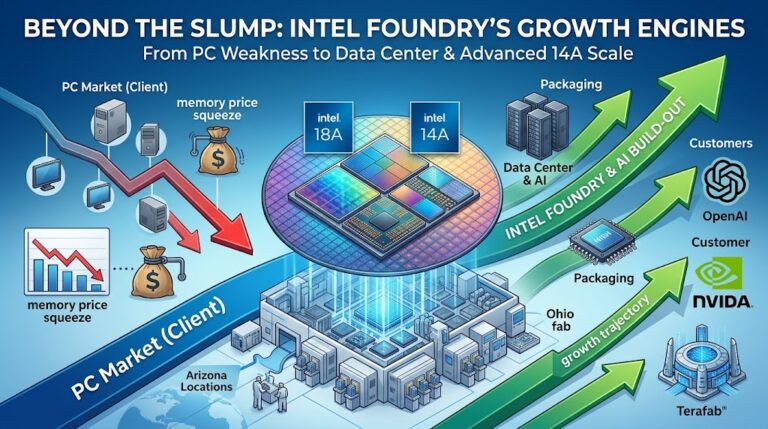
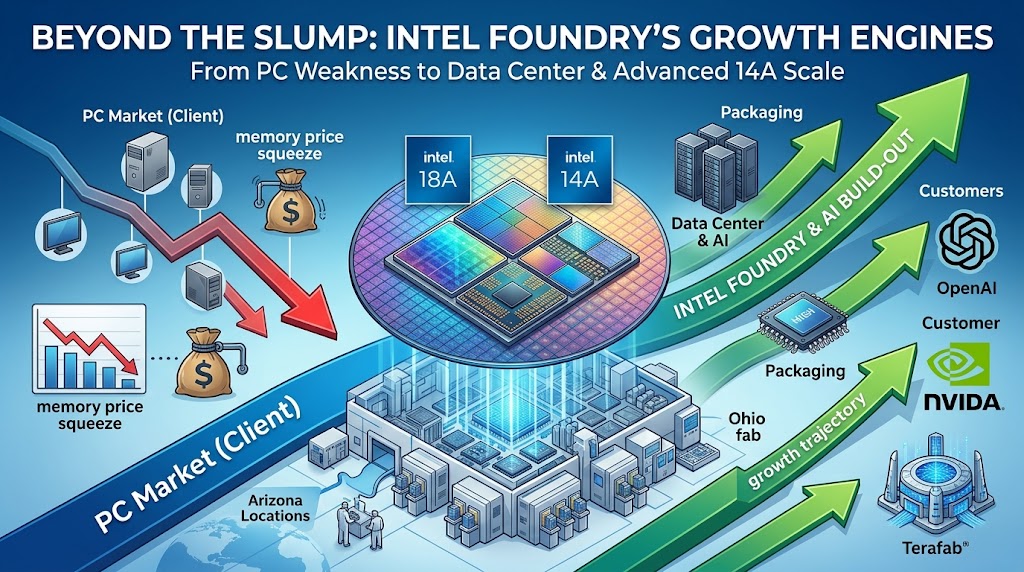
Intel’s stock had its worst day since 1974 after a weak PC forecast. The PC slump is mostly a memory-price problem, and it says little about Intel Foundry. Foundry revenue grew 58% last quarter, losses are shrinking, and Intel’s existing and under-construction fabs could support $50 billion to $65 billion in annual foundry revenue by 2030 if 18A and 14A deliver.
The Selloff: What Wall Street Reacted To
Intel beat its own third-quarter targets on October 29, then lost more than a quarter of its value the next day. The stock closed down about 28.6% at $65.76 on October 30.
The trigger was the outlook. Intel guided fourth-quarter revenue to $15 billion to $16 billion, against roughly $17 billion expected. CFO Dave Zinsner said Intel sees the “PC slowdown continuing at least through the first half of next year.”
| Q3 2026 Segment | Revenue | Change YoY |
|---|---|---|
| Data Center & AI | $7.3B | +78% |
| Client (PCs) | $8.1B | –5% |
| Intel Foundry | $6.7B | +58% |
| Total Intel | $16.5B | +21% |
Two of Intel’s three engines are accelerating. The one that stalled is the one most exposed to a memory-chip price spike.
Why the PC Slump Is a Smokescreen
The cause is memory, not Intel
Intel expects PC unit sales to fall about 12% in 2026 and about 10% in 2027. The company blames high memory prices and shortages, which have pushed up system prices and squeezed corporate IT budgets. Global PC shipments fell 21% in the third quarter. That is an industry-wide supply shock, not a loss of share to a rival.
The slump frees up factory capacity
Here is the part the selloff missed. Intel told analysts that PC weakness lets it shift wafer capacity in Oregon away from PC chips and toward server chips, where demand far exceeds supply. Fewer PC wafers means more room for higher-margin data center and foundry work.
The long-term story kept improving
The same report showed the foundry turnaround on track:
- Foundry revenue: $6.7 billion, up 16% sequentially.
- Operating loss: $1.9 billion, $236 million better than the prior quarter.
- 18A costs: down about 40% since the first quarter, with yields ahead of internal plans.
- 14A: the 0.9 design kit went to select customers in October.
- Fab 62 in Arizona: now ramping as Intel’s second high-volume 18A fab.
CEO Lip-Bu Tan said he is “highly encouraged by the progress we are making with multiple potential customers on 14A.”
The Revenue Math: From $27 Billion to $65 Billion
Intel Foundry’s run rate is roughly $27 billion a year, almost all of it from Intel’s own chips. External revenue was $411 million last quarter.
| Scenario | Internal | External | Total Foundry Revenue |
|---|---|---|---|
| Today (annualized) | ~$25B | ~$1.6B | ~$27B |
| Breakeven case (2027) | ~$28B | ~$4–5B | ~$32–35B |
| Good case (2030) | ~$30B+ | ~$20–35B | ~$50–65B |
These scenarios are the author’s estimates based on public data, not company guidance.
The good case doesn’t require new fabs. It fits inside capacity Intel has already built or is building:
| Fab | Node | Status |
|---|---|---|
| Fab 52, Arizona | 18A | ~40,000 wafers/month at full ramp |
| Fab 62, Arizona | 18A | Ramping; production ~2028 |
| D1X, Oregon | 18A / 14A | 14A risk production 2027–28 |
| Fab 34, Ireland | Intel 3 | €5B expansion underway |
| Ohio | 14A+ | Construction advancing; ~2030 |
At full output, these sites could produce roughly 150,000 to 170,000 advanced wafers a month, by the author’s estimate. At $20,000 to $25,000 per advanced wafer, that supports $40 billion to $50 billion in wafer revenue before packaging and mature-node work.
Why $65 Billion Is Still Small in the AI Build-Out
The five largest hyperscalers are on track to spend $803 billion to $828 billion on capital expenditures in 2026, with more planned for 2027. TSMC alone guided fourth-quarter revenue above $52 billion, an annual run rate above $200 billion.
At $65 billion, Intel Foundry would be about the size TSMC was in 2021. It would be the world’s clear number-two foundry and the only leading-edge alternative built largely on U.S. soil.
Zinsner told analysts that purpose-built silicon, advanced packaging and external wafer foundry each represent tens of billions of dollars in new markets for Intel.
What Analysts Are Saying
The bulls see the foundry as underpriced:
- Melius Research (Ben Reitzes): Buy rating, $165 target, with a path to $200 within two years. His sum-of-the-parts view values the foundry and product businesses at more than $80 per share each, contingent on high-volume 14A commitments.
- KeyBanc (John Vinh): Cites supply-chain feedback that Intel has secured foundry design wins with “AMD, NVDA, MRVL, MSFT, MU, and OpenAI.” Intel has not confirmed these customers.
- Northland Securities (Gus Richard): Upgraded Intel to Outperform in September, citing “material progress” in the turnaround and the scale Elon Musk’s Terafab project could bring to the foundry.
- New Street Research and KGI Securities: Both upgraded Intel in late October, KGI the day of the selloff.
The skeptics want proof first:
- Seaport Research (Jay Goldberg): Downgraded the stock. He argues Intel made too many PC chips and too few server chips, and wants tangible capacity gains first.
- JPMorgan (Harlan Sur): Upgraded to Neutral in October but noted the external foundry business is still small.
- Goldman Sachs and JPMorgan: Kept neutral ratings and lowered price targets after the report.
The 50-analyst average target is about $98, with a range of $50 to $200.
The Risks
- No major 14A customer yet. Intel has not publicly named a high-volume 14A customer beyond Tesla’s Terafab plans.
- Cash burn. Zinsner said 2027 will be an investment year with negative free cash flow as capex rises.
- Execution. Yield, substrate shortages and the Israel fab accident show how quickly supply can slip.
- Shared returns. Brookfield owns 49% of the Arizona fab joint venture, so part of the Fab 52 and Fab 62 economics flows to a partner.
Brian’s Take
After 20-plus years of watching markets, I’ve learned that the biggest selloffs often punish the loudest number rather than the most important one. Last week the loudest number was the PC forecast. The most important number was the foundry’s 58% revenue growth and its shrinking loss.
The PC market will recover when memory supply normalizes, as it always has. The foundry question is bigger and longer-lasting: can America’s only leading-edge chipmaker become the AI industry’s second source? If 18A yields keep improving and one or two major 14A customers sign in the next few quarters, $50 billion to $65 billion in foundry revenue by 2030 is within reach of fabs already standing. That’s the story to watch, not this quarter’s PC orders.
This article is for informational purposes only and is not investment advice.
FAQ
Why did Intel stock fall after its Q3 2026 earnings?
Intel guided fourth-quarter revenue to $15 billion to $16 billion, below Wall Street’s roughly $17 billion forecast, citing a memory-driven PC slowdown and a fab accident in Israel.
Is Intel Foundry profitable?
Not yet. Intel Foundry lost $1.9 billion in Q3 2026, but the loss narrowed $236 million from the prior quarter, and Intel targets breakeven around the end of 2027.
How big could Intel Foundry become by 2030?
In a good-case scenario, existing and under-construction fabs could support $50 billion to $65 billion in annual revenue, up from about $27 billion today.
What is Intel 14A?
Intel 14A is Intel’s next leading-edge manufacturing process. It targets risk production in 2027 and volume production in 2028, and it is the node Intel is marketing most heavily to outside customers.
Does the PC slowdown hurt Intel Foundry?
Only modestly. It reduces some internal wafer demand, but it also frees capacity Intel can shift to high-demand server and foundry work.
Sources and Further Reading
- Intel Corporation – Third-Quarter 2026 Financial Results (Form 8-K)
- Intel Corporation – Form 10-Q for the Quarter Ended September 26, 2026
- The Motley Fool – Intel (INTC) Q3 2026 Earnings Call Transcript
- CNBC – Intel Stock Plunges 21% as Chipmaker Blames PC Slowdown for Weak Guidance
- CNBC – Intel Stock Plunges 29%. Analysts Urge Caution on Buying the Dip
- Technology.org – Intel Stock Plunges Nearly 29% After Weak Forecast, Its Worst Day Since 1974
- Quartz – Intel Stock Falls More Than 22% After Revenue Forecast Misses on PC Weakness
- Benzinga – Intel Analysts Cut Price Targets Due to Q3 Misallocation of Manufacturing Capacity
- Benzinga – Intel Jumps 10% as Analyst Says Musk’s Terafab Could Give Foundry Much-Needed Scale
- Forbes – Intel Stock Has Made a Strong Comeback. How to Play It and Should You Buy?
- Mark LaPedus (Substack) – Intel Posts Results, Losses Mount for Foundry Unit
- Yahoo Finance – Intel Shares Rise Nearly 4% Following JPMorgan Upgrade and Tesla Foundry Agreement
- MarketBeat – Intel (INTC) Stock Forecast and Price Target
- Tom’s Hardware – Intel’s Fab Roadmap Examined: Arizona, Ohio, Ireland and the Deadlines Deciding 14A
- Investing.com – Intel Advances Arizona, Ohio Factory Projects as Chip Demand Outlook Improves
- Converge Digest – Intel Commits €5 Billion to Expand Intel 3 Manufacturing Capacity in Ireland
- TrendForce – Intel Fab 52 Reportedly Rivals TSMC Arizona Phase 1 and 2 Combined Capacity
- TSMC – Third Quarter 2026 Earnings Release
- Hargreaves Lansdown – AI Hyperscalers Expected to Finish the Year Spending $828 Billion on Capex
About the Author