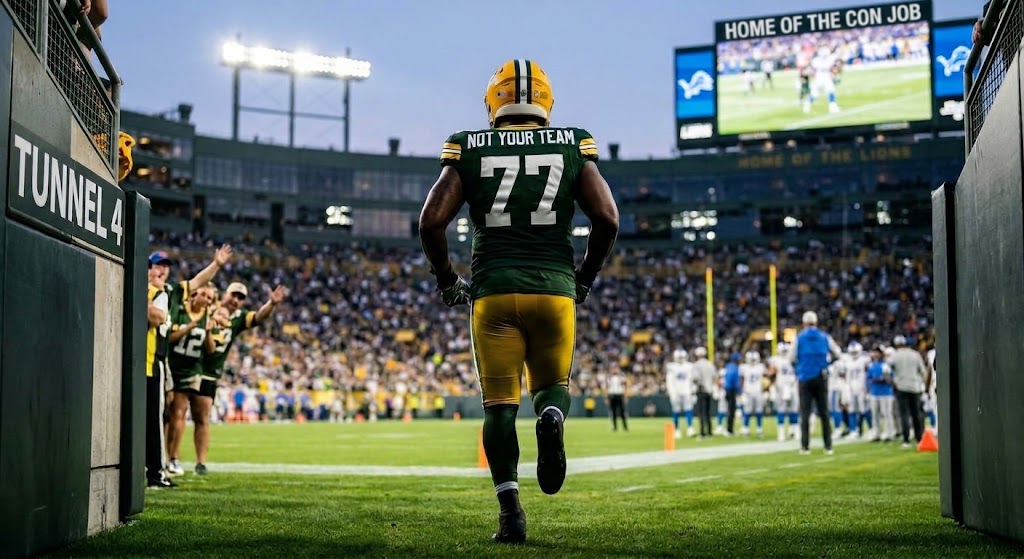
Tribalism, technological panic, and the profitable myth of the coming apocalypse
Opinion | By Brian French, Founder and Publisher, Florida Authority Network
Quick Answer: Americans pick teams on AI and politics because the places that once gave us belonging have faded, and social media rewards outrage. Wisdom means taking off the jersey and seeing what is real: an AI buildout in steel, copper and concrete that could bring breathtaking advances in medicine, science and human creativity.
A Tale of Two Worlds
Open your phone and the world is ending.
Artificial intelligence is a fad. A parrot. A parlor trick. A bubble so swollen it will make 1999 look like a hiccup. Scroll for ten minutes and you can practically smell the smoke.
Now close the phone and drive out to where things get built.
Out there, nobody is talking about a crash. They are talking about waiting lists for high-voltage transformers. Power contracts locked up for a decade. Cloud giants buying every chip a factory can squeeze out of a cleanroom.
On the phone, a cliff. On the ground, a line out the door.
Both can’t be right. So what is going on?
To see why the conversation about AI (and a lot of other things) feels so unmoored from reality, we have to pull back the curtain on the theater.
Because that is what it is. A show. It has a cast, a costume department and a box office. And once you see how the show works, you can finally do something rare these days.
You can look for wisdom: the plain, old-fashioned ability to see things as they are, not as your team needs them to be.
Let’s take our seats.
Act I: The Empty Hall
Every show starts with a stage. Ours starts with an empty one.
Belonging used to come with your address: the Rotary lunch, the church potluck, the hometown paper. The porch lights went out.
Then came the whiplash: the dot-com bust, 2008, the pandemic. Change itself started to feel like a threat.
By 2023, the U.S. Surgeon General was calling loneliness an epidemic. Local news withered into news deserts, and trust in Congress, banks, the press and experts kept sliding.
Lonely, distrustful and afraid, people don’t weigh an innovation. They pick a side.
And somebody was waiting with a costume.
Act II: Suit Up
We are built for the tribe. Decades ago, psychologists Henri Tajfel and John Turner found that we favor our own side even when the sides are picked by a coin flip.
When the church hall emptied out, that need went online. And the feed learned fast: anger keeps us scrolling.
Then came the perfect product. The jersey. Who am I? Who’s with me? Who’s to blame? It answers all three, and it’s the cheapest ticket to belonging ever sold.
Put it on and everything becomes a game. Elections. Vaccines. Interest rates. Electric cars. Facts become trading cards, swapped for loyalty instead of checked for truth.
And where did we get the jersey? From the stadium or ballpark and they have a dirty little secret.
Act III: Rooting for Laundry
Picture the true believer.
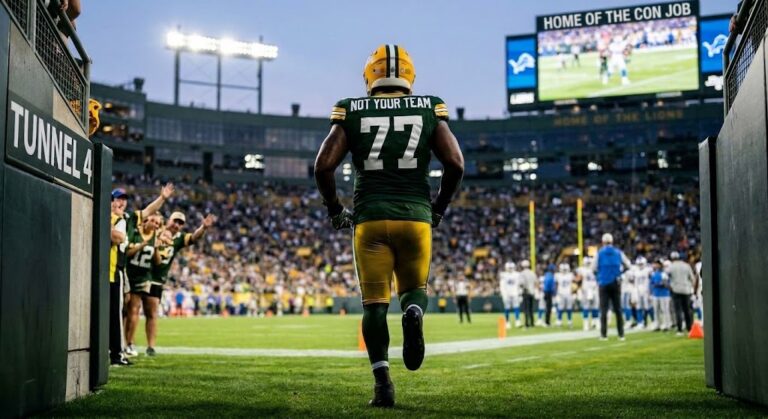
He spends his weekends, his paycheck and a good chunk of his blood pressure on the home team. He paints his face. When they lose, he takes it like a death in the family. The team, he’ll tell you, belongs to the city.
Now look up at the owner’s box.
The owner sees the stadium as a real estate deal and the roster as a stock portfolio. When the city won’t pay for a shiny new arena, he starts flirting with another town. Suddenly, the faithful discover they were tenants all along.
The players know the game too. A star kisses the logo on Sunday and signs with the hated rival on Monday. For him, it’s a contract. For the fan, it’s an identity.
Jerry Seinfeld nailed it: we are all just rooting for laundry.
The uniform is just a costume.
And the costume doesn’t stay at the stadium. Voters defend a party platform the way fans defend a scarf, judging results by which team won instead of what actually changed. Commentators cheer for a stock to crash, not because the numbers say so, but because their side needs to be right.
| The Fan Asks | The Wise Person Asks |
|---|---|
| Which side is this on? | Is this true? |
| Who won the argument? | What actually changed? |
| What does my team believe? | What do the numbers show? |
| Who is to blame? | What can I build? |
So that’s the stage, and that’s the costume. Now cue the new arrival.
Act IV: AI Takes the Field
Artificial intelligence could not have picked a worse moment to walk on stage.
A lonely, distrustful, jittery nation, holding a megaphone wired for outrage. Of course AI got drafted. The only question was which team it would play for.
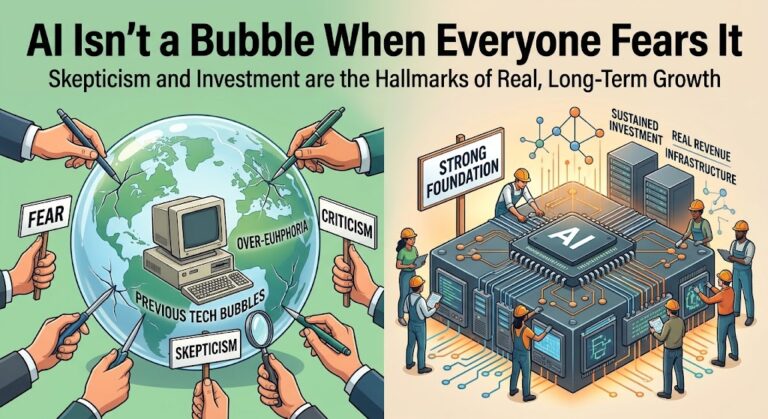
That’s why the bubble talk sounds so sure of itself. When a pundit calls AI a bubble, he is usually blending two very different eras into one scary smoothie.
The dot-com boom was a parade of companies with no earnings, no revenue and often nothing but a slide deck and a web address. Their stock prices floated on a promise, like a balloon tied to a rumor.
Today’s boom has an engine. Many of the companies leading it, from chip designers to the big cloud platforms, report enormous profits and cash flow. They pay for factories and data centers out of earnings. They sell tools businesses are buying right now.
So why all the fury?
Because two different AI stories are playing at the same time, in two different theaters.
In the boardroom, the story is “We need this.” For banks, shippers, software firms and hospitals, AI means speed, savings and survival. If your competitor automates the paperwork while you’re still stapling forms, the market doesn’t send a sympathy card. It sends the bill.
In the living room, the story is “Who invited you?” For the person at home, AI often shows up uninvited, bolted onto a search bar or slipped into a phone update with no explanation. There are far more living rooms than boardrooms, so that sigh is louder. Annoyance turns to resentment. Resentment hardens into a creed.
Both stories are real. But only one of them is pouring concrete.
And there is always someone ready to sell tickets to the other one.
Act V: The Doom Box Office
I spent years as a money manager. The market teaches one lesson fast: fear sells, patience doesn’t.
Nobody ever shared a chart titled “Things Went Fine Again.” Doom, though, is a growth industry.
Shout for ten years that the market is a house of cards, and you’re a crank right up until the correction arrives. Then you’re an oracle. Nobody counts the followers who sat in cash for a decade while the wealth they could have built rolled past their window.
Why don’t the prophets ever change their tune? They joined a team. Once you’re “the guy who calls the crash,” admitting progress feels like treason. The data centers rise, the earnings roll in, and the forecast never changes.
Only the date does.
The doom crowd has a favorite hero, too. You’ve heard his song.
Act VI: John Henry’s Encore
When people feel steamrolled by change, they reach for a bedtime story. In America, that story is John Henry, the steel-driving man who raced a steam drill to prove muscle could beat machine.
He won.
Then he died with the hammer in his hand, his heart burst by stubbornness, pride and sheer exhaustion. He worked himself to death racing a machine built to spare him that very work.
We’ve sung that tale for more than a century as a hymn to human dignity. But slow the song down and listen. A man bet his heart against a boiler, and the boiler had no heart to lose. Strip away the banjo, and that’s not a victory. It’s a tragedy with a catchy chorus.
Today’s John Henrys wear nicer clothes, but they’re running the same race. Refusing to learn new tools gets worn like a medal. Builders, tired of endless hand-wringing, pack up and move somewhere friendlier. And while we argue about whether the hammer is ethical, someone else keeps tunneling.
We Have Seen This Movie Before
We rarely see the harm we do when we hit the brakes on a new technology out of politeness or fear. The bill comes due decades later, and by then nobody remembers who signed it.
In November 1973, with the Arab oil embargo causing gas lines across the country, Richard Nixon launched Project Independence. The goal was to free America from foreign oil, and nuclear power was the centerpiece. Federal planners were projecting roughly 1,000 reactors by the year 2000, delivering clean, cheap electricity for generations.
But Nixon had already signed the law that would undercut his own plan. On January 1, 1970, he signed the National Environmental Policy Act, which required detailed environmental reviews of major federal projects. The intent was worthy. In 1971, a federal appeals court ruled in the Calvert Cliffs case that those reviews applied in full to nuclear plants. Licensing became a marathon of hearings, lawsuits and redesigns. Costs ballooned, and timelines stretched past a decade.
Then Three Mile Island in 1979 turned caution into dread, even though no one died. More than 100 reactor orders were canceled, and for roughly a generation almost no new plant was ordered and built.
Think about what that fear cost.
We spent decades entangled in the Middle East, guarding the flow of oil with money and lives. We burned coal that filled our lungs and our skies. And with abundant, cheap nuclear electricity, the electric car might have arrived decades sooner.
What could have been was lost to fear. It should haunt us to this day, and it would, if more of us knew the story.
We are writing a similar script right now. Every day, Americans give artificial intelligence a thumbs up or a thumbs down. The thumbs down feels safe. History says it is the bigger nightmare.
Here’s the part of the story that rarely gets sung. The steam drill didn’t end human work. It carried human ambition straight through mountains and built the railroads. AI can do the same for the mind, clearing away the dull, repetitive grind so people can spend their hours on judgment, imagination and craft.
John Henry’s mistake wasn’t his courage. It was his choice of opponent.
The smart move was always to climb up and take the controls.
I know, because I finally did.
Backstage: What Happened When I Took the Jersey Off
Time for a confession.
For most of my working life, ideas piled up inside me like mail behind a stuck door. Publications I wanted to launch. Stories nobody was telling. Data I wanted to gather and make useful.
A former money manager learns to read the world in patterns, and one pattern was impossible to miss: Florida’s businesses were growing faster than anyone was covering them, while local news was shrinking.
I had plenty of ideas. What I didn’t have was enough hands.
Then the tools arrived. The very tools the prophets call a fad.
Within months, the Florida Authority Network grew to more than 35 publications covering Florida’s regions, industries, video and press releases, with more than 2,500 articles published. The method is simple to describe and hard to fake: Human Insight plus Tech-Intelligent Curation. Technology gathers and organizes the public record. A person with judgment decides what matters, what’s true and what the reader needs.
That’s what the pessimists keep missing. AI didn’t replace the person with the ideas.
It finally let him catch up to them.
Every creative person I know has a drawer full of unfinished dreams. The question of this decade isn’t whether machines will take those dreams away. It’s whether we’ll finally have the nerve to open the drawer.
Curtain Call: Wisdom Is Taking Off the Costume
So let’s raise the house lights and look at what we saw.
We lost the places where we belonged. We grabbed a jersey to fill the hole. A whole industry learned to profit from keeping it on. And AI got drafted into a game it never signed up for.
Wisdom starts the moment you notice the costume. Here’s what it looks like off the stage.
For the individual: Don’t let fear steer your career. Learn the new tools. Curiosity is the best insurance against being left behind.
For business owners: Ignore the pundit weather report. Watch your own numbers, your own customers and what the tools actually do.
For all of us: When a story is built to push your team buttons, notice it. Whether someone is selling paradise or the apocalypse, the product is usually your attention.
And maybe most of all, rebuild what we lost. Join the league. Read the local paper. Have coffee with the neighbor who wears the other jersey. Shared facts and real community are the oldest cure for tribal fever.
Because the real world doesn’t care what jersey you wear.
The data centers are rising. The grid is being rebuilt. And the tools taking shape today may help cure diseases, speed discovery and unlock the best work of millions of people.
That’s not a bubble. That’s a beginning.
The future belongs to those who hang the costume in the closet, walk out of the echo chamber and pick up the new hammer. Not to race the machine.
To drive it.
About the Author
Brian French is the founder and publisher of the Florida Authority Network, a family of more than 35 Florida business news, industry, video and press-release publications with over 2,500 published articles and counting. A former money manager, he brings an investor’s eye for patterns, incentives and balance sheets to Florida business coverage, pairing technology-driven research with human editorial judgment, an approach he calls Human Insight plus Tech-Intelligent Curation.
His roots run deep in American stubbornness of the productive kind. His French ancestors fought at Lexington and Concord and at Bunker Hill, then settled Lincolnville, Maine, where the shoreline was first known as French’s Beach. Two centuries later, he is still clearing new ground, this time in Florida, one story at a time.
Sources and Further Reading
- Robert D. Putnam, Bowling Alone: The Collapse and Revival of American Community, Simon & Schuster, 2000
- Office of the U.S. Surgeon General, Our Epidemic of Loneliness and Isolation, advisory, 2023
- Northwestern University Medill School of Journalism, The State of Local News report series
- Gallup, annual Confidence in Institutions survey
- Henri Tajfel and John C. Turner, “An Integrative Theory of Intergroup Conflict,” 1979 (social identity theory)
- Roger G. Noll and Andrew Zimbalist, eds., Sports, Jobs, and Taxes: The Economic Impact of Sports Teams and Stadiums, Brookings Institution Press, 1997
- Jerry Seinfeld, stand-up routine on sports fandom (“rooting for laundry”)
- Robert J. Shiller, Irrational Exuberance, Princeton University Press
- Microsoft, Alphabet, Amazon and Meta, annual reports and Form 10-K filings, 2024–2025
- U.S. Department of Energy, Electric Grid Supply Chain Review: Large Power Transformers and High Voltage Direct Current Systems, 2022
- Lawrence Berkeley National Laboratory, 2024 United States Data Center Energy Usage Report
- International Energy Agency, Energy and AI, 2025
- Philip E. Tetlock, Expert Political Judgment: How Good Is It? How Can We Know?, Princeton University Press, 2005
- Scott Reynolds Nelson, Steel Drivin’ Man: John Henry, the Untold Story of an American Legend, Oxford University Press, 2006
- Richard Nixon, Address to the Nation on the Energy Emergency (Project Independence), November 7, 1973
- National Environmental Policy Act of 1969, signed January 1, 1970
- Calvert Cliffs’ Coordinating Committee v. U.S. Atomic Energy Commission, U.S. Court of Appeals for the D.C. Circuit, 1971
- J. Samuel Walker, Three Mile Island: A Nuclear Crisis in Historical Perspective, University of California Press, 2004
- U.S. Energy Information Administration, history of U.S. nuclear power plant orders and cancellations
About the Author