Brian French, wonderings
Quick Answer
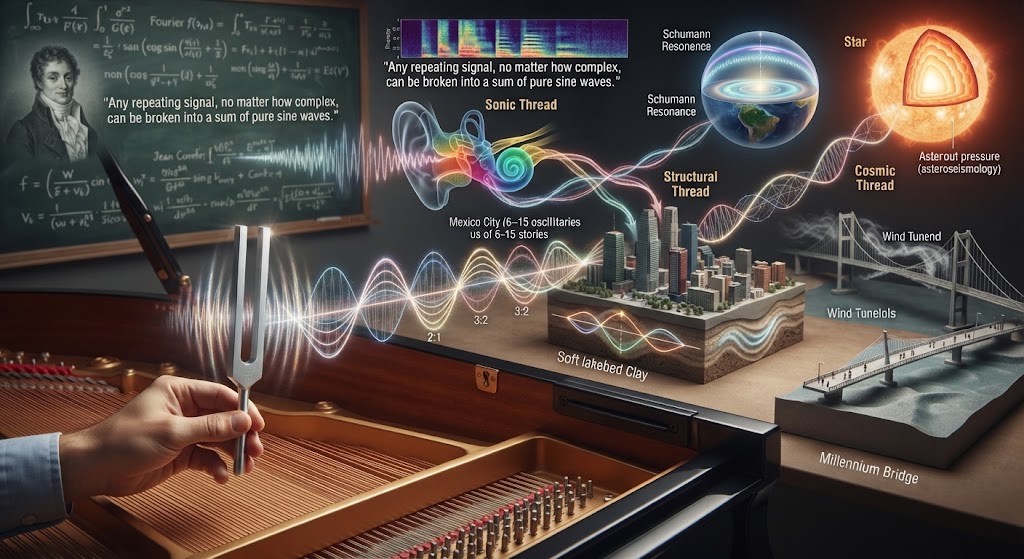
Harmonics are the multiples of a single vibration. They are why a cello sounds different from a trumpet playing the same note, why Pythagoras could build a musical scale from a stretched string, and why a moderate earthquake in 1985 flattened parts of Mexico City hundreds of miles from its source. Science understands the basic arithmetic of harmonics very well. What it understands far less is how they combine, feed back, and run away in real-world systems, and why the human ear finds some of them beautiful.
What a Harmonic Actually Is
Pluck a guitar string and it does not vibrate at one frequency. It vibrates at its fundamental, say 110 cycles per second, and simultaneously at 220, 330, 440, 550 and on up. Each of those is a harmonic, an integer multiple of the base vibration. The string is, in effect, playing a whole chord at once, and your brain fuses the stack into a single note.
The relative strength of those harmonics is timbre. A flute is nearly pure fundamental. A clarinet suppresses the even-numbered harmonics. A violin’s bow drags out a rich, jagged spectrum. Same pitch, different recipe, different instrument. Everything you have ever recognized as a voice, a bell, a saxophone or a footstep is a harmonic fingerprint.
Pythagoras, or someone in his circle, noticed 2,500 years ago that strings with lengths in simple ratios, 2:1, 3:2, 4:3, produced the intervals we call the octave, the fifth and the fourth. Those ratios are the harmonic series. Western music is built on it. So, remarkably, is most music everywhere else.
The Same Physics, Turned Destructive
Every physical object has natural frequencies at which it prefers to vibrate. Push it at one of those frequencies, even gently, and each push arrives just as the last one is peaking. The motion grows. This is resonance, and it is harmonics with the safety off.
The textbook example is a wine glass shattered by a singer. The real-world example is Mexico City. On September 19, 1985, a magnitude 8.0 earthquake struck the Pacific coast roughly 220 miles away. By the time the waves reached the capital they should have been badly weakened. Instead, the ancient lakebed clay under the city rang like a drumhead at a period of about two seconds, amplifying the shaking several-fold. Buildings between roughly six and fifteen stories happen to sway at about two seconds. Those were the ones that collapsed. Shorter and taller buildings nearby stood. The ground and the structures had found the same note.
It happens in engineering too. In 1831 a bridge at Broughton, England, collapsed under soldiers marching in step, and armies have been ordered to break step on bridges ever since. London’s Millennium Bridge had to close within days of opening in 2000 because pedestrians unconsciously synchronized their steps to its sway, feeding the very motion they were bracing against. Jet engines, turbine blades and suspension cables are all designed around the question of which frequencies they must never be allowed to meet.
What Science Knows Cold
The mathematics of a single vibrating string, column of air or beam has been settled since the eighteenth century. Fourier showed in the 1820s that any repeating signal, no matter how complex, can be broken into a sum of pure sine waves. That single idea underpins audio compression, MRI scanners, radio, seismology and the spectrogram on any phone app.
Engineers can calculate the natural frequencies of a well-defined object to high precision. Acousticians can predict the harmonic content of an instrument from its geometry and materials. None of this is mysterious.
Where the Mystery Actually Lives
The trouble starts when systems get complicated, nonlinear and coupled, which is to say when they resemble the real world.
Nonlinear runaway. The clean harmonic series assumes small vibrations. Push harder and the relationships bend. New frequencies appear that were not there before, energy leaks between modes in ways that are extremely hard to predict, and a system can jump suddenly from stable to chaotic. This is the domain of nonlinear dynamics, and while the field has made enormous progress since the 1970s, the general problem of predicting when a driven, coupled system will lock into resonance and amplify remains open. Engineers manage it with safety margins and testing rather than proof.
Site effects in earthquakes. Seismologists know that soft sediment basins amplify shaking, but predicting how much, at which frequencies, for a given quake, is still one of the hardest problems in the field. Basin shape, depth, layering, water content and the angle of incoming waves all interact. Mexico City was a lesson, not a solved equation. Every major city on soft ground, including much of Florida’s coastal strip, carries some version of the same uncertainty.
The Tacoma Narrows problem. The famous 1940 bridge collapse is usually taught as resonance. It was more subtle: a self-exciting interaction between wind and the deck’s twisting motion, now called aeroelastic flutter, in which the structure’s own movement changed the forces driving it. Feedback loops of that kind, where the vibration reshapes its own cause, are the hardest to model and the ones most likely to surprise.
Why the ear cares. The deepest unknown may be the human one. Why do frequencies in simple integer ratios sound consonant to us? The classic explanation, roughness between closely spaced harmonics, accounts for some of it. But a 2016 study of the Tsimane people of the Bolivian Amazon, who had little exposure to Western music, found they showed no preference for consonant over dissonant chords at all. That result, still debated, suggests our sense of harmonic beauty is at least partly learned, layered on top of physics rather than dictated by it. Physics tells us which ratios are simple. It does not tell us why simplicity should feel like home.
The missing fundamental. Play a note’s harmonics without the fundamental and the brain hears the fundamental anyway, a pitch that is not physically present in the sound. It is why a small phone speaker can seem to produce bass it cannot actually generate. The auditory system is reconstructing the harmonic series from its fragments. How it does this so fast and so reliably is still being worked out.
The Music of Everything
Harmonics run through the world at every scale. The cavity between the Earth’s surface and the ionosphere resonates at about 7.8 hertz, driven by global lightning, a planetary hum first measured in the 1950s. Stars ring with pressure waves that astronomers now use to read their interiors, a field called asteroseismology. Bridges, bones, buildings, atoms and molecules all have their notes.
The same law that lets a soprano hold a hall silent lets a lakebed bring down a city. Science has the arithmetic. What it does not yet have is a full account of how those simple ratios behave once they start talking to each other in a messy world, or why, when they line up just right, something in us recognizes it as music.
Sources and Further Reading
- Helmholtz, H., On the Sensations of Tone, 1863 (English translation by A. Ellis, 1885).
- Fourier, J., Théorie analytique de la chaleur, 1822.
- Singh, S.K., Mena, E. and Castro, R., “Some aspects of source characteristics of the 19 September 1985 Michoacan earthquake and ground motion amplification in and near Mexico City from strong motion data,” Bulletin of the Seismological Society of America, 1988.
- Dallard, P. et al., “The London Millennium Footbridge,” The Structural Engineer, 2001.
- Billah, K.Y. and Scanlan, R.H., “Resonance, Tacoma Narrows bridge failure, and undergraduate physics textbooks,” American Journal of Physics, 1991.
- Plomp, R. and Levelt, W.J.M., “Tonal Consonance and Critical Bandwidth,” Journal of the Acoustical Society of America, 1965.
- McDermott, J.H. et al., “Indifference to dissonance in native Amazonians reveals cultural variation in music perception,” Nature, 2016.
- Schumann, W.O., “Über die strahlungslosen Eigenschwingungen einer leitenden Kugel,” Zeitschrift für Naturforschung, 1952.
- Strogatz, S., Nonlinear Dynamics and Chaos, Westview Press, 1994.
About the Author