By Brian French | FloridaTechnologyNews.com | Florida Authority Network
Quick Answer
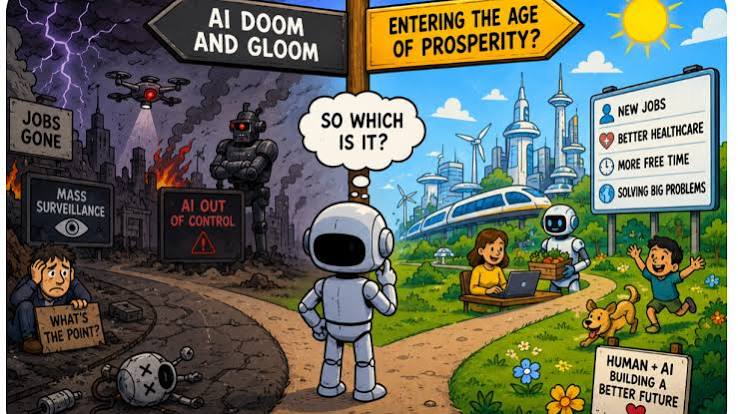
Yes. The internet in the 1990s and 2000s was widely framed as dangerous, overhyped, or both — a threat to children, privacy, jobs, and the economy. Before that, the tractor was blamed for destroying the American farm, and before that, mechanical looms triggered riots. Each time, the fear was partly right about the disruption and mostly wrong about the ending: employment shifted rather than vanished, and living standards rose. The AI debate of 2026 follows the same script almost line for line.
Key Takeaways
- Fear of new technology is a recurring pattern, not a modern invention; it dates at least to the Luddites of 1811.
- The internet was called a fad, a moral menace, and an economic non-event — sometimes by the same experts within a few years.
- The tractor really did eliminate millions of farm jobs, yet the U.S. workforce grew, wages rose, and new industries absorbed the displaced.
- The reliable pattern: short-term pain is real and concentrated, long-term gains are broad and underestimated.
- The honest question about AI is not “will it destroy jobs” but “how fast, who bears the cost, and what replaces them.”
The Luddites Started It
In 1811, English textile workers began smashing the mechanized looms and stocking frames that were undercutting their wages. The British government responded with troops and, in 1812, made frame-breaking a capital offense. The Luddites were not irrational: their specific jobs did disappear. What they could not see was that cheaper cloth would expand textile demand so dramatically that British textile employment grew for decades afterward.
That two-part pattern — the specific fear comes true, the general fear does not — has repeated ever since.
The Tractor: When the Doom Was Real
The tractor is the best case study because the displacement was enormous and undeniable.
| Year | U.S. tractors on farms | Farm share of labor force |
|---|---|---|
| 1910 | ~1,000 | ~31% |
| 1930 | ~920,000 | ~21% |
| 1950 | ~3.4 million | ~12% |
| 2000 | ~4.5 million | under 2% |
Sources: USDA Census of Agriculture; U.S. Census Bureau historical labor series. Figures rounded.
In 1900, roughly four in ten American workers were in agriculture. By the end of the century it was fewer than two in a hundred. Tens of millions of farm jobs — measured against a growing population — simply ceased to exist. The horse and mule population, which peaked near 26 million in 1915, collapsed to a few million by 1960. Blacksmiths, harness makers, and feed suppliers went with them.
Contemporary commentary was grim. In 1930, John Maynard Keynes coined the phrase “technological unemployment” and warned that machines were eliminating jobs faster than new uses for labor could be found. In 1964, a group of scientists and economists sent President Johnson the “Triple Revolution” memo, predicting that automation would sever the link between work and income for most Americans.
What actually happened: total U.S. employment rose from about 29 million in 1900 to over 130 million by 2000. Farm children became factory workers, then office workers, then knowledge workers. Food got dramatically cheaper as a share of household spending, freeing income for everything else. The tractor did not destroy the economy; it built the one we live in.
The pain, however, was concentrated. The rural South, the Dust Bowl migrations, and the collapse of small-town economies were real human costs that the aggregate statistics smooth over.
The Internet: Fad, Menace, or Nothing at All
The 1990s and 2000s produced three distinct flavors of internet pessimism, and all three have exact AI analogs today.
1. “It’s a fad”
Astronomer Clifford Stoll wrote a widely circulated 1995 Newsweek essay arguing that online commerce and digital publishing would never replace real stores and real newspapers. In 1998, economist Paul Krugman predicted that the internet’s economic impact by 2005 would prove no larger than the fax machine’s. Ethernet inventor Robert Metcalfe predicted in 1995 that the internet would “catastrophically collapse” the following year — and publicly ate his printed column in 1997 when it didn’t.
2. “It’s a moral danger”
Time magazine’s July 1995 cover story on “cyberporn” — based on a study later discredited — helped drive the Communications Decency Act of 1996, which the Supreme Court struck down a year later. Through the 2000s, the dominant public framing of the internet was predators, identity theft, and children lost to chat rooms. Y2K, while not an internet issue, fed the same anxiety that networked computers were fragile and untrustworthy.
3. “It’s an economic bubble that will hurt everyone”
The dot-com crash of 2000–2002 erased roughly three-quarters of the NASDAQ’s value and seemed to vindicate the skeptics. Commentators declared the internet economy a fantasy. Amazon, Google, and eBay survived the crash; Facebook, YouTube, and the iPhone had not yet been born.
Each critique had a kernel of truth. Newspapers really were hollowed out. Retail employment really did shift. Privacy really did erode. But the aggregate result was the largest wealth-creation event in economic history and an entirely new labor market.
Why We Always Predict Doom
Four reasons the pattern repeats:
Losses are visible; gains are invisible. In 1920 you could count the displaced farmhands. You could not count the future software engineers, physical therapists, or logistics managers — jobs that did not yet have names. MIT economist David Autor estimates that roughly 60% of U.S. jobs in 2018 did not exist in 1940.
Experts extrapolate the present. Krugman’s fax-machine comparison was reasonable in 1998 if you assumed the internet stayed what it was in 1998.
Fear sells. A cover story on cyberporn outsold a cover story on e-commerce logistics. The same incentive applies to AI-apocalypse content today.
The pain is real and comes first. Doom forecasts are not stupid; they are premature accounting. The costs land in years one through ten. The benefits compound over decades.
The ATM Test
The cleanest modern data point comes from economist James Bessen: ATMs were expected to eliminate bank tellers. Instead, U.S. teller employment rose from roughly 500,000 in 1980 to about 550,000 by 2010. Cheaper branches meant more branches, and tellers shifted to sales and service roles. This is the tractor pattern in miniature — the task was automated, the job was redefined.
The AI Parallel — and Where It Might Differ
A 2013 Oxford study by Frey and Osborne estimated 47% of U.S. jobs were at high risk of automation. Thirteen years later, U.S. unemployment remains near historic lows. That does not settle the question; it restates it.
The credible case that AI is different rests on two claims: speed (adoption in years, not generations) and breadth (cognitive work, not just manual work). Both deserve serious weight. The tractor gave rural America roughly fifty years to adjust. AI may give white-collar America five.
The credible case that AI is the same rests on the historical record: every prior wave produced more work, not less, because cheaper output expands demand, and because human wants are effectively unlimited.
What This Means for Florida
Florida is a useful laboratory. The state’s economy was built by the last two disruptions — mechanized agriculture made large-scale citrus and vegetable farming viable, and the internet made remote relocation to Florida practical for hundreds of thousands of workers who no longer needed to live near a headquarters. The state’s growth since 2020 is, in a real sense, an internet dividend.
Florida’s exposure to AI runs through its largest sectors: tourism and hospitality (customer service automation), real estate and mortgage (document and underwriting automation), health care (diagnostics and administration), and the professional services clustered in Tampa, Miami, Orlando, and Jacksonville. The question for Florida business owners is not whether to adopt but how to redeploy people as tasks disappear.
Brian’s Take
I managed money through the dot-com crash. I remember respected analysts arguing in 2001 that the internet was a failed experiment. The people who were right were not the optimists or the pessimists — they were the ones who separated the timing question from the direction question.
The direction of AI is not in doubt. It will do to cognitive routine work what the tractor did to field labor. The timing, the distribution of pain, and the policy response are wide open. Businesses that plan for the tractor pattern — redeploy, retrain, expand output — will do better than those paralyzed by the Luddite pattern or lulled by the fax-machine pattern.
History does not say the doom-sayers are wrong. It says they are early, narrow, and usually looking at the wrong ledger.
Frequently Asked Questions
Did the tractor really cause mass unemployment?
It caused mass displacement — farm employment collapsed as a share of the workforce. Total employment grew because displaced workers moved into manufacturing and services.
Was the internet actually called dangerous in the 2000s?
Yes. The dominant public framing was online predators, privacy loss, identity theft, and, after 2000, financial ruin from the dot-com bubble.
Is AI different from past technologies?
Possibly in speed and in targeting cognitive rather than manual work. The historical pattern suggests net job creation; the pace of adjustment is the open question.
What should a Florida business do about AI?
Identify which tasks (not jobs) are automatable, adopt early, and redeploy staff toward customer-facing and judgment-heavy work.
Sources and Further Reading
- Keynes, John Maynard. “Economic Possibilities for Our Grandchildren.” 1930.
- Ad Hoc Committee on the Triple Revolution. Memorandum to President Lyndon B. Johnson. March 1964.
- U.S. Department of Agriculture, National Agricultural Statistics Service. Census of Agriculture historical data (tractors, horses and mules, number of farms).
- U.S. Census Bureau. Historical Statistics of the United States: Colonial Times to 1970, labor force by industry.
- Stoll, Clifford. “Why the Web Won’t Be Nirvana.” Newsweek, February 1995.
- Krugman, Paul. “Why Most Economists’ Predictions Are Wrong.” Red Herring, June 1998.
- Elmer-DeWitt, Philip. “On a Screen Near You: Cyberporn.” Time, July 3, 1995.
- Reno v. American Civil Liberties Union, 521 U.S. 844 (1997).
- Bessen, James. Learning by Doing: The Real Connection Between Innovation, Wages, and Wealth. Yale University Press, 2015.
- Frey, Carl Benedikt, and Michael Osborne. “The Future of Employment: How Susceptible Are Jobs to Computerisation?” Oxford Martin School, 2013.
- Autor, David. “Why Are There Still So Many Jobs? The History and Future of Workplace Automation.” Journal of Economic Perspectives, 2015.
- Autor, David, Caroline Chin, Anna Salomons, and Bryan Seegmiller. “New Frontiers: The Origins and Content of New Work, 1940–2018.” Quarterly Journal of Economics, 2024.
- Thompson, E.P. The Making of the English Working Class. 1963 (on the Luddite movement).
- U.S. Bureau of Labor Statistics. Current Population Survey, unemployment rate historical series.
About the Author