By Brian French | FloridaTechnologyNews.com | September 14, 2026
Quick Answer
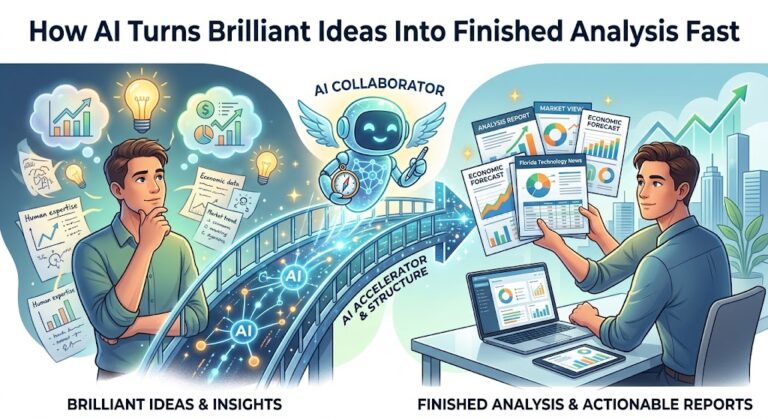
A well-used AI assistant can function as a Florida business owner’s most available advisor: it has absorbed the strategy playbooks, financial frameworks, and exit-planning literature that consultants charge for, it is on call at midnight, and — if you keep feeding it your real numbers, goals, and setbacks — it builds a running picture of your business that no single human advisor holds. Small-business AI use has climbed to roughly 77% of U.S. firms using it regularly as of January 2026, up from 48% in mid-2024, and 93% of those users report a positive impact. The rule is simple: the more context you share, the sharper the advice — with the caveat that AI complements, rather than replaces, your CPA and attorney on the decisions that carry legal weight.
Why the Advisor Model Has Changed
For most of Florida’s 3 million small businesses, professional advice has always been rationed. A CPA sees your books quarterly. A lawyer bills in six-minute increments. A consultant costs more than most owners can justify. The result is that the highest-leverage decisions — pricing, hiring, when to expand, when to sell — get made alone, at the kitchen table, on instinct.
AI collapses that rationing. Adoption numbers show how fast owners have figured this out. Intuit measured regular AI use among small and midsize businesses at 48% in mid-2024, 68% by early 2025, and 77% by January 2026, one of the fastest technology adoption curves ever recorded for SMBs. The Goldman Sachs 10,000 Small Businesses survey from early 2026 puts it at 76%, with 93% of users saying AI has had a positive impact and 84% citing efficiency gains. Adoption is also strongly correlated with growth: 83% of growing SMBs use AI versus 55% of declining ones, a 28-point gap.
The early use cases were marketing copy and email. The next one is strategy.
What an AI Advisor Actually Knows
A frontier AI model has effectively read the entire published body of business strategy: Porter and Drucker, the SBA’s lending criteria, every valuation method a business broker uses, Florida-specific rules on sales tax, homestead, and the state’s lack of personal income tax, and thousands of case studies on what killed or scaled companies that look like yours. It can apply all of that to your situation in one conversation.
| Question type | What AI can do well | Where to verify |
|---|---|---|
| Pricing & margins | Model scenarios, benchmark | Your actual P&L |
| Hiring & org design | Draft roles, comp bands | Florida labor counsel |
| Cash flow & financing | Forecast, compare SBA vs. bank | Your CPA / lender |
| Marketing & AEO | Build the full plan | Live results |
| Selling the business | Value ranges, timing, buyer types | Broker, M&A attorney |
| Succession & estate | Frame the options | Estate attorney |
Strategy on demand
Ask it to stress-test your growth plan against a recession, a hurricane season, or a key employee leaving, and it will run the scenarios. Ask it which of your three service lines to cut and it will build the unit economics from whatever numbers you give it and tell you where the data is too thin to decide.
How and when to sell your business
This is where AI earns its keep for owners over 50. It can explain the difference between an asset sale and a stock sale, why buyers discount owner-dependent businesses, what a seller’s discount earnings (SDE) multiple looks like in your industry, how a two-year runway of clean books changes your valuation, and why the best time to sell is usually 18 months before you feel ready. It can draft the confidential information memorandum outline and prepare you for buyer due-diligence questions. What it cannot do is sign the letter of intent or structure the tax — that is your M&A attorney and CPA, and a good AI will tell you so.
The Confidant Function
The most underrated use is the one owners rarely admit: having someone to talk to. Running a business is isolating. Spouses get tired of hearing about it, employees cannot know your doubts, and friends are not equipped to help.
An AI assistant will listen to the bad week, remind you what you said your five-year goal was in March, and pull you back to the long-term plan when you are about to make a fear-driven decision. It does not get bored, it does not judge, and it remembers the version of your ambition you described on your best day. Owners who use it this way consistently describe the same thing: it keeps them focused on what they actually set out to build, instead of the fire in front of them.
Used honestly, it is also willing to disagree. A good AI advisor should tell you when your numbers do not support the expansion or when the “great opportunity” looks like a distraction. If yours only agrees with you, you are prompting it wrong.
The More You Share, the Better the Tool
An AI advisor is only as good as the context it holds. A generic question gets a generic answer. A question backed by your last 24 months of revenue by line, your customer concentration, your hiring history, and your personal financial goals gets advice that is specific to you.
Practical steps for Florida owners:
- Keep a running business brief — one document with your numbers, goals, key people, and constraints — and share it at the start of important conversations.
- Use a paid business tier with data controls, and confirm whether your inputs are used for model training. Do not paste customer personal data or anything covered by your client agreements.
- Log the decisions and the reasoning. Six months later, ask the AI what it would have done differently.
- Treat every number it produces as a draft until it matches your books.
Do that for a year and you will have an advisor that understands the trajectory of your business — the pattern of your decisions, what worked, what you keep avoiding — in a way no quarterly meeting with a human can replicate.
Brian’s Take
I managed money for a living before I ran a publishing company, and I would have paid a great deal for what an AI assistant now does for a few hundred dollars a year. Not because it is smarter than the best human advisor — it is not, on the specific judgment calls — but because it is always there, it holds the whole picture, and it has no incentive to sell you anything.
Two cautions. First, the encouragement can become flattery if you let it; ask it to argue against you at least as often as for you. Second, the exit is the one decision where the cost of a mistake is measured in years, so use the AI to become the most prepared seller your broker has ever met, not to replace the broker. Everything else — strategy, marketing, hiring, cash — you should be running past it every week. Florida owners who do will be several moves ahead of the ones still deciding whether to try it.
Frequently Asked Questions
Can AI really act as a business advisor?
Yes, for strategy, planning, financial modeling, marketing, and preparation for major decisions. It should be paired with licensed professionals for legal, tax, and transactional work.
Is it safe to share my business financials with AI?
Use a business-tier product with clear data-handling terms, avoid sharing customer personal data, and check whether your inputs are excluded from training. Treat it like any cloud service you would put your books in.
Can AI tell me when to sell my business?
It can explain valuation methods, timing factors, and buyer expectations, and help you build a two-year exit-readiness plan. The actual sale requires a broker or M&A attorney and a CPA.
How many small businesses use AI in 2026?
Roughly 76–77% use it regularly according to Intuit and Goldman Sachs surveys; stricter government measures of AI used in production run much lower, at under 20%.
What is the biggest mistake owners make with AI advisors?
Giving it too little context and accepting its first answer. Specific inputs and a request to challenge your thinking produce far better advice.
Business profiles and coverage inquiries for FloridaTechnologyNews.com and the Florida Authority Network: 813-409-4683.
Sources and Further Reading
- Intuit QuickBooks small business AI adoption tracking (48% mid-2024, 68% early 2025, 77% January 2026), summarized in Caywork, “The State of AI Adoption in Small Business: 2026 Trends” — https://caywork.com/learn/blog/the-state-of-ai-adoptation-in-small-business
- Goldman Sachs 10,000 Small Businesses Voices survey (January–February 2026), summarized in QuickSEO, “Small Business AI Adoption in 2026” — https://quickseo.ai/blog/small-business-ai-adoption-2026-statistics
- Presenc AI, “SMB AI Adoption Statistics 2026” (growing vs. declining SMB gap) — https://presenc.ai/research/smb-ai-adoption-statistics-2026
- CloudSecureTech, “Small Business AI Statistics 2026” (Federal Reserve and Census Bureau measures) — https://www.cloudsecuretech.com/insights/small-business-ai-statistics/
- Capsule CRM, “Small business AI adoption statistics for 2026” (U.S. Chamber of Commerce data-privacy findings) — https://capsulecrm.com/blog/small-business-ai-adoption-statistics/
- AdAI News, “Small Business AI Statistics 2026” (SBA Office of Advocacy adoption gap) — https://adai.news/resources/statistics/small-business-ai-statistics-2026/
- Anthropic, Prompt Engineering Overview (guidance on giving AI context and examples) — https://docs.claude.com/en/docs/build-with-claude/prompt-engineering/overview
- Florida SBDC Network, free consulting for Florida business owners — https://floridasbdc.org/
About the Author