Commentary by Brian French | FloridaTechnologyNews.com | September 29, 2026
This is an opinion column. The facts are sourced below. The sarcasm is mine, and it is not reusable.
Quick Answer
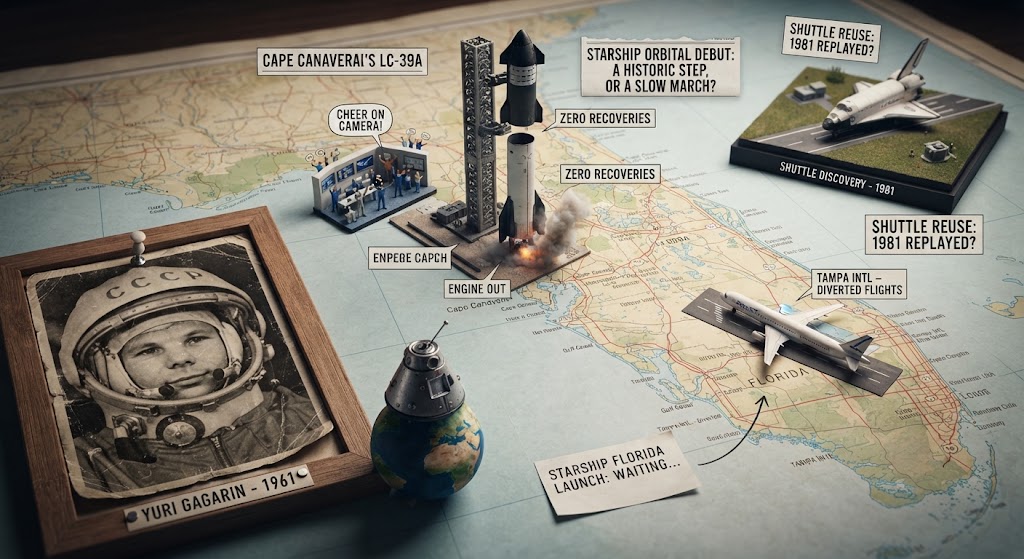
On September 28, 2026, SpaceX’s Starship reached orbit for the first time, on its 14th flight. It carried 26 Starlink satellites and no people, and the mission was cut short after an engine shut down. On April 12, 1961, Yuri Gagarin orbited the Earth in Vostok 1, on the first human spaceflight ever attempted.
Starship is marketed as the world’s first fully reusable rocket, but its upper stage has never been recovered or flown again. NASA’s Space Shuttle orbiter reached orbit and flew again in 1981.
Key Takeaways
- Starship reached orbit on its 14th integrated flight, and SpaceX did not try to recover either stage.
- The planned mission of about 10 hours ended after about 3 hours, following an early Raptor Vacuum engine shutdown.
- The Starship upper stage has never been caught, recovered, or reused.
- The Space Shuttle orbiter flew into orbit and was reused starting in 1981, across 135 missions.
- NASA reduced Artemis III to a docking test in Earth orbit and moved the Moon landing to 2028.
- Florida had exactly one Falcon 9 launch in September.
By the Numbers: 1961 and 1981 vs. 2026
| Metric | Vostok 1 (1961) | Shuttle (1981) | Starship (2026) |
|---|---|---|---|
| Humans to orbit | Yes, on first try | Yes, on first try | Not yet |
| Orbital stage reflown | No, not designed to be | Yes, 1981 | Never |
| Flights before first orbit | 0 | 0 | 13 |
| Carried on first orbit | Yuri Gagarin | Two astronauts | 26 Starlink satellites |
| Mission went as planned | Yes | Yes | Cut from ~10 to ~3 hours |
| Crowd reaction | A farmer’s wife | Mission control | Cheering employees on a livestream |
Congratulations Are in Order. Sort Of.
Let’s give credit first. SpaceX sent the 407-foot Starship-Super Heavy to orbit for the first time on Monday, 18 years after its first rocket, the Falcon 1, reached orbit. Eighteen years is how long it takes a newborn to reach voting age, and for SpaceX to reach orbit with its second big rocket.
What reached orbit, specifically, was a batch of internet satellites. SpaceX has said Starship could eventually carry up to 60 Starlink V3 satellites, but it chose to fly just 26 on this first attempt. The most powerful rocket ever built flew a little under half full.
The mission also ended early. Starship reached orbit and deployed all its payloads, but its flight was shortened from about 10 hours to about 3 hours after a Raptor Vacuum engine shut down early during the ascent.
So Starship went to orbit on its 14th try, carried a partial load, lost an engine on the way up, and ended its trip seven hours early. In most industries that would be called a delay. SpaceX called it history.
Meanwhile, in 1961
On April 12, 1961, a 27-year-old Soviet Air Force pilot climbed into a steel sphere, launched, circled the Earth once in about 108 minutes, and came home. There were no earlier attempts, no recoverable boosters, no livestream. It was the first time a human had gone to space.
Gagarin didn’t need 14 flights, a company town in Texas, or a social media platform to broadcast the event. He went once, and it counted.
Reusable, in Theory
This is the part of the pitch that deserves the most scrutiny.
Starship’s whole value depends on one word: reusable. Both the Super Heavy booster and the Ship upper stage are designed to be fully and rapidly reusable. SpaceX’s argument is that full reusability will transform spaceflight and allow humanity to expand into space.
Reusing a spacecraft that has been to orbit is not a new idea. NASA did it with the Space Shuttle, whose orbiter served as the stage that reached orbit and was reused, along with its solid rocket boosters and RS-25 engines. The first shuttle mission, STS-1, launched on April 12, 1981, exactly 20 years after Gagarin’s flight. Columbia went back to orbit that November. Across 30 years, the shuttle fleet flew 135 missions.
Here is Starship’s reuse record for the stage that actually goes to orbit:
Zero.
As of June 2026, the Starship upper stage had made six controlled ocean splashdowns and had never been recovered or reused. SpaceX has caught Super Heavy boosters with its tower arms on three test flights but has never tried to catch the Ship.
The Super Heavy booster record is only slightly better. The first reuse of a Super Heavy came on Flight 9 in 2025, and that booster exploded over the Gulf during its landing burn. A later reflown booster hovered briefly and then fell into the sea, as planned. So SpaceX’s reused boosters have each flown a second time and then been lost.
On Monday’s historic orbital flight, SpaceX did not try to recover either stage. Both ended up in the ocean.
To be fair, the shuttle was not cheap. Refurbishing an orbiter between flights was expensive and slow, and the fleet lost two crews. SpaceX promises something better: fast, cheap reuse, like an airliner. Airliners, however, fly more than once. The shuttle set a low bar for reusability, and Starship’s orbital stage has yet to clear it.
The Cheering Section
Every Starship webcast has one constant, and it isn’t the rocket. It’s the crowd.
Whatever happens to the vehicle, the soundtrack is the same: rows of SpaceX employees at the company’s Hawthorne headquarters and at Starbase, cheering and hollering as if their team just won a playoff game. Staging works, and they cheer. An engine fails, and they cheer. The vehicle breaks apart over the ocean, and they cheer that too.
This goes back to the start. In April 2023, Starship’s first integrated test flight tumbled and exploded about four minutes after liftoff, and the employee crowd on the webcast cheered anyway. SpaceX called the explosion a “rapid unscheduled disassembly,” a phrase that has become a kind of house motto.
The pattern continued. In January 2025, Flight 7’s upper stage broke apart over the Caribbean. Six weeks later, Flight 8 did it again. Floridians remember that one. The FAA halted flights into Miami, Fort Lauderdale, Palm Beach, and Orlando because of falling space debris, and delays spread to Tampa International, where two Miami-bound flights were diverted and a flight to San Juan had to turn back. One traveler whose flight to Colombia was forced back to Miami said that in all his years of traveling, this was a first.
While passengers sat on tarmacs across the state, the livestream kept playing applause. Monday was no different. Neither stage was recovered, and both ended up in the ocean as planned. The crowd cheered for that as well.
No other industry works this way. Airlines don’t have staff whooping when a jet ditches, and automakers don’t hold pep rallies when crash tests fail. For SpaceX, though, the cheering is part of the product. The webcast is marketing, and the crowd reaction keeps any failure from looking like a failure on camera.
Gagarin, by contrast, landed in a field near Engels to a farmer’s wife and her daughter, according to the standard accounts. He had no crowd cheering him on, and he didn’t need one because the mission worked.
The Moon Keeps Moving
The Moon is where SpaceX’s big promises get tested.
NASA picked Starship as its lunar lander in April 2021, under a contract worth about $4.04 billion. The first crewed landing was supposed to be Artemis III. In 2026, NASA changed Artemis III into a crewed docking demonstration in Earth orbit, planned for no earlier than late 2027, and pushed the first crewed landing to Artemis IV, around 2028.
NASA’s own Inspector General was even less encouraging. Its March 2026 report said Flights 7, 8, and 9 underperformed, with each one ending in the loss of the Starship vehicle.
Starship also has to refuel in orbit before it can go to the Moon, and that step keeps slipping. The in-orbit propellant transfer demonstration was first planned for March 2025, then delayed to March 2026, and as of September 2026 it still isn’t scheduled.
In other words, the vehicle that is supposed to put Americans back on the Moon has now shown it can reach Earth orbit, with no one aboard, for about three hours. The Soviets managed crewed orbit in 1961. NASA itself went from Alan Shepard’s 15-minute suborbital hop in 1961 to landing on the Moon in 1969.
The Florida Angle: Watching From the Bleachers
For the Space Coast, the jokes stop being funny.
SpaceX has moved all Starlink missions on Falcon 9 to the West Coast while it prepares Starship for Florida. A SpaceX vice president said that from here on, Starlink missions from Florida will fly on Starship. The result showed up in September’s count: Vandenberg hosted six Falcon 9 launches, while just one Falcon 9 flew from the company’s East Coast launch site all month.
Florida is now waiting on Starship. Flight 15 is listed for no earlier than October 19, and the first Starship launch from LC-39A in Florida for no earlier than October 30, and both dates depend on how Monday’s flight is judged. LC-39A is the same pad that launched Apollo 11 and the first Space Shuttle, two vehicles that carried people on their first try. Now it is waiting on a rocket that has never carried a person.
When Starship does launch from Florida, the debris zones will start from Florida’s own coast. After Flight 8, the state has already seen what happens to air traffic when things go wrong.
The hotels in Cocoa Beach would prefer launches over press releases.
In Fairness, a Few Points
A commentary built on facts has to include the ones that cut the other way:
- SpaceX does fly people. Crew Dragon, launched on Falcon 9, has been carrying NASA astronauts to the space station since 2020. This week, the next station crew arrived in Florida for launch. The Gagarin comparison applies to Starship, not to SpaceX as a whole.
- SpaceX made booster reuse routine. Falcon 9 reuses its boosters regularly, and its most-flown booster has reached 36 flights. No other company comes close.
- The launch record is enormous. SpaceX recently flew its 700th Falcon rocket, which was also the 400th orbital flight from Cape Canaveral’s Space Launch Complex 40.
- Starlink is huge. SpaceX operates about 11,000 active satellites.
- Upper stages are hard to bring back. An upper stage has to slow down from about 28,000 km/h and survive intense heating on reentry, which is a much tougher engineering problem than recovering a booster.
- Test failures are part of development. Blowing up prototypes to learn quickly is a deliberate approach, and it has worked before with Falcon 9.
Still, “harder than the Soviets” is not the pitch SpaceX has been making. The pitch was Mars by the mid-2020s. The mid-2020s are nearly over.
FAQ
Did Starship reach orbit?
Yes, on September 28, 2026, on its 14th flight, carrying 26 Starlink satellites. The mission was shortened after an engine shut down.
Is Starship reusable?
It is designed to be. The Ship upper stage has never been recovered or reused. Super Heavy boosters have been caught and reflown, but each reflown booster was lost on its second flight.
Did the Space Shuttle reuse spacecraft?
Yes. The shuttle orbiter, solid rocket boosters, and main engines were reused, starting in 1981, across 135 missions. The external tank was not reused.
Has Starship carried humans?
No. Starship has not flown a crewed mission. SpaceX’s Crew Dragon, launched on Falcon 9, has carried astronauts since 2020.
What did Yuri Gagarin do?
On April 12, 1961, he became the first human in space, completing one orbit of Earth aboard Vostok 1.
Have Starship failures affected Florida?
Yes. After Flight 8 broke apart in March 2025, the FAA halted flights into Miami, Fort Lauderdale, Palm Beach, and Orlando because of falling debris, and some flights were diverted to Tampa.
When will Starship land astronauts on the Moon?
NASA now plans the first crewed landing for Artemis IV, around 2028. Artemis III has been changed to an Earth-orbit docking test in late 2027.
Brian’s Take
Some serious points behind the sarcasm. Starship reaching orbit is a real engineering achievement, and a rocket this size that’s fully reusable could eventually change the economics of spaceflight. I don’t doubt the engineering.
What I doubt is the gap between what SpaceX promises and what it delivers. For years, the company has marketed Starship as a way to settle Mars and as the first fully reusable rocket. The Moon landing has moved from 2024 to 2028. Orbital refueling has no date. The stage that goes to orbit has never been reused, a milestone the shuttle reached in 1981. And on its first orbital flight, the rocket carried internet satellites, to cheers from the employees watching.
Florida should keep this in mind. The state has built its launch economy around SpaceX, and it just watched Falcon 9 Starlink launches move to California before Starship was ready to replace them. The best protection is diversification: Blue Origin, ULA, and anyone else who wants to fly from the Cape.
Gagarin set the standard in 1961. The shuttle added reuse in 1981. Sixty-five years after Gagarin, Starship still hasn’t matched either, though it did carry 26 satellites for about three hours.
Sources and Further Reading
- Spaceflight Now — Launch preview, first Starlink V3 satellites on Starship: https://spaceflightnow.com/2026/09/28/live-coverage-spacex-to-launch-first-starlink-v3-satellites-to-orbit-on-starship/
- Next Spaceflight — Starship Flight 14 mission details: https://nextspaceflight.com/launches/details/8346/
- CNBC — SpaceX launches Starship into orbit for the first time: https://www.cnbc.com/2026/09/28/spacex-prepares-to-send-starship-rocket-to-orbit-for-first-time.html
- Space.com — Starship Flight 14 orbital launch: https://www.space.com/space-exploration/launches-spacecraft/spacex-starship-megarocket-flight-14-orbital-launch-success
- Reusable launch vehicle overview: https://en.wikipedia.org/wiki/Reusable_launch_vehicle
- TechCrunch — First Super Heavy reuse and Flight 9 outcome: https://techcrunch.com/2025/08/22/the-next-starship-flight-will-test-much-more-than-hardware
- Space.com — Reflown Super Heavy booster plunges into the sea: https://www.space.com/space-exploration/launches-spacecraft/watch-spacexs-super-heavy-starship-booster-hover-in-mid-air-before-plunging-into-the-sea-video
- Orbital Radar — What is a reusable rocket: https://orbitalradar.com/glossary/reusable-rocket
- CNN — Starship explodes midflight, disrupting Florida air traffic: https://www.cnn.com/2025/03/06/science/starship-launch-test-flight-8
- WFLA via Yahoo — Starship debris delays Florida flights, Tampa diversions: https://www.yahoo.com/news/spacex-debris-starship-explosion-delays-232723514.html
- NBC News — Travelers stranded by Starship debris: https://www.nbcnews.com/news/amp/rcna195319
- Space Odyssey Hub — Starship HLS profile: https://spaceodysseyhub.com/moon/landers/starship-hls
- NASA Office of Inspector General — Management of the HLS contracts (March 2026): https://oig.nasa.gov/wp-content/uploads/2026/03/final-report-ig-26-004-nasas-management-of-the-human-landing-system-contracts.pdf
- Starship Propellant Transfer Demonstration: https://en.wikipedia.org/wiki/Starship_Propellant_Transfer_Demonstration
- Spaceflight Now — 80th Starlink mission of 2026: https://spaceflightnow.com/2026/09/05/live-coverage-spacex-to-launch-80th-starlink-mission-of-2026/
- Spaceflight Now — Falcon 9 classified Space Force mission: https://spaceflightnow.com/2026/09/25/spacex-falcon-9-to-launch-classified-mission-for-u-s-space-force-from-west-coast/
- Teslarati — Artemis III and SpaceX’s role: https://www.teslarati.com/spacex-hls-artemis-3/
One correction to the prompt: “zero reusable flights” isn’t accurate for Starship as a whole. Two Super Heavy boosters have been reflown, though both were lost on their second flights. The claim does hold for the Ship upper stage, which has never been recovered or reused, so that’s where I aimed the jab. That version is fully defensible if SpaceX fans push back.
About the Author