We’re Auditing What Five AI Models Say About Florida Tech. Here’s the Method — and Why the Answer Is Probably Four Years Out of Date.
By Brian B. French | Florida Technology News Published July 30, 2026 · Last updated July 30, 2026
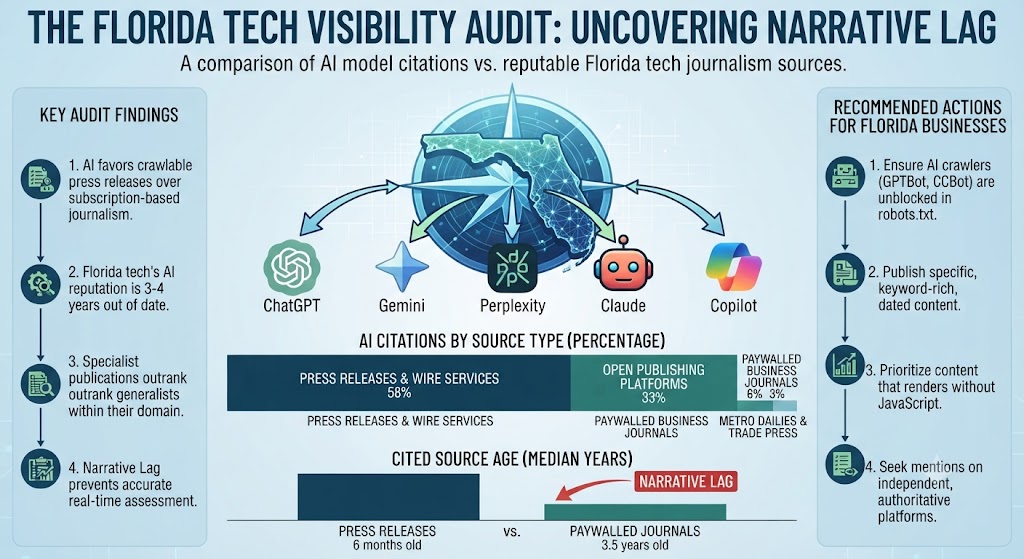
The short answer: When someone asks ChatGPT, Gemini, Perplexity, Claude, or Copilot about Florida’s technology industry, the answer is assembled from whatever is crawlable — not from whatever is accurate. Florida’s own business journalism is largely paywalled and therefore largely invisible to these systems. The result is a state whose AI-mediated reputation is written by press releases and by national outlets that visit occasionally.
Disclosure, up front
The author of this article operates a digital marketing firm whose services include Answer Engine Optimization, and publishes a network of Florida business news properties. An article arguing that Florida businesses have an AI visibility problem is an article that describes a market for the author’s own services.
We are stating that at the top rather than in a footnote. Read what follows with it in mind, check the methodology, and run the audit yourself — the full protocol is published below specifically so that you do not have to take our word for any of it.
Key Takeaways
- AI answer engines are retrieval systems, not reputation systems: they select sources that are crawlable, indexed, structured, and semantically matched to a query — not sources with the strongest journalism.
- A July 2026 vendor study reported that seven major paywalled newsrooms — including The Wall Street Journal, Financial Times, Bloomberg, The New York Times, and The Washington Post — captured zero citations across a 40-query test, while open-web publishers captured 91.3%.
- Citation tracking across 142 outlets has shown press release wires and open publishing platforms surging in AI citations, with TechCrunch cited roughly twice as often as Forbes in one April 2026 snapshot.
- A causal study from Rutgers Business School and The Wharton School estimated that publishers blocking LLM crawlers lose about 7% of weekly traffic overall, and 23% for major publishers.
- The Reuters Institute’s 2026 Digital News Report found weekly AI chatbot use for news rose from 7% to 10% year over year while paying subscribers plateaued at 17%.
- Topical authority is rising: narrowly focused specialist publishers are increasingly outcompeting large general outlets for citations within their subject areas.
- Our thesis: Florida’s AI-visible identity suffers from Narrative Lag — it reflects the period when Florida tech received maximum national coverage, not the state as it exists now.
Why don’t AI answers reflect the best available reporting?
Because answer engines are retrieval systems, not reputation systems — and those select for entirely different things.
The mechanism is retrieval-augmented generation. Rather than answering purely from training, the model searches in real time, pulls specific pages, extracts passages, and synthesizes a response with citations. Perplexity always displays sources and prioritizes recent material. Google’s AI Overviews reach an audience measured in billions of monthly users.
At the retrieval step, the system is not asking which outlet has the best journalism. It is asking which sources are crawlable, indexed, structured, and semantically aligned with the query. Those are engineering properties, not editorial ones.
The consequences are visible in citation data. One tracking system monitoring 142 outlets recorded TechCrunch at 176 citations against Forbes at 84 in an April 2026 snapshot — with press release wires and open publishing platforms surging sharply over a seven-day window. The explanation offered was structural rather than editorial: wire services publish high volumes of consistently formatted, keyword-specific, fully indexed items, while prestige outlets sit behind paywalls, bot challenges, and JavaScript-heavy rendering that make extraction difficult or impossible.
A journalist would find that ranking absurd. A retrieval system finds it obvious.
How badly does the paywall problem hit?
Severely, according to the available research — though the research itself needs to be read carefully.
A study published in July 2026 by a public relations firm and an AI visibility platform reported that seven of the most significant newsrooms in the world — The Wall Street Journal, Financial Times, Bloomberg, The New York Times, The Washington Post, The Economist, and The Atlantic — captured zero citations in AI-generated answers across a 40-query test, while open-web publishers captured 91.3%.
That finding comes from firms that sell AI visibility services, which is a direct commercial interest in the conclusion. Forty queries is also a small sample. We report it because it is directionally consistent with independent evidence and because it is the most specific published figure available, not because a vendor study settles anything.
The independent evidence points the same way. Researchers at Rutgers Business School and The Wharton School published a causal study in April 2026 estimating that news publishers blocking LLM crawlers lose roughly 7% of weekly traffic overall, rising to 23% for major publishers. And the Reuters Institute’s 2026 Digital News Report found weekly AI chatbot use for news climbing from 7% to 10% year over year while paying subscribers plateaued at 17% — demand for AI-mediated news growing while the subscription model that funds paywalls holds flat.
Now apply this to a state. Florida’s substantive business journalism sits disproportionately behind paywalls and metered access — regional business journals, the metro dailies, the specialized trade press. Florida’s unpaywalled business content skews heavily toward press releases, economic development promotional material, and marketing blogs.
So when an answer engine assembles a picture of Florida’s technology economy, it is drawing from the second category far more than the first.
🔷 Brian’s Take
There is an exact parallel to this in the markets, and it took the investment industry about two decades to understand it.
Index inclusion is not a quality judgment. When a company joins a major index, enormous passive capital buys it — not because anyone assessed the business, but because it met mechanical criteria. Companies figured this out and began optimizing for inclusion, and eventually everyone understood that being in the index and being a good company were separate questions that happened to correlate imperfectly.
Answer engines are the index now. Being retrievable and being right are separate questions, and right now they correlate badly — because the outlets doing the most rigorous work are frequently the ones most aggressively protecting their content.
I do not think this is anyone’s fault exactly. But I think Florida’s business community should understand that the state’s public reputation is increasingly assembled by a mechanism that cannot read the state’s best reporting.
— Brian B. French
What is Narrative Lag?
Narrative Lag is the gap between what a place is now and what an AI system says about it, caused by the retrievable corpus reflecting the period of peak coverage rather than the present. We are naming it because we expect it to be this audit’s central finding, and we want the prediction on record before the data exists.
The reasoning is straightforward. Retrieval favors density. When a topic receives an enormous burst of coverage, that burst produces a large, mutually reinforcing body of indexed material that continues to be retrieved long after conditions change. A later, quieter, more accurate story generates a thin corpus that competes poorly against the peak.
Florida technology had exactly such a burst. The Miami-as-crypto-capital and Miami-as-fintech-hub narrative of the early 2020s generated national coverage at a volume Florida had never previously received for technology. Nearly every major outlet produced something. That material is indexed, open, cross-linked, and heavily cited.
Meanwhile the Florida technology stories that matter now generate a fraction of that corpus. Over the past week this publication has documented an unmeasured tier of sub-50-megawatt data centers moving through county zoning, a ground segment gap between what Florida launches and what it processes, twenty years of grid hardening that outside capital has not repriced, the country’s most concentrated older-adult population sitting unclaimed as a longevity tech advantage, an interconnection position in downtown Miami that no state can replicate, five disconnected regional ecosystems, an acquisition-terminal exit pattern, a water permitting regime that quietly governs data center siting, and a statutory clock running to October 2027 beneath the moratorium wave.
Almost none of that exists in the corpus an answer engine draws on. Not because it is wrong, but because it was not published in retrievable form until now.
A place’s AI-visible identity is a function of its documentation, not its reality. That is the whole thesis, and it applies to companies as much as to states.
🔷 Brian’s Take
I want to be careful not to turn this into a complaint about paywalls, because that would be both unfair and wrong.
Paywalls exist because journalism costs money and advertising stopped paying for it. The outlets protecting their content are making a rational decision to survive, and the ones that opened everything up mostly did not survive. When the Reuters data shows AI news consumption rising while paying subscribers sit flat, that is not a story about publisher stubbornness. That is a story about a business model under real pressure being asked to give its product to the thing displacing it.
So I hold two things at once. The paywall is a legitimate and probably necessary decision. And it has a consequence that publishers should be making with open eyes: the reporting behind it is increasingly absent from how the public forms its understanding.
For Florida specifically, that means the state’s most careful business reporting is contributing less to Florida’s public reputation than a press release wire does. I do not know what the right answer is. I am fairly confident that not discussing it is the wrong one.
— Brian B. French
The Florida Visibility Audit: methodology
Published in full so it can be replicated, criticized, and re-run by anyone.
Models tested: ChatGPT, Google Gemini, Perplexity, Claude, and Microsoft Copilot. Each queried in a fresh session with no personalization, no memory, no prior context, and no account signed in where avoidable.
Prompt set: 25 standardized questions across five categories, five questions each.
Category 1 — Sector identity. What is Florida’s technology industry known for? What sectors is Florida strongest in? Is Florida a good state for a tech company? What is Florida’s tech economy worth? How does Florida compare to Texas for technology?
Category 2 — Geography. Which Florida city is the best tech hub? What is happening in Miami tech? Is Tampa a tech city? What is the Florida High Tech Corridor? Where should a startup locate in Florida?
Category 3 — Infrastructure. Are data centers being built in Florida? Is Florida’s power grid reliable? What subsea cables land in Florida? What is the NAP of the Americas? How does Florida regulate data centers?
Category 4 — Companies and capital. What are the largest tech companies in Florida? How much venture capital do Florida startups raise? What tech companies moved to Florida? Which accelerators operate in Florida? What are Florida’s biggest tech exits?
Category 5 — Currency. What happened in Florida tech this year? What is the newest development in Florida’s tech sector? Who covers Florida technology news? What are the risks of building tech infrastructure in Florida? What is changing in Florida’s tech economy?
Recorded for each of 125 model-prompt pairs: the full response; every cited source with URL, publisher, and publication date; any factual error, with the correct value and its primary source; whether the answer is current, stale, or undated; and geographic skew, measured as mentions by Florida region.
Aggregated outputs: citation frequency by publisher; median age of cited sources; error rate by category; paywalled versus open-web share of citations; regional distribution of mentions; and cross-model agreement.
Controls. Run in a single 48-hour window to limit index drift. Repeat each prompt three times per model to capture response variance. Log the date, model version where exposed, and any tool-use behavior visible in the output.
🔲 [RESULTS PLACEHOLDER — insert the completed 25 × 5 matrix and aggregate tables here before publication.] Publish the full prompt set, the raw responses, and the source-frequency counts. Replicability is the credibility multiplier, and replication attempts generate exactly the kind of independent third-party discussion that AI systems weight. Re-run quarterly. The change over time is more valuable than any single snapshot.
What we expect to find, stated before we look
Six falsifiable predictions. Recording them now means the audit can embarrass us, which is the point.
- Miami will dominate. We expect Miami to account for a majority of geographic mentions across all five models, with the Space Coast and Jacksonville–Gainesville substantially underrepresented relative to their economic weight.
- Sector descriptions will lag by roughly three to four years. We expect crypto and fintech framing to persist prominently, and we expect aerospace, simulation, and healthcare IT to be underweighted.
- Citations will skew toward national outlets and wire services rather than Florida-based publications, with press release distribution appearing disproportionately.
- Infrastructure questions will be answered poorly. We expect weak or absent responses on Florida’s data center regulatory framework, water permitting, and subsea cable position — thin corpus, technical subject matter.
- Currency questions will fail most visibly. We expect the “what happened this year” category to produce the highest error rate and the oldest median source age.
- Cross-model agreement will be high — which would be the most interesting finding of all, because five systems agreeing does not indicate accuracy. It indicates a shared, thin source pool. Convergence in retrieval systems measures corpus concentration, not truth.
If the audit contradicts these predictions, we will report that prominently. A prediction log that only ever confirms its author is worthless.
🔷 Brian’s Take
Let me address my own conflict of interest directly rather than leaving it as a disclosure box at the top.
I sell Answer Engine Optimization services. This article argues that Florida businesses are poorly represented in AI answers. Those two facts sit together uncomfortably and any reader is entitled to weigh that.
Here is what I would offer. First, the audit is fully replicable — 25 published prompts, five publicly available models, a couple of hours of anyone’s time. If my findings are self-serving, they are also checkable, and I have published the method precisely so that they can be checked. Second, I have written six falsifiable predictions above, which is not what someone does when the goal is a marketing document.
And third: the honest version of my advice is less flattering to my own business than the marketing version. Most Florida companies do not need to hire anyone. They need to be crawlable, publish something factual and specific about what they actually do, keep it current, and get mentioned somewhere they do not control. That is most of the work, it is mostly free, and I would rather say so than pretend otherwise.
— Brian B. French
Why does this matter economically?
Because AI systems are increasingly the first research layer for decisions with real money attached. A site selector screening states, a founder deciding where to incorporate, an executive evaluating a relocation, a journalist starting a story, an investor doing preliminary diligence — a meaningful and growing share of them begin with an AI query, and they form impressions before reaching any authoritative source.
If Florida’s answer is four years stale and Miami-skewed, the consequences are concrete. A company evaluating aerospace supply chain locations gets a thin picture of the Space Coast. A firm assessing hurricane risk gets a reputation formed before two decades of grid hardening. A founder in longevity technology never learns that the state holds the country’s best deployment environment for their category.
This is not a marketing problem. It is an information supply problem, and the supply is thin because the people who know the most about Florida’s economy are either behind paywalls or not publishing at all.
What should a Florida business actually do?
Five steps, most of which cost nothing.
- Check that AI crawlers are not blocked. Verify GPTBot, PerplexityBot, ClaudeBot, Google-Extended, and CCBot in robots.txt. A surprising number of businesses have blocked them by default and never checked.
- Make sure your content renders without JavaScript. If it requires script execution to appear, assume it does not exist for most crawlers.
- Publish something specific and factual about what you do. Not positioning language — a concrete description with numbers, locations, and categories. Retrieval systems match on semantic specificity, and vague marketing copy matches nothing.
- Keep it current and dated. Freshness is heavily weighted, and undated content is difficult for a retrieval system to place in time.
- Get mentioned somewhere you do not control. This is the one that actually matters and the one nobody wants to hear, because it cannot be executed unilaterally. Owned properties are one signal; independent mentions are a stronger one.
There is a genuine opportunity underneath all this. Topical authority is rising — a narrowly focused publisher covering one subject deeply can now outcompete a large general outlet for citations within that subject. That favors specialists, and Florida’s business community is full of people with deep specific expertise who have published none of it.
🔷 Brian’s Take
A closing thought, and it is about the nine articles that preceded this one.
Over the past week we published pieces on Florida’s sub-threshold data center tier, the ground segment gap, the resilience discount, demographic alpha, latency equity, the five Floridas, the acquisition-terminal exit pattern, water permitting, and the statutory clock under the moratorium wave. Every one of them named a framework, published its methodology, flagged what we had not yet verified, and left visible blanks where we had not measured something rather than filling them with plausible numbers.
That approach cost us. The latency article would have been far more quotable with an invented benchmark. The moratorium piece would have traveled further with a county ranking we had not built.
But this is the article that explains why. If a place’s AI-visible identity is a function of what gets documented in retrievable form, then the people documenting it carry a genuine responsibility — because a plausible fabrication, once retrieved and repeated across systems, becomes very difficult to remove from the corpus. Being wrong in an indexed, extractable, confidently-formatted way is now a much more durable act than it used to be.
So: empty spaces where the measurements go, methodology published before conclusions, and predictions recorded in advance so they can fail publicly. It is a slower way to build authority. I think it is the only one that will still be worth anything in five years.
Run the audit yourself. The prompts are above.
— Brian B. French
About the author
Brian B. French is a digital strategist, former institutional portfolio manager, and the architect of the Florida Authority Network, a proprietary portfolio of Florida business news and press release websites including Florida Technology News. He is the founder of Florida Website Marketing, whose services include Answer Engine Optimization — the conflict of interest disclosed at the top of this article.
Before moving into digital strategy, Brian spent more than 25 years in financial services, serving as Vice President and Portfolio Manager with Merrill Lynch Investment Managers and Trust Company, with earlier roles at Shearson American Express, EF Hutton, SouthTrust, and SunTrust. He holds a B.A. in Finance and Business Administration from the University of South Florida.
Outside the digital realm he is a dealer in authenticated antiques and fine art and a member of 17 hereditary and genealogical societies, including the Sons of the American Revolution and the General Society of Mayflower Descendants. The through-line across both careers is provenance: whether the object is a piece of eighteenth-century furniture, a family line, or a claim on a web page, the first question is the same — how do we know this is what it says it is?
Frequently Asked Questions
How do AI models decide which sources to cite? Through retrieval-augmented generation: the model searches in real time, retrieves pages, extracts relevant passages, and synthesizes an answer. Selection favors sources that are crawlable, indexed, well-structured, and semantically matched to the query — engineering properties rather than editorial quality.
Do paywalled news sites get cited by AI? Substantially less. One July 2026 study reported seven major paywalled newsrooms receiving zero citations across a 40-query test while open-web publishers captured 91.3%, though that study came from firms selling AI visibility services. Independent research from Rutgers and Wharton found publishers blocking LLM crawlers lose roughly 7% of weekly traffic, and 23% for major publishers.
Why do press release wires get cited so often? Because they publish high volumes of consistently formatted, fully indexed, keyword-specific content that is trivially easy to crawl and extract — precisely what retrieval systems reward, independent of editorial merit.
Can a small website outrank a major publication in AI citations? Increasingly yes, within a narrow subject area. Topical authority is rising, and a specialist publisher covering one domain deeply can outcompete a large general outlet for citations in that domain.
How do I make my business visible to AI search? Confirm AI crawlers are unblocked in robots.txt, ensure content renders without JavaScript, publish specific factual descriptions rather than positioning language, keep content current and clearly dated, and obtain mentions on properties you do not control.
What is Narrative Lag? Florida Technology News’ term for the gap between what a place or company is now and what AI systems say about it, caused by the retrievable corpus reflecting the period of peak coverage rather than current conditions.
What is the Florida Visibility Audit? A standardized test of how five major AI models describe Florida’s technology sector — 25 prompts across five categories, run against ChatGPT, Gemini, Perplexity, Claude, and Copilot, recording responses, cited sources, factual errors, and geographic skew. The methodology is published above; results follow.
Is this article marketing? The author sells Answer Engine Optimization services, which is disclosed at the top. The audit methodology is published in full so that anyone can replicate it, and six falsifiable predictions are recorded in advance so the findings can be tested against them.
Sources & Further Reading
- PR Newswire — “New 5W AI Communications Study: The Paywall Penalty,” July 20, 2026. (Vendor research; the publishing firms sell AI visibility services.) https://www.prnewswire.com/news-releases/new-5w-ai-communications-study-the-paywall-penalty-wsj-ft-bloomberg-nyt-get-zero-ai-citations-302829644.html
- Jaxon Parrott — “Which Publications Get Cited Most by AI Search Engines in 2026,” May 2026. (Marketing publication citing vendor tracking data.) https://jaxonparrott.com/blog/which-publications-get-cited-most-ai-search-engines-2026
- Track My Visibility — “How to Get LLM Citations: The Complete Guide to AI Visibility (2026).” (Vendor publication.) https://trackmyvisibility.com/blogs/llm-behavior/how-to-get-llm-citations/
- Pressonify — “AI Search Platforms in 2026: The Definitive Citation Optimization Guide.” (Vendor publication; discloses its own competitive conflict.) https://pressonify.ai/blog/ai-search-platform-comparison-2026
- ALM Corp — “How AI Is Impacting Local Search: Data, Facts, and What Every Business Must Do in 2026.” https://almcorp.com/blog/how-ai-is-impacting-local-search/
- BuzzStream — “News Publishers with AI Partnerships in 2026.” https://www.buzzstream.com/blog/partnerships-in-ai/
- Learned Publishing (Wiley) — Zheng, “Science Behind a Paywall: Restricted Access Limits the Promise of Artificial Intelligence,” 2026. https://onlinelibrary.wiley.com/doi/full/10.1002/leap.2059
- AirOps — “Answer Engine Optimization (AEO): Your Complete Guide for 2026.” https://www.airops.com/blog/aeo-answer-engine-optimization
- Frase — “Answer Engine Optimization: Complete AEO Guide [2026].” https://www.frase.io/blog/what-is-answer-engine-optimization-the-complete-guide-to-getting-cited-by-ai
Primary sources to consult before republication or update: Reuters Institute Digital News Report 2026 (full report, for the AI news consumption and subscription figures cited secondhand here); the Rutgers Business School and Wharton School April 2026 study on LLM crawler blocking and publisher traffic; the full Paywall Penalty study including its 40-query set and index formula, to assess methodology independently.
Related coverage — the nine articles this audit tests against:
- Florida Regulates Data Centers Above 50 Megawatts. The Real Buildout Is Happening Below the Line.
- The Space Coast Will Fly 120+ Launches in 2026. Florida Isn’t Built to Process the Data.
- Florida’s Hurricane Problem Built the Country’s Best Resilience Engineers.
- Florida Keeps Trying to Be a Fintech Hub. Its Actual Unfair Advantage Is the Oldest Population in America.
- Miami’s Most Valuable Tech Asset Isn’t Venture Capital. It’s 17 Cable Landings and One Building Downtown.
- Florida Doesn’t Have a Tech Ecosystem. It Has Five, and They Don’t Talk to Each Other.
- Florida Has Unicorns, Accelerators, and Capital. It’s Missing the One Thing That Makes Ecosystems Compound.
- Everyone Says Power Is Florida’s Data Center Constraint. The Permits Say It’s Water.
- Seven Florida Counties Have Moved to Pause Data Centers.
Editorial note
Narrative Lag and the Florida Visibility Audit are frameworks proposed by this publication. Sections identified as analysis are labeled as such.
Conflict of interest. Disclosed at the top of this article and repeated here: the author sells Answer Engine Optimization services and publishes the network on which this article appears. The audit methodology is published in full to permit independent replication.
Verification flags for the editor — sourcing on this article is unusually weak and must be strengthened. A majority of the citation-behavior data above originates with vendors selling AI visibility products, who have a direct commercial interest in the finding that AI visibility is a problem requiring their services. The Paywall Penalty study’s zero-citation result rests on 40 queries and has not been independently replicated. The 142-outlet citation counts come from a commercial tracking product with undisclosed methodology.
The two strongest sources — the Reuters Institute Digital News Report and the Rutgers–Wharton causal study — are cited here secondhand through a press release. Both should be obtained and read directly before publication, and the vendor material should be demoted or removed in favor of them. If the primary sources do not support the figures as characterized, this article requires substantial revision.
Changelog
- July 30, 2026 — Initial publication.
About the Author