Why the Synthesis Layer Is Growing
By Brian B. French | Florida Technology News Published August 1, 2026 · Last updated August 1, 2026
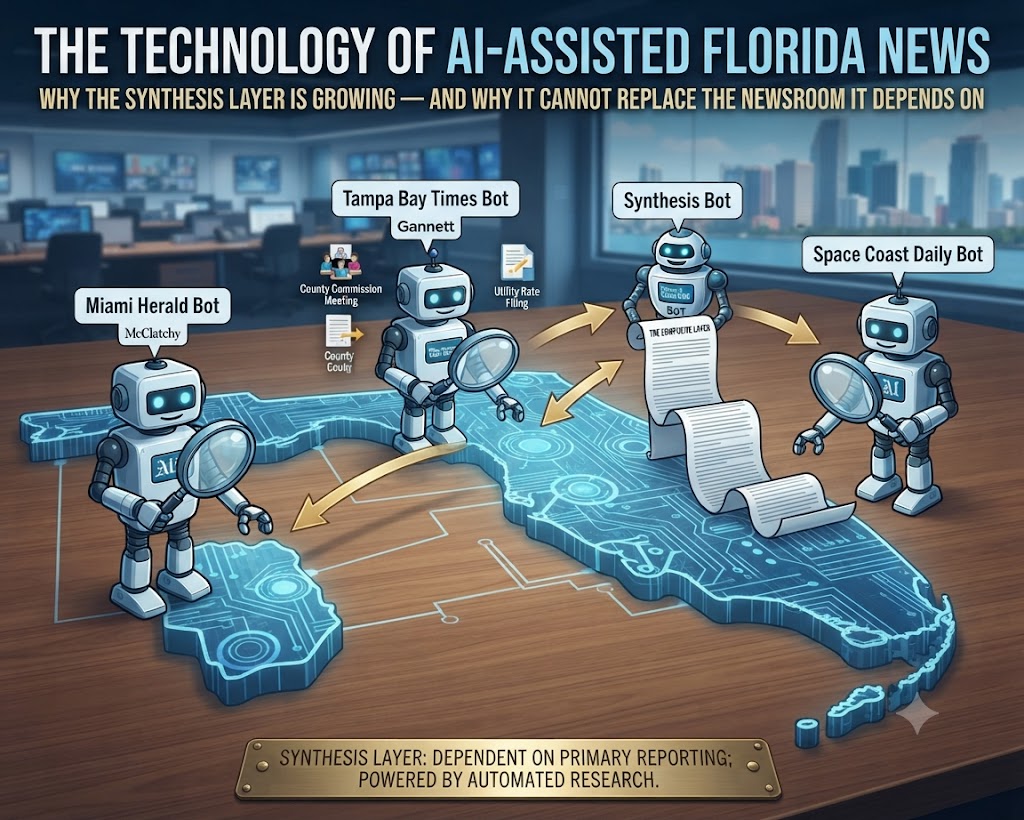
The short answer: AI has collapsed the cost of the work surrounding writing — transcription, tagging, research retrieval, formatting — which makes a new tier economically viable: composite journalism, where a small publisher synthesizes fragmented primary reporting into long explanatory pieces. That tier is growing fast. It also cannot exist without the newsrooms it draws from, and any composite publisher who forgets that is destroying their own supply chain.
Key Takeaways
- Muck Rack’s State of Journalism 2026, drawing on roughly 900 working journalists surveyed in March, found 82% already use AI tools regularly, with ChatGPT leading adoption at 47% and Gemini at 22%.
- Reuters Institute research found weekly AI usage among general news audiences nearly doubled in a single year, from 18% to 34%.
- The Reuters Institute’s 2026 survey of 280 executives across 51 countries points to a clear bifurcation: routine content moves to automation, while complex, accountable, source-driven journalism stays human.
- Only 38% of news executives report confidence in journalism’s future — down from 60% in 2022.
- Medill’s State of Local News Report 2025 counted 213 news desert counties, up from 206, with another 1,524 counties down to a single news source — roughly 50 million Americans with limited or no access to local news.
- The same report found genuine cause for optimism: more than 300 local news startups launched over five years, 80% of them digital-only.
- Our thesis: composite journalism is a real and growing third category, distinct from both automated routine content and primary newsgathering — and its defining risk is that it is easy to build in a form that consumes its own inputs.
What is composite journalism?
Composite journalism is long-form explanatory work assembled from many fragments of primary reporting, plus original analysis, published by an outlet that did not gather most of the underlying facts. It sits between the reporting layer and the reader, and it is a genuinely distinct product rather than a lesser version of either.
Consider how a significant regional story actually reaches the public now. A county commission votes; a local reporter files 600 words. A state agency issues a rule; a trade outlet covers it in four paragraphs. A company files with the SEC; a wire service produces a brief. A utility intervenes in a rate case; one reporter notices a single line in a filing.
Each item is accurate. Each is short. None of them tells you what is happening, because what is happening is only visible when the four are placed beside one another and someone asks what they add up to.
That connective work is the composite layer. It is what an explainer does, what a good analyst note does, and what almost nobody in regional business media has the staffing to do consistently.
The reason it now exists as a viable publishing category is economic, and the economics changed recently.
What did AI actually change about producing news?
Not the writing. The four hours of work surrounding the writing.
This distinction gets consistently misreported. The newsrooms currently getting real value from AI are not using it to generate articles. They are using it to eliminate the invisible labor that consumes a small team’s day — transcription handled before the reporter returns to their desk, translation that does not require a separate tool, tagging that does not require a separate meeting.
The Associated Press offers a concrete inventory of where this lands: automated public safety incident items, translation of weather alerts, video transcription and summaries, sorting email pitches, and keyword alerts across meeting transcripts. Those are portions of editorial labor being substituted, not the reporter’s role.
The New York Times draws the line explicitly: it never uses AI to write articles, though it does use it for first drafts of summaries and metadata — and even those brief snippets must meet full editorial standards before publication.
The Reuters Institute’s 2026 forecasting work describes the larger shift as moving from AI as a tool to AI as infrastructure, with automation embedded in content management systems and workflows, and back-end automation rated important by 97% of respondents.
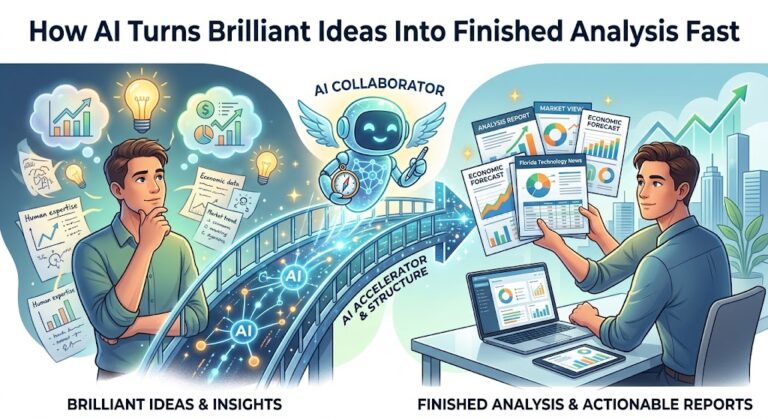
Why this matters for the composite layer specifically: the binding constraint on explanatory work has always been research time. Reading forty documents, pulling the relevant passages, checking them against one another, and organizing them into an argument is expensive, and it is exactly the category of labor that has become dramatically cheaper. The writing is still the writing. The judgment is still the judgment. But a two-person operation can now do research reconnaissance that used to require a team.
🔷 Brian’s Take
Someone put this more sharply than I could. Martin Schori at Aftonbladet: if creating text no longer costs anything, that brings brutal new competition.
He is right, and I would add the corollary that follows from it. When the cost of producing text collapses, text stops being the product. What remains scarce is everything text used to be a proxy for — judgment about what matters, willingness to say something falsifiable, a named person whose reputation is attached, and the discipline to leave a blank space where you have not actually measured something.
I have spent the past week publishing ten long pieces on Florida’s technology economy. The writing was the cheapest input in every one of them. What cost something was deciding which of six plausible theses was actually supportable, and then flagging in print the places where I was relying on a single source or had not verified a statute.
Anyone can now generate three thousand words about Florida data centers. Very few people will publish three thousand words that say, in the middle, here is the number I refuse to estimate. That is the whole competitive position, and it has nothing to do with the technology.
— Brian B. French
What are legacy newsrooms doing, and what does the data say about where this lands?
The industry’s own forecasting points to a bifurcation, and it explains where a composite publisher actually fits.
The Reuters Institute’s survey of 280 executives across 51 countries describes routine content moving to automation while complex, accountable, source-driven journalism stays human. The outlets investing in investigative depth, distinctive local coverage, and named journalist voices with genuine audience relationships are described as building the thing AI cannot commoditize.
Adoption inside newsrooms is already near-universal. Muck Rack’s 2026 survey of roughly 900 working journalists found 82% using AI tools regularly — beat reporters and regional editors, not just staff at tech-forward startups.
On the demand side, audience behavior is moving faster than most publishers’ strategy. Weekly AI usage among general news audiences nearly doubled in a year, from 18% to 34%. Semafor’s Gina Chua expects traffic to news sites to keep falling as chatbot use accelerates. NPO’s Ezra Eeman frames the required shift bluntly: publishers must stop thinking about AI in Media and start thinking about Media in AI.
Confidence has fallen accordingly. Only 38% of news executives report feeling confident about journalism’s future, down from 60% in 2022.
Note where the composite layer sits in that bifurcation: nowhere. It is neither routine automated content nor primary accountable reporting. It is a third thing — synthesis — and the industry’s own framing does not have a slot for it. That is both the opportunity and the reason the category needs a standard before it develops bad habits.
Will composite publishers replace metro dailies?
No — and publishers in this category should stop saying otherwise, because the claim is both wrong and self-destructive.
This is the section where we part company with the more triumphalist version of this argument, so let us be direct about the mechanics.
A composite publisher’s raw material is primary reporting. Every explanatory piece this publication produced over the past week rests on work someone else did first: a reporter sitting through a Citrus County commission meeting, a Tampa Bay Times journalist reading an FPL rate filing closely enough to notice a lawyer’s disclosure about confidential agreements, a local outlet documenting which speaker showed up to oppose a Pasco County moratorium. None of that appears without someone being in the room.
Regional dailies — the Miami Herald among them, owned by McClatchy — remain among the few institutions in Florida with the standing, staffing, and legal capacity to do that work at scale. They employ the people who file public records requests, attend the hearings nobody streams, and absorb the legal risk of publishing something a powerful institution would rather suppress. A composite publisher does none of those things and is not structured to.
The industry-wide contraction is real and well documented. Since 2005, newspaper revenues fell from over $50 billion to roughly $20 billion, overall newspaper employment dropped about 70%, and newsroom employment declined nearly 60%. Medill’s 2025 report counted 213 news desert counties, up from 206, with another 1,524 counties down to one remaining source — roughly 50 million Americans with limited or no access to local news.
A composite publisher that celebrates this is celebrating the depletion of its own input supply. The arithmetic is not complicated: fewer reporters in rooms means fewer primary accounts, which means less material to synthesize, which means the composite layer thins along with the layer beneath it. You cannot synthesize reporting nobody did.
The honest framing is not replacement. It is dependency — and dependency creates obligations.
🔷 Brian’s Take
I want to state my own position plainly, because there is a version of this business I have decided not to build.
The extractive version works like this. Monitor local outlets, restate their facts in your own words fast enough to avoid a copyright problem, rank for the query the original reporter should have owned, capture the traffic, send nothing back. It is cheap, it scales beautifully, and with current tools you could run it across every county in Florida with a small team.
I spent twenty-five years in institutional finance and I know what that structure is. It is a business that consumes its own inputs and books the consumption as margin. There is a class of investment that produces excellent returns for exactly as long as it takes to exhaust the underlying asset, and everyone involved is very pleased until quite suddenly nobody is.
The distinction I would draw is between extraction and amplification. Extraction takes the facts and keeps the attention. Amplification takes the facts, credits them clearly, links back so the attention flows to the reporter who earned it, and adds something the original could not — context across sources, a framework, an argument, the connective work a 600-word deadline piece has no room for.
Same technology. Same output length. Opposite effect on whether local reporting still exists in ten years.
— Brian B. French
What do “give me the details” readers actually want?
Explanation, not summary — and the distinction is sharper than it sounds.
There is a real and underserved audience for depth. Readers following Florida’s data center buildout, or the Space Coast’s industrial expansion, or a county’s land use fight, do not want a shorter version of the news. They want the version that answers the questions the news assumed they already knew: what a megawatt means in this context, why the water permit matters more than the zoning vote, what statute is actually driving the timeline.
Three characteristics define this demand, and each one is a constraint on how the composite layer should work:
They will check. A reader who wants details is a reader who follows links, opens the underlying filing, and notices when a claim is unsupported. This audience is the least forgiving of fabrication and the most valuable to have. It is also why linking to primary sources is not a courtesy — it is the product.
They want the disagreement, not the consensus. Depth-seeking readers want to know where the evidence is contested and what the strongest counterargument is. A composite piece that resolves everything cleanly is usually a piece that suppressed something.
They want to know who is talking. Named authorship with a visible track record and stated conflicts of interest matters more to this audience than institutional branding.
Meanwhile the format itself is under pressure — one of the bolder predictions in the Reuters Institute’s expert panel was that the article format is dying, as audiences increasingly encounter news through AI intermediaries and conversational interfaces rather than by visiting publications.
Both things are true simultaneously. Fewer people will arrive at a long explanatory article by navigating to a homepage. More people will encounter its substance through a system that retrieved and summarized it. Which means the composite layer’s job is increasingly to be the most accurate, best-sourced, most extractable version of an explanation — written for a reader who may never see the page it lives on.
The Composite Standard
Five rules that distinguish composite journalism from aggregation. We are publishing them as a standard because the category needs one, and because a standard you publish is a standard you can be held to.
1. Attribution is specific, not gestural. Not “reports indicate.” Name the outlet and the reporter where known, on the specific claim, at the point the claim appears. If a fact came from one newsroom’s work, that newsroom is named next to the fact.
2. Link out, including when it costs you the click. Every primary source that can be linked is linked. A composite publisher whose external links all point to its own network is running an extraction model regardless of what it calls itself.
3. Add something the source could not. Synthesis across multiple reports, an original framework, a data asset the publisher built, or analysis attributed to a named person. If removing the original reporting’s facts leaves nothing behind, the piece should not have been published.
4. Never launder uncertainty. Single-sourced claims are labeled single-sourced. Vendor research is labeled vendor research. Unverified figures are flagged or omitted. Composite work aggregates confidence as easily as it aggregates facts, and four uncertain reports do not become one certain one by being placed in the same paragraph.
5. Publish the gaps. Where a measurement is missing, leave the space visibly empty rather than filling it with a plausible estimate. In a retrieval-mediated information environment, a confident fabrication propagates and is nearly impossible to withdraw.
On the legal dimension, briefly and without pretending to give legal advice: extensive reproduction of another outlet’s expression carries copyright exposure, and reproducing the substance of time-sensitive reporting at scale carries additional risk. Transformation, attribution, linking, and original contribution are not only ethical practices — they are the practical difference between a defensible publication and a liability. Anyone building at scale in this category should get actual counsel, not reassurance from an article.
🔷 Brian’s Take
There is an inequality in this transition that deserves more attention than it gets, and it has nothing to do with technology quality.
National and international brands are securing AI content licensing deals. Small and local outlets largely expect zero licensing income. So the same shift that is producing revenue for large publishers is producing none for the county paper whose reporter attended the hearing that the large publisher’s national story was ultimately based on.
That is a wealth transfer running in the wrong direction, from the layer with the least capacity to the layer with the most. And it compounds a second inequality the Reuters work identifies: the verification burden created by synthetic media falls hardest on the smallest newsrooms, which are precisely the ones without a forensics desk.
I do not have a policy fix. I do think anyone building in the composite layer should understand that they are operating inside a system that is currently under-compensating the people they depend on, and should behave accordingly — with attribution, with links, and with whatever else sends value back down the chain. That is not charity. It is maintenance on the asset you are standing on.
— Brian B. French
What should each party do?
Regional dailies. The Financial Times’ Martin Stabe argues newsrooms need editorial-facing data engineering functions that collect fresh data rather than mining archives. That is the right instinct: the durable asset is proprietary primary material — records nobody else pulled, hearings nobody else attended, datasets nobody else built. That material is what the composite layer cannot manufacture, and it is what AI intermediaries most need and least possess. It also argues for pricing and licensing that material deliberately rather than defaulting to a paywall that, as we reported in our analysis of AI citation behavior, makes the work simultaneously unmonetized and invisible.
Composite publishers. Adopt a published standard. Link generously. Treat the reporting layer as a supplier you are obligated to sustain rather than a resource you are entitled to. And accept the corollary: you should be the first to say publicly that you cannot replace what you draw from.
Readers. Notice which publications link out and which do not. It is the single fastest way to tell whether you are reading amplification or extraction.
Everyone. The optimistic finding in Medill’s data deserves more attention than the grim ones: more than 300 local news startups launched over five years, 80% of them digital-only. The replacement layer is being built. It is smaller, more specialized, and more precarious than what it is replacing, and it will only work if the specialists cite each other honestly.
🔷 Brian’s Take
A closing thought about the outlet this piece has been circling.
If a story I published this week matters — the confidential utility agreements, the statutory clock under the moratorium wave, the water permit that quietly governs where data centers can go — the chain of custody on the underlying facts runs through reporters at organizations I do not own and could not replicate. Some of them work at the Miami Herald and the Tampa Bay Times. Some work at county weeklies with three-person staffs. Several of them, statistically, will not have those jobs in three years.
I am not going to pretend that the Florida Authority Network is a substitute for that. It is not. It is a different layer of the same system, and it is a layer that only has anything to work with because the layer beneath it is still, barely, staffed.
What I will say is that the synthesis layer is real, it is useful, and there is a version of it that strengthens the reporting layer rather than cannibalizing it. That version cites specifically, links outward, adds analysis the original could not carry, and says plainly what it does not know. It is slower and less scalable than the alternative.
I would rather build the durable thing. In five years the extraction operations will have run out of material, and the question of who was doing which will be very easy to answer from the archive.
— Brian B. French
About the author
Brian B. French is a digital strategist, former institutional portfolio manager, and the architect of the Florida Authority Network, a proprietary portfolio of Florida business news and press release websites including Florida Technology News. He is the founder of Florida Website Marketing — the conflict of interest disclosed at the top of this article.
Before moving into digital strategy, Brian spent more than 25 years in financial services, serving as Vice President and Portfolio Manager with Merrill Lynch Investment Managers and Trust Company, with earlier roles at Shearson American Express, EF Hutton, SouthTrust, and SunTrust. He holds a B.A. in Finance and Business Administration from the University of South Florida.
Outside the digital realm he is a dealer in authenticated antiques and fine art and a member of 17 hereditary and genealogical societies. The through-line across both careers is provenance: whether the object is a piece of eighteenth-century furniture, a family line, or a claim on a web page, the first question is the same — how do we know this is what it says it is?
Frequently Asked Questions
What is composite journalism? Long-form explanatory work assembled from many fragments of primary reporting plus original analysis, published by an outlet that did not gather most of the underlying facts. It is a synthesis layer sitting between primary newsgathering and the reader.
How many journalists use AI? Muck Rack’s State of Journalism 2026, surveying roughly 900 working journalists in March 2026, found 82% using AI tools regularly, with ChatGPT at 47% adoption and Google Gemini at 22%.
Do newsrooms use AI to write articles? Generally not at major outlets. The New York Times states it never uses AI to write articles, using it instead for first drafts of summaries and metadata that still undergo full editorial review. The Associated Press applies AI to automated public safety items, weather alert translation, transcription, and internal workflow tasks.
How many Americans lack access to local news? Medill’s State of Local News Report 2025 found 213 news desert counties, up from 206 the prior year, with another 1,524 counties down to a single news source — roughly 50 million Americans with limited or no access to local news.
Is local journalism recovering? Partially. The same Medill research found more than 300 local news startups launched over five years, 80% of them digital-only — though these are typically far smaller than the outlets they partially replace.
Can AI-assisted publishers replace metro daily newspapers? No. Composite publishers synthesize primary reporting they did not produce. Metro dailies retain the staffing, legal capacity, and institutional standing to file records requests, attend hearings, and absorb the legal risk of adversarial reporting. Removing the reporting layer removes the composite layer’s raw material.
What is the difference between extraction and amplification? Extraction restates another outlet’s facts and captures the resulting attention without sending value back. Amplification credits the source specifically, links to it, and adds analysis the original could not carry. The technology is identical; the effect on the reporting layer is opposite.
What is the Composite Standard? Florida Technology News’ published five-rule standard for this category: specific attribution, outbound linking even when costly, original contribution beyond the source facts, no laundering of uncertainty, and visible publication of gaps rather than plausible estimates.
Sources & Further Reading
- Reuters Institute for the Study of Journalism — “How will AI reshape the news in 2026? Forecasts by 17 experts from around the world.” https://reutersinstitute.politics.ox.ac.uk/news/how-will-ai-reshape-news-2026-forecasts-17-experts-around-world
- Medill Local News Initiative, Northwestern University — “News deserts hit new high and 50 million have limited access to local news, study finds,” State of Local News Report 2025. https://www.medill.northwestern.edu/news/2025/news-deserts-hit-new-high-and-50-million-have-limited-access-to-local-news-study-finds.html
- Medill Local News Initiative — The State of Local News 2022 (PDF). https://localnewsinitiative.northwestern.edu/assets/the_state_of_local_news_2022.pdf
- Northwestern University — “As newspapers close, struggling communities are hit hardest by the decline in local journalism.” https://news.northwestern.edu/stories/2022/06/newspapers-close-decline-in-local-journalism
- Educational Technology and Change Journal — “AI in Journalism 2026-2027: ‘more agentic automation,'” April 2026. https://etcjournal.com/2026/04/03/ai-in-journalism-2026-2027-more-agentic-automation/
- Media Copilot — “AI in Newsrooms 2026: Reuters Institute Predictions,” May 2026. https://mediacopilot.ai/reuters-institute-ai-newsrooms-2026-predictions/
- ALM Corp — “Journalism Trends 2026: Complete Guide to Media’s AI Revolution,” January 2026. https://almcorp.com/blog/journalism-media-technology-trends-2026-complete-guide/
- Appworks — “AI in the Newsroom 2026: What’s Actually Working.” https://app-works.app/article/ai-in-the-newsroom-2026-whats-actually-changed
- Columbia Journalism Review — “Help us track job losses in local newsrooms.” https://www.cjr.org/business_of_news/layoffs-gannett-mcclatchy-journalists.php
Primary sources to consult before republication or update: Reuters Institute Journalism, Media, and Technology Trends and Predictions 2026 (full report); Muck Rack State of Journalism 2026 (full report); Medill State of Local News Report 2025 (full dataset); Pew Research Center newsroom employment series; McClatchy corporate filings for current ownership and operating figures.
Related coverage:
- We’re Auditing What Five AI Models Say About Florida Tech.
- Seven Florida Counties Have Moved to Pause Data Centers.
- Everyone Says Power Is Florida’s Data Center Constraint. The Permits Say It’s Water.
Editorial note
Composite journalism as defined here, the Composite Standard, and the extraction/amplification distinction are frameworks proposed by this publication. Sections identified as analysis are labeled as such. This article is not legal advice; copyright and related exposure in aggregation and synthesis publishing is fact-specific and requires qualified counsel.
On the Miami Herald and McClatchy. This article references the Miami Herald as an example of a regional daily performing primary newsgathering, and cites industry-wide contraction figures from Pew and Medill. We have not independently verified current Herald newsroom staffing, circulation, or financial performance and have deliberately made no claims about them. Any specific assertion about that newsroom’s condition should be sourced directly before publication.
Verification flags for the editor. The Muck Rack survey figures, the Reuters Institute executive survey figures, the 18%-to-34% audience AI usage figure, and the 38% executive confidence figure all reached us through secondary coverage rather than the primary reports. Obtain and read the Reuters Institute and Muck Rack reports directly before publication; where the primaries differ from the characterizations here, follow the primaries. Several supporting sources are marketing or vendor publications and should be demoted in favor of the Reuters Institute and Medill originals. The newspaper revenue and employment decline figures derive from Medill and Pew research of varying vintage — confirm the most current series before publishing percentages.
Changelog
- August 1, 2026 — Initial publication.
About the Author