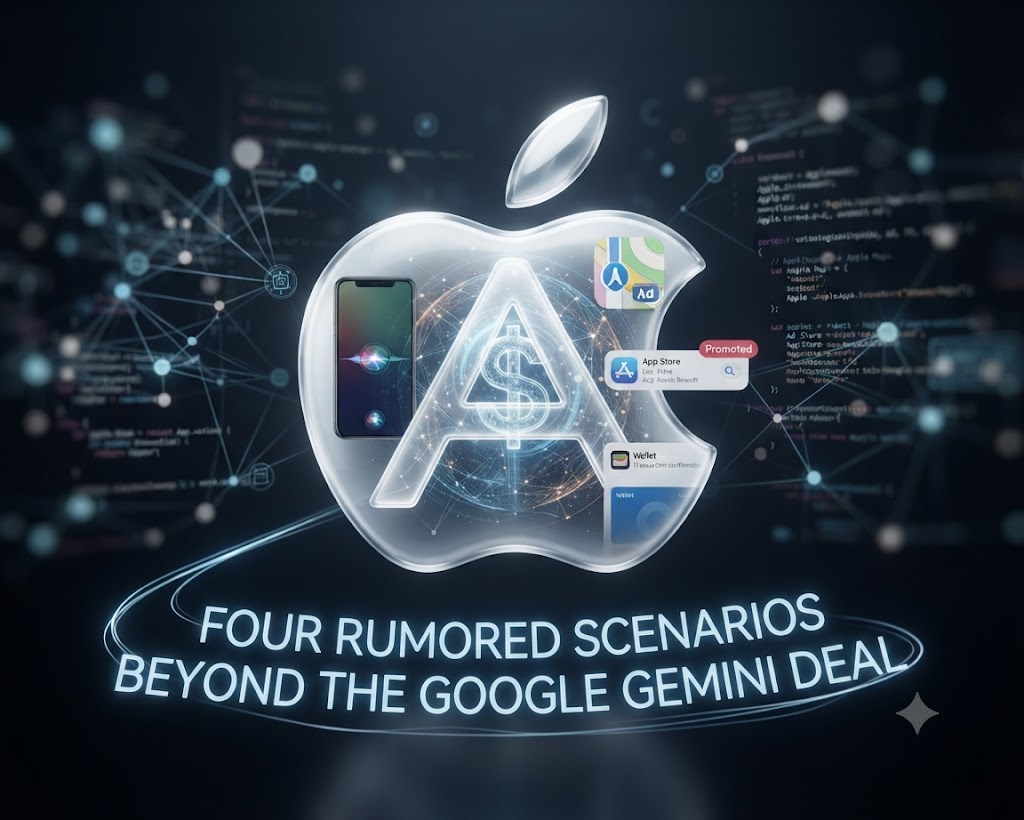
4 Rumored Scenarios Beyond the Google Gemini Deal
Last updated: July 21, 2026 | Category: AI, Search, Advertising Strategy
Quick Answer: Apple currently licenses Google’s Gemini models (a deal estimated at roughly $1 billion per year) to power the rebuilt Siri and Apple Foundation Models. But Apple is unlikely to let Google capture the advertising economics of AI-driven search on 2.5 billion+ active Apple devices indefinitely. The four most credible rumored paths for Apple to capture AI ad revenue are: (1) building its own “World Knowledge Answers” answer engine with sponsored answers, (2) expanding the privacy-first Apple Ads network from the App Store and Maps into Siri and AI surfaces, (3) renegotiating the Google relationship into an AI-era revenue-share (“the new ISA”), and (4) becoming the toll booth for agentic commerce — taking a cut of transactions Siri completes, rather than selling ads at all.
The Setup: What Is the Apple–Google Gemini Deal?
In January 2026, Apple and Google announced a multiyear partnership under which the next generation of Apple Foundation Models is based on Google’s Gemini models and cloud technology. Key facts:
- Cost: Estimated at ~$1 billion per year (per Bloomberg’s Mark Gurman); official terms undisclosed.
- Scope: A custom Gemini model (reported at ~1.2 trillion parameters, roughly 8x larger than Apple’s in-house cloud models) powers the rebuilt Siri unveiled at WWDC 2026 with iOS 27.
- Privacy structure: The model runs on Apple’s Private Cloud Compute servers. Google does not get Apple user data.
- Not exclusive: Apple retains its ChatGPT integration for opt-in complex queries and continues in-house Foundation Models work.
Here is the tension at the heart of this article: the deal covers model licensing, not the downstream monetization of AI search behavior. Google already pays Apple an estimated $20+ billion annually to be Safari’s default search engine — because search queries turn into ad revenue. As queries migrate from the Safari search bar to conversational AI answers, the question becomes: who monetizes the answer?
If Gemini-powered answers eventually carry sponsored results, and Google keeps that revenue, Apple would be paying $1B/year to hand Google an ad platform on Apple’s own screens. That is not a stable equilibrium — and Apple’s recent moves suggest it knows it.
Why Won’t Apple Let Google Monetize AI Ads on the iPhone?
Three structural reasons:
- Apple is already building an ad business. Apple rebranded “Apple Search Ads” to simply Apple Ads in April 2025, added multiple ad slots to App Store search in March 2026, and confirmed ads in Apple Maps launching summer 2026 as part of the new Apple Business platform. Advertising is projected to contribute roughly $8.5 billion to Apple in 2026 — small by Google standards, but the fastest-growing high-margin line inside a Services segment that crossed $100 billion in 2025.
- The Google default-search payments are under threat. Regulatory pressure (the DOJ antitrust remedies) and the shift of query volume to AI assistants both erode the traditional Google/Safari arrangement. Apple needs a replacement revenue engine.
- Services growth is Wall Street’s obsession. With hardware upgrade cycles flattening and analysts openly questioning whether AI drives iPhone upgrades, monetizing the attention layer — Siri, Spotlight, Safari, Maps — is Apple’s clearest AI revenue story.
Scenario 1: “World Knowledge Answers” Becomes Apple’s Own Answer Engine — With Sponsored Answers
What’s rumored: Bloomberg reported that Apple’s Answers, Knowledge, and Information (AKI) team has been building World Knowledge Answers (WKA) — an in-house AI answer engine designed to turn Siri into a rival to ChatGPT, Perplexity, and Google’s AI Mode. It synthesizes web results into multimodal summaries (text, images, video, local results) and is planned to expand beyond Siri into Safari and Spotlight. WWDC 2026 showcased an overhauled search function alongside the new Siri.
The monetization speculation: Once Apple owns the answer surface — even if Gemini does the heavy lifting underneath — Apple controls what appears around and inside the answer. The rumored playbook:
- Sponsored answers / promoted sources inside Siri and Spotlight results, analogous to sponsored listings in App Store search today.
- Local answer monetization: “Best pizza near me” answered by Siri with a Maps-ads-style sponsored placement — the Maps ad auction infrastructure launching in summer 2026 is a ready-made backend.
- AEO/GEO becomes an Apple channel: Brands would need to optimize content for inclusion in Apple’s answer index, and Apple could sell visibility into that index the way Google sold visibility into the SERP.
Why it’s plausible: Apple explored acquiring Perplexity and Mistral before deciding to build in-house. It wouldn’t build an answer engine on top of a $1B/year Gemini license just to leave it unmonetized.
Why it might not happen (soon): Apple’s brand is built on not feeling like an ad platform. Expect Apple to call these “helpful suggestions,” not ads — and to move slowly.
Scenario 2: The Privacy-First Apple Ads Network Expands Into Every AI Surface
What’s rumored/observable: Apple is methodically laying pipe for a full-stack, contextual (not tracking-based) ad network:
- April 2025: Search Ads rebranded to Apple Ads — a signal of ambitions beyond the App Store (App Store, Apple News, and MLS today).
- March 2026: Multiple ad slots added to App Store search results (UK and Japan first, then all markets).
- April 14, 2026: Apple Business launched in 200+ countries — a platform connecting businesses to consumers across Maps, Mail, Wallet, Siri, and other Apple products, with brand profiles and rich place cards.
- Summer 2026: Search ads go live in Apple Maps (US and Canada first), with businesses bidding on queries — explicitly modeled on Google Maps ads, but with contextual signals only (search term, approximate location) and rotating identifiers instead of user tracking.
The speculation: Apple Business already lists Siri among its consumer touchpoints. The rumored trajectory is a “privacy-safe ad network for the AI era”: contextual ad placement inside AI-generated answers, Siri suggestions, Wallet offers, and Mail — sold on the pitch that Apple reaches the wealthiest mobile audience on earth (158M US iPhone users; 850M weekly App Store visitors; 60%+ conversion on top search placements) without surveillance advertising.
Why it’s plausible: It’s already happening — Maps ads are the proof of concept. Media analysts are openly writing “prepare to see Apple turn into an advertising machine.” Incoming CEO John Ternus inherits a Services growth mandate.
Why it might not happen (fully): Ads in Siri responses risk the exact user backlash Apple weaponized against Meta and Google. Apple will likely confine ads to “commercial intent” surfaces (Maps, App Store, Wallet, shopping queries) and keep conversational Siri clean — at least initially.
Scenario 3: The “New ISA” — Apple Renegotiates the Google Deal Into an AI Revenue Share
What’s rumored: The original Information Services Agreement (ISA) — Google paying Apple ~$20B/year for Safari default placement — is the most profitable contract in tech history for Apple. The speculative (and frequently rumored) endgame is that Apple flips the Gemini arrangement into its AI-era successor:
- Instead of Apple paying Google $1B/year for models, the relationship inverts once AI answers carry ads: Google pays Apple a traffic-acquisition-cost (TAC)-style revenue share on any ad or commercial revenue generated from Gemini-powered queries originating on Apple devices.
- Alternatively, a hybrid: Apple’s license fee nets against a share of Google’s AI ad monetization, mirroring how the search deal evolved.
Why it’s plausible: It’s exactly how the two companies have always operated — Google buys distribution, Apple sells access to its users. Google’s Gemini deal was partly motivated by protecting its position on 2+ billion Apple devices against OpenAI. Apple has leverage: the partnership is explicitly non-exclusive, and Apple keeps ChatGPT and in-house models as credible alternatives.
Why it might not happen: Antitrust. The DOJ remedies case specifically targeted default-placement payments; recreating the ISA for AI answers invites immediate regulatory attack — a concern Elon Musk voiced publicly the day the Gemini deal was announced (“unreasonable concentration of power”). Any revenue share would likely need to be structured as something that doesn’t look like a default-placement payment.
Scenario 4: Skip Ads Entirely — Siri as the Toll Booth for Agentic Commerce
What’s rumored: The most forward-looking speculation says Apple’s real AI monetization won’t look like advertising at all. The rebuilt Siri can hold conversations, remember context, act across apps, and complete multi-step tasks (WWDC 2026 demos included planning a World Cup watch party end-to-end). The rumored monetization stack:
- Transaction commissions: When Siri books the restaurant, orders the product, or hails the ride, Apple takes a cut — App-Store-economics applied to agentic actions, powered by Apple Pay and Wallet (which is simultaneously gaining features like bill splitting and “Create a Pass”).
- Lead-gen / affiliate fees: “Suggested Places” in Maps and Siri recommendations monetized per referral rather than per impression — ads that don’t look like ads.
- Paid Apple Intelligence tier: Analysts (Morgan Stanley among them) have flagged iCloud+/subscription bundling as a “clearer path to monetizing AI” — a premium Siri with advanced agentic capabilities folded into Apple One.
Why it’s plausible: It fits Apple’s DNA — monetize the transaction and the platform, keep the experience ad-light, and let advertisers fight over the remaining commercial surfaces. It also sidesteps the privacy-brand contradiction entirely.
Why it might not happen alone: Commissions on agentic commerce will trigger the same developer/regulator fights as the App Store 30%. Most analysts expect Apple to run this scenario alongside Scenario 2, not instead of it.
Comparison Table: The Four Scenarios at a Glance
| Scenario | Revenue Model | Timeline Signal | Biggest Risk |
|---|---|---|---|
| 1. World Knowledge Answers + sponsored answers | CPC/CPM in AI answers | WKA rumored since Sept 2025; new search shown at WWDC 2026 | Brand dilution (“Siri is an ad machine”) |
| 2. Apple Ads network expansion | Privacy-first contextual auction across Maps, App Store, Wallet, Siri | Maps ads live summer 2026; Apple Business live April 2026 | User backlash; ecosystem fatigue |
| 3. AI-era Google revenue share (“new ISA”) | TAC-style share of Gemini ad monetization | Gemini deal is multiyear and non-exclusive — renegotiation leverage built in | Antitrust regulators |
| 4. Agentic commerce toll booth | Commissions, affiliate fees, subscriptions | Siri task completion + Wallet commerce features shipping in iOS 27 | Developer/regulatory fights over the cut |
FAQ (AEO Quick Answers)
Does Apple make money from ads today? Yes. Apple Ads (formerly Apple Search Ads) sells placements in the App Store, Apple News, and MLS, with Apple Maps ads launching summer 2026. Advertising is projected at roughly $8.5 billion in 2026 revenue.
Does Google get Apple user data under the Gemini deal? No. The custom Gemini model runs on Apple’s Private Cloud Compute infrastructure, and Apple states user data is not shared with Google.
Will Siri show ads? Not today. But Siri is listed as a touchpoint in the new Apple Business platform, and rumors point toward sponsored placements in commercial-intent AI answers over time.
What is World Knowledge Answers? Apple’s internally developed AI “answer engine,” built by its AKI team, designed to power conversational search in Siri and eventually Safari and Spotlight — Apple’s most direct move into search since deferring to Google.
Why does the Google–Apple search deal matter here? Google pays Apple an estimated $20B+/year for Safari default placement. As search shifts to AI answers, that revenue stream is at risk — and every scenario above is, at bottom, Apple’s plan to replace or exceed it.
Brian’s Take 💬
Here’s my read: the $1B Apple pays Google is a rental payment, not a surrender. Apple has done this before — it rented Google Maps until its own Maps was (eventually) good enough, and it rented Intel chips until Apple Silicon was ready. The Gemini deal buys Apple time while the AKI team builds World Knowledge Answers and while Apple Ads quietly assembles the pieces of a real ad network — App Store slots in March, Apple Business in April, Maps ads this summer. That’s not a coincidence; that’s a roadmap.
My bet is a blend of Scenarios 2 and 4: Apple keeps conversational Siri ad-free to protect the brand, monetizes commercial intent (Maps, shopping, local, App Store) through its privacy-first auction, and takes a toll on agentic transactions through Apple Pay. Scenario 3 — a new revenue share with Google — probably happens too, but quietly and structured to survive regulators. The one thing I’d rule out is the status quo: Apple will not spend a decade watching Google monetize AI answers on screens Apple manufactured, in an assistant Apple branded, for users Apple acquired. Cupertino always ends up owning the toll booth.
— Brian
Resources & Further Reading
- Reuters / MarketScreener — Google and Apple enter multi-year AI deal for Gemini models (Jan 12, 2026): https://www.marketscreener.com/news/google-and-apple-enter-into-multi-year-ai-deal-for-gemini-models-ce7e58dad188f421
- 9to5Mac — New details on the Apple–Google AI deal, model distillation, and data-center access (Mar 25, 2026): https://9to5mac.com/2026/03/25/new-details-on-apple-google-ai-deal-revealed-including-gemini-changes-report/
- AppleInsider — Google confirms context-aware, Gemini-built Siri debuts in 2026 (Apr 22, 2026): https://appleinsider.com/articles/26/04/22/google-confirms-context-aware-siri-built-from-gemini-will-debut-in-2026
- Bloomberg — Apple to introduce search ads in Maps as Services revenue grows (Mar 23, 2026): https://www.bloomberg.com/news/articles/2026-03-23/apple-is-set-to-add-search-advertising-to-maps-in-services-push
- AppleInsider — Apple Maps ads are private and launch in the summer; Apple Business platform (Mar 24, 2026): https://appleinsider.com/articles/26/03/24/apple-maps-ads-are-private-and-launch-in-the-summer
- Marketing Dive — Apple rolls out ads for Maps as advertising revenue hits all-time highs (Mar 25, 2026): https://www.marketingdive.com/news/apple-rolls-out-ads-for-maps-as-advertising-revenue-grows/815613/
- Search Engine Land — Apple’s World Knowledge Answers AI search plans (Sep 3, 2025): https://searchengineland.com/apple-world-knowledge-answers-ai-search-461569
- iGeeksBlog — Apple’s AI answer engine could arrive sooner than expected (Sep 2025): https://www.igeeksblog.com/apples-ai-answer-engine-could-arrive-sooner-than-expected/
- CNN Business — Apple lays out AI plans with a brand-new Siri at WWDC 2026 (Jun 8, 2026): https://www.cnn.com/2026/06/08/tech/apple-wwdc-tim-cook
- CNN Business — Apple’s big Siri update is here; the monetization challenge begins (Jun 13, 2026): https://www.cnn.com/2026/06/13/tech/apple-siri-ai-update
- MediaPost — “Apple Turns To Ads” — analyst view on Apple’s advertising machine (May 1, 2026): https://www.mediapost.com/publications/article/414764/apple-turns-to-ads.html
- Apple Ads (official) — Platform overview and Maps ads waitlist: https://ads.apple.com/ and https://ads.apple.com/maps
Disclosure: Scenarios 1–4 blend confirmed product moves with reported rumors and speculation. Rumored features, timelines, and deal terms are unconfirmed by Apple and Google and may change.
About the Author