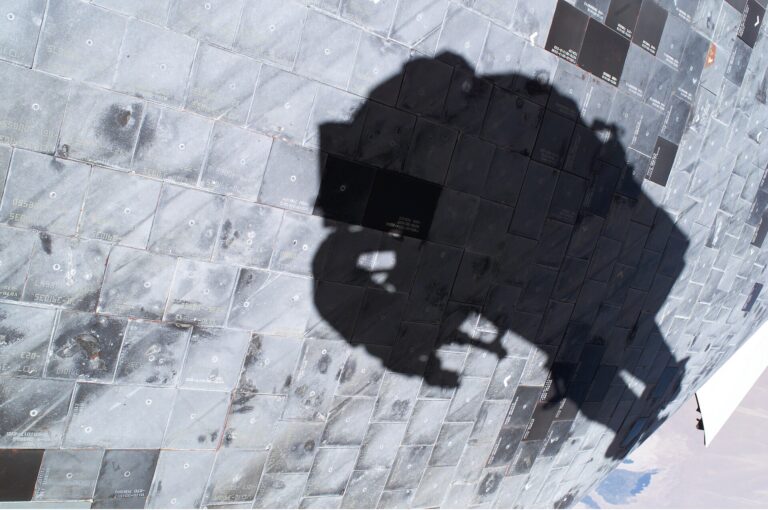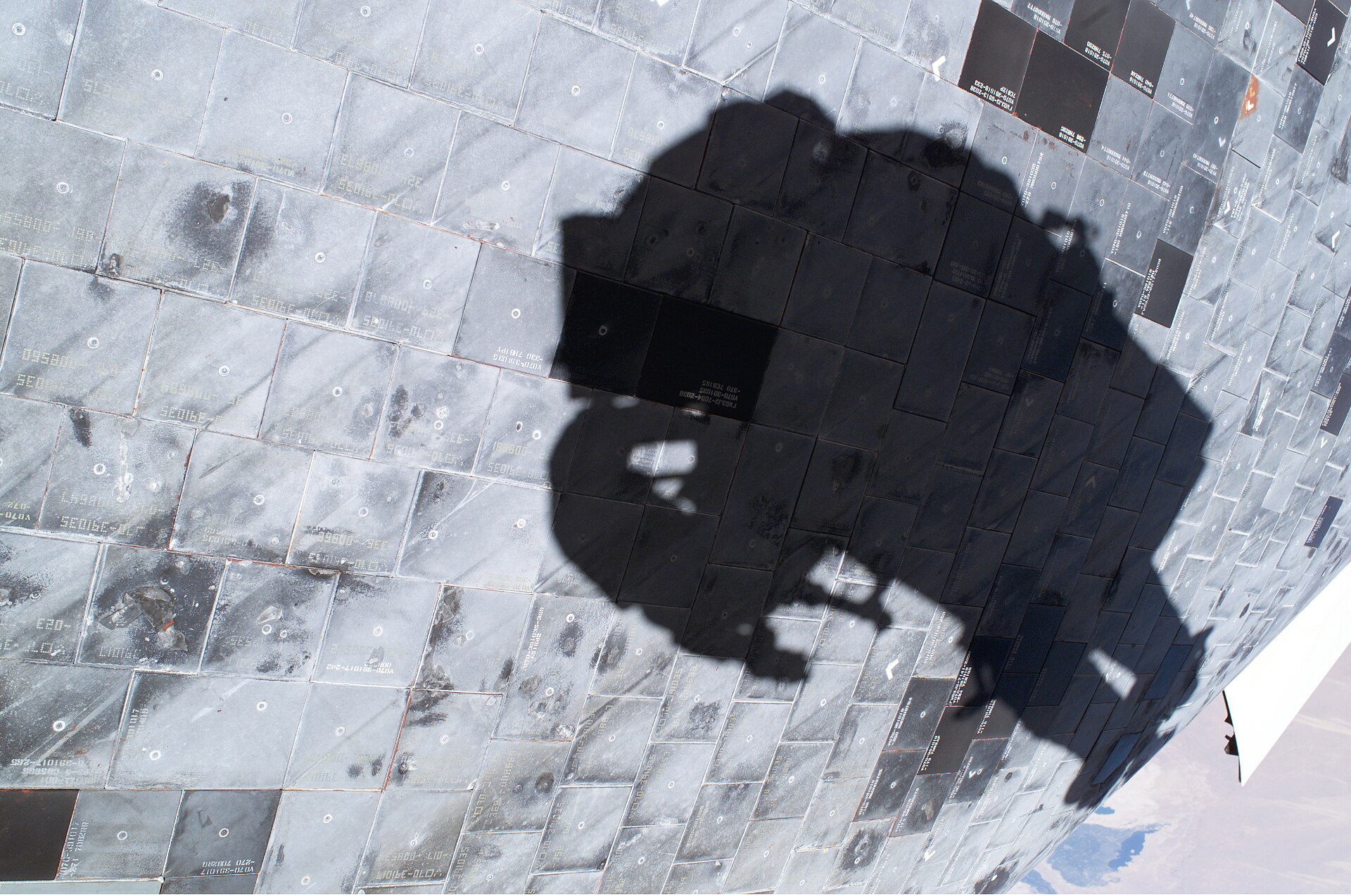
Space Shuttle Discovery’s underside heat shield tiles, photographed in orbit during STS-114 in 2005. Image: NASA, public domain, via Wikimedia Commons.
Analysis | Florida Technology News.com | November 18, 2026
Quick Answer: SpaceX caught a Starship upper stage with its launch tower for the first time on November 14, 2026, but no Starship upper stage has ever flown a second time. Former NASA heat shield experts say the tile system may need days to weeks of work between flights, which is the same problem that sank the Space Shuttle’s economics. Until a caught ship reflies quickly and cheaply, Starship’s “fully reusable” business model is still unproven.
Key Facts at a Glance
| Item | Status as of Nov. 18, 2026 |
|---|---|
| Integrated Starship test flights | 15 since April 2023 |
| Starship upper stages caught | 1 (Ship 42, Nov. 14, 2026) |
| Starship upper stages reflown | 0 |
| Super Heavy boosters caught / reused | 3 caught, 2 reused (all first-generation) |
| Flight 15 booster | Lost in the Gulf of Mexico |
| Heat shield tiles per ship | About 18,000 ceramic tiles |
| Program cost to date | More than $15 billion |
| SpaceX IPO valuation (June 2026) | About $1.75 trillion |
The Catch Was Spectacular. It Was Not Proof.
The pictures from Starbase, Texas, were remarkable. On Flight 15, Ship 42 spent about 22.5 hours in orbit, released 26 Starlink V3 satellites and then came home to be grabbed by the tower’s mechanical “chopstick” arms. Television networks called it historic, and in a narrow sense it was. No orbital upper stage had ever been caught that way before.
But the world’s fascination with the catch has run ahead of what the catch actually shows. Catching a rocket is a recovery method. It is a clever way to avoid landing legs and to put the vehicle back near the launch mount. It does not tell anyone how much the vehicle costs to refurbish, how long it takes to fly again, or whether it can fly again at all without major repair.
The space trade press has been careful on this point. NewSpace Economy’s mission review of Flight 15 lists “rapid reuse of recovered spacecraft” as not demonstrated and notes that no launch price, refurbishment cost or routine turnaround interval was established by the flight. Ship 42’s readiness for another flight had not been publicly established. SpaceX has not published a reflight date for it.
The same flight also lost its booster. Booster 22, the first third-generation Super Heavy meant to be caught, was waved off from the tower, diverted offshore and destroyed over the Gulf of Mexico. SpaceX said its guidance system detected the booster was outside the conditions needed for a catch. The root cause remains under investigation. The planned “double catch” of both stages on one mission did not happen.
Recovery Is Not Reuse
Reusability is an economic claim, not an engineering stunt. A rocket is reusable in a business sense only when it can fly again at a fraction of the cost of building a new one, on a schedule that lets the fleet earn money. SpaceX proved this with Falcon 9, whose first-stage boosters now fly routinely and repeatedly. That record is real and deserves credit.
Starship is a different and much harder problem. A Falcon 9 booster drops back from the edge of space at a fraction of orbital speed. A Starship upper stage comes home from orbit at roughly 17,000 miles per hour and must survive the full fury of reentry heating. That is where the heat shield comes in, and that is where the business case gets shaky.
Even the most hopeful hardware news this fall was modest. After Ship 40 splashed down intact in the Indian Ocean on Flight 13 in July, SpaceX shipped it back to Starbase, where some of its heat shield tiles were removed and reused. Reusing individual tiles is a step. Reflying a whole ship is the test that matters, and it has not happened.
The Heat Shield Problem SpaceX Itself Has Admitted
Starship’s belly is covered by about 18,000 hexagonal ceramic tiles over a stainless steel hull. Elon Musk has repeatedly said this is the hardest remaining piece of the program. In a February 2026 podcast he called a reusable heat shield the “biggest problem that remains” for Starship, and said rapid reuse cannot depend on laboriously inspecting tens of thousands of tiles.
That is the crux. If every ship has to be inspected tile by tile, with cracked tiles swapped out and gap fillers reset, the turnaround stretches from hours to weeks. The rocket is then reusable the way the Space Shuttle was reusable: technically yes, economically no.
The evidence so far is mixed at best. Imagery from Ship 40’s July splashdown showed cracked tiles, broken tile edges and white streaks along tile seams, which outside experts read as hot plasma getting between the tiles. Ship 42 was cleared to return home on Flight 15 based on camera images taken by Starlink satellites and ground tracking, not a hands-on inspection. And after the catch, video showed ablative material on the ship rubbing against the tower arms. Musk responded on November 16 that it will be replaced with stainless steel wool on future flights, without saying which flight. In other words, the catch itself introduced a new wear point on the vehicle’s thermal protection.
Bloomberg’s November analysis put it plainly: the shield has shown it can keep Starship intact, but it is not yet clear that it will be robust enough for full and rapid reuse. Intact is not the same as ready to fly.
The Space Shuttle Has Seen This Movie
The comparison to the Space Shuttle is not a cheap shot. It is the most relevant precedent in the history of spaceflight. The Shuttle was sold to Congress in the early 1970s as a reusable space truck that would fly dozens of times a year and drive launch costs down. Its orbiter was protected by roughly 24,000 tiles. It flew 135 missions over 30 years, an average of about four and a half flights a year.
Tile inspection and refurbishment were a major reason why. Each orbiter spent months between missions being inspected and repaired. A 2011 analysis by Roger Pielke Jr. and Radford Byerly in the journal Nature put the program’s true cost at about $1.5 billion per flight when all program costs were counted. And in 2003, Columbia was lost with seven astronauts after foam debris breached the thermal protection on its wing. The return-to-flight mission, STS-114, included a spacewalk to pull loose gap fillers from Discovery’s belly, the tiles shown in the photo above.
| Measure | Space Shuttle | Starship (so far) |
|---|---|---|
| Original promise | Frequent, low-cost reusable flights | Full reuse, turnaround in hours |
| Heat shield | About 24,000 tiles over aluminum | About 18,000 tiles over steel |
| Actual cadence | About 4.5 flights per year | 2 flights in Q3 2026, all test or early operational |
| Upper stage reflights | Each orbiter reflown many times, after months of work | None |
| Cost per flight | About $1.5 billion, all-in | Not disclosed; analysts estimate up to $100 million expendable |
SpaceX’s defenders point out a real difference: Starship’s 304L stainless steel airframe can tolerate far more heat than the Shuttle’s aluminum, so a missing tile is survivable instead of catastrophic. That is a genuine safety advantage. But survivable is not the same as fast to turn around, and fast turnaround is the whole business case.
What the Skeptics Are Saying
The most pointed criticism has come from people who know heat shields better than almost anyone. In July, three former NASA figures reviewed the Flight 13 splashdown imagery and told Ars Technica and Bloomberg the tiles cannot support SpaceX’s goal of relaunching a ship within hours.
- Dan Rasky, who spent nearly four decades studying heat shield materials at NASA Ames Research Center and co-invented PICA, the material behind the heat shield on SpaceX’s own Crew Dragon, called Starship’s current thermal protection system “a dead-end” for missions requiring full and rapid reuse. He expects days to weeks of hands-on work between flights.
- Charles Camarda, a former NASA astronaut and research scientist who flew on STS-114, the first Shuttle mission after the Columbia disaster, joined the assessment. The group argued the tile design borrows heavily from the Shuttle approach, and that is the problem.
- Charles Miller, who led the NASA transition team for the Trump administration, was the third author of the analysis.
Financial analysts have raised a separate set of doubts. Satellite market analyst Tim Farrar told clients that without full reusability, Starship’s launch cost “may not be much lower than Falcon 9,” even at its full 100-ton capacity, estimating up to $100 million per launch, or about $1,000 per kilogram. He also argued the launch rate is limited by how fast SpaceX can build new upper stages and refurbish boosters.
Morningstar valued SpaceX at about $780 billion in June 2026, well under half the roughly $1.75 trillion valuation at which the company went public.
The Business Model Depends on a Promise Not Yet Kept
SpaceX’s own IPO filing makes the stakes clear. The risk factors state, “Our ability to execute our growth strategy is highly dependent on Starship.” That is not a skeptic’s line. It is the company’s own warning to investors.
The reason is Starlink. According to TechCrunch’s reading of the S-1, SpaceX must replace about one-fifth of its satellites every year just to keep current service levels. Musk has said SpaceX could go bankrupt without Starship’s ability to replace satellites cheaply. Yet the filing was also the first time SpaceX acknowledged that full Starship reusability is not necessary to launch its next generation of Starlink satellites. That is a quiet but important retreat: an expendable or partly reusable Starship can keep the network running, but it does not deliver the dramatic cost cuts the valuation assumes.
The numbers from SpaceX’s first quarters as a public company show how expensive the bet is. Third-quarter 2026 revenue was $14.6 billion, up 161% from a year earlier, driven mostly by its artificial intelligence segment and Starlink. But capital spending was $19.6 billion in the quarter, and the Space segment, which includes launch and Starship development, posted a $7 million operating loss on $1.77 billion of revenue as Starship spending rose. At IPO, Euronews calculated investors were paying roughly 94 times SpaceX’s 2025 revenue of $18.7 billion.
Put simply, the market is pricing SpaceX as if Starship’s rapid reuse is a matter of when, not if. The flight record says it is still a matter of if.
What SpaceX’s Supporters Argue
A fair analysis has to give the other side its due. Supporters make several strong points:
- Track record. SpaceX was told booster landings and reuse were impossible, then made Falcon 9 reuse routine.
- Rapid iteration. SpaceX builds, flies and fixes faster and cheaper than NASA ever could with the Shuttle, and each Starship flight has shown visible heat shield improvement.
- Revenue already flowing. Flight 14 in September was Starship’s first revenue-generating orbital mission, and SpaceX said it added about 10 times the downlink capacity of a Falcon 9 Starlink launch.
- Musk’s own view. In August, Musk told investors he would consider the heat shield problem “solved at this point.”
Those points are real. But a claim that a problem is solved is not the same as a ship flying twice, and investors should weigh the gap between the two.
Why It Matters for Florida
Florida has more riding on Starship than any state outside Texas. The FAA approved SpaceX in early 2026 to conduct up to 44 Starship launches and 88 landings a year from Launch Complex 39A at Kennedy Space Center. A second Starship complex at Space Launch Complex 37 on Cape Canaveral Space Force Station has been approved for roughly 76 launches a year across two pads, and SpaceX is building a large processing facility, the Gigabay, at its Roberts Road site. Reports point to a first Florida Starship launch as soon as December.
Those launch counts assume rapid reuse. If each ship needs weeks of tile work, Florida’s approved cadence becomes a ceiling that is never reached, and the jobs, supplier contracts and tourism forecasts built on it will need to be scaled back. Space Coast economic planners, suppliers and local governments should treat high-cadence Starship forecasts as a best case, not a base case.
What to Watch Next
| Milestone | Why it matters |
|---|---|
| Reflight of Ship 42 or any caught ship | The first real test of upper stage reuse |
| Days between landing and relaunch | Turnaround time is the economic proof |
| Tiles replaced per flight | Shows whether inspection burden is shrinking |
| Booster 22 investigation | Third-generation booster catches are still unproven |
| First Florida Starship launch | Tests whether Space Coast cadence plans are realistic |
| Space segment profit margins | Shows whether Starship is lowering or raising costs |
Brian’s Take
I spent years as a Portfolio Manager and Trust Officer at Merrill Lynch and SunTrust, and the first rule I learned about valuing a growth company is to separate what has been done from what has been promised. SpaceX has done extraordinary things. Falcon 9 reuse changed the launch industry. But the trillion-dollar story is not Falcon 9. It is Starship, and Starship’s core promise, a fully and rapidly reusable ship, has not been demonstrated once.
The catch is great television. It is also, in business terms, a minor milestone. It saves landing legs and puts the vehicle near the pad. It says nothing about the cost line that matters: what it takes to make that ship fly again. When the man who invented the heat shield material on SpaceX’s own capsule calls the Starship tile approach a dead end for rapid reuse, investors should listen.
We have seen this before. The Space Shuttle was reusable on paper and ruinously expensive in practice, largely because of the tiles. Until SpaceX shows a caught ship flying again within days, not months, I would treat every projection built on rapid Starship reuse, including the launch counts planned for our own Space Coast, as a hope rather than a forecast. This is analysis, not investment advice.
Frequently Asked Questions
Has a SpaceX Starship ever been reused?
No Starship upper stage has flown twice. SpaceX caught its first upper stage, Ship 42, on November 14, 2026, and has not announced a reflight date. Some individual tiles from Ship 40 were reused, and two first-generation Super Heavy boosters have been reflown.
Why is Starship’s heat shield a problem for reuse?
The ship relies on about 18,000 ceramic tiles. Flights have shown cracked tiles and signs of hot gas between them. If each ship needs tile-by-tile inspection and repair, turnaround takes days or weeks instead of hours, which raises costs.
How is Starship like the Space Shuttle?
Both use ceramic tile heat shields and were promoted as reusable systems that would cut launch costs. The Shuttle averaged about four and a half flights a year and roughly $1.5 billion per flight, partly because of tile maintenance.
Does SpaceX need full reusability to stay in business?
Not necessarily. SpaceX’s IPO filing acknowledged that full reusability is not required to launch its next Starlink generation. But without it, costs stay higher and the business case behind its valuation weakens.
What does this mean for Florida’s Space Coast?
Florida has approvals for up to about 120 Starship launches a year from LC-39A and SLC-37. Those numbers depend on rapid reuse. Slower turnaround would mean fewer launches and smaller economic gains than forecast.
Sources and Further Reading
- “Starship’s path to reusability looks murky after SpaceX’s S-1,” TechCrunch, May 26, 2026
- “SpaceX’s Future Hinges on Starship. Can It Deliver?” Bloomberg, November 2026
- “SpaceX Starship Heat Shield Can’t Support Rapid Flights: Experts,” Bloomberg Law, July 29, 2026
- “Experts warn current Starship heat shield tech is a ‘dead end’ for rapid reuse,” Ars Technica, July 2026
- “Starship’s heat shield looked great after Flight 13 but experts spotted something troubling,” Gizmodo, July 2026
- “Starship Flight 15: Historic Spacecraft Catch, Successful Satellite Deployment, and a Lost Booster,” NewSpace Economy, November 14, 2026
- “SpaceX catches Starship after orbit in historic first as booster explodes over Gulf,” The National Desk, November 14, 2026
- “Relive Starship’s historic Flight 15,” Space.com, November 2026
- “Starship’s Heat Shield Could Get a Surprising Change After Tower Catch,” Tesla North, November 17, 2026
- “How Starship’s Heat Shield Works, and What Flight 13 Showed,” Migflug, November 2026
- SpaceX third-quarter 2026 results, Form 8-K, October 20, 2026
- “SpaceX’s stock market debut: Five risks investors need to know,” Euronews, June 12, 2026
- “SpaceX IPO bets $2 trillion on Musk’s ambitious rockets-to-AI vision,” Aaj News, May 21, 2026
- “SpaceX shifts away from Dragon launches at pad 39A as Starship looms,” Spaceflight Now, February 6, 2026
- Pielke, R. Jr. and Byerly, R., “Shuttle programme lifetime cost,” Nature, 2011
- “List of Starship launches” and “SpaceX Starship,” Wikipedia, accessed November 2026
About the Author