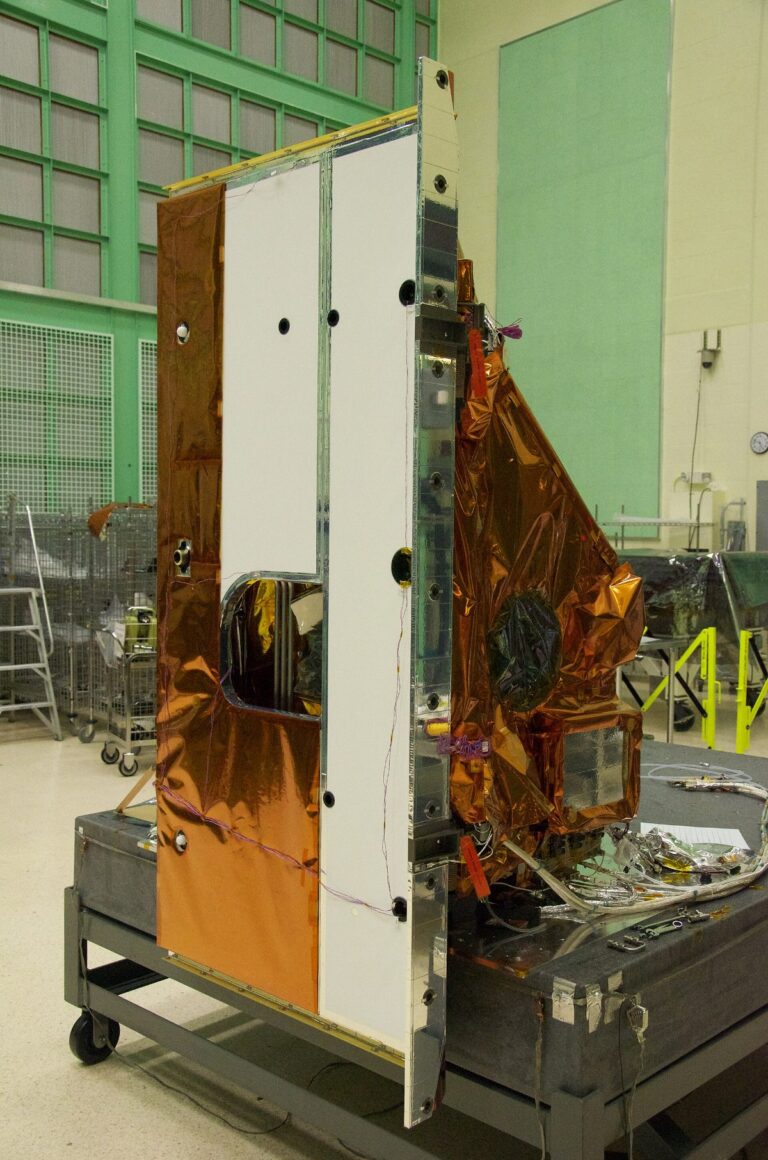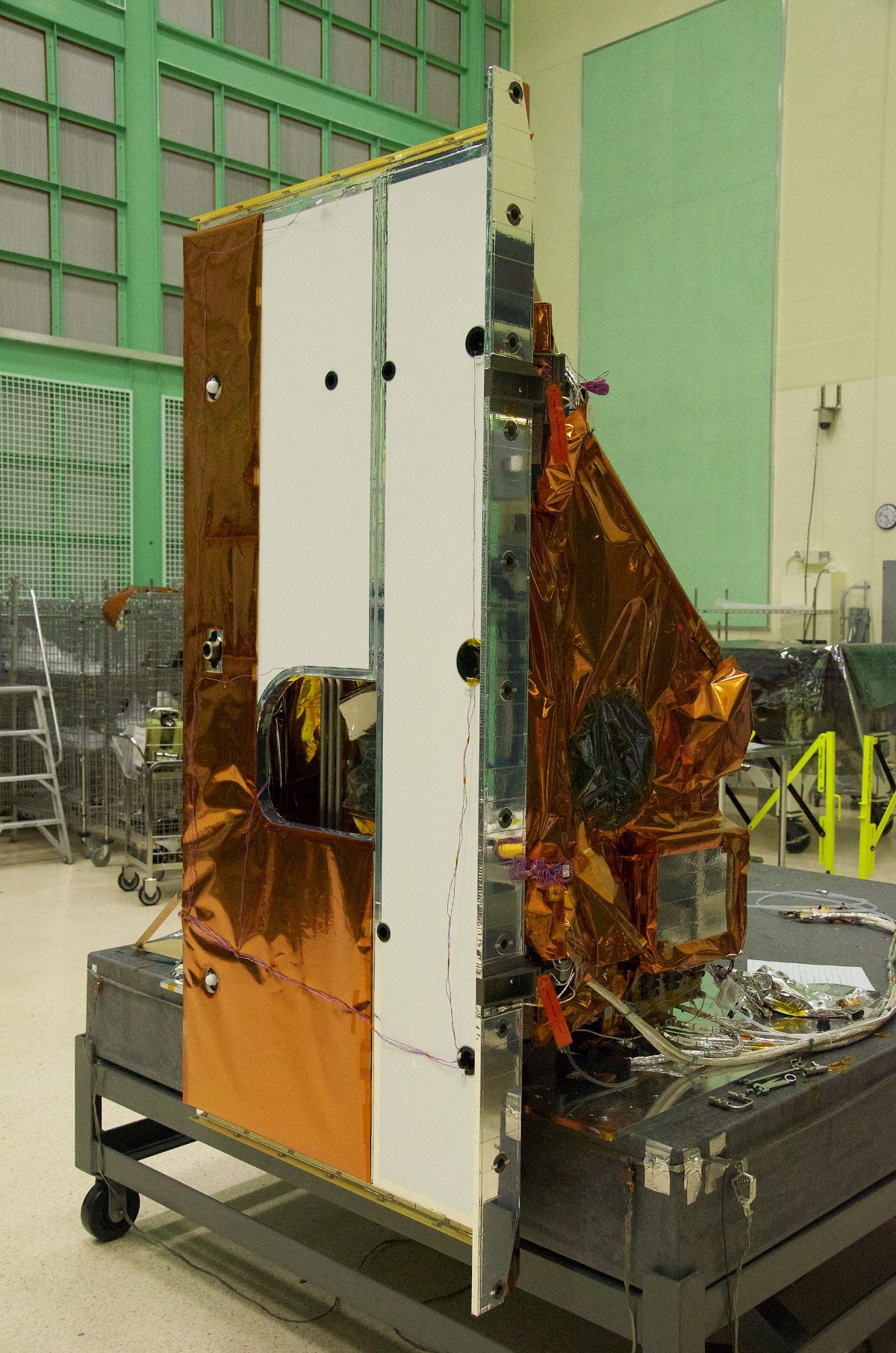
The Thermal Infrared Sensor (TIRS) built for Landsat. Photo: NASA Goddard Space Flight Center via Wikimedia Commons. License: Public domain.
Quick Answer: Orlando-based LightPath Technologies reported fiscal 2027 first quarter revenue of $20.8 million, up 38%, and gross margin of 41.4%, up from 29.8%, driven by infrared cameras and optics for counter-drone and defense programs. Backlog reached a record $132.9 million, and the company completed its exit from China, though it still posted a net loss of $1.7 million.
LightPath Technologies, Inc. (NASDAQ: LPTH), the Orlando optics and infrared imaging manufacturer, is in the middle of a transformation from a components supplier into a maker of complete camera systems for defense customers. Its fiscal 2027 first quarter results, released November 10, 2026, show that shift in the numbers: assemblies and modules now make up more than half of revenue, gross margin jumped more than 11 percentage points, and backlog has grown 54% in a year.
For Florida’s technology economy, LightPath is a useful case study of how defense demand, especially for counter-drone systems, is reshaping smaller Central Florida manufacturers. Here is what the quarter showed and what it means.
What did LightPath report for fiscal 2027 first quarter?
For the quarter ended September 30, 2026, LightPath reported revenue of $20.8 million, up 38% from $15.1 million in the first quarter of fiscal 2026. Gross profit nearly doubled, rising 92% to $8.6 million from $4.5 million, and gross margin expanded to 41.4% from 29.8%.
The company remained unprofitable on a GAAP basis. Net loss narrowed to $1.7 million, or $0.02 per share, from $2.9 million, or $0.07 per share, a year earlier. Adjusted EBITDA, a non-GAAP measure, rose to $1.3 million, or 6% of revenue, from $0.4 million, marking the fifth consecutive quarter of positive adjusted EBITDA.
| Metric (fiscal Q1) | FY2027 | FY2026 | Change |
|---|---|---|---|
| Revenue | $20.8M | $15.1M | +38% |
| Gross profit | $8.6M | $4.5M | +92% |
| Gross margin | 41.4% | 29.8% | +11.6 pts |
| Operating expenses | $10.8M | $7.0M | +54% |
| Net loss | -$1.7M | -$2.9M | Improved |
| EPS | -$0.02 | -$0.07 | Improved |
| Adjusted EBITDA | $1.3M | $0.4M | +252% |
| Backlog (Sept. 30) | $132.9M | $86.0M | +54% |
| Cash and equivalents | $82.9M | n/a | vs. $93.2M on June 30, 2026 |
Source: LightPath Technologies fiscal 2027 first quarter results release, November 10, 2026.
Revenue came in slightly below the company’s own expectations, according to Nasdaq’s summary of the earnings call, which management attributed mainly to supply chain delays for motors, externally sourced optics for its G5 cameras, electronics and detectors.
What changed below the gross profit line?
Cost of sales rose to $12.2 million from $10.6 million, a 15% increase against 38% revenue growth, which is how the margin expanded. Below operating income, LightPath swung from interest expense of about $269,000 a year earlier to interest income of about $671,000, reflecting the larger cash balance. The company also cited a lower earnout fair value adjustment as a factor in the narrower loss. On a non-GAAP EBITDA basis, before stock compensation and other adjustments, LightPath was still slightly negative at about $768,000, improved from about $1.3 million a year earlier.
How much has LightPath’s share count grown?
Weighted average shares outstanding rose to about 70.0 million in the quarter from about 43.3 million a year earlier, an increase of roughly 62%, based on figures in the release. That dilution, which funded the cash balance and acquisitions, means per-share results improve more slowly than total results. Net loss narrowed 41% in dollars, while loss per share improved from $0.07 to $0.02 partly because the loss was spread over more shares. The company’s accumulated deficit stood at about $253 million at quarter-end.
Which LightPath product lines are growing fastest?
LightPath reports four product groups. The fastest growth came from assemblies and modules, which include the G5 Infrared camera business.
| Product group | FY2027 Q1 | FY2026 Q1 | Change |
|---|---|---|---|
| Assemblies and modules | $10.5M | $6.0M | +76% |
| Infrared components | $4.7M | $4.1M | +15% |
| Visible components | $4.6M | $3.8M | +19% |
| Engineering services | $0.9M | $1.1M | -18% |
Source: LightPath fiscal 2027 first quarter release. Prior-year figures reclassified by the company; rounded figures may not sum.
Why are assemblies and modules now half of revenue?
Assemblies and modules rose to 51% of total revenue from 40% a year earlier. The company said the growth was driven by G5 Infrared camera and module sales for surveillance and counter-unmanned aircraft systems (C-UAS) programs. This is the core of LightPath’s strategy: selling complete imaging subsystems rather than individual lenses, which carries higher revenue per unit and, as the quarter showed, better margins.
What drove infrared and visible component sales?
Infrared components rose 15% to $4.7 million, including $1.1 million from Amorphous Materials, a business LightPath acquired in January 2026. That growth was partly offset by lower sales to European defense customers because of order timing. Visible components rose 19% to $4.6 million on higher sales to European industrial customers and to U.S. defense customers and distributors. Engineering services fell 18% to $0.9 million because of the timing of customer programs.
How large is LightPath’s backlog?
Backlog is the number management emphasizes most. LightPath ended the quarter with a record backlog of approximately $132.9 million, up 20% from $110.9 million at June 30, 2026, and up 54% from $86.0 million a year earlier. About $110.8 million of that backlog is scheduled for delivery within 12 months, up about 30% from the prior quarter. On the call, management said all backlog orders are firm and funded with signed delivery dates, according to Nasdaq.
To put the backlog in perspective, the $110.8 million due within a year is more than five times the company’s first quarter revenue.
What major orders did LightPath win?
| Order or program | Detail |
|---|---|
| C-UAS follow-on orders (July-Oct. 2026) | More than $30M in total |
| Single C-UAS/defense supplier | More than $19M of optical assembly orders, double its full fiscal 2026 total |
| October C-UAS order | $6.3M |
| Global technology customer | $11M infrared camera follow-on order, with a planned transition from germanium optics to BlackDiamond |
| Defense drone camera order (October) | More than 50,000 optical assemblies |
| CLEAR program | Funded prototype agreement to develop BlackDiamond glass and optics as germanium alternatives |
Sources: LightPath fiscal 2027 first quarter release; Nasdaq, LightPath Technologies Q1 Earnings Call Highlights.
The drone camera order illustrates the capacity challenge. LightPath’s current capacity for those assemblies is just under 10,000 units per month, and the company’s goal is several tens of thousands per month over the next 12 months, according to the call summary. CEO Sam Rubin said demand could eventually require 100,000 units per month.
What is BlackDiamond glass and why does it matter?
BlackDiamond is LightPath’s family of chalcogenide glasses used in infrared optics, sold under an exclusive license from the U.S. Naval Research Laboratory. Its strategic value is that it can replace germanium, a material used in infrared lenses whose supply has been a concern for U.S. defense programs.
In the quarter, LightPath disclosed a funded prototype agreement under the Department of War’s Critical Low-risk Electro-optic Alternatives for Resilience (CLEAR) program to develop BlackDiamond glass and optics as germanium alternatives for electro-optical and infrared systems. Nasdaq’s call summary referred to it as the Navy CLEAR program, with prototypes to be delivered over the next two years. Rubin described it in the release as “direct government support for the materials at the center of our platform.”
Why did LightPath exit China?
LightPath completed the sale of its subsidiary LightPath Optical Instrumentation (Zhenjiang) Co., Ltd. as of October 30, 2026, and said it no longer has any facilities or operations in China. According to the Nasdaq call summary, the exit was required for some U.S. government programs, and the buyer will remain a supplier for certain commercial products.
LightPath’s primary manufacturing is in Orlando, with additional facilities in Texas, New Hampshire and Latvia, according to the company’s description of itself in the release. For a defense supplier, a U.S. and European manufacturing footprint is increasingly a requirement rather than a preference.
How is LightPath spending its cash?
Cash and equivalents fell to $82.9 million at September 30, 2026, from $93.2 million at June 30. The company attributed the decline to a $10.1 million investment in working capital, mostly advance purchases of critical materials, and $2.5 million of capital spending, mainly for manufacturing capacity including glass fabrication. Cash used in operations was $8.3 million, and inventory rose $13.5 million to $31.5 million.
Operating expenses rose 54% to $10.8 million. Selling, general and administrative expenses climbed 84% to $8.0 million, reflecting $1.4 million of higher non-cash stock compensation, the addition of Amorphous Materials, and information technology spending to meet defense cybersecurity standards. New product development spending more than doubled to $2.0 million.
LightPath also faces a final $9 million earnout payment related to G5 Infrared, made up of about $6.3 million in cash and $2.7 million in shares, scheduled for the first half of January 2027. Management said on the call that it is comfortable with its liquidity and could pursue acquisitions.
| Balance sheet item (Sept. 30, 2026) | Amount |
|---|---|
| Cash and equivalents | $82.9M |
| Inventory | $31.5M |
| Total assets | $197.0M |
| Total liabilities | $36.8M |
| Stockholders’ equity | $151.3M |
| Shares outstanding | 70.1M |
Source: LightPath fiscal 2027 first quarter release.
What did LightPath management say about the outlook?
LightPath did not issue numeric revenue or earnings guidance. Rubin said in the release, “Fiscal 2027 is off to a strong start, led by backlog, a key indicator of our expected future revenue trends,” and “Our focus for the balance of fiscal 2027 is converting this backlog on schedule.”
On the call, according to Nasdaq, Chief Financial Officer Al Miranda said gross margins should “start with the number four,” meaning in the 40% range, and management said first quarter operating expenses are more indicative of the spending plan than the prior quarter’s $12.6 million. Rubin acknowledged supply chain risk, saying, “I cannot guarantee it will not be a problem.”
The company also announced leadership additions: Michael Amorelli was promoted to vice president of engineering for imaging systems, and Scott Payette, a former Anduril Industries production leader, was appointed vice president of LightPath and general manager of G5 Infrared LLC.
Brian’s Take
When I look at a company like LightPath, I start with the backlog, because that’s the closest thing to visibility a small manufacturer can offer. Roughly $111 million due within 12 months against a $20.8 million quarter is a meaningful cushion, and management says it’s all firm and funded. The 41.4% gross margin tells me the move from selling lenses to selling camera systems is paying off where it counts.
The risk, as I read it, is execution, not demand. Capacity for drone camera assemblies is just under 10,000 units a month against an order for more than 50,000, the company is spending ahead on materials, and the CEO himself won’t promise supply chain won’t bite. Cash went from $93.2 million to $82.9 million in one quarter, with a G5 earnout payment due in January. None of that is alarming, but it’s the part of the story I’d watch.
For Florida, this is the kind of company that matters more than its size suggests. An Orlando manufacturer that has exited China, holds a Navy-licensed germanium alternative, and is scaling for counter-drone demand is exactly the profile of defense-tech growth Central Florida should want more of.
Frequently Asked Questions
Where is LightPath Technologies headquartered?
LightPath Technologies is based in Orlando, Florida, where it has its primary manufacturing, with additional facilities in Texas, New Hampshire and Latvia.
What was LightPath’s fiscal 2027 first quarter revenue?
Revenue was $20.8 million for the quarter ended September 30, 2026, up 38% from $15.1 million a year earlier.
How big is LightPath’s backlog?
Backlog reached a record of approximately $132.9 million at September 30, 2026, with about $110.8 million scheduled for delivery within 12 months.
Is LightPath profitable?
Not on a GAAP basis. It reported a net loss of $1.7 million, or $0.02 per share, but adjusted EBITDA was positive at $1.3 million for the fifth straight quarter.
What is BlackDiamond glass?
BlackDiamond is LightPath’s chalcogenide infrared glass, licensed exclusively from the U.S. Naval Research Laboratory, designed as an alternative to germanium in infrared optics.
Does LightPath still operate in China?
No. LightPath completed the sale of its Zhenjiang, China subsidiary as of October 30, 2026, and has no remaining China facilities or operations.
Sources and Further Reading
- LightPath Technologies Reports Fiscal 2027 First Quarter Financial Results, LightPath Technologies via Newswire
- LightPath Technologies Q1 Earnings Call Highlights, Nasdaq
- Lightpath Q1 Revenue Surges 38% to $20.8 Million Amid Record $133 Million Backlog, Panabee
About the Author