TeraFab: Inside the SpaceX-Tesla Chip Gamble That Could Cost Trillions and Take a Decade to Pay Off
Florida Technology News | By Brian French Semiconductor & Space Industry Desk
Quick answer: SpaceX and Tesla’s jointly backed chip manufacturing project, known as TeraFab, has already drawn commitments in the tens of billions of dollars, with independent analyst estimates suggesting a fully built-out facility could ultimately require somewhere between $5 trillion and $13 trillion. Because of a multi-year backlog on extreme ultraviolet lithography machines from ASML, the only company that makes the tools needed for leading-edge chips, and because chip fabrication is one of the most technically unforgiving manufacturing processes on Earth, most industry analysts believe meaningful, high-yield production is realistically five to ten years away, if it happens at all.
What Is TeraFab, and Why Are SpaceX and Tesla Building It?
Earlier this year, Elon Musk unveiled plans for a chip manufacturing campus in Grimes County, Texas, that he has taken to calling TeraFab. The pitch is ambitious even by Musk-company standards: a single manufacturing site reportedly designed to exceed 100 million square feet, described by some coverage as larger than the Pentagon, Apple Park, the Mall of America, and Tesla’s own Giga Texas plant combined. The stated goal is to produce the AI inference chips that power Tesla’s Optimus humanoid robots and Cybercab autonomous vehicles, space-hardened processors for SpaceX and Starlink, and high-bandwidth memory to feed xAI’s data centers, all under one roof, with an eventual target of supporting roughly one terawatt of compute capacity per year.
The logic behind TeraFab is straightforward on paper. Tesla and SpaceX both depend heavily on advanced chips, and today those chips come from external foundries such as TSMC and Samsung, companies that also supply Nvidia, Apple, and virtually every other major chip buyer on the planet. By building their own fabrication capacity, Musk’s companies would, in theory, secure a dedicated supply of chips without competing for allocation against the rest of the industry. Intel joined the project in April, agreeing to contribute its 18A manufacturing process and its design, fabrication, and packaging expertise, a move that briefly boosted Intel’s market value on the news.
It’s worth noting how unusual this structure is. Vertically integrating chip production into a car company and a rocket company is not something any other automaker or aerospace firm has attempted at this scale. TSMC alone spent decades and tens of billions of dollars becoming the world’s leading contract chipmaker, and it still depends entirely on ASML for the lithography tools that make cutting-edge chips possible. TeraFab is attempting to compress a multi-decade industrial buildup into a single, unprecedented project.
Brian’s Take: “What strikes me most isn’t the ambition, it’s the sequencing. Musk has a well-documented pattern of announcing a factory before the hardest engineering problems are solved, and with cars and rockets that approach has sometimes worked because the failure modes are visible and fixable on the fly. Chip fabrication doesn’t forgive that kind of iteration. You can’t ‘move fast and break things’ when a single contaminated wafer batch costs millions of dollars and weeks of lost time. I think the timeline being discussed publicly is aspirational marketing more than an engineering schedule.”
How Much Will TeraFab Actually Cost?
Public figures around TeraFab’s price tag have moved dramatically since the March announcement, and that movement itself tells a story. Musk’s initial unveiling put the project at roughly $20 billion. Within weeks, SpaceX and Tesla jointly committed a reported $16.8 billion to begin construction. By May, SpaceX had filed paperwork suggesting the total chipmaking investment could reach $55 billion for its portion alone, with combined estimates across all partners potentially climbing toward $119 billion.
Then came the independent analysis. Wall Street research firm Bernstein, led by semiconductor analyst Stacy Rasgon, published an estimate that a fully realized TeraFab, one actually capable of hitting the announced one-terawatt compute target, could require capital expenditure of $5 trillion to $13 trillion. For context, that upper figure exceeds the current market capitalization of most of the world’s largest companies combined, and Bernstein’s own framing noted it could represent more than 70% of the total value the semiconductor industry has ever deployed in capital spending.
That gap, between the tens of billions committed so far and the trillions that full-scale execution would require, is the single most important number in this story. It is the difference between building a factory and building an entire vertically integrated semiconductor ecosystem, including power generation, water treatment, specialty gas supply chains, cleanroom infrastructure, and a workforce with skills that currently exist almost nowhere outside of Taiwan, South Korea, and a handful of American and European sites.
Brian’s Take: “Every time I see a headline cost figure for TeraFab, I ask what it’s actually funding, phase one construction, or the finished terawatt-scale vision. Those are wildly different numbers, and conflating them is how companies quietly walk back expectations two years later without anyone noticing. I’d watch the capital raises closely. Tesla and SpaceX can self-fund initial buildings, but trillions in equipment spending means outside capital, and outside capital means outside scrutiny of the timeline.”
The ASML Bottleneck: Why You Can’t Buy Your Way Out of the Backlog
This is the constraint that no amount of money fully solves, at least not quickly. Every chip fabrication plant capable of producing leading-edge logic chips depends on extreme ultraviolet, or EUV, lithography machines, and those machines are made by exactly one company in the world: ASML, based in the Netherlands. TSMC, Samsung, Intel, and now reportedly TeraFab are all customers competing for the same limited annual output of these machines, each of which costs well over $200 million, with the newest High-NA EUV systems priced above $400 million apiece.
ASML’s own executives have acknowledged that TeraFab factors into their capacity planning. In July, ASML’s chief financial officer told reporters that the company’s expansion plans for 2027 and 2028 already account for anticipated tool demand from the Texas project. That is a notable admission: it means ASML itself does not expect to deliver meaningful tool volume to TeraFab before 2027 at the earliest, and likely later once installation, calibration, and qualification are factored in. Industry discussion has pointed to an existing order backlog measured in years, not months, for the most advanced tools, because ASML’s own manufacturing capacity for these machines is limited by precision optics, specialized components, and a supply chain it does not fully control either.
This is the part of the story that headlines about “ground being broken” and “buildings taking shape” tend to skip. A finished cleanroom shell without lithography, etch, deposition, and metrology tools installed and running is an empty warehouse. And unlike a car factory, where you can add a second stamping press from a competing vendor, there is no alternative supplier for EUV lithography. If ASML’s queue is full, TeraFab waits in line like everyone else, regardless of how large a check gets written.
Brian’s Take: “This is the constraint I’d flag first to anyone evaluating TeraFab as an investment or a supply-chain bet. Money buys priority, sometimes, but it doesn’t buy machines that don’t exist yet. ASML has spent over a decade perfecting EUV manufacturing, and they are not going to double their own output because a new customer showed up with a big checkbook. If I’m right, TeraFab’s actual chip output timeline is set more by Veldhoven, the Netherlands, than by anything happening in Grimes County.”
Beyond the Building: Why Chip Fabrication Is Harder Than Construction
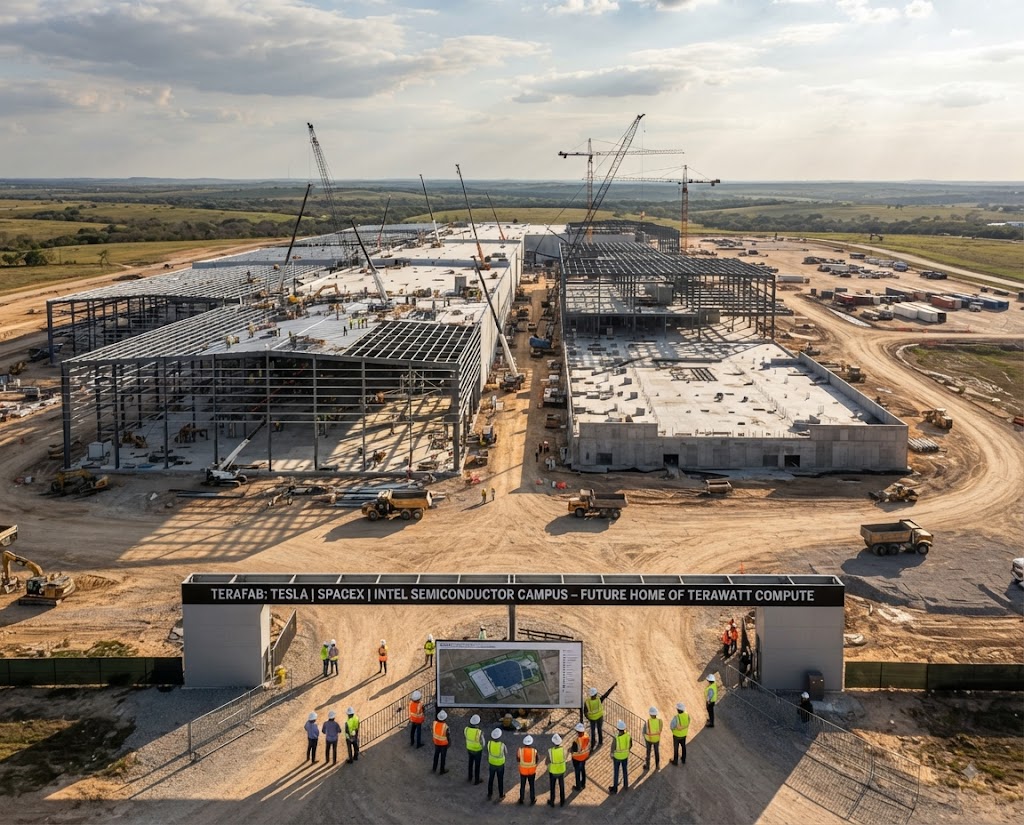
It’s easy to conflate “building a giant building” with “manufacturing chips,” but they are almost entirely different disciplines. Pouring concrete, erecting steel, and running power and water lines is a solved engineering problem; TeraFab’s construction pace, documented in recent drone flyovers, is genuinely impressive. But a semiconductor fab is not a warehouse with machines in it. It is arguably the most process-sensitive manufacturing environment ever created by humans.
Modern logic chips are built through hundreds of sequential steps, photolithography, etching, ion implantation, chemical vapor deposition, and chemical-mechanical polishing, repeated across dozens of layers, each requiring nanometer-level precision. A single speck of dust, a temperature fluctuation of a fraction of a degree, or a vibration from a truck outside can ruin an entire wafer lot. That is why fabs run cleanrooms rated far beyond hospital surgical suites, and why the equipment inside them requires specialized technicians who often train for years before they’re trusted to run a tool unsupervised.
Then there’s yield, the percentage of chips on a wafer that actually work and meet spec. New fabs almost universally start with poor yields, sometimes in the single digits, and it can take years of iterative tuning to reach the 80 to 90 percent yields needed for profitable mass production. TSMC and Samsung, companies with decades of institutional knowledge, still regularly report yield struggles when ramping brand-new process nodes. Building memory chips, DRAM and the high-bandwidth memory TeraFab reportedly intends to produce, introduces its own separate set of process challenges distinct from logic chips, effectively meaning TeraFab is trying to become expert in two of the industry’s hardest disciplines simultaneously, from scratch.
Brian’s Take: “People keep sending me photos of the TeraFab construction site like it settles the debate. It doesn’t. A steel structure tells you nothing about whether the process engineering team can get a 3-nanometer node to acceptable yield. TSMC’s Arizona fab took years longer than planned to reach production-quality yields, and TSMC has been doing this since 1987. TeraFab’s core team is, by comparison, starting from a much thinner base of institutional chipmaking experience, Intel’s involvement notwithstanding.”
Historical Precedent: Other Mega-Fabs That Stumbled
TeraFab would not be the first ambitious, headline-grabbing chip fab to face a gap between announcement and reality. Intel’s Ohio “Silicon Heartland” project, originally unveiled with enormous fanfare, saw its timeline pushed back multiple times as demand forecasts and capital priorities shifted. Foxconn and Wisconsin’s abandoned display factory promises are a cautionary tale from outside chips but within the same playbook of grand manufacturing announcements. GlobalFoundries scaled back leading-edge ambitions after concluding the capital requirements to stay competitive with TSMC and Samsung were unsustainable. Even TSMC’s own Arizona expansion, backed by one of the most experienced fabrication operators on Earth and supported by billions in U.S. CHIPS Act funding, took considerably longer than initially announced to begin volume production at target yields.
The pattern across nearly every one of these projects is the same: initial capital and timeline estimates prove optimistic, equipment delivery and installation take longer than planned, yield ramp takes longer than planned, and workforce training takes longer than planned. None of these delays are unique to any one company’s competence; they reflect the underlying difficulty of the discipline itself. A car company and a rocket company attempting this for the first time, even with Intel’s help, has no obvious reason to be exempt from that pattern, and several reasons to be more exposed to it, including a public statement history of aggressive timelines that has not always matched delivery in Tesla’s Full Self-Driving rollout or SpaceX’s Starship development cadence, both of which eventually succeeded but on timelines measured in years beyond original announcements.
Brian’s Take: “I don’t think TeraFab is destined to fail outright, SpaceX in particular has a track record of eventually delivering on outlandish-sounding goals after burning through money and time nobody expected. But ‘eventually, after burning far more time and money than promised’ is precisely the pattern investors and partners should price in now, not discover later. The question isn’t whether Musk’s companies can eventually make chips. It’s whether the capital markets and the timeline being sold to the public today can survive the multi-year gap between groundbreaking and profitable output.”
The Realistic Timeline: Why Five to Ten Years Is the Honest Estimate
Stitching together the ASML tool backlog, the physical construction schedule, the equipment installation and qualification process, and the historical yield-ramp timelines of comparable fabs, a five-to-ten-year window between today and meaningful, high-volume, high-yield chip production at TeraFab is a defensible estimate, and arguably a generous one. That breaks down roughly as follows: construction and shell completion measured in one to three years, given the pace already shown; EUV and supporting tool delivery realistically not beginning at scale until 2027 or later per ASML’s own capacity commentary, with full tool installation and calibration adding another one to two years on top of delivery; and yield ramp to commercially viable output historically taking two to four additional years even for experienced operators.
Layer those stages together, accounting for the near certainty of some delays given the unprecedented scale involved, and a facility announced in 2026 realistically does not reach steady, profitable, high-yield production before the early-to-mid 2030s. During nearly all of that window, TeraFab will be a capital sink: billions of dollars spent on construction, equipment, specialty materials, and a growing workforce, with little or no chip output to offset the spending. That is not necessarily catastrophic for two companies as large and cash-generative as SpaceX and Tesla, but it is a materially different story than the one implied by announcement-day headlines, and it is the central reason a growing number of analysts, Bernstein among the most explicit, have urged caution about near-term expectations.
Brian’s Take: “If someone tells you TeraFab will be shipping meaningful chip volumes for Optimus or Starlink by 2028, ask them what assumption they’re making about ASML’s delivery schedule, because that’s the actual pacing item, not construction speed. My honest read: 2031 to 2033 is a more credible window for anything resembling steady-state, high-yield production, and even that assumes no major surprises, which would itself be a first for a project this size.”
What This Means for Investors, Employees, and Florida’s Tech Sector
Florida doesn’t host TeraFab directly, but the state’s tech and aerospace ecosystem, from the Space Coast’s launch infrastructure to a growing cluster of chip-adjacent manufacturers and Tesla supplier relationships around the state, has real exposure to how this plays out. A successful TeraFab could eventually diversify chip supply away from Asia-Pacific concentration, a goal shared by U.S. policymakers since the CHIPS Act. A stumbling or delayed TeraFab, on the other hand, could tie up capital that Tesla and SpaceX might otherwise deploy toward core vehicle, robotics, or launch programs, and could complicate hiring in a semiconductor labor market that is already stretched thin nationwide, including for the specialized process engineers Florida’s own advanced manufacturing programs are trying to cultivate.
For investors specifically, the lesson from comparable megaprojects is to treat announcement-stage capital figures as a floor, not a ceiling, and to watch for the concrete milestones that actually matter: confirmed EUV tool delivery dates, first wafer starts, and reported yield data, rather than construction photos or square-footage superlatives. For everyday readers simply trying to understand what TeraFab means for the tech products they use, the realistic takeaway is patience: don’t expect TeraFab-made chips inside a Tesla, an Optimus robot, or a Starlink terminal for several years yet, and treat any near-term claims to the contrary with healthy skepticism grounded in how this industry has actually behaved before.
Brian’s Take: “I’d love to be wrong about the long timeline, a faster, cheaper path to U.S. chip independence would be great for the country and great for Florida’s own manufacturing ambitions. But wanting a good outcome and expecting one on the announced schedule are different things, and my job here is to separate the two.”
Frequently Asked Questions
Is TeraFab a real joint venture between SpaceX and Tesla? Yes. Public reporting confirms SpaceX and Tesla have jointly committed billions of dollars to the Texas facility, with Intel joining as a process and manufacturing partner in April 2026.
How much will TeraFab cost in total? Initial commitments are in the $16.8 billion to $20 billion range, with filings suggesting the total buildout could reach $55 billion to $119 billion. Independent analyst estimates from Bernstein put the cost of achieving the full announced one-terawatt compute target at $5 trillion to $13 trillion.
Why can’t TeraFab just buy more chipmaking equipment to go faster? Because the most advanced lithography tools are made exclusively by ASML, whose own manufacturing capacity and order backlog constrain delivery timelines regardless of a customer’s budget. ASML has confirmed TeraFab is already factored into its 2027-2028 capacity planning.
When will TeraFab actually produce usable chips at scale? No official production date for high-yield volume manufacturing has been confirmed. Based on equipment delivery timelines and historical yield-ramp patterns at comparable fabs, a five-to-ten-year window from the 2026 announcement is a realistic estimate for meaningful, profitable output.
Could TeraFab fail outright? Outright cancellation seems less likely than significant delay and cost overrun, based on the track record of Musk-affiliated megaprojects and comparable chip fabs elsewhere. The more probable risk is a multi-year gap between capital spent and chips produced.
Bottom Line
TeraFab is a real, well-funded, and genuinely ambitious attempt to bring vertically integrated chip manufacturing inside the Tesla and SpaceX ecosystem. It is also, by the numbers currently being discussed by ASML, Bernstein, and comparable historical fabs, a project where the distance between groundbreaking and meaningful production will likely be measured in years, not months, and where the fully realized cost could run into the trillions rather than the tens of billions announced so far. None of that makes TeraFab a hoax or a certain failure. It makes it a long, expensive bet whose payoff, if it comes, is most plausibly a story for the early 2030s rather than the late 2020s.
Resources
- Reuters, “ASML financial guidance includes Terafab plans, CFO says,” July 15, 2026
- Tom’s Hardware, “Analyzing Elon Musk’s TeraFab — A step towards Tesla and SpaceX’s partial vertical integration, or an unattainable dream?”, March 30, 2026
- Tom’s Hardware, “Elon Musk’s Terafab semiconductor project could cost $5 trillion, Bernstein claims,” March 26, 2026
- Tom’s Hardware, “SpaceX files for $55 billion semiconductor fab in rural Texas for Musk’s Terafab,” May 6, 2026
- Tom’s Hardware, “Intel joins Elon Musk’s TeraFab project,” April 7, 2026
- Tom’s Hardware, “Elon Musk’s massive Terafab chip-making facility starts to take shape,” August 2026
- U.S. News & World Report / Reuters, “Factbox: Elon Musk Lays Out Terafab AI Chip Project Plan,” April 23, 2026
- Forbes, “Intel Joins Terafab To Build Elon Musk’s AI Chip Factory,” April 10, 2026
- Anastasi In Tech, “TeraFab — New Chip Factory That Terrifies TSMC,” YouTube
Note: TeraFab is a fast-moving, recently announced project, and figures around cost, scope, and timeline have already shifted several times since the initial announcement. Readers should treat all cost and schedule estimates in this article, and in any coverage of the project, as subject to change and verify current details against primary reporting before making financial decisions.
A note on sourcing: this article draws on publicly reported figures and analyst estimates current as of early-to-mid August 2026. TeraFab’s costs, partners, and timeline are likely to continue evolving, and Florida Technology News will update coverage as new details emerge.
About the Author