Has Tesla Lost the Autonomous Car Race? The 2026 Evidence Says Yes
By Brian French | Updated August 12, 2026
Quick Answer
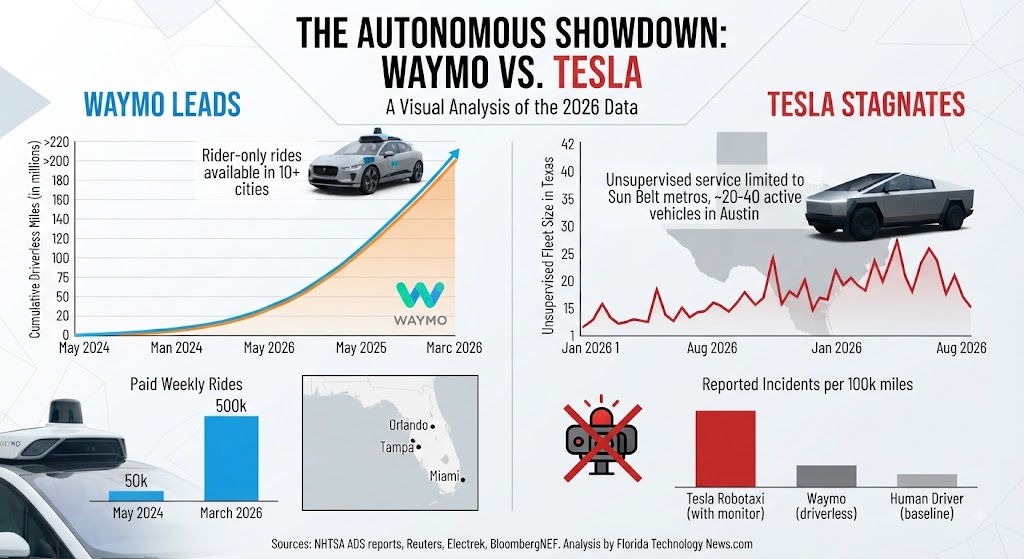
Yes — as of August 2026, Tesla is badly losing the autonomous vehicle race. Waymo operates roughly 4,000 driverless vehicles across more than ten metro areas, has surpassed 220 million fully autonomous rider-only miles, and is delivering hundreds of thousands of paid driverless rides every week. Amazon’s Zoox has driven more than 3 million autonomous miles, carried close to a million riders, and began charging for rides in Las Vegas on August 10, 2026. Tesla, more than a year after launching “Robotaxi” in Austin, has roughly 20 to 40 vehicles operating without a safety monitor in Texas — a fleet that has at points shrunk rather than grown. Tesla’s camera-only architecture, its refusal to adopt lidar, its heavily criticized safety statistics, and its inability to scale past a pilot all point to the same conclusion: the vision-only bet has not paid off, and the gap is widening.
About Brian French
Brian French is the owner and publisher of the Florida Authority Network news platform and writes extensively on technology, with a focus on autonomous vehicles, transportation, and the gap between what technology companies promise and what they ship.
Before turning to publishing, he spent his career on Wall Street as a money manager and stock analyst — a background that shapes how he reads this beat.
He has followed the robotaxi sector since the earliest Waymo permit filings in Arizona and has spent years tracking NHTSA Standing General Order crash disclosures, state DMV disengagement reports, and the quarterly claims made by every major player in the space.
The Scoreboard: Where Each Company Actually Stands in August 2026
For a decade, “who’s winning self-driving” was an argument about vision, philosophy, and press conferences. It isn’t anymore. There are now numbers, and they are not close.
Waymo. Through March 2026, Waymo had driven 220.6 million rider-only miles without a human driver. Its latest safety analysis covers more than 220 million fully autonomous miles across five operating geographies, and reports 94% fewer crashes causing serious or fatal injuries, 82% fewer crashes in which an airbag deployed, and 82% fewer crashes involving any reported injury, compared with human drivers in the same areas over the same period — regardless of fault. Waymo has grown from 50,000 paid weekly rides in May 2024 to 500,000 per week, expanding beyond Phoenix, San Francisco, and Los Angeles into Austin, Atlanta, Miami, Dallas, Houston, San Antonio, and Orlando. At its current scale — over four million miles driven weekly — Waymo’s own analysis suggests the system prevents approximately one serious-injury crash every eight days.
Zoox. Amazon’s purpose-built robotaxi — no steering wheel, no pedals, no driver’s seat — went from an oddity to a commercial service in under a year. Since launching publicly, Zoox has driven more than 3 million miles on public roads and carried nearly 1 million riders across Las Vegas, San Francisco, Miami, and Austin. On August 5, 2026, Zoox announced it would begin charging for rides in Las Vegas starting August 10 — its first commercial launch. Zoox is now widely positioned as the second-largest player in the U.S. robotaxi market behind Waymo.
Tesla. Here is where the story gets uncomfortable for the company with the largest market capitalization in the automotive world. Texas DMV registration data submitted under new reporting rules showed 42 registered robotaxis in the state — dramatically below Elon Musk’s earlier projection of roughly 1,000 vehicles within a month of launch.
Unsupervised operations began in Austin on January 22, 2026 with a single vehicle, grew to eight in February, and reached roughly 30 across Austin, Dallas, and Houston by mid-2026. Worse, the trend line has not been monotonic. In late May 2026, tracking data indicated Tesla had just 32 active unsupervised robotaxis across three cities, while the broader ride-hailing fleet including supervised vehicles in California fell from 165 active vehicles in April to 34 — a decline Tesla has not publicly explained. By late July 2026, Tesla had switched on service in Tampa and Orlando the day before its Q2 earnings call, while the Austin fleet — its oldest, most-validated, most-mapped market — remained stuck under 20 unsupervised cars.
That last detail is the whole argument in miniature. If your technology were ready, you would flood your best market. Tesla is instead adding pins to a map.
🔎 Brian’s Take #1
Forget the philosophy debate for a second and just read the deployment numbers. Waymo went from 50,000 to 500,000 paid weekly rides in under two years. Zoox went from zero to a paid commercial service in Las Vegas. Tesla went from ten cars in Austin to — depending on the week — somewhere between 17 and 32 cars without a safety monitor, spread across three or four metros. That is not a slow start. A slow start still moves in one direction. Tesla’s unsupervised fleet has expanded, contracted, and drifted sideways for eight months. Meanwhile, the company keeps announcing new cities, because lighting up a geofence is a map edit and a tweet, while actually deploying a dense, reliable driverless fleet is the hard engineering problem Tesla still has not solved anywhere on Earth. When a company that manufactures two million cars a year cannot put 50 driverless cars on the road in the city it has been operating in the longest, the constraint is not manufacturing. It’s the software. It’s the sensors. It’s the architecture.
Why the Lidar Decision Is Now the Defining Mistake
In 2019, Elon Musk called lidar “a fool’s errand” and said anyone relying on it was “doomed.” That statement is now the most consequential engineering call in the company’s history, and it has aged badly.
Waymo’s approach is deliberately redundant. The Waymo Driver uses cameras, radar, and lidar together, with each sensor providing a complementary field of view that the company describes as especially helpful in inclement weather. Zoox does the same. Every major operator that has achieved driverless commercial operation at scale — Waymo, Zoox, Nuro, and the Chinese operators — uses multi-modal sensing. Every single one.
The engineering logic is not complicated. Cameras infer depth; lidar measures it. Cameras degrade catastrophically in direct sun glare, heavy rain, spray, fog, and low-light conditions where a low-contrast object sits against a low-contrast background. Radar penetrates weather but has poor angular resolution. Lidar gives you a direct, geometric, weather-tolerant point cloud. Stack all three and a failure in one modality is caught by the other two. Run only cameras and every failure is a single point of failure.
Musk’s counterargument was always economic and philosophical: humans drive with two eyes, lidar was expensive, and sensor fusion introduced ambiguity. Two of those three arguments have collapsed. Lidar unit costs have fallen by more than an order of magnitude since 2019, to the point where sensor cost is no longer the binding constraint on a robotaxi’s unit economics — vehicle depreciation, remote assistance staffing, cleaning, and depot operations dominate. And the “humans only use eyes” analogy was always weak: humans also have a brain with general world knowledge, a neck that turns, and the ability to slow down when they can’t see. A neural network trained on video clips has none of that.
What’s left is the philosophical argument, and philosophy does not show up in a crash-per-mile table.
Has Tesla’s FSD “Learning Curve” Plateaued?
Tesla’s entire thesis rests on a scaling assumption: with enough fleet data, camera-only neural networks will keep improving until they cross the threshold of human-level safety. The assumption is that the curve keeps bending upward.
The evidence for a plateau is not that improvement has stopped. It’s that improvement has stopped mattering.
Consider the sequence. Community tracker data showed FSD v14.1 producing what analysts called the biggest sequential improvement in four years of data collection. The tracker’s core metric, miles to critical disengagement, showed a greater-than-20x jump after v14.1.x released in October, from 441 miles to over 9,200 — followed by a subsequent downtick in performance with v14.2.x. That downtick took the figure back down to roughly 1,500 miles to critical disengagement, which Piper Sandler attributed to sparse data on the new version, noting that of 17,000 miles gathered only about 4,500 could be used to track critical disengagements.
Read that carefully. The headline metric swung by a factor of six between two point releases of the same software generation, and the explanation was that the underlying dataset was too small and too self-selected to be reliable. That is not a measurement of progress. That is noise dressed as a trend line, produced by volunteers who opt in, who choose when to engage the system, and who disproportionately drive it in conditions where it works.
Now look at what Tesla itself did with that supposedly transformational improvement. Nine months after Austin went live, Tesla had 25 unsupervised vehicles and 14 logged crashes, and Musk deferred scaling to FSD v15 — an architectural overhaul scheduled for late 2026 at the earliest and early 2027 at the latest. Musk also acknowledged that the Hardware 3 platform fitted to a substantial portion of Tesla’s global fleet lacks the memory bandwidth required for unsupervised operation and cannot be upgraded without replacing both the compute unit and the cameras.
Two admissions are buried in there, and both are devastating. First: the current architecture is not the one that will achieve autonomy, which means the v14 improvements everyone cheered were not sufficient. Second: millions of cars sold with a promise of future full self-driving cannot be upgraded to deliver it without a hardware replacement Tesla has not committed to funding at scale.
A learning curve that requires a full architectural rewrite to continue is not a smooth exponential. It’s a wall that a company is trying to tunnel through.
Has Vision-Only Autonomy Failed?
Stated plainly: yes. Vision-only has failed to produce what it was supposed to produce, on the timeline it was supposed to produce it, in the conditions it was supposed to handle.
The measure of failure isn’t that Tesla’s cars drive badly. In good conditions, in a mapped and heavily-rehearsed geofence, they often drive impressively. The measure of failure is that after eleven years of promises, roughly a decade of fleet data collection, more miles of consumer driving data than any competitor could dream of, and the single largest real-world training corpus in the industry, Tesla still cannot take the human out of the car at scale — while a competitor with a fraction of the data, using lidar, took the human out years ago and now runs half a million paid rides a week.
If the data-scale thesis were correct, Tesla should have won already. It had the most data by orders of magnitude. It lost anyway. The most parsimonious explanation is that the bottleneck was never data volume. It was the information the sensors physically cannot capture.
Tesla’s vision-only system relies on eight cameras to navigate, and rain, fog, and sun glare obstruct those cameras, degrading system performance. Every one of those is a condition that lidar handles and cameras don’t.
🔎 Brian’s Take #2
Here’s the tell. If vision-only were working, Tesla would be publishing. Waymo publishes peer-reviewed safety analyses, submits to independent academic review, breaks results out by city, and files full narrative crash descriptions with federal regulators. Tesla publishes a marketing page and redacts its crash narratives as confidential business information. Companies that are winning show their work. Companies that are losing control the frame. The fact that Tesla’s public case for FSD safety rests on a self-constructed comparison rather than on the obvious, available, and far more persuasive move — just remove the safety monitors and let the driverless miles speak — tells you everything about how confident the people inside the building actually are.
The Weather Problem: Every Tesla Robotaxi City Is a Warm One
Look at the map. Austin. Dallas. Houston. Tampa. Orlando. The Bay Area. Every single Tesla Robotaxi deployment sits in a mild-winter metro.
This is not an accident, and Tesla is not alone in it — Waymo’s commercial cities have historically skewed Sun Belt too. But there is a decisive difference in what each company is doing about it.
Waymo has been actively building for winter for years. It has run winter road trips since 2017 in Michigan, in Buffalo, in Truckee, and across the Upper Peninsula, and its sixth-generation hardware is designed for winter environments with sensors that can melt snow off them. It announced expansion into Detroit and Denver, cities where roads are slick with ice and visibility is poor for more hours of the day. In March 2026 it released footage of its vehicles operating in snowy conditions in Denver, Detroit, New York City, Philadelphia, Houston, and Washington, D.C. Waymo’s stated design goal is one generalizable system where the same Driver that navigates foggy San Francisco can navigate snowy Denver, and the company explicitly credits the camera-radar-lidar combination for inclement weather performance. It has pushed a 2026 expansion list toward fifteen-plus cities including Minneapolis.
Tesla has announced no equivalent program. There is no Tesla winter validation fleet in Michigan. There is no snow-melting sensor package, because there is no sensor package beyond cameras and a windshield wiper. When Austin had an ice storm in January 2026, the fleet paused for two days.
Pausing during an ice storm is defensible. Pausing during an ice storm when your entire commercial thesis is a nationwide autonomous network covering every American city is a preview of a structural limitation. A robotaxi service that cannot operate in Chicago in February, Boston in January, or Minneapolis at all is not a transportation network. It’s a seasonal amenity in the Sun Belt.
And here is the part that should worry Tesla shareholders most: the current comparison already flatters Tesla. Tesla’s crash numbers, disengagement numbers, and availability numbers are all generated in the easiest driving conditions in the United States — dry pavement, high visibility, no road salt, no black ice, no snowbanks obscuring lane markings, no low winter sun blasting directly into a camera lens at 4 p.m. Apply Buffalo or Denver conditions to a camera-only stack and the gap does not narrow. It blows open.
How Tesla’s Safety Numbers Are Constructed — and Why Researchers Say They Mislead
Tesla has spent years telling the public that its driver assistance systems are roughly ten times safer than human drivers. That claim has now been examined in detail by journalists, academics, and federal legislators, and it has not survived the examination.
A Reuters investigation published May 28, 2026 examined the methodology directly. The review found several invalid data comparisons underlying the statistics in Tesla’s FSD safety report, and ten of eleven traffic-safety researchers who reviewed the methodology said it amounted to misleading marketing rather than a serious investigation into a critical safety issue. Tesla compares a rate of crashes in FSD-piloted Teslas that triggered airbag deployments against a federal crash rate for all vehicles that includes far less-severe accidents, and it compares its cars to the average U.S. vehicle, which is much older than the average Tesla.
That is the core trick, and it is worth restating in plain language: Tesla counts only its own severe crashes, then compares that count to everybody else’s severe and minor crashes, then attributes the resulting gap to its software. A senate oversight letter to NHTSA described the same problem — Tesla counted crashes in its own fleet involving airbag deployments and compared that figure to federal crash data tracking crashes in which a vehicle was towed from the scene, a broader category capturing many less severe crashes.
The structural criticisms compound. Tesla’s methodology is self-reported, it counts only crashes that trigger an airbag or restraint, it does not disclose raw crash counts or vehicle miles traveled, and its Autopilot figures come disproportionately from limited-access highways — already the safest roads — while the federal baseline blends all road classes. It is also not Autopilot versus humans; it is Autopilot plus a supervising human against humans, and there is no way to know how many accidents the human drivers prevented during that mileage. Add selection effects — Tesla owners skew toward newer vehicles, higher incomes, and tech-enthusiast demographics with inherently lower baseline crash risk, and Autopilot usage clusters into daytime and favorable conditions.
Every single one of those distortions runs in the same direction. That is the part that should end the debate about whether this is sloppiness or strategy. Random error produces mistakes in both directions. Tesla’s produce only one.
And the internal view is no more reassuring. Reuters interviewed nine former Tesla data labelers — the workers who train the AI by reviewing footage from the eight exterior cameras — and seven of the nine said they wouldn’t trust FSD to drive them. A veteran self-driving engineer who reviewed Tesla crash data for years called the company’s safety claims “bullshit.” The labelers described reviewing clips of cars hitting cats, dogs, and deer, sometimes without braking before impact, frequently speeding, and occasionally near-missing children playing in the street.
🔎 Brian’s Take #3
Compare the transparency postures and the whole race becomes legible. Waymo files full narrative crash descriptions with NHTSA. So do Zoox, Aurora, and Nuro. Tesla is the only major autonomous operator that redacts every single crash narrative as confidential business information. So when a Tesla robotaxi struck a cyclist, the public record says a cyclist was struck — and then a black bar. Think about who benefits from that black bar. Not riders. Not regulators. Not the cyclist. There is exactly one party whose interests are served by making it impossible to independently assess what the software did wrong, and that party is the one filing the redaction.
The Actual Crash Record: What the Federal Data Shows
Strip away the marketing and look at the mandatory federal disclosures.
Updated NHTSA filings examined by Electrek showed Tesla had reported a total of 14 documented collisions involving its Robotaxi service since operations began in Austin in June 2025, including a collision with a fixed object at 17 mph, a crash with a bus while the Robotaxi was stationary, a crash with a truck at 4 mph, and two incidents in which the vehicle backed into a pole or tree. Against an estimated 800,000 fleet miles, that works out to roughly one crash every 57,000 miles — approximately four times worse than the rate implied by Tesla’s own Vehicle Safety Report benchmark of one minor collision per 229,000 miles for average drivers. Measured against NHTSA’s standard of one police-reported crash per 500,000 miles, the gap widens to nearly nine times worse; even on the most conservative comparison, including unreported fender-benders at roughly one per 200,000 human miles, Tesla’s fleet still crashes at about 3.5 times the human rate.
And the crucial context: every Tesla robotaxi in that reported mileage had a safety monitor onboard who could intervene at any moment — a human being whose entire job was to prevent crashes — and the rate was still an order of magnitude worse than ordinary human drivers operating alone.
The head-to-head is starker still. A comparison of NHTSA incident reports found Tesla Robotaxis crashing approximately once every 62,500 miles against Waymo’s roughly one per 98,600 miles, with Waymo operating fully driverless while Tesla ran safety monitors. A more sophisticated analysis using fault attribution reaches the same conclusion from a different angle. Waymo is at fault in only 12–15% of its reported incidents and is frequently struck while stopped — a pattern that itself indicates enormous operational mileage — while Tesla’s fewer reported crashes show a higher at-fault rate even under supervision, suggesting less real-world driving and system immaturity.
There is one more data point that captures the difference in institutional seriousness. Waymo spent a decade documenting more than 13 million California test miles before earning its commercial driverless permit there. Tesla has logged 562 California autonomous test miles since 2016.
Five hundred sixty-two.
Why a Handful of Crashes Could End the Program Entirely
This is the risk that Tesla’s fleet size makes acute rather than manageable, and it is the reason the small deployment numbers are not merely embarrassing but existentially dangerous.
Statistical safety arguments require volume. Waymo can absorb a bad incident because it has 220 million driverless miles of context to place it in; a single crash moves its rate by a rounding error, and its published, independently reviewed methodology means regulators and the public can evaluate the event against an established baseline. Tesla has none of that cushion. With a fleet in the dozens and a few hundred thousand unsupervised miles, two or three serious injury crashes in a short window would not be an anomaly in the data. They would be the data.
The precedent is fresh and unambiguous. Cruise had a functioning commercial service in multiple cities, a fleet vastly larger than Tesla’s current robotaxi deployment, and billions of dollars in GM backing. One pedestrian incident in San Francisco, compounded by a disclosure failure, and the permits were suspended, the leadership resigned, and General Motors eventually shut the entire program down. The technology did not become worse overnight. The regulatory and political tolerance evaporated overnight.
Tesla is more exposed to that dynamic than Cruise was, for four reasons. Its crash rate is already measurably worse than human drivers and than every peer. Its crash narratives are redacted, which means that in the days after a serious incident the company will have no credible independent record to point to. NHTSA already has four active investigations into FSD and Autopilot. And Tesla’s public safety claims have now been contradicted in detail by Reuters, by academic researchers, by federal legislators, and by its own former employees — which means that when the company says “the data shows we’re safe,” the sentence will not do the work it needs to do.
Tesla also revised a July 2025 crash report to indicate the incident involved a hospitalization, after initially classifying it as property damage only. In a crisis, that correction becomes exhibit A.
🔎 Brian’s Take #4
I want to be precise about what “losing the race” means, because it doesn’t mean Tesla is going bankrupt or that FSD is worthless. FSD (Supervised) is a genuinely impressive consumer driver-assistance product and it is getting better. What it means is this: Tesla set the terms of this competition itself. It promised a nationwide autonomous network, a million robotaxis on the road, and an appreciating fleet of self-driving assets. Judged against Tesla’s own stated goal, on Tesla’s own stated timeline, using Tesla’s own chosen metric of driverless deployment, the company is running roughly five years behind a competitor it publicly dismissed and is now being passed by an Amazon subsidiary that started far later with a purpose-built vehicle. Waymo is doing 500,000 paid driverless rides a week. Zoox is charging money in Las Vegas. Tesla is under 20 unsupervised cars in Austin, thirteen months in. You do not need a model to interpret that. You need a calendar.
The Strongest Counterargument — And Why It Doesn’t Rescue the Thesis
Fairness requires stating the bull case at its best, because it is not empty.
Tesla’s defenders argue that Waymo’s approach doesn’t scale economically: hand-built sensor suites, expensive vehicles, per-city HD mapping, remote assistance staffing, and depot infrastructure make each Waymo an expensive asset, while a Tesla is a mass-produced consumer car whose autonomy hardware costs a fraction as much. On this view, Waymo is winning a demonstration and Tesla is building a manufacturing platform, and the moment camera-only crosses the safety threshold, Tesla scales from 40 cars to 400,000 faster than Waymo can build 4,000 more. Supporters also point to the genuine v14 improvements, to Piper Sandler’s assessment that Tesla is close to removing safety operators, and to the fact that Waymo’s own impressive safety statistics come predominantly from low-speed urban surface streets in fair weather with human-benchmark baselines that include many underreported minor collisions.
Those criticisms of Waymo’s benchmarking are legitimate and worth taking seriously. But the argument fails on its central premise, which is a conditional: when camera-only crosses the safety threshold. Everything in the bull case is downstream of that clause. Tesla’s manufacturing advantage is real and it is worth nothing until the software works without a human in the seat, and Tesla’s own CEO has now deferred that milestone to a not-yet-built architecture on hardware most of the existing fleet doesn’t have. Lidar costs have collapsed, which erodes the cost argument. And Waymo is not standing still — it is expanding into snow, onto freeways, into airports, and toward international markets while Tesla renegotiates its own deadline.
A cheaper car that cannot drive itself is not a cheaper robotaxi. It’s a car.
Frequently Asked Questions
Is Tesla behind Waymo in self-driving? Yes, substantially. Waymo has driven more than 220 million fully autonomous rider-only miles and delivers roughly 500,000 paid driverless rides per week across ten-plus U.S. metros. Tesla’s unsupervised robotaxi fleet numbers in the dozens across three to five metros as of mid-2026.
Does Tesla use lidar? No. Tesla’s production vehicles and its Robotaxi fleet rely on a camera-only architecture using eight exterior cameras. Waymo, Zoox, Nuro, and every other operator running driverless commercial service use a combination of cameras, radar, and lidar.
How many Tesla robotaxis are there? Texas DMV filings showed 42 registered robotaxis in the state, of which roughly 20 to 32 operate without an in-car safety monitor, spread across Austin, Dallas, and Houston. Tesla does not disclose exact fleet counts.
Are Tesla’s safety statistics accurate? Independent review says no. A Reuters investigation found that ten of eleven traffic-safety researchers who examined Tesla’s FSD safety methodology described it as misleading marketing rather than serious safety analysis, primarily because Tesla compares its own airbag-deployment crashes against much broader federal crash categories.
Can self-driving cars handle snow? Waymo has conducted winter validation in Michigan, upstate New York, and the Sierra Nevada for years, and its sixth-generation hardware includes sensors designed to shed snow. Tesla has announced no comparable winter validation program, and all of its robotaxi markets are mild-winter cities.
Has Tesla’s FSD stopped improving? FSD continues to improve as a supervised consumer feature. What has stalled is the metric that matters commercially: Tesla has not been able to remove safety monitors at scale, and Musk has deferred meaningful scaling to a future architectural rewrite, FSD v15, targeted for late 2026 at the earliest.
Sources and Further Reading
Primary company data
- Waymo, Safety Impact Data Hub — https://waymo.com/safety/impact/
- Waymo, “Safety data update, June 2026” — https://waymo.com/blog/shorts/safetydata-june26/
- Waymo, “Waymo safety impact update: 170M miles” — https://waymo.com/blog/shorts/waymo-safety-impact-update-170m/
- Waymo, “Creating an all-weather Driver” — https://waymo.com/blog/2025/10/creating-an-all-weather-driver/
- Waymo, “2025 Year in Review” — https://waymo.com/blog/2025/12/2025-year-in-review/
- Tesla, FSD (Supervised) Vehicle Safety Report — https://www.tesla.com/fsd/safety
Investigative reporting
- Reuters, “Why Tesla’s AI trainers don’t trust its self-driving tech – or its safety stats” (May 28, 2026) — https://www.reuters.com/investigations/why-teslas-ai-trainers-dont-trust-its-self-driving-tech-or-its-safety-stats-2026-05-28/
- Electrek, “Tesla’s own AI trainers don’t trust ‘Full Self-Driving’ or its safety stats, Reuters finds” — https://electrek.co/2026/05/28/tesla-fsd-safety-stats-misleading-reuters-investigation/
- Electrek, “Tesla ‘Robotaxi’ status check: 8 months in, 19% availability” — https://electrek.co/2026/02/16/tesla-robotaxi-status-check-8-months-in/
- Electrek, “Tesla’s own Robotaxi data confirms crash rate 3x worse than humans even with monitor” — https://electrek.co/2026/01/29/teslas-own-robotaxi-data-confirms-crash-rate-3x-worse-than-humans-even-with-monitor/
- Electrek, “Tesla adds Robotaxi in Tampa and Orlando as Austin stalls” — https://electrek.co/2026/07/21/tesla-robotaxi-tampa-orlando-austin-fleet-stalls/
- Futurism, “Tesla Robotaxis Crashing Vastly More Often Than Human Drivers” — https://futurism.com/advanced-transport/tesla-robotaxis-crashing-more-human-drivers
Fleet size and deployment tracking
- electrive, “Tesla robotaxi fleet in Texas reaches only 42 vehicles” — https://www.electrive.com/2026/06/02/tesla-robotaxi-fleet-in-texas-reaches-only-42-vehicles/
- Zag Daily, “Tesla robotaxi fleet shrinks” — https://zagdaily.com/connected/tesla-robotaxi-fleet-shrinks/
- Automotive World, “Tesla robotaxi fleet hits 25 as Musk defers scale to FSD V15” — https://www.automotiveworld.com/news/tesla-robotaxi-fleet-hits-25-as-musk-defers-scale-to-fsd-v15/
Competitive landscape
- TechCrunch, “Waymo’s skyrocketing ridership in one chart” — https://techcrunch.com/2026/03/27/waymo-skyrocketing-ridership-in-one-chart/
- CNBC, “Amazon’s Zoox to launch paid robotaxi rides in Las Vegas on Aug. 10” — https://www.cnbc.com/2026/08/05/amazon-zoox-paid-robotaxi-rides-las-vegas.html
- Reuters via U.S. News, “Zoox to Widen US Robotaxi Footprint With San Francisco, Vegas Expansion” — https://money.usnews.com/investing/news/articles/2026-03-24/zoox-to-widen-us-robotaxi-footprint-with-san-francisco-vegas-expansion
- Las Vegas Sun, “Free rides no more: Zoox robotaxi service to begin charging” — https://lasvegassun.com/news/2026/aug/06/free-rides-no-more-zoox-robotaxi-service-to-begin/
Analysis and methodology critique
- Brad Templeton, Forbes, “Studying ‘Fault’ In Robotaxi Crashes; Tesla’s Not Getting Hit Enough” (Aug 5, 2026) — https://www.forbes.com/sites/bradtempleton/2026/08/05/studying-fault-in-robotaxi-crashes-teslas-not-getting-hit-enough/
- Brad Templeton, Forbes, “Tesla Finally Releases FSD Crash Data That Appears More Honest” — https://www.forbes.com/sites/bradtempleton/2025/11/14/tesla-finally-releases-fsd-crash-data-that-appears-more-honest/
- Sen. Edward Markey, letter to NHTSA on Tesla safety data (June 2026) — https://www.markey.senate.gov/imo/media/doc/tesla_data_nhtsa_letter.pdf
- TechCrunch, “Tesla releases detailed safety report after Waymo co-CEO called for more data” — https://techcrunch.com/2025/11/14/tesla-releases-detailed-safety-report-after-waymo-co-ceo-called-for-more-data/
- FrontierNews, “Waymo’s Real Safety Record: What 2026 Accident Data Reveals” — https://www.frontiernews.ai/news/article/waymos-real-safety-record-what-2026-accident-data-f9ec28ae
Winter and weather
- Westword, “Will Denver’s Snowless Winter Affect Waymo’s Rollout?” — https://www.westword.com/news/how-snowless-denver-winter-affects-waymo-rollout-40852827/
- Gizmodo, “Is Waymo Ready for the Icy Streets of Detroit and Denver?” — https://gizmodo.com/waymo-detroit-denver-snow-2000686511
- NBC10 Philadelphia, “Waymo preps self-driving vehicles for Philadelphia winter weather” — https://www.nbcphiladelphia.com/news/local/waymo-self-driving-vehicles-winter-weather-snow-philadelphia/4362950/
Federal data
- NHTSA Standing General Order ADS Incident Reporting database — https://www.nhtsa.gov/laws-regulations/standing-general-order-crash-reporting
This article represents the author’s analysis and opinion based on publicly available data as of August 12, 2026. Autonomous vehicle deployment figures change rapidly; readers should verify current numbers against primary sources before relying on them. Nothing here is investment advice.
About the Author