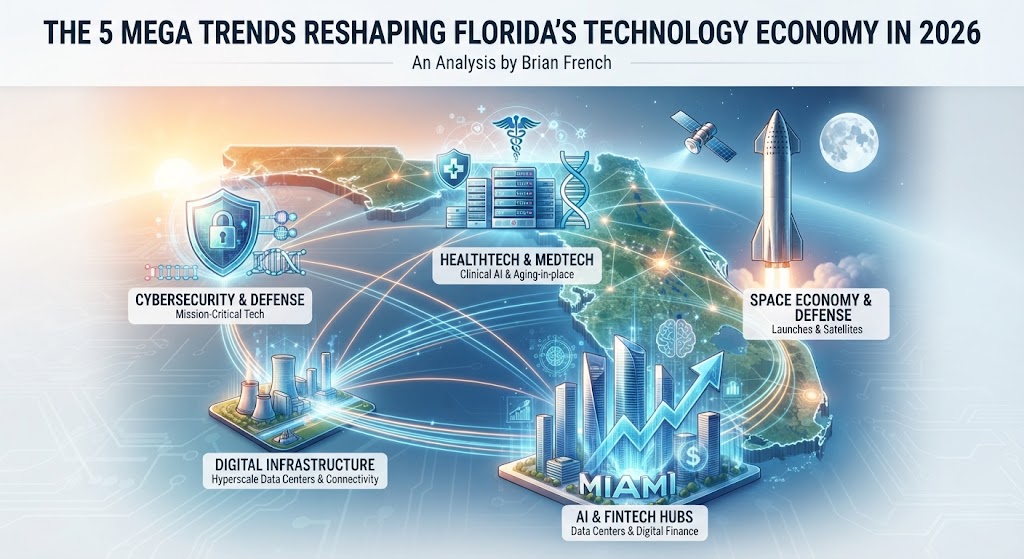
What are the biggest technology trends in Florida?
Explore the 5 mega trends driving Florida tech in 2026 — AI and data centers, the space economy, fintech, healthtech, and defense-grade cybersecurity — with expert analysis from former institutional money manager Brian French.
Quick Answer: What Are the 5 Technology Mega Trends in Florida?
The five technology mega trends transforming Florida in 2026 are: (1) Artificial intelligence and hyperscale data center buildout, (2) the commercial space economy on the Space Coast, (3) fintech and digital finance centered in Miami, (4) healthtech and medtech innovation, and (5) cybersecurity and defense technology. Together, these trends are supported by more than 310,000 IT professionals, billions in annual venture funding, record-setting rocket launch activity, and a projected 11% expansion of the state’s IT sector through 2028.
Why Florida, and Why Now?
For decades, Florida’s economic story was written in three chapters: tourism, real estate, and retirees. That story is being rewritten in real time. Florida now ranks fourth in the nation for technology industry employment, hosts one of the fastest-growing venture ecosystems in the country, and launched more rockets into orbit in 2025 than any other place on Earth.
This isn’t an accident. It is the compounding result of structural advantages — no state income tax, a business-friendly regulatory posture, proximity to Latin American markets, world-class launch infrastructure, and a pandemic-era migration of capital and talent that never reversed. South Florida startups raised over $4.13 billion in 2025, and the momentum carried into 2026, with roughly $832 million raised by Miami-area startups in the second quarter of 2026 alone. Palantir moved its global headquarters from Denver to Miami in February 2026 — a symbolic and practical vote of confidence that would have been unthinkable five years ago.
But headlines about unicorns and relocations only scratch the surface. Beneath them, five distinct mega trends are converging to reshape Florida’s economy, labor market, and investment landscape. This article breaks down each one, why it matters, who’s driving it, and what to watch next — with a candid “Brian’s Take” analysis after each trend from Brian French, a former institutional money manager and analyst who now applies a capital-markets lens to regional technology ecosystems.
Mega Trend #1: Artificial Intelligence and the Hyperscale Data Center Buildout
What’s happening
Artificial intelligence is the defining technology force of the decade, and Florida is positioning itself as both a producer and consumer of AI at scale. The Brookings Institution recently named Miami a “Star Hub” for AI growth, a designation reserved for metros with rapidly compounding AI talent, startups, and investment. Miami’s AI startup scene now spans surgical intelligence (Theator), marketing analytics (Prescient), immersive 3D collaboration (Mytaverse), and enterprise software — companies building applied AI grounded in real-world industries rather than pure research.
The physical infrastructure is following the software. Florida — long a secondary market for data centers — is seeing its first wave of hyperscale, AI-ready campuses move through planning and construction. Notable projects include:
- Project Tango in Loxahatchee (Palm Beach County): a proposed hyperscale AI campus on roughly 202 acres, designed for up to 3.7 million square feet across nine multi-story buildings, sited near Florida Power & Light’s West County Energy Center for power access.
- Atlas Compute AI Data Center Campus, the Fort Meade Data Center Campus, Cielo Haines City, and the NextNRG Nassau County Campus — a pipeline that signals Florida’s transition from data center afterthought to genuine growth hub.
Why Florida? Strong fiber connectivity, access to subsea cable networks landing in South Florida (the digital gateway to Latin America), comparatively lower land costs, and utilities with existing generation capacity. The state’s universities — the University of Miami, Florida International University, UF and others — have expanded AI and computer science programs to feed the talent pipeline.
Why it matters
AI infrastructure is the railroads of the 21st century. Regions that host compute capacity attract the engineers, the startups, and the enterprise customers that cluster around it. Florida’s healthcare, finance, logistics, and hospitality industries are enormous natural buyers of AI — meaning locally built AI companies have customers within driving distance, not just demo calls.
🔎 Brian’s Take
“When I was allocating institutional capital, we had a saying: follow the capex, not the press release. Florida’s AI story passes that test. Anyone can host a conference; you can’t fake a 202-acre land assembly next to a power plant. The data center pipeline tells me hyperscalers and their financing partners have done the site math — power, water, fiber, latency to Latin America — and Florida clears the hurdle. My caution: AI compute is a capital-intensive, cyclical business, and Florida is entering as a secondary market late in a national buildout boom. The winners here will be applied-AI companies selling into Florida’s giant healthcare and financial services base — not speculative GPU landlords. Watch power availability and insurance costs; those are the real constraints nobody puts in the pitch deck.”
Mega Trend #2: The Commercial Space Economy — The Space Coast Goes Vertical
What’s happening
Florida’s Space Coast closed 2025 with a record 109 orbital launches, shattering every previous annual record, and officials expect 100 to 115 launches in 2026 — with the Eastern Range projected to support 300 to 350 launches annually within a decade. That trajectory has triggered the largest infrastructure modernization at Cape Canaveral in three decades, an effort Space Launch Delta 45 calls the “Spaceport of the Future.”
The buildout is staggering in scale:
- SpaceX’s Gigabay: a $1.8 billion, 815,000-square-foot Starship and Super Heavy integration facility under construction at the Cape, targeted for completion in 2026 and expected to create roughly 600 jobs. SpaceX is developing three Starship-capable sites across the Space Coast — including the conversion of historic Launch Complex 39A — with regulatory approval for up to 120 Starship launches per year from Florida. The first Florida Starship launch is targeted for late summer to early fall 2026.
- United Launch Alliance is scaling its Vulcan Centaur cadence, with plans for up to 25 launches in 2026.
- Blue Origin’s New Glenn has entered the flight rotation, adding a third heavy-lift provider to the manifest.
- NASA’s Artemis II is slated to carry four astronauts around the Moon aboard Orion and SLS.
- Novel players are emerging, from Lonestar Data Holdings (which completed integration and testing of “Freedom,” the world’s first physical lunar data center payload) to Star Catcher (which demonstrated optical power beaming of over 1.1 kW at the Launch and Landing Facility).
The economic gravity is spreading beyond Brevard County. The Miami Innovation Aerospace Initiative (MIA) launched in 2026 with a roadmap that includes a pitch day, a 500+ leader summit, and by 2027, international satellite offices and a dedicated aerospace research park — positioning South Florida as the commercial, capital, and hemispheric business backbone behind the Space Coast’s launch operations. Meanwhile, the Palm Bay–Melbourne–Titusville corridor has solidified as a national hub for edge AI, satellite autonomy, and high-reliability machine learning, with senior AI engineering salaries at defense contractors ranging from roughly $130K to over $220K.
Why it matters
Space is no longer a government program; it’s an industrial sector. Launch cadence drives everything downstream — satellite manufacturing, payload integration, ground systems, data services, insurance, and workforce training. Florida owns the runway, and the state is reinforcing it: the Governor’s FY26 budget recommendations included fresh aerospace funding, and Space Florida continues to land deals like Leonardo’s $65 million support center and Williams International’s $1 billion+ turbine campus in the Panhandle.
🔎 Brian’s Take
“Launch cadence is the single best leading indicator in this sector — it’s the space economy’s equivalent of same-store sales. Going from 109 launches to a projected 300+ within a decade isn’t linear growth; it’s a regime change. As an analyst I’d frame it this way: Florida has a near-monopoly on the scarcest asset in the industry — proven, high-cadence orbital launch real estate — and monopolistic assets attract ecosystems. The Gigabay alone is a $1.8 billion fixed-capital commitment; companies don’t strand that kind of capital lightly. The risk factors I’d flag: concentration risk in SpaceX (one company drives most of the manifest), Starship execution risk, and workforce housing on the Space Coast, which is already tight. But if you’re looking for Florida’s most defensible mega trend — the one with the deepest moat — this is it.”
Mega Trend #3: Fintech, Digital Finance, and the “Wall Street South” Migration
What’s happening
Miami’s push to become a financial-technology capital has moved from marketing slogan to measurable reality. The region’s startup ecosystem is now valued at roughly $95 billion, supports six active unicorns, and attracted dedicated investment vehicles from SoftBank, an expanded a16z presence, and active Founders Fund backing for Miami-based fintech and AI startups. Local firms — TheVentureCity, eMerge Americas, Rokk3r Labs — have matured into a genuine regional investor bench that barely existed in 2019.
The structural drivers are durable:
- Tax arbitrage. Florida has no state income tax. For founders and early employees with equity compensation, the difference versus California’s top rate compounds into life-changing money at exit.
- Latin American gateway. Miami’s fintech and crypto companies leverage proximity, language, and banking relationships to serve LatAm markets — a structural advantage no other U.S. metro can replicate.
- Institutional migration. Citadel, and now Palantir’s headquarters, anchor a growing cluster of hedge funds, family offices, and trading firms — the customers and acquirers fintech startups need.
- Finance-tech convergence. Financial services roles across Florida increasingly require data and technical skills, and the overlap between finance and technology is where many of the state’s highest-paying jobs are now appearing.
The sector has also matured past its 2021 crypto-mania phase. Observers note South Florida has moved beyond “Bitcoin theatrics” toward institutional-grade infrastructure: payments, risk and compliance AI, merchant acquiring technology, and B2B financial software.
Why it matters
Fintech is Florida’s most capital-efficient mega trend. It doesn’t require launch pads or 200-acre data centers — it requires talent, customers, and capital, and all three are now co-located in South Florida. The convergence of hedge fund money, LatAm remittance and banking flows, and a maturing VC bench creates a flywheel that gets harder to stop each year.
🔎 Brian’s Take
“I spent my career inside institutional finance, so I’ll say this plainly: money managers are herd animals, and the herd has moved. When Citadel relocates, when Palantir plants its flag, when SoftBank raises a dedicated Miami vehicle — those aren’t lifestyle decisions, they’re allocation decisions made by people who model everything. The tax math alone is a permanent, structural subsidy for Florida-domiciled talent. My analyst’s caveat is scale honesty: Miami wins on momentum and growth rate but still trails the Bay Area and New York badly on absolute scale, exit volume, and depth of senior engineering talent. That’s not a bear case — it’s a maturity gap, and maturity gaps close when the flywheel keeps spinning. The metric I’d watch: repeat founders. When Miami’s first generation of unicorn employees starts founding companies locally instead of decamping to SF, the ecosystem becomes self-sustaining.”
Mega Trend #4: Healthtech and Medtech — Where Florida’s Demographics Become a Product Lab
What’s happening
Healthcare is Florida’s largest employment engine — education and health services added over 35,000 jobs year-over-year — and the fastest-growing roles increasingly sit at the intersection of healthcare, technology, and operations. Hospitals and health systems across the state now run on data platforms, digital front doors, and AI-assisted workflows, creating sustained demand for health-focused software talent.
On the innovation side, Miami has been explicitly identified as a growing medtech hub, and the startup evidence backs it up. Theator, the surgical intelligence company, uses computer vision to transform surgical video into structured clinical data across leading health systems — one of several AI-health companies choosing to build from South Florida. The logic is simple: two of AI’s biggest application areas, healthcare and financial services, are massive industries in South Florida, and the concentration of hospitals, insurers, and health systems creates a natural customer base within the metro.
Florida’s demographic profile — the second-oldest state population in the country — makes it the single best real-world laboratory in America for:
- Aging-in-place and remote patient monitoring technology
- Medicare Advantage analytics and value-based care platforms
- Clinical AI and surgical intelligence
- Telehealth and home-based care logistics
- Senior-focused consumer health applications
Academic infrastructure reinforces the trend: the University of Miami’s health system, UF Health, Moffitt Cancer Center, and a dense private hospital market give healthtech founders clinical partners, trial sites, and design partners at every stage.
Why it matters
Every developed economy is aging; Florida is simply aging first and at scale. Products validated against Florida’s Medicare-heavy, multilingual, geographically dispersed patient population export cleanly to the rest of the U.S. — and increasingly to Latin America. Healthtech is also counter-cyclical relative to consumer tech: healthcare spending doesn’t pause for rate cycles.
🔎 Brian’s Take
“In portfolio construction, you want assets whose demand curve doesn’t care about the Fed. Healthcare is that asset, and Florida is long healthcare demand in a way no other state can match. Here’s the framing I’d give an investment committee: Florida isn’t just a market for healthtech — it’s the beta test for the entire developed world’s demographic future. A remote-monitoring platform that works for a 78-year-old Medicare Advantage patient in Clearwater will work almost anywhere. The risks are real: healthcare sales cycles are brutal, reimbursement policy is a single point of failure, and clinical AI faces an evolving FDA posture. But the trend has something rare — a demand tailwind measured in decades, not quarters. If I were underwriting Florida’s five mega trends purely on durability of end-market demand, healthtech wins.”
Mega Trend #5: Cybersecurity and Defense Technology — Florida’s Quiet Powerhouse
What’s happening
Cybersecurity and quantum technologies are leading the evolution of Florida’s information technology sector, according to the state’s own economic development analysis. The numbers are substantial: the sector spans more than 310,000 IT professionals statewide, employment has risen 3% since 2022, the sector is projected to expand 11% through 2028, and Florida’s security software publishing segment was projected to reach approximately $1.7 billion in revenue by 2025. West Palm Beach is rapidly emerging as one of the state’s most dynamic tech hubs within this ecosystem.
The defense technology layer adds heft. South Florida is becoming what local observers call a “mission-critical hub for defense innovation,” with specialized capital flowing from Palm Beach-based IronGate Capital and New World Angels’ Space & Defense Ventures Group — which made its first flagship investment in Seagate Space. Govo Venture Partners launched a $100 million second fund focused on GovTech. Accelerators like the Gold Coast Tech Accelerator and 35 Mules are supporting hardware-cycle startups. Up the coast, the Palm Bay–Melbourne–Titusville corridor concentrates defense contractors (anchored by L3Harris) building secure systems, edge AI, and satellite autonomy — “hard AI” for aerospace and defense with senior salaries exceeding $220K.
Demand-side pressure is equally strong: managed service providers across Central Florida report that cybersecurity and business continuity are the dominant client priorities heading through 2026, as digital transformation expands the attack surface for the state’s small and mid-sized businesses.
Why it matters
Cybersecurity is the connective tissue across the other four mega trends: AI data centers need securing, launch systems and satellites are national security assets, fintech runs on trust, and healthcare is the most-breached industry in America. Florida’s combination of military installations (CENTCOM, SOUTHCOM, Space Launch Delta 45), defense primes, and a rising GovTech venture base gives it a full-stack defense-and-security economy — from procurement relationships to startup formation to exit paths.
🔎 Brian’s Take
“Defense tech is where I’d tell a young analyst to look for mispriced opportunity in Florida. The market prices Miami as fintech and Brevard as rockets, but the security layer underneath both is underappreciated. Two things stand out from a capital-flows perspective. First, specialized funds — IronGate, Space & Defense Ventures, a $100M GovTech fund — mean dedicated capital with mandate-driven deployment, which smooths the funding valleys that kill hardware startups. Second, the customer is the U.S. government, the world’s least price-sensitive, most credit-worthy buyer, in a geopolitical environment where defense budgets are a one-way ratchet. The risks: procurement timelines can starve startups, and consolidation by primes can cap outcomes. But cybersecurity plus defense is the trend most insulated from a consumer recession — and in Florida, it comes with built-in customers wearing uniforms.”
Deep Dive: Composite Analysis — How the Five Trends Interlock
Individually, each mega trend is a strong regional story. Together, they form something more valuable: a self-reinforcing economic flywheel. Here’s the composite view.
1. The convergence map
- AI × Space: The Space Coast is a national hub for edge AI and satellite autonomy; Lonestar is literally launching data centers to the Moon from Florida pads. AI models increasingly consume satellite data (earth observation, logistics, insurance), and Florida hosts both the launch infrastructure and the emerging compute infrastructure.
- AI × Fintech: Miami’s maturing fintech scene is being rebuilt around AI — risk scoring, merchant-acquiring intelligence, compliance automation — with hedge funds and trading firms as anchor customers for AI talent.
- AI × Healthtech: Surgical intelligence, clinical data platforms, and Medicare analytics companies choose Florida because the customers (health systems, insurers, seniors) are the state’s largest industry.
- Space × Defense: Launch cadence, Starship national-security missions at SLC-37, and the Palm Bay defense corridor make Florida indispensable to U.S. space-defense posture — which pulls procurement dollars, cleared talent, and specialized venture capital into the state.
- Fintech × Defense/GovTech: The same institutional capital migrating to Palm Beach now funds defense and GovTech vehicles — a direct crossover of “Wall Street South” money into mission-driven technology.
- Cybersecurity × Everything: Every trend above expands Florida’s attack surface and therefore its security demand. Cyber is the tax every other trend pays — and Florida companies are collecting it.
2. The structural foundation (why the flywheel spins)
Four durable inputs power all five trends simultaneously:
Capital migration. The post-2020 relocation of hedge funds, family offices, and VCs was widely dismissed as a fad. Six years on, the evidence — $4.13B raised in 2025, $832M in a single 2026 quarter, dedicated SoftBank and a16z vehicles, Palantir’s HQ — shows a permanent repricing of Florida as an investable geography.
Tax and cost structure. No state income tax functions as a permanent compensation subsidy that compounds with equity outcomes, while commercial real estate in Brickell or Wynwood remains far cheaper than Silicon Valley equivalents. This shifts startup budgets from overhead to R&D.
Irreplaceable physical assets. The Eastern Range, deep-water ports, subsea cable landings, and power-adjacent land for data centers are assets competitors cannot replicate at any price. They anchor the trends that require atoms, not just bits.
Demographic demand. Florida’s population growth and age profile generate native demand for healthtech, fintech (wealth management, payments), and consumer AI — meaning Florida startups can reach product-market fit without leaving the state.
3. The honest risk ledger
A composite analysis that ignores risk isn’t analysis. The material risks:
- Scale gap: Florida still trails the Bay Area and New York in senior engineering depth, exit volume, and absolute capital — momentum is not yet mass.
- Concentration risk: The space trend leans heavily on SpaceX execution; a Starship program delay ripples across the entire Space Coast supply chain.
- Climate and insurance: Hurricane exposure and a hardening property insurance market raise the cost of the physical infrastructure (data centers, launch facilities, offices) that three of five trends depend on.
- Power constraints: Hyperscale AI campuses are ultimately utility projects; Florida’s grid buildout must keep pace or the data center pipeline stalls.
- Housing and workforce: Brevard County housing is tight, and Miami is no longer cheap — cost-of-living inflation could erode the very arbitrage that started the migration.
- Policy dependence: Defense, space, and healthtech all carry federal budget and regulatory exposure.
4. The composite verdict
Ranked by defensibility of moat: (1) Space (monopoly physical assets), (2) Healthtech (decades-long demographic demand), (3) Cybersecurity/Defense (government demand ratchet), (4) Fintech (network effects still forming), (5) AI/Data Centers (highest growth, but Florida enters as a secondary market in a national arms race). The critical insight is that Florida doesn’t need to win any single national category — it needs the five trends to keep feeding each other. On current evidence, they are.
Frequently Asked Questions (FAQ)
What is the biggest tech trend in Florida right now? Artificial intelligence is the broadest trend, touching every sector, but the commercial space economy is Florida’s most defensible: the Space Coast set a record 109 launches in 2025 and is building toward 300+ annually within a decade.
Is Miami really a tech hub or just hype? The data now supports the claim: roughly $4.13 billion raised by South Florida startups in 2025, a ~$95 billion ecosystem valuation, six unicorns, and Palantir’s 2026 headquarters relocation — though Miami still trails the Bay Area and NYC in absolute scale.
How many tech workers are in Florida? Florida employs more than 310,000 IT professionals, ranking fourth in the nation for tech industry employment, with the IT sector projected to grow 11% through 2028.
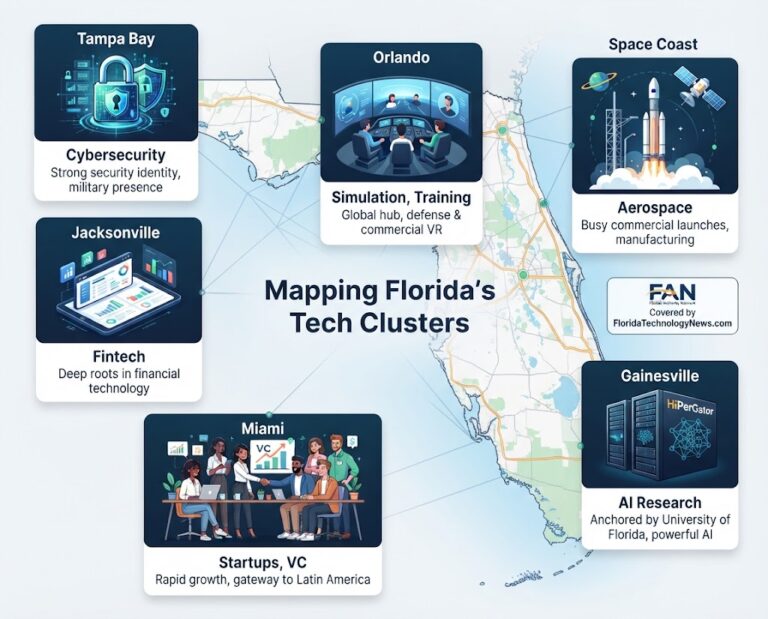
Which Florida cities are the top tech hubs? Miami (fintech, AI, VC), the Space Coast/Palm Bay–Melbourne–Titusville corridor (aerospace, defense, edge AI), Tampa–St. Petersburg (cybersecurity, financial services), Orlando (simulation and modeling), and the rapidly emerging West Palm Beach.
Why are data centers coming to Florida? Strong fiber connectivity, subsea cable access to Latin America, lower land costs, and available power capacity are drawing hyperscale, AI-ready campus projects such as Project Tango in Palm Beach County.
About Brian French
Brian French is a former institutional money manager and analyst with a career spent evaluating companies, industries, and capital flows on behalf of institutional clients. His background spans equity research, portfolio management, and macro-driven sector analysis — experience he now applies to dissecting regional technology economies, emerging industries, and long-horizon investment themes. Known for a “follow the capital, not the headlines” approach, Brian focuses on the durable structural forces — demographics, infrastructure, tax policy, and institutional money movement — that determine which regional booms become permanent economies and which fade. He writes and speaks about the intersection of finance, technology, and economic geography, with a particular focus on Florida’s transformation into a national technology powerhouse.
Nothing in this article constitutes investment advice. All commentary reflects general analysis of publicly reported information.
Resources and Sources
- Florida Department of Commerce / FloridaCommerce – Information Technology Target Industry Overview — IT sector employment, cybersecurity growth, 11% projected expansion through 2028. (floridajobs.org)
- Value Add VC – “Miami Tech Hub 2026” — South Florida venture funding totals ($4.13B in 2025; $832M in Q2 2026), unicorn count, ecosystem valuation, Palantir HQ relocation. (valueaddvc.com)
- WFTV / Space Launch Delta 45 — 2026 launch projections (100–115), Eastern Range capacity outlook (300–350 annually), “Spaceport of the Future” modernization. (wftv.com)
- Space Florida – 2025/2026 Aerospace Industry Wins — SpaceX Gigabay ($1.8B, 815,000 sq ft), Lonestar lunar data center, Star Catcher power beaming, Leonardo and Williams International investments. (spaceflorida.gov)
- Tesorb – SpaceX Florida Starship Launch Complex Tracker — Three Starship-capable sites, LC-39A conversion, SLC-37 rebuild, 120-launch annual approval, 2026 first-flight targeting. (tesorb.com)
- Yahoo News / Local Space Coast Reporting — Record 109 launches in 2025, ULA Vulcan cadence plans, Blue Origin New Glenn, Artemis II. (yahoo.com)
- Blackridge Research – Top Upcoming Data Center Projects in Florida — Project Tango, Atlas Compute, Fort Meade, Cielo Haines City, NextNRG campuses; Florida’s emergence as a hyperscale growth hub. (blackridgeresearch.com)
- Blumberg Capital – AI Startups in Miami to Follow in 2026 — Theator, Prescient, Mytaverse, and Miami’s applied-AI ecosystem. (blumbergcapital.com)
- Refresh Miami – Defense Innovation Coverage — IronGate Capital, New World Angels Space & Defense Ventures Group, Govo Venture Partners’ $100M GovTech fund, Gold Coast Tech Accelerator, 35 Mules. (refreshmiami.com)
- MIUniversity – “Why Miami Is the Silicon Valley of the South” — Brookings “Star Hub” AI designation, cost-of-business comparisons, fintech/medtech sector framing. (miuniversity.edu)
- Nucamp – Space Coast AI Employer Analysis — Palm Bay–Melbourne–Titusville edge AI/satellite autonomy specialization and salary ranges. (nucamp.co)
- Florida Coastal University – Top Growing Industries in Florida 2026 — Healthcare job growth (+35,000 YoY in education/health services), finance-technology convergence, statewide employment data. (floridacoastaluniversity.com)
- Outsource Accelerator – Top Tech Companies in Florida — 310,000+ IT professionals, #4 national tech employment ranking. (outsourceaccelerator.com)
- Miami Innovation Aerospace Initiative (MIA) — 2026 launch, Pitch Day and Summit roadmap, 2027 research park plans. (miamiinnovationaerospace.com)
- Capital Analytics Associates – Invest: Miami — Long-run structural analysis of Miami’s tech ecosystem development. (capitalanalyticsassociates.com)
About the Author