Intel’s Reemergence and Its Goal to Master Both Chip Foundry and Design
Overview: Can Intel become the only company that both designs leading-edge chips and manufactures them on U.S. soil?
A deep dive into Intel’s 18A and 14A nodes, the “double margin” opportunity, supply-constrained demand, the U.S. government’s 10% stake, and what Wall Street’s bulls are saying in 2026.
Quick Answer: What Is the Bull Case for Intel in 2026?
Intel is attempting something no other company on Earth is positioned to do: design leading-edge processors and manufacture them — for itself and for outside customers — on the most advanced process nodes in the United States. If it succeeds, Intel captures two layers of profit that its rivals split between themselves and TSMC. In 2026 the pieces are converging: 18A is in high-volume production with yields reportedly climbing toward 85%, 18A-P is in risk production, 14A is ahead of schedule with a customer PDK due in October, revenue grew 25% in Q2 (the fastest in nearly 15 years), demand is outrunning supply, the U.S. government owns roughly 10% of the company, and Wall Street analysts have set price targets as high as $200. The stock has risen more than 170% year-to-date and was one of 2026’s best-performing large-cap semiconductors.
The Biggest Turnaround in Semiconductor History Is Underway
Two years ago, Intel was the cautionary tale of American technology — a fallen giant that missed mobile, missed AI, lost the process lead to TSMC, and watched its market value collapse by more than 60% in a single year. Its board forced out CEO Pat Gelsinger in late 2024. Analysts debated a breakup. The consensus assumption was that Intel Foundry would be sold, spun off, or quietly shut down.
That consensus was wrong.
Under CEO Lip-Bu Tan, who took the helm in March 2025, Intel has strung together seven consecutive quarters of beating its own guidance. Q2 2026 revenue came in at $16.13 billion, up 25% year-over-year and 12% above Wall Street’s estimate; non-GAAP earnings per share of $0.42 nearly doubled expectations. Data Center & AI revenue jumped 59%. Server chip average selling prices hit a record ~$1,200, up 43% year-over-year. And management guided Q3 revenue to $15.8–$16.8 billion, well above the Street’s $15.1 billion.
But the earnings beat is only the surface. The deeper story — the “big enchilada” — is a structural bet that Intel can do what neither Nvidia, AMD, Apple, Qualcomm, nor Broadcom can do: own both halves of the semiconductor value chain. This article lays out why that bet is more credible than skeptics admit, why physics and geopolitics are both tilting in Intel’s favor, and what the sharpest Wall Street analysts are saying.
The “Double Margin” Thesis: Why Owning Design and Foundry Together Is a Financial Weapon
How the semiconductor value chain splits profit today
In the modern chip industry, profit is divided in two:
- The design margin. Fabless companies like Nvidia, AMD, Apple, and Broadcom design chips and earn gross margins that often exceed 50–75%. They do not own factories.
- The manufacturing margin. TSMC fabricates those chips for the fabless world and earns gross margins in the high-50s percent range while operating near-monopoly capacity at the leading edge.
Every fabless company effectively pays TSMC a toll. Every advanced-node wafer that leaves Taiwan carries a foundry markup that the chip designer must absorb before earning its own profit.
What Intel gets if 18A and 14A succeed
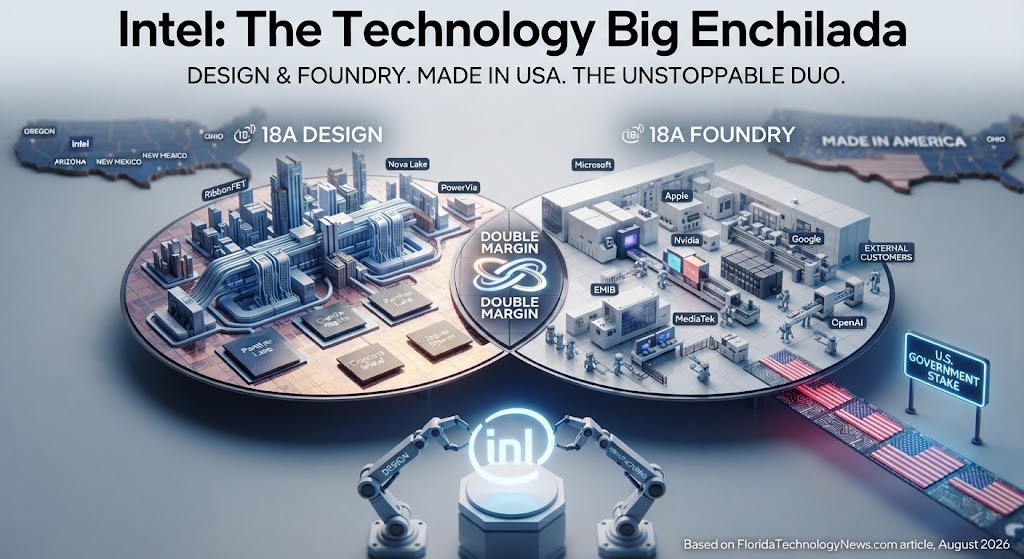
Intel is the only company with a credible path to collecting both margins:
- On its own products (Panther Lake and Nova Lake client CPUs, Granite Rapids, Diamond Rapids and Coral Rapids server CPUs, Crescent Island and Jaguar Shores AI accelerators), Intel keeps the design margin and the manufacturing margin, because it fabricates them in-house on 18A rather than paying TSMC’s toll. As 18A yields improve — reportedly rising from roughly 65% to around 85% in a single quarter — the manufacturing cost per good die drops and the margin captured expands. This is a large reason non-GAAP gross margin jumped 12 percentage points year-over-year to 41.8% in Q2, roughly 280 basis points above the company’s own guidance.
- On external foundry customers — Microsoft (a committed 18A customer), Apple (in confirmed discussions), reportedly Nvidia, AMD, Google, Amazon, MediaTek and OpenAI on 18A-P, 14A, and EMIB/Foveros advanced packaging — Intel earns the manufacturing margin TSMC currently monopolizes.
This is why Bank of America models Intel’s earnings power at more than $6 per share by 2030 — up sharply from a prior $3-to-$4 range — and why BofA sizes the foundry opportunity above $45 billion by decade’s end. It’s why KeyBanc’s John Vinh raised his target from $100 to $155, and why HSBC’s Frank Lee carries a $200 target. The bulls are underwriting the arithmetic of two margins stacked on one wafer.
The margin math in plain English
If Intel manufactures a server CPU internally at, say, a 45% blended gross margin today, and 18A/18A-P yield maturity pushes that toward the 55–60% range that a mature leading-edge fab supports, that improvement alone flows almost entirely to operating income. Layer on external wafers priced at foundry-market rates for customers who cannot get enough TSMC capacity, and Intel Foundry — which lost roughly $2.1 billion in Q2 — is on a management- and analyst-endorsed path to operating break-even by 2027 and meaningful profitability beyond. BofA projects Intel Foundry revenue could grow from roughly $1.1 billion in 2026 to nearly $40 billion by 2030.
18A and 14A: The Nodes That Make It Possible
18A — the first leading-edge logic node built entirely in America
Intel 18A is a 1.8-nanometer-class process featuring RibbonFET gate-all-around transistors and PowerVia backside power delivery — technologies TSMC’s rival N2 node only partially matches. It is the first leading-edge logic node fully developed and manufactured in the United States, at Intel’s fabs in Oregon and Arizona.
Key 2026 milestones:
- Volume production — Core Ultra Series 3 (Panther Lake) launched on 18A; Intel says 18A yields “continue to improve” as it ramps supply against strong demand.
- 18A-P — the performance-enhanced variant entered risk production in June 2026 (announced at the VLSI Symposium), promising roughly 9% better performance at iso-power and 40% lower thermal resistance. Analysts increasingly view 18A-P as competitive with TSMC’s N3, which is severely supply-constrained.
- First to High-NA EUV — ASML said on its July 15 earnings call that Intel is the first company delivering high-volume logic chips using High-NA EUV lithography — a genuine technological first that gives Intel a multi-year head start on the tools every next-generation node will require.
- Advanced packaging — Intel’s EMIB packaging is reportedly achieving 98% yields, and alleged packaging customers include Nvidia (Feynman GPU), Google (TPU), and Amazon (AWS Trainium 3). Packaging is the hidden bottleneck of the AI era, and Intel is one of only two companies on Earth with leading-edge capacity.
14A — the node designed from day one for external customers
Where 18A was built primarily for Intel’s own products, 14A was architected as an external foundry node with High-NA EUV baked in from the start. On the Q2 call, Lip-Bu Tan said 14A is ahead of schedule on defect density and transistor performance, with the PDK 0.9 due in October 2026, risk production in 2027, and high-volume ramp in 2028. Intel’s process design kits, once an embarrassment, are now described by management as industry-standard, aided by a Cadence Design Systems partnership to deliver production-ready 14A kits.
Tan told analysts he is “increasingly confident that 14A will be a highly competitive process.” Firm customer supplier decisions are expected in the second half of 2026 into the first half of 2027 — with reports naming Google, Apple, AMD, and Nvidia among potential commitments once PDK 1.0 lands.
Capital discipline is the new Intel
Critically, Intel says it will only build 14A capacity against firm customer commitments — the opposite of the “build it and they will come” spending that hobbled the previous regime. Yet capex is still rising: 2026 capex now exceeds $20 billion (tooling spend up ~40%), 2027 is guided meaningfully higher, and Intel’s equipment orders are reportedly up more than 50% year-over-year. That is a company spending into demand it can see, not demand it hopes for.
More Demand Than Supply: The Most Bullish Sentence in Semiconductors
The most important line from Intel’s Q2 2026 call had nothing to do with a product launch. It was Lip-Bu Tan telling investors that strong demand for Intel’s products continues to outpace the company’s growing supply.
Read that again in context of the entire industry:
- TSMC cannot keep up. CEO C.C. Wei has publicly said it will be a long time before TSMC can meet customer demand. N3 is bottlenecked; N2 is spoken for.
- Apple is short on chips. Tim Cook told investors on Apple’s own earnings call that component shortages were limiting iPhone and Mac growth and that Apple has less supply-chain flexibility than normal. Analysts at Melius Research immediately pointed to Intel as the logical way for Apple to de-risk — and Apple has since been confirmed to be in discussions with Intel Foundry, with President Trump publicly referencing the deal in June.
- Server CPUs are sold out. AI data centers need “head-node” and agentic CPUs alongside GPUs. Intel and AMD have signed multi-year supply agreements with data-center customers, and server processor prices are reported up more than 40% since the start of the year. Bank of America’s Vivek Arya has argued Intel’s data-center share through 2028 is now a function of supply, not chip design.
- Intel itself can’t ship enough. CFO David Zinsner told analysts Intel will not catch up on supply in the fourth quarter — a statement about capacity, not demand — and noted that AI-driven businesses now represent roughly 70% of Intel revenue, growing more than 70% year-over-year.
- Even Intel’s stock offering was oversubscribed. In August 2026 Intel upsized a $15 billion equity raise to $20 billion after, according to Tan, demand exceeded supply by more than five times. BofA called the raise a bullish tell rather than distress.
This is the fundamental asymmetry that makes the foundry bet work: the world is short leading-edge wafers and advanced packaging, and there are exactly two companies capable of supplying them. In a shortage, the second supplier doesn’t need to be better than the first — it only needs to be good enough and available. Intel’s 18A-P and 14A are now, by most credible accounts, good enough. And Intel is the only one with spare land, spare fabs, and a government that wants it to win.
Made in America: Why U.S. Sourcing Is Intel’s Structural Moat
The geopolitical premium
More than 90% of the world’s most advanced logic chips are manufactured in Taiwan, roughly 100 miles from mainland China. Every hyperscaler, defense contractor, automaker, and consumer-electronics company on Earth has the same unhedged risk. Intel is the only company that offers leading-edge logic manufacturing — and leading-edge packaging — entirely on U.S. soil, with fabs in Arizona, Oregon, New Mexico, and a massive campus under construction in Ohio.
That is not a marketing bullet point. It is a procurement requirement for:
- U.S. defense and intelligence customers, whose secure-enclave programs require domestic fabrication.
- Hyperscalers designing custom silicon (Google TPU, Amazon Trainium, Microsoft Maia) who face board-level pressure to dual-source away from Taiwan.
- Apple, whose $600 billion American Manufacturing Program commitment created both the political incentive and the strategic framework to diversify to a U.S. foundry.
- Elon Musk’s Terafab, which has tapped Intel to manufacture chips, with speculation that Intel’s Ohio fab could be combined with the Terafab project.
The U.S. government’s 10% stake changes the game
In August 2025, the U.S. government converted CHIPS Act grants into an approximately $8.9 billion investment for a roughly 9.9–10% equity stake in Intel — a “Secure Enclave” arrangement that makes the federal government Intel’s largest single shareholder. The stake’s value has since risen roughly 300–330%, a fact President Trump has repeatedly touted. (One accounting side effect: because Intel must mark that obligation to market each quarter, the surging share price produced a $12.5 billion non-cash charge in Q2 that turned an operationally profitable quarter into an $11 billion GAAP loss. It’s paper, not cash — and it exists because the stock went up.)
Why the stake matters for the bull case:
- Alignment. Washington now has a direct financial and strategic interest in Intel Foundry succeeding. That translates into policy support — the government reportedly cleared antitrust hurdles for AI partnerships such as SambaNova, and the White House has publicly championed the Apple and Nvidia relationships.
- Customer signaling. When the U.S. government owns 10% of a foundry and the President personally announces its customer wins, chip designers dependent on federal contracts, export licenses, and tariff relief take notice.
- Nvidia’s investment. Nvidia’s $5 billion investment in Intel in September 2025 and its subsequent partnership on x86-plus-RTX products and packaging created a second strategic anchor. Nvidia has run multi-project wafer tests on 18A.
- Financing credibility. With Uncle Sam on the cap table and Nvidia alongside, Intel raised $20 billion in equity in a single week in August 2026 — the government did not need to participate.
The upshot: Intel is now the de facto national-champion foundry of the United States, with a coordinated onshoring push involving the federal government, Nvidia, Apple, and Musk. No competitor can replicate that positioning at any price.
What Wall Street’s Bulls Are Saying
The sell-side is split — consensus is still Hold, and roughly two dozen analysts remain Neutral — but the direction of revisions since June has been overwhelmingly one way: up. Here’s how the bull camp frames it.
Bank of America — Vivek Arya (Buy, $145 target, previously $160). In a rare double upgrade from Underperform straight to Buy on June 11, Arya said he now has higher confidence in Intel’s ability to address industry constraints in leading-edge wafers and packaging while supplying a much larger agentic-CPU market. BofA models Intel earnings power above $6 per share by 2030, values the foundry opportunity above $45 billion, projects Intel CPU sales topping $40 billion by 2030 (about 25% of a $170 billion server market), and after Q2 highlighted a “clear roadmap to operating margin breakeven by 2027” for the foundry, supported by committed 18A-P and 14A volumes. Arya’s post-offering note framed the $20 billion raise as evidence of “increasing management confidence in both internal demand and external foundry customer engagement.”
HSBC — Frank Lee (Buy, $200 target). The Street’s high target. Lee’s thesis is that Intel Foundry is now operational rather than developmental, that Apple and Microsoft are confirmed 18A design partners, and that formal orders and early revenue recognition arrive in the second half of 2026. He notes 18A yields of roughly 85% versus roughly 90% at TSMC N2 — meaning Intel is “no longer playing catch-up.” A successful external foundry, in his framing, would fundamentally re-rate Intel’s multiple by adding a high-growth business unrelated to Intel’s own chips.
KeyBanc — John Vinh (Overweight, $155 target, up from $100). KeyBanc, citing FactSet channel checks, reported that Intel has secured design wins with AMD, Nvidia, and OpenAI across 18A/18A-P and 14A, alongside EMIB packaging at 98% yields. Vinh’s target increase after Q2 was among the largest on the Street.
Citi — Atif Malik (Buy, $130 target). Malik expects Intel’s CPU business to grow significantly over five years on agentic-AI demand and forecasts Intel holding roughly 47% of the CPU market by 2030.
Melius Research (Buy, ~$150 target). Melius upgraded Intel to Buy in January 2026 when the stock was near $50 — one of the earliest bullish calls on the Street — and has argued that Apple could reduce its manufacturing risk by using Intel alongside TSMC.
Goldman Sachs initiated coverage at Neutral with a $150 target — a “neutral” that sits above the stock’s current price. Benchmark clusters near $150. UBS (Timothy Arcuri) raised to $121, Susquehanna and TD Cowen to $115 — all while keeping Hold ratings, a pattern one commentator described as “targets up sharply, convictions largely unchanged.”
Even the skeptics concede the setup: as one analysis put it, the range of targets from $45 to $200 describes “two different companies” — a struggling product firm, or a U.S. foundry champion — and a single credible 14A commitment could collapse that dispersion fast.
The Bull Case, Summarized
- Two margins, one wafer. Intel is the only firm positioned to keep both the design and manufacturing profit on leading-edge chips — and to sell the manufacturing margin to everyone else.
- The nodes are real. 18A is in volume with rising yields; 18A-P is in risk production; 14A is ahead of schedule; Intel is first to High-NA EUV in volume; EMIB packaging yields are near-perfect.
- Demand exceeds supply — everywhere. TSMC is capacity-constrained, Apple is short chips, server CPUs are sold out at record prices, and Intel itself cannot ship enough. Shortages reward the second supplier.
- America needs a domestic foundry, and Intel is the only one. The government’s 10% stake, Nvidia’s $5 billion investment, Apple’s onshoring commitment, and Musk’s Terafab form a coordinated onshoring coalition.
- The financials have inflected. Seven straight guidance beats, 25% revenue growth, 59% data-center growth, 41.8% gross margin, $7 billion in quarterly operating cash flow, roughly $30 billion in cash plus a fresh $20 billion raise.
- The catalysts are dated. 14A PDK 0.9 in October 2026; external 14A commitments in H2 2026 through H1 2027; first Apple volume 12–18 months out; foundry break-even targeted for 2027; 14A volume in 2028.
- The Street hasn’t fully re-rated. With consensus still at Hold and most analysts merely raising targets, a marquee external customer announcement is the kind of event that forces upgrades.
The Honest Risks (Because Bulls Who Ignore Risk Get Hurt)
- Execution. A six-month delay in 18A-P yield maturity could push foundry break-even from 2027 into 2028 and, by some analyst estimates, trigger a 25–30% drawdown.
- External revenue is still tiny. Intel Foundry’s external revenue was $293 million in Q2 — about 5% of segment revenue. Everything above is a forecast until contracts with dollar values are disclosed.
- Cash burn. Adjusted free cash flow was negative $8.4 billion in Q2 as capex ramps above $20 billion; the $20 billion equity raise dilutes shareholders 4–5%.
- Valuation and volatility. The stock ran from about $37 at the start of 2026 to a $142 high on June 30, then fell roughly 30% in July before rebounding on earnings. Momentum cuts both ways.
- Concentration in TSMC for some products. More than 90% of Nova Lake desktop CPUs are reportedly built on TSMC N2, not 18A — a reminder that Intel’s own dual-sourcing is pragmatic, not ideological.
None of these risks negate the thesis. They define the price of admission.
Frequently Asked Questions
What is Intel’s 18A process? Intel 18A is a 1.8-nanometer-class manufacturing node using RibbonFET gate-all-around transistors and PowerVia backside power delivery. It is the first leading-edge logic node developed and manufactured entirely in the United States and entered high-volume production in 2026.
What is Intel 14A? 14A is Intel’s next node after 18A, designed from the outset for external foundry customers and built around High-NA EUV lithography. The customer PDK 0.9 is due in October 2026, risk production in 2027, and high-volume production in 2028.
Does the U.S. government own Intel? The U.S. government holds a roughly 9.9–10% equity stake in Intel through an approximately $8.9 billion investment made in August 2025, structured under the CHIPS Act “Secure Enclave” agreement. It is a passive stake but makes Washington Intel’s largest single shareholder.
Is Apple going to use Intel Foundry? Apple has been confirmed to be in discussions with Intel Foundry about manufacturing lower-end M-series chips on 18A/18A-P. No signed contract with disclosed volumes has been announced as of August 2026; analysts expect first volume 12–18 months after commitment.
Why is Intel stock up so much in 2026? Seven consecutive earnings beats, 25% revenue growth, 59% data-center growth, rising 18A yields, the Apple and Microsoft foundry relationships, the government and Nvidia stakes, and a global shortage of leading-edge chips have driven the stock up more than 170% year-to-date.
About the Author: Brian French
Brian French is a former institutional money manager and analyst with a career spent evaluating companies, industries, and capital flows on behalf of institutional clients. His background spans equity research, portfolio management, and macro-driven sector analysis — experience he now applies to dissecting technology turnarounds, semiconductor supply chains, and long-horizon investment themes. Known for a “follow the capital, not the headlines” approach, Brian focuses on the durable structural forces — capacity constraints, government policy, balance-sheet capacity, and institutional money movement — that determine which comeback stories become permanent franchises. He writes and speaks about the intersection of finance, technology, and economic geography.
Nothing in this article constitutes investment advice or a recommendation to buy or sell any security. All commentary reflects analysis of publicly reported information as of August 2026. The author may hold positions in securities discussed.
Resources and Sources
- Intel Corporation — Q2 2026 Earnings Release and Conference Call (July 23, 2026) — Revenue, EPS, segment results, Q3 guidance, 18A yield commentary, 14A timeline, capex, and quotes from Lip-Bu Tan and David Zinsner. (intc.com / Money365.Market earnings analysis)
- Intel Corporation — 2025 Annual Report to Shareholders (Form ARS), CEO Letter — Foundry strategy, 14A customer decision timeline, capital discipline. (sec.gov)
- CNBC — “Intel (INTC) earnings report Q2 2026” — 25% revenue growth as fastest in ~15 years, government 10% stake context, data center +59%, capex commentary. (cnbc.com)
- Money365.Market — “Intel Q2 2026 Earnings: Skeptics vs a 7th Straight Beat” — Detailed segment tables, GAAP vs. non-GAAP reconciliation, government-stake revaluation charge, analyst price-target table. (money365.market)
- Bank of America Securities — Vivek Arya research (June 11, June 23, July 24, Aug 12, 2026) via Benzinga, TheStreet, TipRanks, Motley Fool, TradingView, BigGo Finance — Double upgrade, $135/$160/$145 targets, $6+ 2030 EPS, $45B+ foundry TAM, foundry revenue path to ~$40B by 2030, capital-raise commentary.
- TradingKey — Intel Q2 2026 Earnings Results Analysis — HSBC Frank Lee $200 target, Apple/Microsoft as 18A partners, ASML High-NA confirmation, 85% vs 90% yield comparison. (tradingkey.com)
- TradingKey — “Intel Stock Outlook: Can the Apple Foundry Deal Justify INTC’s 250% Rally?” — Rally history, 18A-P risk production, Trump confirmation of Apple deal, risk of yield delay. (tradingkey.com)
- TipRanks — “Intel Stock Price Forecast Ahead of Q2 Earnings” — Citi Atif Malik $130 target and 47% CPU-share forecast; KeyBanc John Vinh $155 target. (tipranks.com)
- Wccftech — “Intel Foundry Snags AMD, NVIDIA, and OpenAI as Design Wins on 18A & 14A” (July 14, 2026) — KeyBanc/FactSet-sourced design wins, EMIB 98% yields, packaging customers. (wccftech.com)
- Wccftech — “Intel Gives Rundown on 14A/18A Chips & Advanced Packaging Opportunities” — 14A PDK 0.5 sampling, capital-discipline stance, 18A-P vs. TSMC N3. (wccftech.com)
- Tom’s Hardware — “Intel says it has two prospective customers for 14A” — Lip-Bu Tan quotes on 14A engagement and supplier-decision timing. (tomshardware.com)
- TrendForce — “Intel Foundry Said to Boost Equipment Orders by 50%+ YoY” — Equipment order growth, potential Google/Apple/AMD/Nvidia 14A commitments, Terafab partnership. (trendforce.com)
- Electronics Weekly — “Intel Foundry: The Last Chance” — Ming-Chi Kuo reporting on Apple’s 18A-P PDK evaluation and target volumes. (electronicsweekly.com)
- Investing.com — “Apple-Intel Chip Manufacturing Deal Reshapes Foundry Race” — 18A-P risk production at VLSI Symposium, government stake details, credibility framing. (investing.com)
- The Next Web — “Intel hits all-time high on Apple foundry talks as US government’s $8.9B stake returns 300%” — Government stake performance, Lip-Bu Tan restructuring history, Q1 2026 results. (thenextweb.com)
- Stocktwits — “INTC Stock Jumps Overnight: Report Says Apple In Discussion With Intel Foundry” — Tim Cook supply-chain quote, Nvidia partnership, Terafab. (stocktwits.com)
- FinanceFeeds — “Intel stock forecast: $150 bull case, $90 bear case for 2026” — Analyst target dispersion, Goldman Sachs and Melius/Benchmark targets, Microsoft 18A commitment. (financefeeds.com)
- BigGo Finance / Benzinga — Intel $20 Billion Equity Offering coverage (August 2026) — Offering upsized on 5x demand, $95 pricing, server ASPs at record $1,200, government non-participation. (finance.biggo.com / benzinga.com)
- Yahoo Finance — “Intel Stock Rises as Analyst Sees Apple Supply Opportunity” — Melius commentary, Apple component shortages. (finance.yahoo.com)
- Simply Wall St — Intel (NASDAQ:INTC) Stock Analysis — Consensus target updates, multi-year server CPU supply deals and pricing. (simplywall.st)
- Winbuzzer — “Intel’s 18A and 14A Bets Face Make-or-Break Year” — Product roadmap (Panther Lake, Nova Lake, Diamond Rapids, Crescent Island, Jaguar Shores), TSMC N2 sourcing for Nova Lake. (winbuzzer.com)
- Forbes — “Intel Foundry In 2026: An Inflection Point?” — Historical foundry losses, $100B+ manufacturing pledge, 14A commitment-gated capacity. (forbes.com)
- MarketBeat — KeyCorp / Melius / TD Cowen / JPMorgan / Truist rating history (January 2026) — Early-2026 analyst positioning for context on the rerating. (marketbeat.com)
About the Author