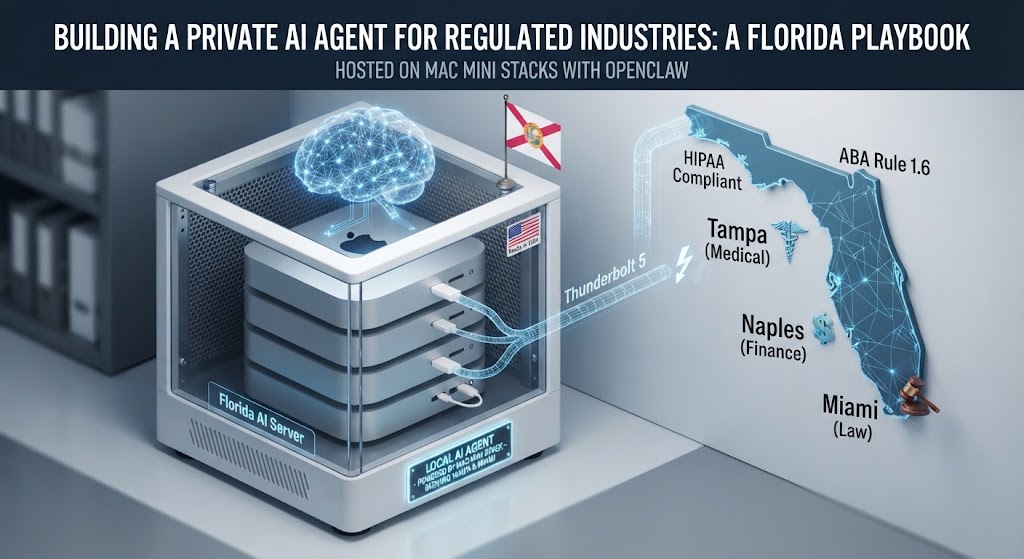
Florida Business Brief: How to build a private, locally hosted AI agent by stacking Apple Mac minis to run Llama and OpenClaw — and why Florida tech professionals can turn this into a high-value business serving law firms, medical practices, and financial advisors that cannot send sensitive data to cloud AI.
Quick Answer: What Is a Local AI Agent, and Why Should Florida Tech Workers Care?
A local AI agent is an autonomous AI assistant that runs entirely on hardware you control — no OpenAI, no Anthropic, no Google — using open-weight models like Meta’s Llama and an agent framework like OpenClaw. In 2026, Apple’s Mac mini has become the default hardware for these systems: its unified memory lets a single $600–$2,000 box run 8B–70B-parameter models, and stacking several minis over Thunderbolt 5 with tools like EXO pools their memory to run 200B–670B-parameter models. For Florida tech professionals, this creates a business opportunity that barely existed 18 months ago: law firms, medical practices, and financial services companies are legally and ethically constrained from sending client data to public LLM services, yet they urgently want AI. Building, hosting, and remotely maintaining custom AI agents on the client’s own premises is a service Florida businesses need and few people are yet offering.
The AI Everyone Wants and the Data Nobody Can Share
Walk into any law office in Tampa, any orthopedic practice in Naples, or any RIA in Boca Raton and ask if they use AI. The honest answer is usually a shrug and a confession: “We’d love to, but we can’t put client files into ChatGPT.”
They’re right to hesitate. Attorney-client privilege, HIPAA, FINRA Compliance and SEC record-keeping rules, the Florida Information Protection Act, the Florida Digital Bill of Rights, and ABA Model Rule 1.6 all point in the same direction: confidential data must stay under the professional’s control. Consumer AI tools are not HIPAA-compliant by default, and even enterprise cloud tiers require Business Associate Agreements, careful configuration, and a leap of faith that a third party’s servers won’t become the next breach headline. With the average data breach now costing over $4 million, that leap of faith is one many small and mid-sized Florida firms refuse to take.
Meanwhile, the technology to run genuinely capable AI locally — on a machine sitting in the office closet — has crossed a threshold. Open-weight models from Meta (Llama 4), Alibaba (Qwen 3.5/3.6), Mistral, Google (Gemma 4), and DeepSeek now rival cloud models for most business tasks. Apple Silicon has become the most cost-effective inference platform in the small-business segment. And OpenClaw, an open-source agent framework that went from a weekend project to one of the fastest-growing repositories in GitHub history (150,000+ stars in weeks), turned the Mac mini into what enthusiasts call a “personal AI server.”
Put those pieces together and you have the outline of a new Florida service business: custom, locally hosted AI agents for regulated industries, deployed on client premises and maintained remotely by a Florida tech professional. This article explains the technology, the hardware, the market, and the business model — and ends with a candid analysis from former institutional money manager Brian French.
Part 1: The Hardware — Why the Mac mini Became the AI Server of 2026
Unified memory changes the math
Traditional AI servers need expensive NVIDIA GPUs with dedicated VRAM, and VRAM is the bottleneck: a 70B-parameter model at 4-bit quantization needs roughly 35–40 GB, more than any consumer GPU offers. Apple Silicon sidesteps this with Unified Memory Architecture (UMA) — the CPU, GPU, and Neural Engine share one high-bandwidth pool of RAM. A Mac mini M4 Pro with 64 GB, or a Mac Studio M4 Max with 128 GB, can hold a quantized 70B model entirely in memory and run it at interactive speed.
Practitioners now argue that memory bandwidth, not raw GPU compute, determines local LLM speed for inference — and Apple delivers roughly two to three times the bandwidth per dollar of NVIDIA’s desktop parts. One April 2026 buyer’s guide concluded that a Mac Studio M4 Max delivers twice the bandwidth of NVIDIA’s $4,699 DGX Spark at a lower price, and that a dual-RTX-5090 rig costing $9,000–$12,000 runs a 70B model no faster than a single Mac Studio because PCIe synchronization eats the raw advantage.
The other reasons: silence, power, and always-on
A Mac mini draws a handful of watts at idle, runs 24/7 without fan noise, and costs about $3–5 per month in electricity — cheaper than a VPS and dramatically cheaper than a dual-GPU tower. It fits on a bookshelf. It boots into a mature, security-hardened OS with Keychain, FileVault encryption, and Gatekeeper. And for agent frameworks like OpenClaw, macOS unlocks first-class access to iMessage, Reminders, Notes, Shortcuts, and Calendar — the “killer feature” no Linux box can match.
The demand became so intense in early 2026 that OpenClaw’s viral rise triggered a run on M4 Mac minis and, by some accounts, a global shortage.
Choosing your tier
A practical ladder for a Florida deployment:
- Entry (single Mac mini M4, 32 GB, ~$700–$1,000): Runs 8B–14B models (Llama 3.x/4 Scout-class small variants, Qwen, Gemma) at 40–60 tokens/second — fast enough for drafting, summarization, email triage, and an always-on OpenClaw assistant. Ideal for a solo practitioner or a proof-of-concept.
- Professional (Mac mini M4 Pro 48–64 GB or Mac Studio M4 Max 128 GB, ~$2,000–$4,200 installed): Runs quantized 70B models at roughly 15 tokens/second per user. One analysis modeled a 15-attorney law firm on a single Mac Studio M4 Max with 128 GB, using Open WebUI as the browser front-end for all staff, and calculated payback within 12 months versus ChatGPT Team licenses.
- Cluster (2–8 Mac minis or Mac Studios over Thunderbolt 5, ~$6,000–$25,000): This is where “stacking” earns its name.
Part 2: Stacking Mac Minis — Running Frontier-Class Llama Locally
How clustering works
A transformer model is a stack of layers, and layers can be split across machines. Machine A holds layers 1–40, Machine B holds layers 41–80; a token’s activations flow through A, hop across the cable, continue through B, and the output returns. Two 128 GB Macs behave, logically, like one 256 GB machine.
The best-known open-source tool for this on Apple Silicon is EXO (exo-explore/exo, Apache 2.0, 40,000+ GitHub stars). You install it on each Mac, they discover each other automatically, and EXO shards the model across the pool. Apple’s own MLX Distributed framework offers a lower-level alternative for tensor parallelism.
The 2026 breakthrough: RDMA over Thunderbolt 5
Clustering Macs used to be a science project because the interconnect throttled everything. Two changes fixed that. First, Thunderbolt 5 ships at 80 Gbps full duplex (120 Gbps boost), with sustained real-world throughput around 60 Gbps between Mac Studios — enough headroom for tensor parallelism on 70B-class dense models. Second, macOS 26.2 (April 2026) added RDMA-over-Thunderbolt-5, which practitioners credit as the single change that converted Mac mini clustering from “fun” to “actually usable.” Wi-Fi remains a non-starter (50–80% throughput loss), and 10 GbE works only as a fallback for longer links.
What stacked minis can run
Community and vendor benchmarks as of mid-2026:
- 2 × Mac Studio (M2/M3 Ultra, 128–192 GB each): Llama 3.1 70B at 12–18 tokens/second on one box, or Llama 3.1 405B at 4-bit (roughly 235 GB) split across two — 1–3 tokens/second, too slow for chat but fine for overnight batch work like document review or contract extraction.
- 4 × Mac mini M4 Pro (64 GB each, 256 GB pooled): Comfortable 70B–200B territory with usable interactive speed over TB5.
- 8 × Mac mini M4 Pro (512 GB pooled): EXO Labs’ published benchmark target for DeepSeek V3 671B (4-bit) at roughly 5.4 tokens/second, and enough headroom for Llama 4 Behemoth-class MoE models. Eight is the “magic number” because 512 GB holds a 340 GB model plus context, KV cache, and overhead. Past four nodes you daisy-chain through TB5 hubs.
Two rules of thumb from people who’ve done it: if the model fits on one machine, run it on one machine (sharding always adds overhead), and mixture-of-experts models cluster far better than dense ones — which is convenient, since MoE is where open-weight development is heading.
Why this matters for the business case
A regulated Florida client doesn’t need GPT-5. They need a model that reads their documents, drafts in their voice, follows their procedures, and never phones home. A 70B open-weight model on a $4,000 Mac Studio does that today. For clients who need frontier-class reasoning on privileged data — complex litigation analytics, clinical research summarization, portfolio-level financial modeling — a $15,000–$25,000 mini cluster running a 400B–670B model in-house is now a line item, not a moonshot. Compare that to per-seat cloud subscriptions plus BAA overhead plus perpetual breach exposure, and the math favors local ownership.
Part 3: The Software Stack — Llama, OpenClaw, and the Agent Layer
The model layer
- Ollama or llama.cpp for simple, fully air-gapped model serving; LM Studio for a GUI; vLLM for multi-user production throughput (roughly 3x Ollama).
- Models: Llama 4 (Meta) as the default general-purpose workhorse; Qwen 3.5/3.6 for coding and multilingual work (a real advantage in South Florida); Mistral Large 3; Gemma 4; DeepSeek V3 for frontier-class reasoning on clusters; specialized fine-tunes like BioMedLM for clinical text.
- Front-end: Open WebUI gives every staff member a familiar chat interface in the browser, with per-user logins and document upload, all pointed at the local server.
The agent layer: OpenClaw
OpenClaw (formerly Clawdbot, briefly Moltbot) is what turns a chatbot into an agent — a persistent assistant that connects to messaging platforms (WhatsApp, Telegram, Slack, Discord, iMessage), executes shell commands, browses the web, reads and writes files in permitted folders, and takes autonomous action on a schedule. Because it runs on macOS as a background service, it can respond 24/7. It supports local models via Ollama as its “brain,” which means a fully offline agent with zero API cost.
Practical setup notes from 2026 practitioner guides: install OpenClaw in Docker for isolation; disable sleep, enable auto-restart after power failure, and wrap the process in caffeinate inside a LaunchDaemon so it never naps; use an HDMI dummy plug so the headless mini keeps a display context; and expect rapid version churn (some 2026 point releases were unstable — pin to a known-good build for client deployments).
The connectivity layer: MCP and Tailscale
MCP (Model Context Protocol) servers extend the agent to the client’s systems — a Postgres or SQL Server database, a document management system, a practice-management or EHR export, a CRM. Tailscale provides the network layer: encrypted, identity-based remote access with zero public ports exposed, so the Florida consultant can maintain the box from anywhere without ever opening the client’s firewall to the internet.
Alternative agent frameworks depending on need: LangGraph for multi-step workflows with checkpoints, CrewAI for role-based agent teams, PydanticAI for type-safe structured outputs, and security-first “always-on” stacks like Blink plus Tailscale.
Part 4: The Market — Industries That Cannot Use Cloud AI
Law
Attorney-client privilege and confidentiality obligations under ABA Model Rule 1.6 mean privileged documents cannot leave the attorney’s control. Miami law firms are simultaneously being told to implement strict data-minimization and consumer-rights protocols under the Florida Digital Bill of Rights and Florida Statute §501.171, and warned that misaligned IT risks both regulatory fines and bar discipline. A local agent that performs discovery review, contract extraction, deposition summarization, and first-draft drafting — on a box in the firm’s server closet — solves the problem instead of managing it.
Medical
HIPAA prohibits Protected Health Information from touching any system without a signed BAA, encryption in transit and at rest, audit logging, and assurance the vendor won’t train on the data. Public ChatGPT fails all of those by default. Analysts now describe five realistic 2026 architectures for private healthcare LLMs, and two of them — the on-premises cluster and the air-gapped enclave — are exactly what a Mac mini stack delivers. Florida’s healthcare sector, the state’s largest employer, faces intensified 2026 OCR enforcement, state breach-notification law, and new scrutiny of foreign data flows. A practice-level agent that summarizes visit notes, drafts prior-authorization letters, codes encounters, and answers staff questions against internal protocols — with no PHI egress — is a compliance asset, not a compliance risk.
Financial services
RIAs, broker-dealers, CPAs, and insurance agencies operate under SEC/FINRA supervision and record-keeping rules, PCI-DSS for card data, and Gramm-Leach-Bliley for consumer financial information. Payment card numbers should never enter an LLM at all; client financials, tax returns, and portfolio data should never enter a public one. Miami’s rise as “Wall Street South” means thousands of family offices, hedge funds, and wealth managers with exactly this problem — and budgets to solve it.
Beyond the big three
Accounting firms during tax season, real-estate title and closing companies (wire-fraud paranoia is justified), defense subcontractors on the Space Coast with CMMC/ITAR obligations, and property-insurance adjusters handling claimant data all fit the profile: high-value documents, strict confidentiality, and an appetite for automation.
Part 5: The Business Model — A Service Florida Businesses Need
What you’re actually selling
Not hardware. Not “AI.” You’re selling a locally hosted, custom-built AI agent plus ongoing remote management — the way a managed service provider sells uptime, not routers. A viable Florida practice looks like this:
- Discovery and compliance mapping (billable engagement): audit the client’s data, workflows, and regulatory constraints; define what the agent may and may not touch.
- Build and deploy (project fee, typically $5,000–$40,000 depending on tier): spec and procure the Mac hardware, install the model stack and OpenClaw or an alternative framework, wire MCP connectors to the client’s systems, configure Tailscale, set up Open WebUI for staff, harden the box (FileVault, encrypted backups, audit logs), and document everything.
- Custom agent development (project or retainer): fine-tune prompts, build RAG pipelines over the client’s document corpus, create task-specific agents (intake bot, discovery reviewer, prior-auth drafter, client-reporting generator).
- Managed hosting and remote maintenance (monthly recurring, $500–$5,000): model updates, security patches, monitoring, backups, capacity upgrades, and — critically — being the human on call when the agent does something odd. The client owns the hardware; you own the relationship.
Why Florida, specifically
Florida has more than 310,000 IT professionals and a fast-growing tech ecosystem, but the demand side is what makes this work: the state is dense with exactly the small and mid-sized professional-services firms that are too big to ignore AI and too regulated to use the cloud. Central Florida MSPs already report cybersecurity and business continuity as their clients’ top 2026 priorities — local AI is the natural upsell. And Florida’s no-income-tax, business-friendly climate rewards the solo consultant or small studio that captures recurring revenue.
Pricing anchors
- Single-box entry deployment: $3,000–$8,000 all-in, plus $500–$1,000/month.
- Professional Mac Studio deployment for a 10–25-person firm: $8,000–$20,000, plus $1,000–$2,500/month.
- Cluster deployment for frontier-class models: $25,000–$60,000, plus $2,500–$5,000/month.
Against a 15-seat ChatGPT Team subscription (~$25–30/seat/month) that still can’t legally see privileged data, the local option pays back within a year and keeps paying.
Getting started as a Florida tech worker
Buy one Mac mini M4 with as much memory as you can afford (it’s soldered; you can’t add it later). Install Ollama and Llama, then OpenClaw in Docker, then Tailscale. Build an agent that runs your own life for a month. Then find one attorney, one physician, and one financial advisor in your network and offer to build them a pilot at cost. Their referrals are your business plan.
Honest Limitations
Local agents are not a universal answer. A Mac mini is the wrong tool for model training, many-parallel browser agents, or environments requiring strict OS-hardening certifications beyond what macOS provides. Open-weight models trail the very best cloud models on the hardest reasoning tasks. Unified memory is not upgradable. OpenClaw’s rapid development means version discipline matters. And a local agent with shell access and file permissions is a powerful tool that must be scoped tightly — the same properties that make it useful make careless configuration dangerous. Part of what a Florida professional sells is precisely the judgment to configure it well.
🔎 Brian’s Take
“When I evaluated businesses for institutional portfolios, the ones I liked most had three properties: recurring revenue, a customer who legally can’t churn to the cheapest alternative, and a moat built from trust rather than technology. This idea has all three. The hardware is a commodity — anyone can buy a Mac mini. The models are free. The moat is the relationship: a Florida attorney or physician isn’t going to hand the keys to their client data to a faceless SaaS company, but they will hand them to a local professional who sat in their office, understood their compliance obligations, and answers the phone. That’s the same dynamic that made local MSPs, local IT shops, and local CPAs durable businesses for forty years — now applied to AI. My caution is the one I’d give any services entrepreneur: don’t fall in love with the tech and under-price the judgment. The client isn’t paying you to install Ollama. They’re paying you to be the person who makes sure their agent never leaks a privileged file. Price accordingly, and this becomes one of the best small-business opportunities in Florida’s technology economy.”
Frequently Asked Questions
Can a Mac mini really run Llama locally? Yes. A Mac mini M4 with 32 GB runs 8B–14B models fluently; an M4 Pro with 48–64 GB runs quantized 70B models. Stacking several minis with EXO over Thunderbolt 5 extends this to 200B–670B models.
What is OpenClaw? OpenClaw (formerly Clawdbot/Moltbot) is an open-source autonomous AI agent framework that runs natively on macOS, connects to messaging platforms, executes tasks, and can use fully local models via Ollama — one of the most popular self-hosted AI projects of 2026.
Is a local AI agent HIPAA-compliant? Local deployment eliminates data egress, which is the core HIPAA concern, but compliance also requires encryption at rest, access controls, audit logging, and documented policies. A properly configured on-premises or air-gapped deployment is one of the recognized 2026 architectures for HIPAA-compliant private LLMs.
How much does a local AI agent for a small law firm cost? Roughly $3,700–$4,200 for a Mac Studio M4 Max (128 GB) plus setup, with payback in under 12 months versus cloud subscriptions for a 15-attorney firm.
Why can’t law firms just use ChatGPT? Attorney-client privilege and confidentiality rules require privileged documents to remain under the attorney’s control; consumer cloud AI tools don’t meet that standard, and Florida law firms face additional 2026 obligations under state privacy statutes.
About the Author: Brian French
Brian French is a former institutional money manager and analyst with a career spent evaluating companies, industries, and capital flows on behalf of institutional clients. His background spans equity research, portfolio management, and macro-driven sector analysis — experience he now applies to dissecting technology business models, regional economies, and long-horizon investment themes. Known for a “follow the capital, not the headlines” approach, Brian focuses on the durable structural forces — recurring revenue, regulatory moats, and trust-based customer relationships — that determine which opportunities become lasting businesses. He writes and speaks about the intersection of finance, technology, and economic geography, with a particular focus on Florida’s technology economy.
This article is for informational purposes only and does not constitute legal, compliance, or investment advice. Consult qualified counsel regarding HIPAA, bar rules, and financial regulations applicable to your practice.
Resources and Sources
- Brian James Curry — “The Mac Mini as AI Server: A Technical Guide to OpenClaw, Open-Source Agents, and Always-On Agentic Infrastructure” (Medium, Feb 2026) — OpenClaw’s growth to 150,000+ GitHub stars, Mac mini as default hardware, agent-framework comparison table, MCP and Tailscale architecture, cost breakdown. (medium.com)
- Bill Wang — “Running OpenClaw with a Local LLM on a Mac mini (No API Cost)” (Towards Dev, Feb–Apr 2026) — Ollama-based fully local OpenClaw setup, Docker isolation, version stability notes. (medium.com/towardsdev)
- SFAI Labs — “Running OpenClaw on a Mac Mini: The Practitioner’s Guide (2026)” — Memory tier guidance, $3–5/month electricity, always-on configuration (caffeinate/LaunchDaemon), limitations for regulated OS-hardening. (sfailabs.com)
- Clawnify — “OpenClaw Mac Mini: The Ultimate Guide to Running Local AI Agents on Apple Silicon” — Unified Memory Architecture explanation, 32B–70B local models, iMessage integration. (clawnify.com)
- Macly — “OpenClaw Mac Mini Cloud Hosting” — OpenClaw messaging integrations, 24/7 background operation, Mac mini demand and shortage. (macly.io)
- Ampere — “How to Set Up OpenClaw on Mac Mini For Local AI Automation” — Gateway setup, permissions, local workflow examples. (ampere.sh)
- Barchart / ABNewswire — “OpenClaw AI Surge Sparks Run on Apple M4 Mac Mini” (Feb 3, 2026) — Mac mini demand spike tied to OpenClaw popularity. (barchart.com)
- Michael Hannecke — “The $10K Sovereign AI Cluster: How SMBs Run 100B Models on Apple Silicon Hardware” (Medium, Mar 2026) — Law-firm sizing example (Mac Studio M4 Max 128 GB, 15 attorneys, 12-month payback), bandwidth-per-dollar comparison, 2–4 Mac TB5 clusters with MLX Distributed/EXO. (medium.com)
- Julien Simon — “What to Buy for Local LLMs (April 2026)” (Medium) — Mac Studio vs. dual RTX 5090 vs. DGX Spark comparison, Mac Studio Ultra 256 GB fitting Llama 3.1 405B at Q4. (julsimon.medium.com)
- Compute Market — “Mac Mini Cluster for Local AI 2026 — Run 70B+ with EXO” (May 2026) — RDMA-over-Thunderbolt-5 in macOS 26.2, 8 × 64 GB = 512 GB DeepSeek V3 benchmark (~5.37 tok/s), MoE vs. dense clustering, cabling guidance. (compute-market.com)
- Contra Collective — “MLX Distributed Inference: Multi-Mac Cluster Setup for Local LLMs (2026)” — Thunderbolt 5 bandwidth (80 Gbps, ~60 Gbps sustained), tensor-parallel traffic math. (contracollective.com)
- Jakub Jirak — “The Multi-Mac AI Cluster — Insane Overkill or the Future?” (Medium, Aug 2026) — Layer-splitting explanation, exo on Mac Studio pair, interconnect penalties. (jakubjirak.medium.com)
- TokenByte — “Model Sharding With EXO: Run Larger LLMs Across Macs” (May 2026) — Community benchmarks (Llama 3.1 8B/70B/405B tok/s), sharding rules of thumb, sleep issues. (tokenbyte.co)
- Lobster Pack — “Exo turns a stack of Macs into one AI supercomputer” (Apr 2026) — EXO overview (Apache 2.0, 43,000+ stars), memory limits per Mac mini tier. (lobsterpack.com)
- Akshat Rai Laddha — “Self Hosting Llama-70B on Apple Silicon hardware with Exo and MLX” (Medium) — 3-node Mac mini cluster case study, network throughput requirements. (medium.com)
- Digital Applied — “Local LLM Deployment: Privacy-First AI Complete Guide” — On-premise LLM rationale for HIPAA/legal privilege/SEC-FINRA, tool privacy matrix (Ollama, llama.cpp, LM Studio, vLLM), $4.44M average breach cost, INT4 quantization sizing. (digitalapplied.com)
- PromptQuorum — “Local LLM for Sensitive Data 2026: HIPAA & PCI-DSS Guide” (May 2026) — Zero-egress principle, PCI-DSS restrictions, air-gapped deployment flow, cost estimates. (promptquorum.com)
- Petronella Technology Group — “HIPAA-Compliant Private LLMs: 5 Architectures” (May 2026) — Five 2026 architectures including on-prem cluster and air-gapped enclave; open-weight model wave (Llama 4, Qwen 3.5, Mistral Large 3, Gemma 4); OCR enforcement context. (petronellatech.com)
- Hakuna Matata Tech — “HIPAA Compliant LLM Explained” — BAA requirement, encryption standards, zero-training verification, audit logging. (hakunamatatatech.com)
- Transform 42 Inc. — “Florida Data Privacy Laws 2026: What Miami Law Firms Must Implement” (June 2026) — Florida Digital Bill of Rights, FL Statute §501.171, ABA Model Rule 1.6 exposure. (transform42inc.com)
- Chambers and Partners — “Data Protection & Privacy 2026 — USA: Florida” (Jones Walker LLP, Mar 2026) — Florida healthcare compliance pressure, HIPAA plus state breach law, foreign-data-flow scrutiny. (practiceguides.chambers.com)
- Lubell Rosen LLC — HIPAA Compliance practice overview — HIPAA/HITECH and Florida Information Protection Act of 2014. (lubellrosen.com)
- Artemis IT — “Top MSP Industry Trends for 2026” — Central Florida SMB demand for cybersecurity and business continuity. (artemisit.com)
- Outsource Accelerator — “Top Tech Companies in Florida” — 310,000+ Florida IT professionals. (outsourceaccelerator.com)
About the Author