Florida Keeps Trying to Be a Fintech Hub. Its Actual Unfair Advantage Is the Oldest Population in America.
By Brian B. French | Florida Technology News Published July 25, 2026 · Last updated July 25, 2026
The short answer: Florida’s tech strategy is imitative — it chases fintech, crypto, and cyber, categories where it ranks somewhere between fifth and fifteenth. It holds a first-place position in exactly one thing: the demographic conditions that make it the best real-world deployment environment in America for aging, care, and longevity technology. We call that unclaimed position Demographic Alpha.
Key Takeaways
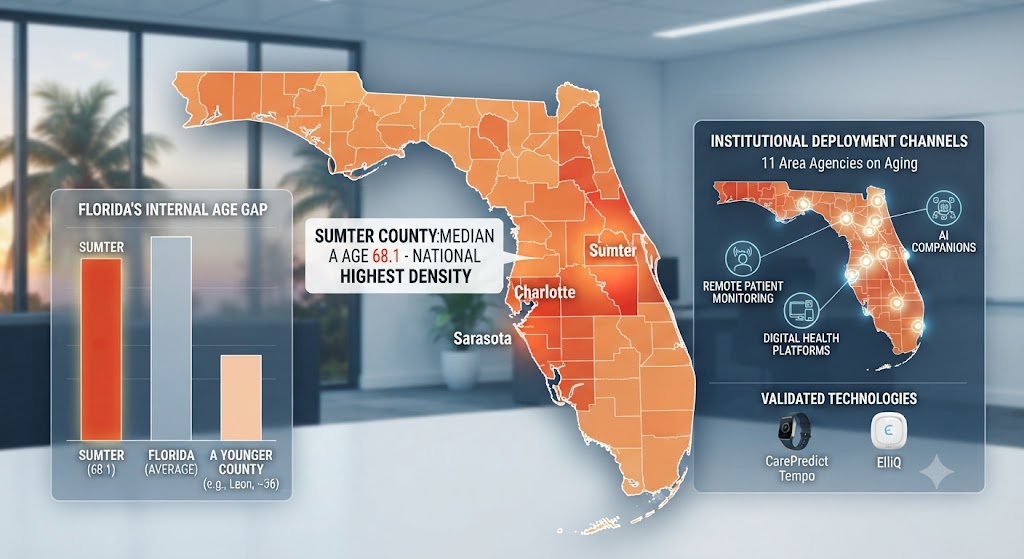
- Sumter County, Florida is the oldest county in the United States, with a median age of 68.1 — and it is one of three Florida counties containing The Villages, the nation’s largest retirement community at 32 square miles.
- Florida has the fifth-highest median age of any state, but also contains counties younger than the national median, giving it one of the widest internal age gaps in the country.
- The national context matters more than the Florida number: the U.S. population aged 65 and older reached 61.2 million in 2024, and older adults now outnumber children in 11 states and nearly 45% of all U.S. counties — up from 31.3% in 2020.
- Florida already has functioning deployment infrastructure: a state Department of Elder Affairs coordinating 11 Area Agencies on Aging, county-level technology pilots, and university research capacity.
- Florida-headquartered CarePredict has raised approximately $49 million for an AI-driven platform and wearable that observes daily activity patterns to predict health decline before it happens.
- Our thesis: Florida is not demographically unusual. It is demographically early — and a product validated here is validated for the median American county roughly a decade ahead.
What is Florida’s actual demographic position?
Florida holds the most concentrated older-adult population in the United States, and it holds it at both extremes — statewide scale and county-level density.
Sumter County is the oldest county in the nation, with a median age of 68.1. It has held the distinction of being the only U.S. county where a majority of residents are 65 or older, a threshold it first crossed with 54.8% in 2015. It is one of three Florida counties that contain The Villages, the largest retirement community in the country at 32 square miles. Charlotte County has also ranked among the oldest counties nationally.
At the state level, Florida has the fifth-highest median age. But the statewide figure conceals the more useful fact: Florida also contains counties younger than the national median, producing one of the widest intra-state age gaps in America.
That range is the underrated part. A company building for older adults can find, inside a single state and a single regulatory environment, a county that is majority-retiree, a county that is demographically average, and a county that is young — which is the closest thing to a controlled comparison that exists outside a laboratory.
So why is Florida chasing fintech?
Because ecosystem strategy is driven by narrative gravity, and narrative gravity points toward whatever is hot somewhere else. Florida’s technology positioning over the past decade has been substantially imitative: Miami as a crypto capital, Miami as a fintech hub, Tampa as a cybersecurity cluster, everywhere as an AI destination.
Some of these have real foundations. Tampa Bay’s cybersecurity cluster has genuine roots, and Miami’s capital markets presence is not imaginary. But in each of these categories Florida is competing against entrenched incumbents with deeper talent pools, and it is competing on inputs — cost, taxes, weather — that other states can partially match.
Aging technology is the one category where Florida is not competing at all, because it already holds the asset that matters and cannot be copied. No state can legislate itself an older population. It takes fifty years and a climate.
The category also suffers a positioning problem: it reads as unglamorous. Nobody’s pitch deck opens with a slide about incontinence sensors. But the sectors that get labeled unglamorous are frequently the ones with durable demand, slow competitive entry, and buyers who genuinely need the product rather than merely wanting it.
🔷 Brian’s Take
I spent 25 years in institutional asset management and this is one of the oldest patterns in the business: everyone crowds into the trade that is already working somewhere else, and by the time a new entrant arrives, the return has been competed away.
Florida decided to be a fintech hub roughly when fintech valuations peaked. It decided to be a crypto capital roughly at the top of that cycle. There is a term for buying an asset because it recently went up a lot, and it is not a flattering one.
Meanwhile the state has been sitting on a position that nobody else can accumulate at any price. In a portfolio, that is the definition of an edge — an exposure your competitors cannot replicate through effort or capital. Florida’s economic development apparatus has spent years chasing beta and ignoring the one place it has genuine alpha.
— Brian B. French
What is Demographic Alpha?
Demographic Alpha is the commercial advantage a region holds when its population composition makes it the best available environment to build, test, and validate products for a market the rest of the country is still approaching. It is a positional asset, not an industry.
The distinction matters because Florida’s aging population is usually discussed as a market — a large pool of consumers to sell to. That framing understates it considerably. Markets can be reached remotely. What cannot be reached remotely is the ability to observe real behavior at scale, iterate against it, and generate the deployment evidence that regulated buyers require.
Demographic Alpha has three components:
Density. Enough concentration for meaningful sample sizes without national distribution.
Institutional channel. Existing organizations that can host deployments — which Florida has, and which is the genuinely rare part.
Gradient. Internal variation that permits comparison across demographic conditions, which Florida’s unusual county-level age spread supplies.
Very few places have all three. Florida is the only U.S. state that has all three at scale.
What aging technology is already working in Florida?
More than most people in Florida’s own tech ecosystem realize, and it is concentrated in exactly the places the ecosystem doesn’t look.
CarePredict, headquartered in Florida, has raised roughly $49 million for an AI-driven digital health platform built around a wearable sensor called Tempo, which observes daily activity patterns — movement, gait, sleep timing, routine — to detect health decline before it presents as an incident. This is a real Florida company with real capital in exactly the category this article is describing, and it is not part of Florida’s standard tech narrative.
County-level deployments are further along than the state’s tech press has covered. Broward County’s Area Agency on Aging has deployed the ElliQ AI companion device, and a Broward pilot has used AI-powered robotic animals capable of telling jokes, delivering medication reminders, and conducting regular check-ins with isolated older adults.
Institutional pilots are running in Florida senior living facilities, including business-intelligence platforms tracking resident and staff location to improve call response times and document them.
Care model changes are moving in parallel. Hospital-at-Home programs — delivering hospital-level care in a patient’s residence with remote monitoring of vital signs — align closely with the preference of Florida’s older residents to age in place.
What is missing is not activity. It is aggregation, visibility, and anyone treating this as a coherent sector.
🔲 [MAP PLACEHOLDER — insert the Florida Longevity Tech Map here before publication.] Two layers: (1) Florida-headquartered companies in aging, care delivery, remote monitoring, and clinical AI — company, county, category, disclosed funding; (2) county-level population aged 65 and older, available from the Florida Office of Economic and Demographic Research’s annual county age-distribution tables. The overlay is the argument. If the companies are not where the density is, that gap is itself the story.
🔷 Brian’s Take
I have built and run digital marketing for Florida businesses for well over a decade, and a large share of my clients sell to people over 65 whether they intended to or not. Here is what that work actually teaches you, and it is not what the design conferences say.
Older users are not bad at technology. They are unusually intolerant of technology that wastes their time, and they have no social incentive to pretend otherwise. A 30-year-old will blame themselves for a confusing interface. A 75-year-old will correctly blame you and never come back. That is a brutally efficient feedback mechanism, and building for it produces products that are simply better.
The second thing: trust decisions in this demographic are made once and held for a long time. Acquisition is slower and harder than the deck assumes; retention is dramatically better. Any founder modeling this market on consumer-app churn assumptions will get both numbers wrong in opposite directions.
— Brian B. French
Why is Florida a deployment advantage and not just a customer base?
Because Florida has an existing public institutional channel for reaching older adults, and that channel is the hardest thing for a startup in this category to build.
Florida’s Department of Elder Affairs coordinates 11 designated Area Agencies on Aging, also operating as Aging and Disability Resource Centers, each responsible for coordinating services across a region. The state also runs SHINE — Serving Health Insurance Needs of Elders — providing free personalized guidance on coverage questions.
To appreciate what this is worth, consider the alternative. A founder in a state without this infrastructure spends eighteen months assembling pilot access one facility at a time, with no standardized evaluation, no route to a regional deployment, and no institutional reference customer at the end. In Florida, those organizations exist, they are already deploying technology, and they have a mandate to bridge the gap between senior needs and available staffing.
This is the piece Florida’s economic development strategy is not using. The state markets tax treatment to companies that could locate anywhere. It does not market the one thing a longevity tech founder genuinely cannot get elsewhere: a coordinated public infrastructure for reaching the population their product serves.
If this is such a strong position, why hasn’t venture capital piled in?
Because the honest answer is that agetech has been a difficult venture category, and pretending otherwise would make this analysis worthless. Venture investment around aging has been characterized as modest relative to the scale of the underlying societal change, and there are structural reasons.
The buyer is fragmented. A product might be paid for by the individual, an adult child, a facility, a health plan, or a government program — often with different decision-makers and different purchasing logic for the same product.
Reimbursement is slow. Anything routed through Medicare or Medicare Advantage inherits long sales cycles and coverage uncertainty that do not fit a two-year fund cycle.
Consumer price sensitivity is real. Substantial portions of the population being served live on fixed incomes.
And the category is operationally heavy. Hardware, home installation, caregiver training, and clinical validation are not software margins.
What follows from this is not that the opportunity is fake — it is that the opportunity may not be venture-shaped. Many of the best businesses here will be durable, profitable, service-inflected companies growing at 20–40% rather than power-law outcomes returning a fund. That is a poor fit for the capital Florida has been trying to attract and an excellent fit for the capital Florida actually has, which skews toward family offices, private wealth, and operators who are themselves retired into the state.
Florida has been trying to import Silicon Valley’s capital model to fund companies in a category that model systematically undervalues, while sitting on a pool of patient capital that matches the category almost perfectly.
🔷 Brian’s Take
I want to sit on that last point because I think it is the actual finding in this article.
When I managed institutional money, we distinguished constantly between a good business and a good venture investment. They are not the same thing and conflating them destroys a lot of capital. A company compounding at 30% with real cash flow and low churn is an excellent asset. It is a mediocre venture asset, because venture math requires a small number of enormous outcomes to carry the losses.
Florida’s tech ecosystem has been organized almost entirely around the venture-shaped question — how do we get more Series A rounds, more unicorns, more exits. Meanwhile the state’s genuine capital advantage is the enormous amount of private and retired wealth sitting here looking for durable income, which is precisely the capital that should be funding profitable, boring, essential longevity businesses.
We have been trying to match the wrong capital to the wrong opportunity in both directions simultaneously. That is a solvable problem and nobody is working on it.
— Brian B. French
Is Florida an outlier — or a preview?
A preview, and this is the strongest argument in the entire case.
The instinct is to treat Florida’s age structure as exceptional, a quirk of retirement migration that makes it a poor model for anywhere else. The national data says the opposite is happening quickly.
The U.S. population aged 65 and older reached 61.2 million in 2024, growing 3.1% in a single year while the under-18 population declined. Older adults now outnumber children in 11 states. And the county-level shift is remarkable: in 2020, 983 of the nation’s 3,144 counties had more older adults than children — 31.3%. By 2024 that figure was 1,411 counties, nearly 45%.
That is a 43% increase in four years in the number of American counties that look demographically more like Florida than like the country’s self-image.
The implication for a founder is direct. A product validated in Sumter County today is not validated for a niche. It is validated for the median American county of the mid-2030s, and quite possibly for the median county of the early 2030s. Florida functions as a forward market — a place where you can observe the operating conditions most of the country will face before most of the country faces them.
Globally the same arrow points the same direction, with roughly one in six people worldwide projected to be over 60 by 2030.
Nobody is currently selling Florida this way, and it is a considerably better pitch than low taxes.
What are the ethical constraints — and why do they matter commercially?
Because this category is uniquely capable of causing harm, and in Florida the harm is already well documented.
Older adults are the most heavily targeted demographic for financial fraud in the country, and Florida’s concentration makes it a focal point. The market response — companies like Carefull, which raised $16.5 million specifically to protect older adults from digital fraud, scams, and identity theft — exists because the problem is enormous.
Three constraints any serious operator in this category has to hold:
Consent and cognition. Products for people who may experience cognitive decline require consent frameworks that account for changing capacity, including who is authorized to act on the user’s behalf and how that authority is verified. This is genuinely hard and mostly unsolved.
Surveillance versus care. Monitoring technology sits on a continuum, and the same activity data that predicts a fall can function as surveillance of an adult who has not meaningfully agreed to it. Better-designed products in the space address this directly — ElliQ, for instance, does not require cameras for basic functions and provides controls over what is shared and with whom.
Dignity as a design requirement. A product that makes someone feel managed will be abandoned regardless of clinical efficacy.
The commercial argument for taking all three seriously is straightforward: this category will be regulated, and it will be regulated in response to whatever the worst actors do. Companies that build defensible consent and privacy practices now will be advantaged when that arrives. Companies that treat older adults as a low-scrutiny market will not survive it.
🔷 Brian’s Take
A personal note to close, because this one is not abstract for me.
Outside the digital work, I deal in authenticated antiques and I have spent years as a genealogist and historian. That means most of my professional life outside marketing has been spent with old things and with older people, and the discipline both demand is the same: establish provenance, verify the claim, and never assume the person in front of you knows less than you do.
The reason I am wary of a lot of what gets pitched at this demographic is that it inverts that posture. It treats older adults as a problem to be managed rather than as customers to be served, and you can feel that inversion in the product within about ninety seconds of using it. So can they.
Florida is going to build this industry whether or not it decides to. The demographics are not negotiable. The only real question is whether we build it well — with consent, with dignity, and with the assumption that the person on the other end is a competent adult who has been alive considerably longer than the founder. I would like Florida to be known for getting that part right.
If you are building in this category in Florida, I want to hear from you. You are currently uncounted.
— Brian B. French
What would it take to claim this position?
Five steps, in ascending order of difficulty:
- Map the sector. No inventory of Florida longevity tech companies exists. Building one is a research project and would immediately make Florida the only state that knows what it has.
- Package the deployment channel. Florida’s Area Agencies on Aging are the state’s most underused economic development asset. A structured, standardized pilot pathway for vetted companies would be a genuine national differentiator.
- Match the right capital. Florida’s private and retired wealth is well suited to durable, cash-generative longevity businesses. Nobody is intermediating between the two.
- Fund the validation infrastructure. Florida’s universities are positioned to serve as the country’s clinical and behavioral validation environment for aging technology. That is a fundable, defensible, permanent institutional advantage.
- Change the pitch. Stop marketing Florida as a cheaper place to run a fintech company. Start marketing it as the only place in America where you can build for the demographic future and test it on the demographic present.
About the author
Brian B. French is a digital strategist, former institutional portfolio manager, and the architect of the Florida Authority Network, a proprietary portfolio of Florida business news and press release websites including Florida Technology News.
Before moving into digital strategy, Brian spent more than 25 years in financial services, serving as Vice President and Portfolio Manager with Merrill Lynch Investment Managers and Trust Company, with earlier roles at Shearson American Express, EF Hutton, SouthTrust, and SunTrust. He holds a B.A. in Finance and Business Administration from the University of South Florida.
Outside the digital realm he is a dealer in authenticated antiques and fine art and a member of 17 hereditary and genealogical societies, including the Sons of the American Revolution and the General Society of Mayflower Descendants — a background that informs his professional preoccupation with provenance and verification.
Frequently Asked Questions
What is the oldest county in the United States? Sumter County, Florida, with a median age of 68.1. It has been the only U.S. county where a majority of residents are aged 65 or older, and it is one of three Florida counties containing The Villages, the nation’s largest retirement community at 32 square miles.
Does Florida have the oldest population in America? Florida has the fifth-highest median age among states and the most concentrated older-adult population overall, though it also contains counties younger than the national median — one of the widest internal age ranges of any state.
How many Americans are 65 or older? The U.S. population aged 65 and older reached 61.2 million in 2024, a 3.1% increase from 2023, while the under-18 population declined slightly over the same period.
Are older adults outnumbering children in the United States? In many places, yes. Older adults outnumbered children in 11 states and in nearly 45% of U.S. counties in 2024 — 1,411 of 3,144 counties, up from 983 counties in 2020.
What agetech companies are based in Florida? CarePredict is the most prominent, having raised roughly $49 million for an AI-driven platform and wearable sensor that observes daily activity to predict health decline. Florida also hosts county-level deployments including ElliQ AI companions through Broward County’s Area Agency on Aging. No comprehensive inventory of the sector currently exists.
What is Florida’s Department of Elder Affairs? It is the state agency coordinating services for older Floridians, overseeing 11 designated Area Agencies on Aging that also operate as Aging and Disability Resource Centers, plus programs including SHINE for insurance counseling.
Why don’t venture capitalists invest more in aging technology? Structural reasons: fragmented buyers, slow reimbursement cycles tied to Medicare and Medicare Advantage, price sensitivity among fixed-income customers, and hardware and service intensity that compresses margins. Many strong businesses in this category are durable and profitable without being venture-scale.
What is Demographic Alpha? It is Florida Technology News’ term for the commercial advantage a region holds when its population composition makes it the best available environment to build, test, and validate products for a market the rest of the country is still approaching.
Sources & Further Reading
- U.S. Census Bureau — “Older Adults Outnumber Children in 11 States and Nearly Half of U.S. Counties,” June 26, 2025. https://www.census.gov/newsroom/press-releases/2025/older-adults-outnumber-children.html
- U.S. Census Bureau — “Older Population and Aging” topic page and county age visualizations. https://www.census.gov/topics/population/older-aging.html
- U.S. Census Bureau — “Sumter County, Fla., is Nation’s Oldest,” CB16-107. https://www.census.gov/newsroom/archives/2016-pr/cb16-107.html
- Florida Realtors — “Census Shows Big Age Gaps Across Florida Counties,” July 2025. https://www.floridarealtors.org/news-media/news-articles/2025/07/census-shows-big-age-gaps-across-florida-counties
- Florida Office of Economic and Demographic Research — “Florida Estimates of Population 2025,” including county rankings by percent of population aged 65 and older. https://edr.state.fl.us/Content/population-demographics/data/Estimates2025.pdf
- Crunchbase News — “From Longevity To Aging In Place, These Are The Top Areas For Senior-Focused Startups.” https://news.crunchbase.com/health-wellness-biotech/longevity-venture-funding-senior-focused-startups/
- James Madison Institute — “Florida’s Silver Tech Revolution: AI’s Promise for Elderly Healthcare.” https://jamesmadison.org/florida-daily-floridas-silver-tech-revolution-ais-promise-for-elderly-healthcare/
- South Florida Hospital News — “Navigating the Digital Age: Advances in Senior Care Technology.” https://southfloridahospitalnews.com/alzheimer-focus-navigating-the-digital-age-advances-in-senior-care-technology/
- America’s Health Rankings — Population Age 65+ in Florida. https://www.americashealthrankings.org/explore/measures/pct_65plus/pct_65plus_white/FL
Primary sources to consult before republication or update: Florida Department of Elder Affairs annual reports and Area Agency on Aging service data; U.S. Census Bureau Vintage 2025 county population estimates; CMS Medicare Advantage penetration data by Florida county; Florida EDR Table 14 (county rankings by percent aged 65 and older).
Related coverage:
- Florida Regulates Data Centers Above 50 Megawatts. The Real Buildout Is Happening Below the Line.
- The Space Coast Will Fly 120+ Launches in 2026. Florida Isn’t Built to Process the Data.
- Florida’s Hurricane Problem Built the Country’s Best Resilience Engineers. Nobody Is Selling That.
Editorial note
Sections identified as analysis represent the author’s interpretation and are labeled as such. Demographic Alpha is a framework proposed by this publication, not an established term.
Verification flags for the editor. Three items above require confirmation against primary sources before publication. First, Sumter County’s majority-65+ status derives from Census estimates of varying vintage; confirm the current figure against Vintage 2025 estimates rather than relying on the median age alone. Second, CarePredict’s funding total is a cumulative disclosed figure from secondary reporting and should be checked against current filings. Third, the Broward County ElliQ deployment and the associated Florida International University research finding on companion devices are reported in secondary sources of uneven quality; confirm both directly with the Broward County Area Agency on Aging and with FIU before publication, or remove the research claim.
This article discusses technology deployed for vulnerable populations. Nothing here is medical advice or a product endorsement.
Changelog
- July 25, 2026 — Initial publication.
About the Author