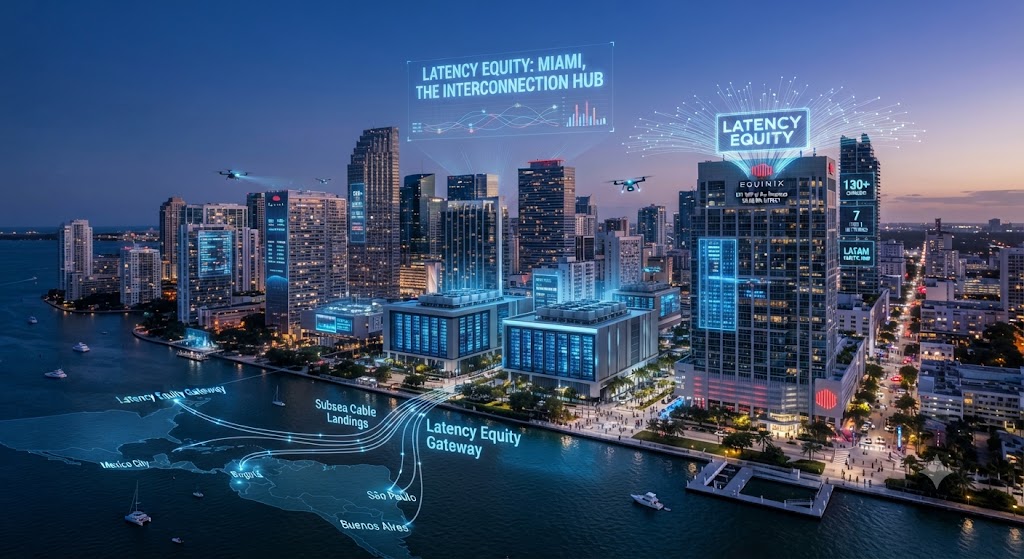
Miami’s Most Valuable Tech Asset Isn’t Venture Capital. It’s 17 Cable Landings and One Building Downtown.
By Brian B. French | Florida Technology News Published July 25, 2026 · Last updated July 25, 2026
The short answer: Miami measures its tech economy in funding rounds and unicorn counts, where it ranks around 12th nationally. Its genuinely world-class asset is physical interconnection — Florida has roughly 17 subsea cable landing sites with more in development, and a single downtown building carries the majority of internet traffic between North America and Latin America. We call that unpriced position Latency Equity.
Key Takeaways
- The NAP of the Americas — Equinix MI1 at 50 NE 9th Street in downtown Miami — is a six-story, roughly 750,000-square-foot purpose-built facility that functions as the primary interconnection hub between North America, Latin America, and the Caribbean.
- MI1 hosts more than 130 telecommunications carriers, with roughly 47% of them based in Latin American and Caribbean markets, plus seven Tier 1 network service providers.
- Reporting has placed 18 subsea cables coming into the facility, and Florida overall has approximately 17 cable landing sites with about seven more in development.
- The reason is geography, not policy: running terrestrial fiber through Latin America is nearly impossible because of the Andes, the Amazon, and the Antilles, so the region depends on submarine cables that terminate in the Miami metro.
- Meanwhile Miami’s tech narrative runs on different numbers entirely — Florida startups raised roughly $4.13 billion across 588 deals in 2024, with the Miami–Fort Lauderdale region taking about $2.77 billion, and Miami counted six active unicorns, ranking roughly 12th among U.S. ecosystems.
- Our thesis: Miami competes hard on a metric where it is respectable and ignores the one where it is unrivaled — and that asset carries a concentration risk nobody is discussing.
What is the NAP of the Americas?
It is the building through which the majority of internet traffic between the United States and Latin America physically passes. Equinix MI1, still widely called the Network Access Point of the Americas, sits at 50 NE 9th Street in downtown Miami — six stories, roughly 750,000 square feet of purpose-built data center space across floors of about 120,000 square feet each, occupying something on the order of 16 acres.
It was established in 2001 through a partnership between Telcordia and Terremark, specifically to capitalize on Miami’s position relative to international undersea fiber. Equinix acquired it from Verizon as part of a 29-data-center transaction, and it was widely regarded as the crown jewel of that deal — not for its square footage, but for the concentration of networks inside it.
The interconnection density is the whole point. MI1 hosts more than 130 telecommunications carriers, roughly 47% of them based in Latin American and Caribbean markets, alongside seven Tier 1 network service providers. It is where most Latin American networks peer with one another, making it the largest peering location in the city. Equinix has described it as carrying the majority of Latin America and Caribbean traffic bound for more than 148 countries.
The subsea connections run through the campus: termination points for systems between North America and Brazil, including Monet and GlobeNet, sit in the MI3 facility and are reachable from MI1 via 38 high-speed dark fiber backbones. Reporting has put 18 subsea cables coming into the NAP, with Florida overall hosting roughly 17 landing sites and approximately seven more in the works.
For scale on why any of this matters: more than 97% of all international internet traffic travels through subsea cables.
Why does Latin American internet traffic go through Miami?
Because of terrain, not tax policy — and this is the single most important fact in Florida’s technology economy.
Running terrestrial fiber optic cable across Latin America is close to impossible at scale. The obstacles are the Andes, the longest continental mountain range on the planet; the Amazon, the world’s largest tropical rainforest; and the Antilles, thousands of islands operating under more than 30 different flags and therefore more than 30 different regulatory regimes.
Call it the Andes Problem. A region that cannot economically connect itself overland must connect itself by sea, and submarine cables need a common landing point with the network density to make interconnection worthwhile. Miami became that point and has stayed that point for a quarter century.
This is a fundamentally different kind of advantage than anything else in Florida’s economic development portfolio. Tax treatment can be matched by any state that wants to match it. Cost of living erodes as a place succeeds. Talent relocates. But no competing metro can legislate itself closer to the Caribbean basin or make the Andes shorter.
Miami’s position was not won. It was inherited from physical geography and then built upon — which is precisely what makes it defensible, and precisely why it deserves more strategic attention than it gets.
🔷 Brian’s Take
In portfolio work you learn fairly early to distinguish a moat from a momentum story, and the test is simple: what would a well-funded competitor have to do to take this away from you?
For most of what Florida markets — low taxes, business-friendly regulation, weather, cost of living — the answer is “pass a bill” or “wait for the cycle to turn.” Six states could replicate Florida’s tax position within one legislative session if they decided to. That is not a moat. That is a temporary price advantage, and price advantages get competed away.
For Miami’s interconnection position, the answer to that question is: move the Andes. That is the only real moat in Florida’s entire technology story, and I would argue the state has spent more marketing dollars in the last five years promoting the things anyone can copy than promoting the one thing nobody can.
— Brian B. French
What is Latency Equity?
Latency Equity is the durable economic value a region holds from its physical interconnection position — measured in cable landings, peering density, and milliseconds rather than in funding rounds. We are naming it because Miami has an enormous amount of it and carries none of it on any balance sheet anyone consults.
The concept has three properties that make it different from the assets economic development agencies normally track:
It is physical. Interconnection position is built from cable landings, dark fiber, and network presence. It cannot be relocated by an acquisition or a headquarters move.
It compounds. Networks locate where other networks already are, because the value of joining an exchange rises with the number of participants already inside it. Miami’s density attracts more density.
It is invisible. No local business journalism metric captures it. No accelerator cohort demonstrates it. It generates no founder profiles. It simply sits there, carrying most of a hemisphere’s traffic.
That invisibility is the problem this article exists to address.
How does Miami measure itself instead?
In capital metrics, where it performs respectably and unremarkably. Florida startups raised roughly $4.13 billion across 588 deals in 2024, placing the state among the top six nationally for both deal count and value. The Miami–Fort Lauderdale region accounted for about $2.77 billion, ranking sixth nationally by deal count and ninth by deal value. Miami counts six active unicorns and sits around 12th among U.S. startup ecosystems, with total exit value reported at $2.1 billion and an ecosystem valuation estimated near $95 billion. It has been described as the second fastest-growing startup environment in the country.
These are genuinely good numbers. Nothing here disputes them.
But notice the shape of them: sixth, ninth, twelfth, second-fastest-growing. These are the metrics of a strong challenger. They describe a city doing well in a national competition against opponents with structural head starts — and they are the metrics Miami leads with in every pitch it makes.
Meanwhile, on interconnection, Miami is not sixth or twelfth. It is the point through which a hemisphere connects, and it does not lead with that at all.
🔷 Brian’s Take
Here is what I have actually observed operating digital properties for clients with Latin American audiences, and it is more prosaic than the strategy language suggests.
When a site serving customers in Bogotá or São Paulo is hosted in the wrong place, you do not get an outage. You get something worse and harder to diagnose: everything works, slightly badly, forever. Pages load a beat late. Checkout abandonment ticks up a few points. Nobody files a support ticket saying “your latency is poor” — they just leave, and the analytics show a soft conversion problem that gets blamed on creative, or pricing, or the market.
I have watched more than one client spend real money rebuilding a funnel when the actual problem was that their packets were taking a scenic route through Northern Virginia. Latency is not an engineering abstraction. It is a revenue line, and it is nearly invisible until somebody measures it.
— Brian B. French
What is the concentration risk nobody discusses?
Miami’s interconnection advantage is real, valuable, and unusually concentrated — and concentrated assets erode quietly. Every account of the NAP of the Americas reads as celebration. This section is the counterweight, and we regard it as the most useful thing in this article.
Three risks deserve open discussion.
Physical and operational concentration. A hemisphere’s interconnection running substantially through one campus in downtown Miami is a remarkable engineering achievement and a real single-point exposure. The facility is built for redundancy with N+1 electrical and mechanical systems, and Equinix operates it to a standard appropriate to its importance — but the risk in question is not really about one building’s uptime. It is about what happens to a region’s connectivity strategy when the alternatives were never developed because the primary always worked.
Route bypass. Miami’s position depends on remaining the most efficient landing point. New cable systems making direct runs between Latin American markets and other U.S. or European landing points would erode transit dependence on Miami incrementally, without any single announcement that reads as a threat. This is how interconnection hubs lose position historically — not through a collapse, but through a decade of routes that quietly no longer need them.
Intra-regional buildout. The Andes Problem is a constraint, not a law of nature. As Latin American markets build out domestic and regional infrastructure — including their own data centers, exchanges, and cable systems — the necessity of routing through Miami for intra-regional traffic declines. Colombia, Brazil, Chile, and Mexico all have growing domestic infrastructure. That is good for them, and it is a slow structural headwind for Miami’s transit position.
None of this suggests the asset is in immediate jeopardy. It suggests that an inherited advantage nobody is actively defending is exactly the kind that gets lost, and that Miami currently has no public strategy for defending it because it has no public accounting of owning it.
Why does this matter more in the AI era?
Because AI inference is latency-sensitive in a way that batch computing never was, and because data residency requirements are hardening across Latin America.
The shift is straightforward. Training large models is a batch process where a few hundred milliseconds are irrelevant. Serving them is interactive, and interactive workloads live or die on round-trip time. As AI moves from research into products that people use conversationally, the physical distance between the user and the inference endpoint becomes a product-quality variable rather than an infrastructure detail.
Equinix is already positioning its Miami facilities on exactly this basis, marketing them as supporting AI deployment through high-density power, rich interconnection, and direct subsea cable access as a low-latency gateway to Latin America.
The second driver is regulatory. Data residency and sovereignty requirements are tightening across the region, which pushes toward processing closer to the user rather than in a distant U.S. region — and creates demand for compute positioned exactly where Miami sits.
Which returns this to the question Florida is arguing about right now. Serving AI workloads to Latin America from Miami requires compute in or near Miami, and as we reported in our analysis of Florida’s 50-megawatt regulatory threshold, the state’s data center debate is focused almost entirely on large rural campuses sited for cheap power. The facilities that would monetize Miami’s interconnection position are smaller, urban, expensive to power, and completely absent from the conversation.
🔷 Brian’s Take
When I was managing institutional assets, a position this concentrated and this strategically important would have generated a risk memo, not a press release. Somebody would have been assigned to answer three questions in writing: what is this position actually worth, what specifically would erode it, and what are we doing about that.
As far as I can determine, nobody in Florida has written that document. Miami has an inherited, geography-derived, genuinely world-class asset, and the public conversation about it consists almost entirely of celebratory coverage noting that a lot of cables come ashore here.
Inherited advantages are the easiest ones to lose, because nobody feels responsible for defending something they did not build. The Andes are not going anywhere, but the assumption that traffic must route through Miami is a commercial condition, not a permanent one, and commercial conditions change on a ten-year clock while nobody is watching.
— Brian B. French
What would a latency-first strategy actually look like?
Five steps, in ascending order of difficulty:
- Measure and publish the numbers. Nobody has published a rigorous, independent comparison of round-trip times from Miami versus competing U.S. metros to major Latin American markets. This is a weekend of work with public measurement infrastructure and it does not exist.
- Put interconnection on the scoreboard. Cable landings, carrier counts, peering participants, and measured latency to key markets should appear in the same reports that currently track funding rounds. What gets reported gets defended.
- Recruit on physics. Florida’s pitch to a company serving Latin American customers should lead with the interconnection position and treat the tax treatment as a footnote. Right now it is exactly inverted.
- Connect it to the compute debate. Miami’s interconnection value is only realizable if there is compute near it. That argues for urban, moderate-scale facilities — a different policy conversation than the one Florida is currently having about rural hyperscale campuses.
- Write the risk memo. Somebody — Beacon Council, a university, the state — should commission an honest assessment of what would erode Miami’s transit position and over what timeframe. That document would be genuinely valuable and it would be the first of its kind.
🔲 [LATENCY TABLE PLACEHOLDER — insert measured results here before publication.] Measure median round-trip time from Miami, Dallas, Ashburn, and Los Angeles to São Paulo, Bogotá, Mexico City, Santiago, Panama City, and San Juan. Method: public looking-glass servers and distributed measurement platforms such as RIPE Atlas. Run at multiple times of day across several days; report medians and variance, not single pings. Publish the full methodology and raw data. We are deliberately not estimating these figures. A specific latency number is the most citable element this article could contain, which is exactly why it should not be published until it has been measured.
What this means for a Florida business
If you serve Latin American customers and you have never checked where your infrastructure actually is, that is a cheap thing to fix and a likely source of quiet revenue loss. Many Florida companies host with providers defaulting to Northern Virginia or Ohio regions because that is where the cheapest capacity sits, then serve Bogotá or Santiago customers over a path that leaves Florida, goes north, and comes back down.
The diagnostic is inexpensive: measure round-trip time from your actual customer geographies to your actual endpoint, then compare against a Miami-hosted alternative. The difference may be immaterial. If it is not, the fix is a configuration change rather than a rebuild.
The strategic version of this applies to positioning as much as hosting. A Florida company selling into Latin American markets has a credibility asset available to it that a competitor in Denver does not, and most Florida companies never mention it.
🔷 Brian’s Take
A closing note about why I left a blank space in the middle of this article.
The single most valuable thing I could have put in this piece is a latency table — hard numbers, Miami versus everywhere else, to the major Latin American capitals. It would be quoted constantly. It is exactly the kind of specific, extractable fact that gets cited and re-cited until it becomes the accepted figure.
Which is precisely why I am not estimating it. I could produce plausible numbers from general knowledge and most readers would never check. But a fabricated benchmark that gets repeated is worse than no benchmark, and in a business built entirely on being trustworthy about facts, the temptation to fill that gap with something that sounds right is the exact temptation you have to refuse.
So the table is coming, measured properly, with the methodology published so anyone can check my work. Until then the space stays empty, and I would rather this article be less quotable and more true.
If you run infrastructure serving Latin American markets from Florida, I would like to compare notes when we run the measurements.
— Brian B. French
About the author
Brian B. French is a digital strategist, former institutional portfolio manager, and the architect of the Florida Authority Network, a proprietary portfolio of Florida business news and press release websites including Florida Technology News.
Before moving into digital strategy, Brian spent more than 25 years in financial services, serving as Vice President and Portfolio Manager with Merrill Lynch Investment Managers and Trust Company, with earlier roles at Shearson American Express, EF Hutton, SouthTrust, and SunTrust. He holds a B.A. in Finance and Business Administration from the University of South Florida.
He applies the same analytical discipline he once used for institutional portfolios to a different problem: how Florida businesses establish verifiable credibility in an AI-first search environment. Contact: [editorial contact]
Frequently Asked Questions
What is the NAP of the Americas? The Network Access Point of the Americas, now operated by Equinix as MI1, is a carrier-neutral data center and internet exchange at 50 NE 9th Street in downtown Miami. It functions as the primary interconnection hub for telecommunications traffic between North America, Latin America, and the Caribbean, and was established in 2001 by Telcordia and Terremark.
How many subsea cables land in Miami? Reporting has placed 18 subsea cables coming into the NAP of the Americas, with Florida overall hosting approximately 17 cable landing sites and about seven additional sites in development.
Why is Miami the internet gateway to Latin America? Because Latin America’s geography makes terrestrial fiber impractical at scale — the Andes, the Amazon, and the Antilles all obstruct overland routes — so the region depends on submarine cables, most of which terminate in the Miami metro area where sufficient network density exists to make interconnection worthwhile.
How many carriers are in Equinix MI1? More than 130 telecommunications carriers, with roughly 47% based in Latin American and Caribbean markets, alongside seven Tier 1 network service providers.
Is Miami a good place to host infrastructure for Latin American customers? For latency-sensitive workloads serving Latin American users, Miami is generally the best-connected U.S. location, given the concentration of subsea cable landings and regional peering. Whether it is the right choice for a specific application depends on measured performance from your actual customer geographies.
How big is the NAP of the Americas building? Roughly 750,000 square feet across six stories, with individual floors of approximately 120,000 square feet, on a site of about 16 acres. Capacity has been reported at approximately 6,500 cabinets following a $60 million expansion.
How much venture capital do Miami startups raise? Florida startups raised approximately $4.13 billion across 588 deals in 2024, with the Miami–Fort Lauderdale region accounting for roughly $2.77 billion — sixth nationally by deal count and ninth by deal value. Miami counts six active unicorns and ranks around 12th among U.S. startup ecosystems.
What is Latency Equity? It is Florida Technology News’ term for the durable economic value a region holds from its physical interconnection position — cable landings, peering density, and measured latency to key markets — as distinct from the capital metrics ecosystems usually track.
Sources & Further Reading
- Submarine Networks — “Equinix MI1 — Miami NAP of America,” facility profile. https://www.submarinenetworks.com/en/stations/north-america/usa-east/miami-nap
- Equinix — “Why Miami is Latin America’s Center of Interconnection.” https://blog.equinix.com/blog/2018/05/01/why-miami-is-latin-americas-center-of-interconnection/
- Equinix — “NAP of the Americas Expansion Extends Capacity & Access to LATAM and Caribbean Markets.” https://blog.equinix.com/blog/2018/08/20/equinix-nap-of-the-americas-expansion-extends-capacity-access-to-latam-and-caribbean-markets/
- Data Center Knowledge — “Equinix Expands Miami Data Center Key to Latin American Connectivity.” https://www.datacenterknowledge.com/networking/equinix-expands-miami-data-center-that-s-key-to-latin-american-connectivity
- NBC 6 South Florida — “Internet subsea cables are managed from this building in Miami,” September 2024. https://www.nbcmiami.com/news/local/nap-of-the-americas-internet-subsea-cables/3399049/
- Equinix — Miami data centers and interconnection services overview. https://www.equinix.com/data-centers/americas-colocation/united-states-colocation/miami-data-centers
- Miami-Dade Beacon Council — Technology target industry profile. https://www.beaconcouncil.com/technology/
- Refresh Miami — “The mood at FVCC: Investor optimism about Florida’s tech trajectory,” February 2026. https://refreshmiami.com/news/the-mood-at-fvcc-investor-optimism-about-floridas-tech-trajectory/
Primary sources to consult before republication or update: TeleGeography Submarine Cable Map for current Florida landing stations and planned systems; FCC submarine cable landing license filings; PeeringDB records for Miami exchange participants; RIPE Atlas or comparable measurement platform for latency verification.
Related coverage:
- Florida Regulates Data Centers Above 50 Megawatts. The Real Buildout Is Happening Below the Line.
- The Space Coast Will Fly 120+ Launches in 2026. Florida Isn’t Built to Process the Data.
- Florida’s Hurricane Problem Built the Country’s Best Resilience Engineers.
- Florida Keeps Trying to Be a Fintech Hub. Its Actual Unfair Advantage Is the Oldest Population in America.
Editorial note
Sections identified as analysis represent the author’s interpretation and are labeled as such. Latency Equity and the Andes Problem are framings proposed by this publication, not established industry terms.
Verification flags for the editor. Several facility figures above come from Equinix’s own marketing and blog material and from secondary reporting of varying dates — square footage, cabinet counts, carrier counts, and the 47% Latin American carrier share have been reported across a span of years and should be confirmed against current Equinix documentation before publication. The subsea cable counts (18 into the NAP, roughly 17 Florida landing sites with seven in development) derive from 2024 local television reporting; verify against the TeleGeography Submarine Cable Map, which is the authoritative public source and will also capture systems added since. The acquisition date of the facility from Verizon is reported inconsistently across sources as 2016 and 2017; confirm before stating.
No latency figures appear in this article because none have been independently measured. The measurement table described above should be completed before this piece is promoted as definitive.
Changelog
- July 25, 2026 — Initial publication.
About the Author