Florida Doesn’t Have a Tech Ecosystem. It Has Five, and They Don’t Talk to Each Other.
By Brian B. French | Florida Technology News Published July 25, 2026 · Last updated July 25, 2026
The short answer: Florida is discussed either as one statewide tech ecosystem or through whichever metro is being profiled that week. It is neither. Florida contains five functionally separate ecosystems with different capital sources, different sector specializations, and almost no movement of people between them. The binding constraint is not capital availability. It is talent liquidity.
Key Takeaways
- Florida’s venture capital is severely concentrated: in 2023, South Florida startups raised roughly $2.41 billion across 393 deals — about 69% of the state’s total venture capital.
- In 2024, Florida startups raised approximately $4.13 billion across 588 deals, with the Miami–Fort Lauderdale region taking about $2.77 billion of it, ranking sixth nationally by deal count and ninth by deal value.
- Tampa Bay has produced comparable long-run outcomes through different machinery: Tampa Bay Wave’s 550-plus alumni have raised nearly $1.6 billion since 2008, and Embarc Collective’s roughly 125 active startups raised over $565 million in 2024 alone.
- The Florida High Tech Corridor spans a 23-county region from Tampa Bay to the Space Coast — a footprint most Floridians could not draw from memory.
- Palantir moved its headquarters from Denver to Miami in February 2026, making it, at a valuation above $300 billion, the largest publicly traded company headquartered in South Florida. Its principal executive office is in Aventura, roughly 20 miles north of downtown Miami.
- Our thesis: Florida’s recent corporate arrivals are adding new isolated nodes rather than densifying existing ones — which makes the fragmentation problem worse, not better.
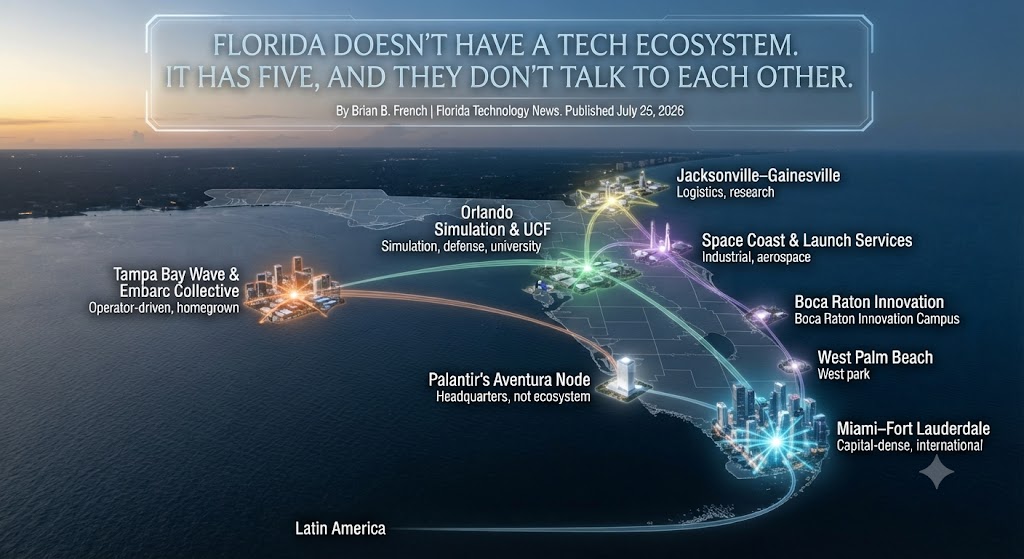
What are Florida’s five tech ecosystems?
Florida contains five distinct technology economies that share a state government and almost nothing else. This division is our analytical framework rather than an official designation, and we present it as such.
1. Miami–Fort Lauderdale. Capital-dense, internationally oriented, consumer and fintech weighted, with strong Latin American ties — roughly 35% of Miami startups are founded by Latino entrepreneurs. It holds six active unicorns and ranks around 12th among U.S. ecosystems. Its capital comes substantially from relocated wealth, international investors, and family offices.
2. Tampa Bay. Enterprise software, cybersecurity, and healthcare IT. Its capital is more locally generated and its outcomes more operator-driven. ConnectWise’s roughly $1.5 billion exit catalyzed a cybersecurity cluster, and founder Arnie Bellini reinvested proceeds into local workforce development and AI and cyber education — the clearest example in Florida of an exit compounding in place.
3. Orlando and the I-4 corridor. Simulation, training, modeling, optics and photonics, and hospitality technology, anchored by the University of Central Florida and a defense simulation cluster with no real parallel elsewhere in the state.
4. The Space Coast. Aerospace, launch services, and their supply chain — a genuinely world-class industrial economy that operates almost entirely outside the venture-backed startup framework the other regions use.
5. Jacksonville–Gainesville. Logistics technology, financial services operations, and university research commercialization out of the University of Florida, with a capital environment and cost structure unlike anywhere else in the state.
Each of these is a real ecosystem. None of them is Florida.
How concentrated is Florida’s venture capital?
Severely, and the concentration is the clearest quantitative evidence that these are separate markets rather than one. In 2023, South Florida startups raised approximately $2.41 billion across 393 deals — around 69% of all venture capital raised in Florida. The 2024 figures show the same shape: roughly $4.13 billion statewide across 588 deals, with about $2.77 billion of it in the Miami–Fort Lauderdale region.
That is not a gradient. That is a market with a center and a periphery.
But the picture inverts when you change the metric from capital deployed to companies produced. Tampa Bay Wave’s alumni base of more than 550 companies has raised nearly $1.6 billion since 2008, and it does so charging no fees and taking no equity. Embarc Collective’s roughly 125 active startups raised over $565 million in 2024 alone.
So Tampa Bay produces companies at a rate that does not match its share of the state’s venture dollars. Read one way, that is an efficiency story. Read another, it is evidence that Tampa Bay companies are raising from capital sources outside Tampa Bay — and possibly outside Florida — because the capital that sits 280 miles south is not functionally accessible to them.
🔷 Brian’s Take
I have operated a network of Florida business news properties from Tampa Bay for years, and the regional separation is not an abstraction to me — it shows up directly in the data I look at every week.
Content about Tampa business does not organically reach Miami readers. Orlando coverage does not travel to Jacksonville. These audiences behave like separate media markets because they are separate media markets, and the business communities underneath them are separated the same way. A company can be well known in Tampa Bay and completely unknown in Fort Lauderdale, three hours away, in the same state, in the same industry.
That has a cost people underestimate. Reputation is a business asset, and in Florida it does not travel. Every company that expands from one Florida metro to another effectively re-enters the market as an unknown quantity. I would be curious what that friction costs the state annually, and I suspect the number would be uncomfortable.
— Brian B. French
What is talent liquidity, and why does Florida lack it?
Talent liquidity is the ease with which experienced people can move between companies inside an ecosystem without relocating their household. It is the mechanism that actually makes clusters work, and it is what Florida’s geography defeats.
In a functioning cluster, a senior engineer can leave one company and join another without selling a house, changing schools, or leaving a professional network. That mobility does three things: it prices talent efficiently, it transfers operating knowledge between companies, and it lowers the personal risk of joining a startup — because if the startup fails, another employer is fifteen minutes away.
Florida’s metros are 200 to 300 miles apart. Tampa to Miami is roughly a four-hour drive. Orlando to Jacksonville is about two and a half. These distances are too far for commuting and too close to feel like different states, which produces the worst of both conditions: the regions compete for the same companies and the same state resources while being unable to share the same workers.
The consequence is that each Florida ecosystem must independently reach critical mass in every function it needs — senior engineering, product leadership, enterprise sales, experienced operators — rather than drawing on a shared statewide pool. Five sub-critical talent markets do not aggregate into one healthy one.
Capital, notably, does not have this problem. Money moves 280 miles instantly. People do not. Which is why Florida’s ecosystem debate, which is almost entirely about attracting more capital, is aimed at the input that is already mobile.
Doesn’t Palantir moving to Miami change everything?
It changes the headline number and almost nothing about the mechanism — and the distinction is the most important analytical point in this article.
In February 2026, Palantir announced it had moved its headquarters from Denver to Miami. At a valuation above $300 billion, it became the largest publicly traded company headquartered in South Florida, surpassing NextEra Energy. It reported net income of $1.6 billion on $4.5 billion in revenue for 2025, with 2026 revenue projected near $7.2 billion.
This appears to answer a criticism investors have long made of Florida — that a durable ecosystem needs at least one very large public technology company headquartered locally to train operators, recycle wealth into angel capital, and spawn second-generation companies.
Look closer at the mechanics.
Palantir’s SEC filings place its principal executive office at 19505 Biscayne Boulevard, Suite 2350, in Aventura — a suite in an office tower roughly 20 miles north of downtown Miami, and not in the submarket where Miami’s startup ecosystem operates. As of late 2025 the company reported approximately 4,429 full-time employees worldwide, with about 600 in the Denver office. Palantir did not publicly specify how many employees would relocate to Florida.
Call this the Aventura Test: does a corporate relocation bring employees, or does it bring a mailing address? The anchor-company effect that ecosystem theorists describe depends entirely on people — engineers who leave after four years and start something, executives who angel-invest locally, managers who train the next cohort. None of that is produced by a change of legal domicile.
We are not suggesting the move is meaningless. A $300 billion company choosing Florida is a genuine signal, it will attract other companies, and it may over time build real headcount here. We are suggesting that the ecosystem benefit is a function of employees on the ground, and that number is currently unknown and worth reporting rather than assuming.
The same pattern applies to Florida’s other recent arrivals. ServiceNow has been expanding office space in West Palm Beach. D-Wave Quantum has been associated with the Boca Raton Innovation Campus, a 1.7-million-square-foot former IBM facility housing more than 100 companies. Citadel operates from Miami.
Now plot those: Aventura, West Palm Beach, Boca Raton, downtown Miami. Four locations spanning roughly 70 miles of coastline, in four different submarkets, none of them clustered with the others.
Florida is not densifying. It is adding nodes.
🔷 Brian’s Take
When I was in institutional asset management, we were careful to distinguish between a balance sheet event and an operating event. Reincorporating in Delaware is a balance sheet event. Opening a plant is an operating event. Both show up in a press release; only one changes what the company actually does day to day.
A headquarters relocation is usually closer to the first category than the second, and I say that with no disrespect to Palantir, which is a serious company. But “principal executive office” is a legal term of art. It describes where certain officers are domiciled for regulatory purposes. It does not describe where four thousand people go to work.
Florida keeps celebrating the announcement and skipping the follow-up question, which is the only one that matters: how many employees, in what functions, by when? That is a knowable number, and somebody in Florida’s economic development apparatus should be tracking it for every relocation the state announces. As far as I can tell, nobody is.
— Brian B. French
Is fragmentation actually a problem? The honest counterargument
Plenty of large states have multiple separate tech ecosystems and do fine, so the fragmentation itself is not automatically a defect. California has the Bay Area and Los Angeles, which are meaningfully distinct. Texas has Austin, Dallas, and Houston. Nobody considers those states broken.
The distinguishing variable is scale, not count.
The Bay Area alone is a globally significant ecosystem. Austin alone is a top-tier national ecosystem. Those regions do not need to interoperate with their in-state neighbors because each independently exceeds critical mass in every function.
Florida’s five nodes do not. Miami is the largest and it ranks around 12th nationally. Tampa Bay, Orlando, the Space Coast, and Jacksonville–Gainesville each sit well below that. So Florida is running five sub-scale ecosystems in a state whose combined activity would rank considerably higher if it functioned as one market — while structurally unable to combine them.
The other honest counterargument is that sector specialization is genuinely valuable. Orlando’s simulation cluster and the Space Coast’s aerospace base are real, deep, and defensible precisely because they are specialized. Forcing artificial integration would not improve them.
The argument here is narrower than “Florida should be one ecosystem.” It is that Florida has no mechanism for the specific things that should flow between regions — talent, capital relationships, and reputation — and that the absence is not a deliberate choice anyone made.
Is anyone actually working on this?
Yes, and the most substantive attempt is recent enough that most people haven’t noticed it. In July 2026, Embarc Collective announced a partnership with the Florida High Tech Corridor to expand long-term support for founders building venture-backable companies in Florida. The arrangement gives participating founders access to Embarc’s coaching and resources alongside the Corridor’s network of universities, industry, investors, and government agencies.
The Florida High Tech Corridor is the relevant institution here, and it is underappreciated: it operates across a 23-county region stretching from Tampa Bay to the Space Coast, which is precisely the kind of footprint that cuts across the regional silos.
This matters because it is the first well-resourced attempt to build a genuinely cross-regional support structure rather than another metro-specific program. Whether it works will depend on whether it moves people and relationships across regions or simply extends one region’s program menu into another’s territory.
There is also evidence that the capital side is warming. The Florida Venture Capital Conference drew a record number of startup applications — over 300 — with 54 fundraising startups selected to pitch. Over the years, roughly 2,000 companies have presented at Florida Venture Forum events and gone on to raise more than $30 billion.
🔲 [MATRIX PLACEHOLDER — insert the Five Floridas comparison matrix here before publication.] Columns: Region · Dominant sectors · Anchor institutions · Active accelerators · Disclosed alumni funding · Dominant capital source · Largest local employer.
🔲 [TALENT LIQUIDITY MEASUREMENT — the harder and more valuable asset.] Sample 300–500 senior technical and product roles across the five regions and measure what share of job changes were intra-region versus inter-region over 24 months. Public professional profiles make this feasible. If inter-region movement is in the low single digits, that number becomes the definitive citation for this entire argument — and nobody has ever produced it.
Why does each region specialize so differently?
Because each grew from a different anchor, and anchors determine sector. Orlando’s simulation and training cluster exists because of decades of defense simulation contracting. The Space Coast exists because of Cape Canaveral. Tampa Bay’s cybersecurity concentration traces substantially to ConnectWise and MacDill’s defense presence. Miami’s fintech and consumer orientation follows from its role as a financial and trade gateway.
This is worth stating plainly because it undercuts a common policy instinct — that Florida should pick a statewide technology specialization and pursue it. There is no statewide specialization to pick. The state contains five different industrial histories, and a strategy that works for Brevard County aerospace suppliers is close to irrelevant in Gainesville.
The corollary is that Florida’s economic development apparatus, which largely operates at the state level with county-level execution, is structured at neither of the two levels where the actual ecosystems exist.
🔷 Brian’s Take
There is an observation I keep returning to, made by people who study this ecosystem seriously: Florida’s policy environment is more laissez-faire than strategic. It is built to attract businesses through tax policy and regulatory simplicity, not to coordinate innovation around shared outcomes.
I think that is exactly right, and I do not think it is an accident or a failure. It is a coherent philosophy that has worked well for Florida on its own terms — the population growth and business formation numbers are real.
But attraction and coordination are different capabilities, and they produce different results. Attraction gets you Palantir’s address. Coordination gets you a state where an engineer in Tampa can plausibly join a company in Miami, where a Jacksonville founder has a relationship with an Orlando investor, and where reputation earned in one metro is worth something in another.
Florida has spent twenty years getting very good at the first and has not seriously attempted the second. The Embarc–Corridor partnership is the first thing I have seen that even points in that direction.
— Brian B. French
What would actually work?
Five interventions, in ascending order of difficulty:
- Measure inter-region talent movement. The number does not exist. Producing it would define the problem in a way that arguing about it cannot.
- Track relocation headcount, not relocation announcements. Every company Florida announces should have a public follow-up at 12 and 24 months reporting actual Florida employees. This is the single cheapest accountability mechanism available.
- Fund cross-region programming deliberately. The Embarc–Florida High Tech Corridor partnership is the template. Extend the logic to the two regions it does not cover.
- Build statewide reputation infrastructure. Florida lacks any mechanism by which a company’s credibility in one metro transfers to another — no statewide recognition programs with real selectivity, no cross-regional trade press, no shared founder directory.
- Stop marketing Florida as one ecosystem. The pitch should be specific: aerospace supply chain to Brevard, enterprise software to Tampa Bay, Latin American market entry to Miami, simulation to Orlando. A generic “Florida is a tech hub” message is weaker than any of the five specific ones.
What this means if you’re a founder or an operator
Pick the region that matches your sector, not the region with the best headline. A cybersecurity founder in Miami and a fintech founder in Tampa Bay are both operating against the grain of their local ecosystem — recruiting from a shallow local pool and raising from investors whose pattern-matching runs elsewhere.
The corollary for talent: your Florida market is your metro, not your state. Assume the professional network you build in Tampa Bay has limited value in Miami, and plan accordingly.
🔷 Brian’s Take
A closing thought about how a state talks about itself.
Every regional economic development organization in Florida has an incentive to describe its own metro as the Florida story, and each does it competently. What none of them has an incentive to do is describe the state accurately — because an honest description would concede that no single Florida metro is yet a top-five American technology ecosystem, while making the more interesting argument that the combined activity would be, if the parts were connected.
I would rather Florida made the second argument. It is more truthful, it is more ambitious, and it points toward something you can actually build. The current approach — five regions each claiming to be the whole thing — produces five marketing campaigns and no strategy.
If you have moved between Florida metros for a technology job, in either direction, I would like to hear how it went. That experience is the data nobody has collected.
— Brian B. French
About the author
Brian B. French is a digital strategist, former institutional portfolio manager, and the architect of the Florida Authority Network, a proprietary portfolio of Florida business news and press release websites including Florida Technology News.
Before moving into digital strategy, Brian spent more than 25 years in financial services, serving as Vice President and Portfolio Manager with Merrill Lynch Investment Managers and Trust Company, with earlier roles at Shearson American Express, EF Hutton, SouthTrust, and SunTrust. He holds a B.A. in Finance and Business Administration from the University of South Florida.
He applies the same analytical discipline he once used for institutional portfolios to a different problem: how Florida businesses establish verifiable credibility in an AI-first search environment. Contact: [editorial contact]
Frequently Asked Questions
How many tech ecosystems does Florida have? Florida Technology News identifies five functionally separate ones: Miami–Fort Lauderdale, Tampa Bay, Orlando and the I-4 corridor, the Space Coast, and Jacksonville–Gainesville. This is an analytical framework rather than an official designation.
Where does most Florida venture capital go? South Florida. In 2023, South Florida startups raised roughly $2.41 billion across 393 deals — about 69% of the state total. In 2024, the Miami–Fort Lauderdale region accounted for approximately $2.77 billion of Florida’s roughly $4.13 billion.
Which Florida city is best for tech startups? It depends on sector. Miami is strongest for fintech, consumer, and Latin American market access. Tampa Bay is strongest for cybersecurity, enterprise software, and healthcare IT. Orlando leads in simulation, training, and optics. The Space Coast is the center for aerospace. Jacksonville and Gainesville concentrate in logistics, financial operations, and university research commercialization.
Is Palantir headquartered in Florida? Yes. Palantir announced in February 2026 that it moved its headquarters from Denver to Miami, with SEC filings placing its principal executive office in Aventura, Florida. At a valuation above $300 billion it is the largest publicly traded company headquartered in South Florida. The company has not publicly specified how many employees are relocating.
What is the Florida High Tech Corridor? A technology-based economic development organization operating across a 23-county region extending from Tampa Bay to the Space Coast, working with universities, industry, investors, and government agencies. In July 2026 it announced a partnership with Embarc Collective to expand founder support statewide.
What is the largest startup accelerator in Florida? By disclosed alumni outcomes, Tampa Bay Wave — more than 550 alumni companies that have raised nearly $1.6 billion since 2008, charging no fees and taking no equity. Embarc Collective’s roughly 125 active startups raised over $565 million in 2024.
What is talent liquidity? The ease with which experienced workers move between employers within an ecosystem without relocating their household. It is the mechanism that transfers operating knowledge between companies and lowers the personal risk of joining a startup, and Florida’s inter-metro distances substantially defeat it.
What is the Aventura Test? Florida Technology News’ term for the question that should follow any corporate relocation announcement: does the move bring employees, or only a mailing address? Ecosystem benefits depend on people on the ground rather than legal domicile.
Sources & Further Reading
- Bloomberg — “Palantir Moves Headquarters to Miami From Denver,” February 17, 2026. https://www.bloomberg.com/news/articles/2026-02-17/palantir-moves-headquarters-to-miami-from-denver
- CNBC — “Palantir moving its headquarters from Denver to Miami,” February 17, 2026. https://www.cnbc.com/2026/02/17/palantir-headquarters-miami-denver.html
- Fox Business — “AI giant Palantir moves its headquarters to Florida,” February 2026. https://www.foxbusiness.com/technology/ai-giant-palantir-moves-its-headquarters-florida-tech-company-exodus-continues
- Miami-Dade Beacon Council — Technology target industry profile. https://www.beaconcouncil.com/technology/
- Value Add VC — “Florida Startup Accelerators 2026: Every Program in the State Ranked by Outcomes.” https://valueaddvc.com/blog/florida-startup-accelerators-2026-every-program-in-the-state-ranked-by-outcomes
- Value Add VC — “South Florida Startup Accelerators & Incubators 2026.” https://valueaddvc.com/south-florida-accelerators
- Embarc Collective — “Florida High Tech Corridor and Embarc Collective Partner to Expand Access to Startup Growth Program Across Florida,” July 21, 2026. https://embarccollective.com/resources/florida-high-tech-corridor/
- Refresh Miami — “The mood at FVCC: Investor optimism about Florida’s tech trajectory,” February 2026. https://refreshmiami.com/news/the-mood-at-fvcc-investor-optimism-about-floridas-tech-trajectory/
- Kevin O’Brien — “Florida, Miami Startups, the Startup Ecosystem,” February 2026. https://seobrien.com/miami-startups
Primary sources to consult before republication or update: PitchBook or Crunchbase Florida deal data by MSA; Florida Venture Forum annual reports; Florida High Tech Corridor program documentation; Palantir SEC filings (10-K, principal executive office and headcount disclosures); Enterprise Florida and county EDO relocation announcements with follow-up employment figures.
Related coverage:
- Florida Regulates Data Centers Above 50 Megawatts. The Real Buildout Is Happening Below the Line.
- The Space Coast Will Fly 120+ Launches in 2026. Florida Isn’t Built to Process the Data.
- Florida’s Hurricane Problem Built the Country’s Best Resilience Engineers.
- Florida Keeps Trying to Be a Fintech Hub. Its Actual Unfair Advantage Is the Oldest Population in America.
- Miami’s Most Valuable Tech Asset Isn’t Venture Capital. It’s 17 Cable Landings and One Building Downtown.
Editorial note
The five-ecosystem division presented here is Florida Technology News’ analytical framework, not an official or standard designation. The Aventura Test and the talent liquidity framing are ours. Sections identified as analysis are labeled as such.
Verification flags for the editor. Accelerator alumni funding figures are self-reported by the programs and aggregated by a third-party ranking site; confirm against each organization’s own current disclosures. Venture capital totals for 2023 and 2024 come from an economic development organization’s published profile and should be checked against PitchBook or Crunchbase before publication, as methodologies for assigning deals to regions vary considerably. Palantir’s employee count and Denver office headcount are as of late 2025 and will have changed; check the most recent 10-K. D-Wave Quantum’s Florida presence is referenced across sources of uneven quality — confirm current status and location directly before publication.
A note on the strongest claim. The assertion that Florida lacks inter-regional talent mobility is, at present, an argument rather than a measurement. The talent liquidity study described above would convert it into a finding. Until that study exists, this article should be read as a hypothesis with supporting circumstantial evidence, and we have written it that way deliberately.
Changelog
- July 25, 2026 — Initial publication.
About the Author