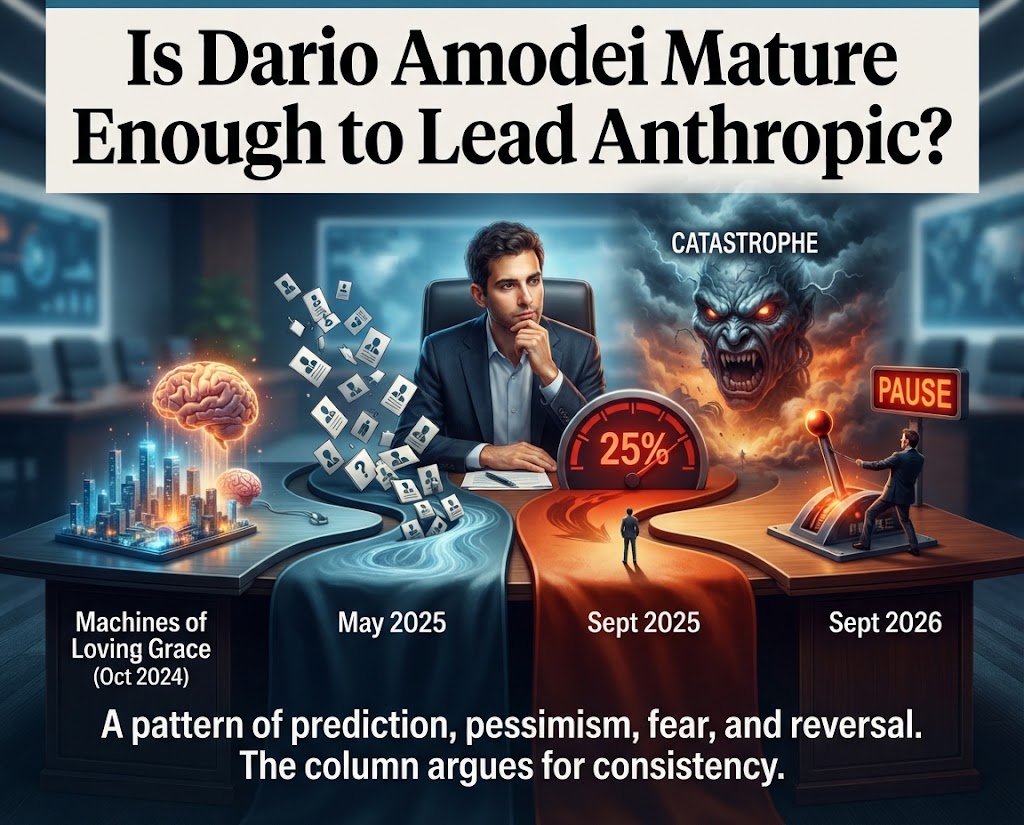
Quick Answer: Over two years, Anthropic CEO Dario Amodei has predicted a golden age, a jobs collapse, a 25% chance of catastrophe, and then a call to slow his own industry down. This column argues that pattern shows an unsettled thinker and an immature leader, and that he should deliver concrete solutions or step aside.
A CEO Who Can’t Settle on What He Believes
The first test of a leader is whether he can tell you what he thinks and still think it next quarter. Amodei fails that test.
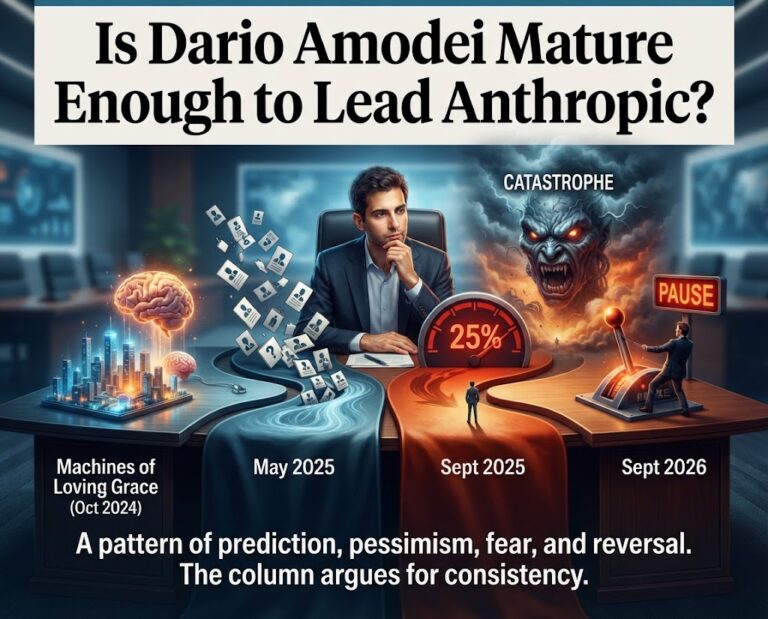
In October 2024, he was the industry’s great optimist. His essay “Machines of Loving Grace” predicted that AI-enabled biology and medicine could compress 50 to 100 years of progress into 5 to 10 years. The same essay imagined curing most mental illness in just a few AI-accelerated years.
Seven months later, he was the industry’s great pessimist. He told Axios that AI could eliminate half of all entry-level white-collar jobs within five years and push unemployment to between 10% and 20%.
Then he raised the stakes again. Asked for his “p(doom)” number, the probability that AI destroys humanity, he said there’s a 25% chance things go really, really badly. In the same breath he put the odds of a great outcome at 75%, which even he admits leaves little middle ground.
By May 2026 the story had changed again, with Amodei shifting from jobs disappearing to jobs transforming and multiplying. And on September 12, 2026, he published “We Must Pace the Frontier,” calling on the AI industry to deliberately slow the rate at which it improves model capabilities.
The Whiplash, Year by Year
| Date | Amodei’s Position |
|---|---|
| Oct 2024 | AI compresses a century of medicine into a decade |
| May 2025 | Half of entry-level office jobs gone within 5 years |
| Sept 2025 | 25% chance AI goes “really, really badly” |
| Jan 2026 | Rapid acceleration ahead, still no call to slow |
| May 2026 | Jobs will transform and multiply |
| Sept 2026 | Industry must slow its own progress |
Any one of these views can be defended. Held in sequence by the same man running the same company, they read less like a strategy and more like a mind that hasn’t made itself up.
Intellectual Consistency: The Core Problem
Consider what Amodei is asking the public to believe all at once. First, that AI will cure disease and end poverty. Second, that there’s a one-in-four chance it will go catastrophically wrong. Third, that he should keep building it anyway. And fourth, that his competitors should be restrained by regulation he helps design.
Even sympathetic observers have noticed. Axios framed the question plainly this month: why is the industry racing toward a technology its own builders believe could destroy us? As that same report noted, almost nobody would accept a 10% catastrophe risk from a plane, a drug, or a nuclear reactor.
A mature scientist resolves contradictions like these before going public. Amodei broadcasts all of them, then asks everyone else to sort it out.
His latest essay shows the same pattern. One analysis found that the proposal has no actual pacing mechanism, no speed limit, and no enforcement beyond one lab’s pledge. Former Microsoft Windows chief Steven Sinofsky offered the sharpest response: Amodei can just do this rather than calling for it.
That’s the crux. If he truly believes the frontier is moving too fast, he runs a frontier lab. He can slow it tomorrow. Instead, he asks Washington for a narrow antitrust waiver so rival labs can coordinate on safety. To critics, that looks like a CEO who wants the brakes installed on everyone else’s car.
Leadership Maturity: Picking Fights He Can’t Finish
The second test of a leader is judgment under pressure. Here Amodei’s record is a string of public brawls.
He has likened President Trump to a “feudal warlord.” When the White House’s AI adviser David Sacks accused Anthropic of fear-mongering to capture regulators, Amodei answered with a lengthy public statement rebutting what he called “inaccurate claims,” which intensified the fight rather than ending it.
Then came the Pentagon. The Defense Department wanted unrestricted access to Anthropic’s models for all lawful purposes. Anthropic wanted assurances its technology wouldn’t be used for fully autonomous weapons or domestic mass surveillance. The talks collapsed, and the Trump administration ordered federal agencies and military contractors to stop doing business with Anthropic. OpenAI struck a deal with the Pentagon within hours.
The cost was steep. Anthropic’s own leadership warned in court that the government’s actions could cut its 2026 revenue by multiple billions of dollars. On September 25, an appeals court upheld the Pentagon’s blacklisting.
Two days later, Amodei sat down for dinner at the White House with the same president he’d compared to a warlord, in what was reportedly their first one-on-one meeting.
Principled stand or improvisation? A mature executive picks the hill before the battle, not after the casualties.
Why This Matters to Business Owners
This isn’t just Silicon Valley gossip. Florida companies are betting payrolls, hiring plans, and technology budgets on AI tools, including Anthropic’s. When the CEO of a major vendor swings from utopia to catastrophe to “slow down,” customers are left guessing.
One enterprise advisor has argued that Amodei’s 25% catastrophe estimate now belongs in companies’ procurement reviews, since it’s the first technology bought from vendors whose own leaders publicly doubt its safety. That’s an extraordinary thing for a CEO to hand his customers’ risk committees.
And the stakes for investors are rising. Axios reported critics calling the recent doom debate fear marketing, arriving weeks before an IPO that could value Anthropic at $2 trillion. Public-market investors will expect steady guidance, not a new worldview every season.
What Amodei Should Do Now
If Amodei wants to be taken seriously as a leader rather than a commentator, the path is clear:
- Pick a forecast and own it. State his current view on jobs and risk, and explain what changed from his earlier predictions.
- Act before he asks. If the frontier must slow, publish Anthropic’s own capability limits with dates, rather than waiting for rivals or regulators.
- Fund the fix. Commit a set share of revenue to retraining the entry-level workers he says are most at risk.
- Back rules small firms can meet. Drop anything that looks like a licensing moat for the largest labs.
- Stop fighting in public. Settle policy disputes in the room, not on social media.
If he can’t do those things, the board should find a CEO who can.
What His Defenders Say
Amodei’s supporters see the same record very differently. They argue his shifting views reflect honesty about a technology that is itself changing fast. They point out that a federal judge granted Anthropic an injunction, suggesting the Pentagon may have been engaged in First Amendment retaliation, and that more than 30 OpenAI and Google DeepMind employees publicly backed Anthropic’s lawsuit. His risk estimates aren’t outliers either: Nobel laureate Geoffrey Hinton has put the chance of AI causing human extinction at 10% to 20%. And his pacing call won unusual support, with Sam Altman pledging to match Anthropic’s first commitment and Elon Musk posting that “Dario is right.” Readers can decide whether that’s an unsettled mind or a leader updating in public.
Sources and Further Reading
- Machines of Loving Grace (Dario Amodei)
- Anthropic CEO warns AI could eliminate half of entry-level white-collar jobs (Fortune)
- Amodei on AI: “There’s a 25% chance that things go really, really badly” (Axios)
- Dario Amodei is changing the narrative on AI jobs (Fortune)
- Amodei calls to “pace the frontier”; Altman and Musk agree (NYU Shanghai RITS)
- We Must Pace the Frontier, explained (ComputingForGeeks)
- Dario Amodei’s pacing essay is vague (StartupHub.ai)
- Who is for and against “We Must Pace the Frontier” (MRKT3.0)
About the Author