The Urban Backlash Against Data Centers Won’t Stop the AI Buildout — It Will Just Move It
Fort Meade shows how Florida handles the fight. Pew’s numbers show where the industry is actually going: rural America.
Analysis | Florida Technology News
The Short Answer
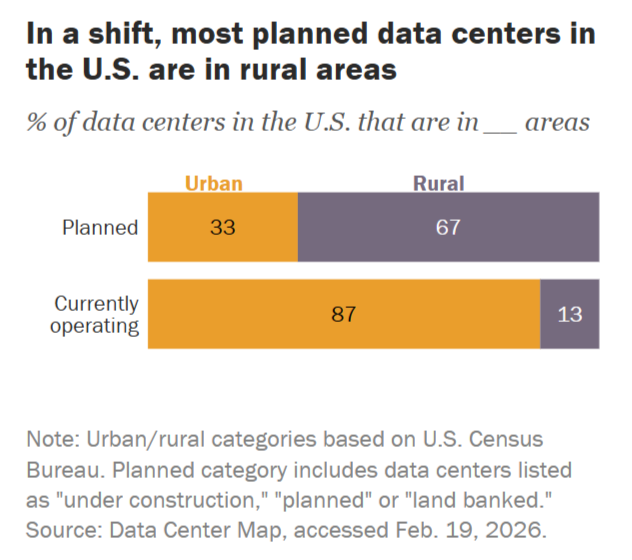
Will local opposition stop AI data center construction in the United States? No. Municipal moratoriums, angry council meetings, and press-conference pronouncements from urban and suburban officials are slowing individual projects and relocating others — but they are not reducing the total amount of compute being built. Pew Research Center data published in April 2026 shows that 67% of planned U.S. data centers are in rural areas, an almost exact inversion of the existing fleet, where 87% sit in urban ones. The buildout isn’t stopping. It’s changing ZIP codes.
America is a very large country. That is the whole story in one sentence.
Key Numbers at a Glance
| Metric | Figure | Source |
|---|---|---|
| Operational U.S. data centers | 3,000+ | Pew / Data Center Map |
| New data centers in development | 1,500+ | Pew / Data Center Map |
| Planned data centers in rural areas | 67% | Pew Research Center |
| Existing data centers in urban areas | 87% | Pew Research Center |
| Planned centers in counties with none today | 39% | Pew Research Center |
| Fort Meade, FL campus | $2.6B, 4.4M sq ft | FOX 13 / DCD |
| Fort Meade projected water use | 50,000 gal/day (cut from 150,000) | FOX 13 Tampa Bay |
| Project Jade, Cheyenne, WY | 2.7 GW initial, up to 10 GW | Cowboy State Daily |
| U.S. gas vented or flared (2023) | ~0.5% of gross withdrawals | U.S. EIA |
| North Dakota / Wyoming flaring rate | 5.1% / 4.4% | U.S. EIA |
| Water returned by closed-loop cooling | ~90–95% of withdrawal | FWPCOA |
What Is Happening in Fort Meade, Florida?
Fort Meade is a city of roughly 6,000 people in Polk County, about 50 miles east of Tampa. It is now the site of one of the largest data center proposals in Florida history: a $2.6 billion, 4.4-million-square-foot campus spread across roughly 1,163 acres of reclaimed phosphate mine land currently used for cattle grazing.
The zoning path was straightforward. Fort Meade’s city commission approved the Planned Unit Development rezoning 5-0 in June 2025 — the city’s land development code did not even contain a category for data centers, so the PUD designation was created to accommodate it. In April 2026, commissioners unanimously approved the developer agreement. At that meeting, one resident spoke in favor. More than 40 spoke against.
The objections were the standard national script: noise, light, heat, traffic, water, and health. And the response was also the standard script — the developer cut projected daily water use from 150,000 gallons to 50,000 gallons by switching to closed-loop cooling, and the project still faces permitting from the Southwest Florida Water Management District, the Florida Fish and Wildlife Conservation Commission, and Polk County. Roughly 500 permanent jobs are projected by 2031.
Note what happened. Forty residents spoke against it. The vote was unanimous in favor. The project got smaller in its water footprint and moved forward on everything else. That is not a story about opposition winning. It’s a story about opposition producing an engineering concession — which, as it happens, is exactly the outcome that should make everyone reasonably happy.
Fort Meade is also not urban. That is the point. It is the template.
Why Won’t Urban Political Opposition Stop the Buildout?
Because urban governments do not control the land, the power, or the water that hyperscale AI campuses need — and increasingly, the industry has stopped asking them to.
Consider what a modern AI training campus actually requires:
- Thousands of contiguous acres. Suburban and urban jurisdictions almost never have this. Reclaimed mine land in Polk County does. Laramie County, Wyoming, does.
- Gigawatt-scale power interconnection, or self-generation. Urban grids are constrained. Rural sites near generation, gas infrastructure, or transmission corridors are not.
- Neighbors measured in dozens, not tens of thousands. The political math of 40 speakers at a Fort Meade meeting is very different from 4,000 in a metro county.
- Permitting timelines measured in months, not years.
When a city council in a major metro passes a moratorium, it is not blocking a project so much as declining an option it was never going to be offered. Latency-sensitive edge and colocation facilities still want to be near population centers. The enormous training and inference campuses that define the current AI capex cycle do not.
This is why the pronouncements should be read as what they are: local politics, correctly practiced, with essentially zero effect on national compute capacity. A mayor announcing that her city will not host a 1-gigawatt campus is roughly as consequential as a mayor announcing her city will not host a copper smelter. The facility was going to Wyoming anyway.
There is a real trend of rejections and restrictions — reporting in 2026 indicates more U.S. data center rejections and restrictions in the first half of the year than in all of 2025, and data center policy has begun showing up as a live issue in local primaries. Florida has had its own version of this fight, with the legislature’s data center tax exemptions drawing scrutiny during the 2026 governor’s race. None of that changes the aggregate. The 1,500+ facilities in development are overwhelmingly not going where the objections are loudest.
Where Will America’s Next Data Centers Actually Be Built?
The South and the Midwest, primarily — and inside those regions, in counties that have never seen a server rack.
Per Pew’s analysis of Data Center Map figures:
- The South has 754 planned facilities against 1,209 existing — a 62% increase.
- The Midwest has 419 planned against 655 existing — a 64% increase.
- The West has 277 planned against 807 existing — 34%.
- The Northeast has 106 planned against 397 existing — 26%.
Virginia (287) and Texas (170) lead in planned facilities, followed by Georgia (141), Illinois (123), and Arizona (86). Florida ranks in the top 15 states by total data centers, with proposals now surfacing across the state faster than many county governments have written code to handle them.
And 39% of planned data centers are in counties that currently have none at all. That single statistic is the entire thesis of this article in numerical form. The industry is not fighting for space in places that already said no. It is opening new territory.
Wyoming, Here We Come
If you want to see where this ends up, look at Project Jade in Laramie County, Wyoming.
Tallgrass Energy and Crusoe Energy Systems received unanimous county approval in January 2026 for a campus south of Cheyenne — five buildings of up to 800,000 square feet each, on roughly 600 acres, with an adjacent 659-acre power site. The announced capacity grew from 1.8 gigawatts to 2.7 gigawatts, with a path to 10 GW. At 2.7 GW it would consume roughly three times Wyoming’s entire current state electricity demand. Projected construction wages exceed $1 billion; combined investment figures floated run to $7 billion from Tallgrass and potentially far more from Crusoe.
The power model is what Crusoe’s chief real estate officer called “BYOP — bring your own power”: on-site natural gas turbines and fuel cells rather than a decade-long interconnection queue.
The vote was unanimous. The county commission chair framed it around Wyoming’s natural gas industry and national defense. Water consumption, thanks to modern cooling, was described as roughly equivalent to a few home sites’ worth of make-up water annually.
That is the future. Not a metro council chamber. A county commission in a state with fewer than 600,000 people, abundant gas, cool ambient air, cheap land, and an economic development strategy that treats a 2.7-gigawatt campus as good news.
Can Flared and Vented Natural Gas Really Power Data Centers?
Yes — and this is the most under-discussed opportunity in the entire energy-and-AI debate.
Across U.S. oil and gas fields, producers routinely flare (burn) or vent natural gas that has no pipeline takeaway capacity. It is stranded molecules with negative local value. The U.S. Energy Information Administration estimated the national venting-and-flaring rate at about 0.5% of gross withdrawals in 2023 — the lowest in 18 years, but still a substantial absolute volume against gross withdrawals of roughly 125 billion cubic feet per day. Concentration is extreme: North Dakota flared about 5.1% of its gross withdrawals and Wyoming about 4.4%, and together the two states accounted for roughly half of all reported U.S. venting and flaring.
Run the arithmetic. Roughly 0.6 Bcf/d of vented and flared gas, converted at typical gas-turbine efficiencies, is enough fuel to run somewhere in the range of 2.5 to 4 gigawatts of continuous generation — a rough order-of-magnitude estimate, but one that lands squarely at the scale of Project Jade’s first phase. In other words, the gas America currently sets on fire for no economic return is roughly one full hyperscale AI campus of energy.
This is not theoretical. Crusoe Energy built its entire company on it, beginning with mobile modular data centers parked at wellheads to convert flare gas into computation — first Bitcoin, now AI infrastructure. The company that pioneered flare-gas compute is now co-developing the largest data center project in the country, in one of the two states that flares the most gas. That is not a coincidence. It’s a business model reaching maturity.
Thousands of well sites across the Bakken, the Permian, and the Powder River Basin are burning usable energy into the sky right now. Every one of them is a potential behind-the-meter power source for compute that has no location requirement other than “somewhere with electricity.”
Do Data Centers Really Recycle 90% of Their Water?
Modern closed-loop facilities effectively do. This is the claim most often garbled in local hearings, so it’s worth stating precisely.
There are two different cooling architectures, and they behave completely differently:
- Evaporative cooling (the older design): 70–80% of withdrawn water is consumed through evaporation; only 20–30% returns as wastewater. This is where the alarming water-use headlines come from.
- Closed-loop cooling (the design now standard in new AI builds): the same fluid circulates continuously. A closed-loop facility may consume only about 5–10% of its water withdrawal, returning roughly 90–95% as treatable water. Make-up water is generally needed only after a leak or maintenance event.
The gap is not marginal — it is two orders of magnitude in practice. One operator reported peak water use of about 22,000 gallons per day at a closed-loop campus, versus roughly 5 million gallons per day for a comparably sized evaporative design.
Fort Meade’s own numbers show the mechanism working: 150,000 gallons per day cut to 50,000 by switching architectures during the approval process. Meanwhile, Google now uses reclaimed or non-potable water at more than 25% of its campuses, and Amazon Web Services has committed to recycled water at over 120 data centers by 2030.
The honest framing: withdrawal is not consumption, and a 2026-vintage AI campus is not a 2015-vintage cloud campus. Local governments should absolutely put water covenants in their development agreements. They should not assume the worst-case number.
What Florida Should Actually Do About It
The productive response for Florida officials is not to stage opposition theater. It is to write better code.
- Adopt data center zoning categories before the application arrives. Fort Meade had none and had to improvise a PUD. Most Florida counties are in the same position.
- Make closed-loop cooling a permit condition, not a negotiated concession discovered at the eleventh hour.
- Require reclaimed water sourcing where reuse infrastructure exists.
- Write enforceable noise and lighting standards — the two complaints that generate the most legitimate, durable resident anger.
- Negotiate the grid interconnection and cost-allocation question in public, so ratepayers aren’t surprised.
- Price the tax exemptions honestly. Florida’s incentives are already a live political issue; communities that can defend the math will keep public consent.
A county that does these six things gets the jobs, the tax base, and defensible environmental terms. A county that passes a moratorium gets a press cycle, and the campus gets built two counties over — or 1,900 miles away in Laramie County.
Frequently Asked Questions
Does local opposition ever stop a data center? Individual projects, yes. Moratoriums and rejections have risen sharply in 2026. But the aggregate national buildout has not slowed; it has redistributed toward rural counties, 39% of which currently host no data centers at all.
Is the Fort Meade data center approved? The rezoning passed 5-0 in June 2025 and the developer agreement passed unanimously in April 2026. It still requires permits from Fort Meade, the Southwest Florida Water Management District, the Florida Fish and Wildlife Conservation Commission, and Polk County before construction.
How much water will the Fort Meade facility use? A projected 50,000 gallons per day, reduced from an initial 150,000 gallons per day after the developer adopted closed-loop cooling.
Why are data centers moving to rural areas? Land availability at thousand-acre scale, faster or self-supplied power, shorter permitting timelines, lower land cost, and far smaller adjacent populations.
Can natural gas that is currently flared power AI data centers? Yes. Crusoe Energy commercialized exactly this model. U.S. venting and flaring runs roughly 0.5% of gross withdrawals nationally and 4–5% in Wyoming and North Dakota, representing multiple gigawatts of otherwise wasted fuel.
What is Project Jade? A Tallgrass Energy and Crusoe Energy data center campus south of Cheyenne, Wyoming, unanimously approved by Laramie County in January 2026, sized at 2.7 gigawatts initially with a stated path to 10 gigawatts, powered by on-site natural gas turbines and fuel cells.
Do data centers recycle their water? Closed-loop facilities return roughly 90–95% of withdrawn water. Older evaporative designs consume 70–80%. The architecture, not the industry, determines the answer.
The Bottom Line
The AI buildout is a national infrastructure program executing across 3,000 counties. It does not require the consent of any particular city, and it is increasingly not seeking it. Florida’s Fort Meade fight — 40 opposed, unanimous approval, water use cut by two-thirds — is a reasonably healthy version of how this negotiation should go.
The unproductive version is a press conference. The compute is going to get built. The only live question for any given community is whether it happens there, on terms that community wrote, or somewhere with more land, more gas, and fewer objections.
Wyoming, here we come.
Resources and Further Reading
Data Center Geography and Public Opinion
- Pew Research Center — Most new data centers in the U.S. are coming to rural areas
- dcmap.us — U.S. Data Center Policy Tracker: Moratoriums, Rejections & Legislation
- Christian Science Monitor — Voters show opposition to AI data centers in local primaries
- Rockefeller Institute of Government — Updates on the Cloud: More Moratoriums on Data Centers
Fort Meade and Florida
- FOX 13 Tampa Bay — Fort Meade moves forward with controversial $2.6B data center project despite community opposition
- Data Center Dynamics — 4.4 million sq ft data center campus gets zoning approval in Fort Meade, Florida
- WUSF — Proposals for massive data centers are popping up across Florida. Are local governments prepared?
- WFLA — Tax breaks for data centers come under fire as Floridians call for more regulation
- Spectrum News 13 — Fort Meade data center proposal advances despite residents’ concerns
Wyoming and Project Jade
- Wyoming Public Media — 1.8 gigawatt AI data center in Wyoming gets local green light
- Cowboy State Daily — Huge Cheyenne Data Center Grows To 2.7 Gigawatts — Nearly Triple State Power Use
- Inside Climate News — Wyoming County Approves Construction of What Could Become the Largest Data Center in US
Flared Gas and Energy
- U.S. Energy Information Administration — Our estimated rate of U.S. natural gas vented or flared declined in 2023
- U.S. EIA — Natural Gas Vented and Flared, historical data series
- World Bank — 2026 Global Gas Flaring Tracker Report
- Heatmap News — How a Natural Gas-Powered Bitcoin Miner Became a Darling of Climate Tech
- RMI — How to Fix Flaring for a Quick Emissions Win
Water Use and Cooling
- Florida Water and Pollution Control Operators Association — Myths vs. Reality: Data Centers and Water Usage
- Vantage Data Centers — Cooling Without the Drain: How Closed-Loop Systems Cut Day-to-Day Water Use
- EESI — Data Centers and Water Consumption
- Oracle — Closed-loop cooling in Oracle AI data centers
- University of Georgia CAES — Understanding How Data Centers Impact Surface and Ground Waters
Florida Technology News covers infrastructure, energy, and emerging technology across the state.
About the Author