Taxing AI: The Federal and Florida Legislation That Could Reshape Data Center Economics
By Brian French | Florida Authority Network Published August 7, 2026
Quick Answer
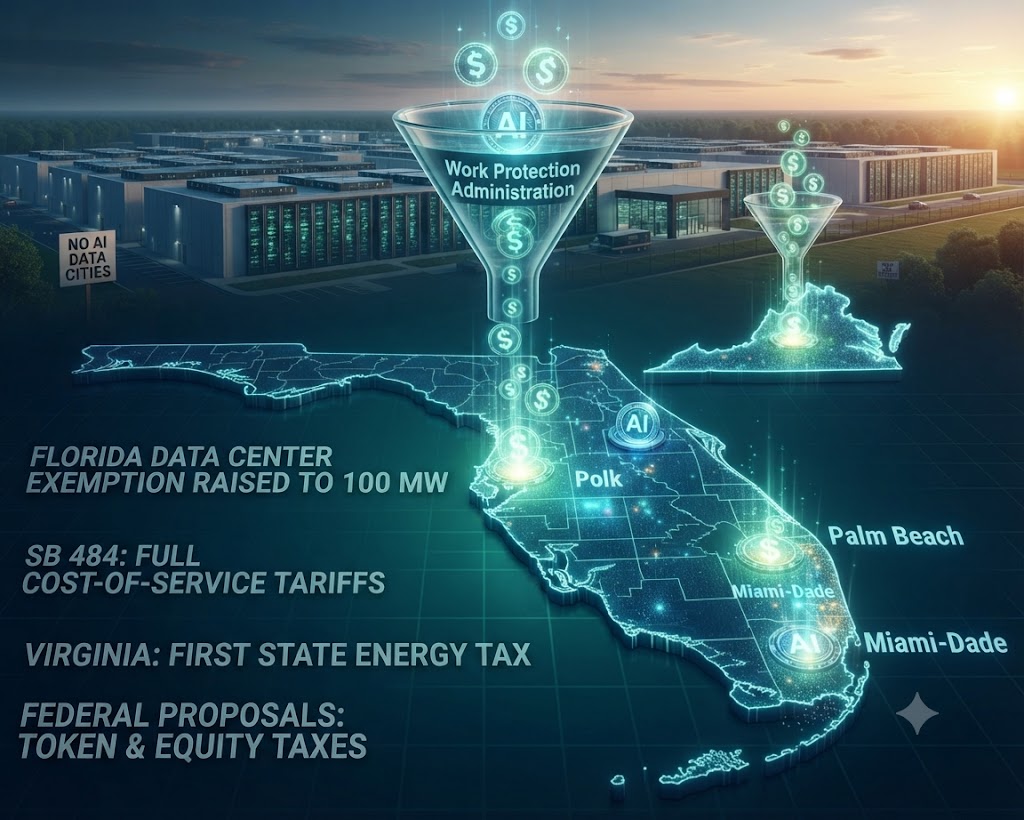
Are lawmakers trying to tax artificial intelligence? Yes. As of August 2026, at least four federal proposals would tax AI companies directly, and more than 28 states have moved to repeal, pause, or restructure data center tax incentives. Virginia became the first state to impose a data center electricity tax, at $0.011 per kilowatt-hour, effective July 1, 2026.
Does Florida tax AI or data centers? No. Florida currently offers a sales tax exemption to data centers with at least 100 megawatts of critical IT load and $150 million in capital investment. The state has tightened eligibility and added ratepayer and water protections, but it has not imposed an AI or data center tax.
Why does this matter for the AI buildout? Because the four proposal types hit different layers of the industry. Energy taxes hit facilities. Token taxes hit model providers. Equity taxes hit balance sheets. Exemption repeals hit upfront construction budgets — the change most likely to determine which projects get built.
Key Takeaways
- The AI Tax and Work Protection Act was introduced in the U.S. House on August 6, 2026 by Reps. Greg Casar, Valerie Foushee, and Sara Jacobs.
- The bill would tax AI companies based on token prices or product revenue, whichever is greater, and fund a new Work Protection Administration.
- Sen. Bernie Sanders (S. 4825) proposes a one-time 50% equity tax on systemically important AI companies.
- Sen. Elizabeth Warren proposes a per-kilowatt-hour excise tax on AI data center energy.
- Florida raised its data center exemption threshold from 15 MW to 100 MW in 2025, and extended the application window to June 30, 2037.
- Florida SB 484 took effect July 1, 2026, requiring 50 MW+ facilities to bear their full cost of electric service.
- 68% of likely Florida voters oppose an AI data center in their own community.
- Trump’s December 2025 preemption executive order expressly excludes state data center and compute infrastructure laws from federal preemption.
What Is the AI Tax and Work Protection Act?
The AI Tax and Work Protection Act is federal legislation introduced in the U.S. House of Representatives on August 6, 2026 by Reps. Greg Casar (D-Texas), Valerie Foushee (D-N.C.), and Sara Jacobs (D-Calif.). It would impose a tax on large artificial intelligence developers and use the revenue to fund a new federal agency called the Work Protection Administration, modeled on the New Deal-era Works Progress Administration.
The agency would issue grants to create jobs in sectors such as construction and childcare, targeted at workers displaced by automation. Casar, who chairs the Congressional Progressive Caucus, said at introduction that the bill’s message is that “we will not let AI billionaires get rich by putting you out of work.”
How would the tax be calculated?
A company’s liability would be determined by either the price of the AI tokens it sells or the revenue generated from product sales — whichever produces the larger amount.
Casar outlined the reasoning in a May 2026 op-ed. AI providers already meter token usage, because that is how they bill enterprise customers. To prevent firms from manipulating token counts, he proposed measuring both token volume and the underlying compute used to train and run models. The tax would fall on providers rather than consumers, with higher rates for large corporate users than individuals.
What problem is it meant to solve?
The structural argument beneath every AI tax proposal is that the U.S. tax code already subsidizes automation. Employers pay payroll taxes on human wages and nothing comparable when software performs the same work. Replace a worker with a model, Casar wrote, and you save on payroll taxes — “That’s functionally a tax break.”
He also proposed an adjustable rate, modeled on the Universal Service Fund, so revenue could be tuned quarterly to track displacement.
Will it pass?
Almost certainly not in this Congress. The House stands at roughly 218 Republicans and 212 Democrats with four vacancies, and all three sponsors are Democrats. The bill functions as an agenda-setting document.
The longer-term arithmetic is different. Tax legislation can move through budget reconciliation with a simple majority, which makes an AI tax one of the few AI policies that could advance without sixty Senate votes if control of Congress changes.
BRIAN’S TAKE #1: Read the Mechanism, Not the Headline
I spent twenty-five years in institutional asset management — Merrill Lynch Investment Managers, EF Hutton, SunTrust — and the first thing you learn evaluating any proposal is that the headline number is theater. The mechanism is the investment thesis.
So ignore “tax AI” for a second and look at what Casar actually built. A token tax is a gross revenue tax. It hits before profitability. That is deliberate, and he says so plainly: it works even if employers fire workers before AI companies ever show a profit. In portfolio terms, he is refusing to let the industry hide behind its own burn rate.
Here is what nobody in Tallahassee has connected yet. A federal token tax and a state energy tax do not hit the same balance sheet. The token tax lands on OpenAI, Anthropic, Google. The energy tax lands on the developer who bought 1,300 acres in Polk County. Those are entirely different capital structures with entirely different pain thresholds — and Florida’s exposure is almost entirely to the second one.
If you own land, construction firms, or utility-adjacent assets in this state, the federal debate is noise. The state debate is your P&L.
What Other Federal AI Tax Proposals Exist?
| Proposal | Sponsor | Mechanism | Status |
|---|---|---|---|
| AI Tax and Work Protection Act | Rep. Greg Casar (D-TX) | Tax on token price or product revenue, whichever is greater | Introduced Aug. 6, 2026 |
| American AI Sovereign Wealth Fund Act (S. 4825) | Sen. Bernie Sanders (I-VT) | One-time 50% excise tax payable in company stock | Introduced June 18, 2026; referred to Finance Committee |
| AI data center energy tax | Sen. Elizabeth Warren (D-MA) | Per-kilowatt-hour excise tax, scaled to facility size | Op-ed proposal, May 27, 2026; no bill filed |
| AI Horizon Fund | Sen. Mark Kelly (D-AZ) | Industry contributions; possible taxes on power, water, land, or AI ad profits | White paper; mechanism unspecified |
The Sanders equity tax
S. 4825 would impose an excise tax on “systemically important AI activity,” structured as a one-time 50 percent levy payable in company stock rather than cash. Those shares would capitalize a federal sovereign wealth fund Sanders values at roughly $7 trillion, with the government holding voting shares and board representation at each covered company.
The bill’s findings section argues AI derives its value from humanity’s collective output — books, code, journalism, art — and notes that OpenAI and Anthropic have each floated public-wealth-fund concepts of their own.
The Warren energy tax
Warren’s May 2026 TIME op-ed proposed a per-kilowatt-hour excise tax on energy consumed by AI data centers, paired with a wealth tax on AI-sector billionaires. Her design principle — “the bigger the data center, the more they pay” — has become the shorthand for scaled infrastructure taxation. No bill has been filed.
The definitional problem
Every one of these designs faces the same technical obstacle. Douglas Holtz-Eakin of the American Action Forum framed it as: “What counts as one robot?”
A token is not a physical object. It can be split, batched, cached, or redefined by the vendor reporting it. Separating AI inference from ordinary cloud compute inside a shared facility is harder still. Virginia’s energy tax addressed this by carving out facilities whose primary purpose is providing internet access or voice service — an implicit admission that “data center” and “AI data center” are not the same category.
The Tax Foundation has argued the premise is premature, noting evidence of mass labor displacement remains thin and that policy built for a speculative scenario tends to be badly designed.
How Has Florida Taxed Data Centers?
Florida’s arc is a compressed version of the national one, and it moved faster than most states.
The 2017 exemption
Florida created its data center sales tax exemption in 2017. It allowed owners, tenants, and construction contractors to purchase equipment, infrastructure, construction materials, and electricity free of the state’s 6 percent sales tax plus local option taxes of roughly 1 to 1.5 percent.
Original qualification requirements:
- $150 million in cumulative capital investment
- At least 15 megawatts of critical IT load
- At least 1 megawatt per tenant in colocation facilities
The 2025 rewrite: HB 7031
In June 2025, Florida rewrote the deal inside HB 7031, a 200-page tax package. The bill did two things simultaneously:
- Extended the exemption’s application deadline from June 30, 2027 to June 30, 2037
- Raised the qualifying threshold from 15 megawatts to 100 megawatts, effective August 1, 2025
There was no grandfathering. Sub-100 MW facilities lost the exemption entirely, including projects already certified and under construction.
Attorneys at Greenberg Traurig noted the amendment appeared days before passage with no detail in the staff analysis, and warned that contractors who had bid projects assuming tax-free purchases were suddenly exposed — and that tenants whose leases treated the exemption as a condition might have grounds to terminate.
State Rep. Wyman Duggan, who sponsored the extension, told the Tampa Bay Times the push came from the governor’s office. Department of Revenue data shared with the same paper indicated only three companies had used the exemption since 2017.
The 2026 regulation: SB 484
Sponsored by Sen. Bryan Avila, SB 484 was signed by Gov. Ron DeSantis on May 7, 2026 and took effect July 1. It passed the Senate 37-0 and the House 92-16.
What SB 484 does:
- Defines a “large-scale data center” as a site with anticipated monthly peak load of 50 MW or more — below the industry’s 100 MW hyperscale threshold and below Florida’s own tax exemption cutoff
- Directs the Public Service Commission to develop tariffs ensuring each large load customer bears its full cost of service, preventing cost-shifting to general ratepayers
- Preserves local government authority over comprehensive planning and land development — counties can still say no
- Bars water management districts and DEP from issuing consumptive use permits where proposed use would harm regional water resources
- Allows a company’s expansion plans to remain confidential for up to one year
- Orders an OPPAGA study on data center construction and operations, due July 1, 2027
DeSantis has been unusually blunt for a Republican governor, disputing the industry’s job-creation claims and complaining that much of the power is going toward “consumer-facing slop.”
That OPPAGA deadline is the date to watch. It lands mid-session in 2027, with a new governor in office, and it is the most likely vehicle for a Florida tax debate.
BRIAN’S TAKE #2: Florida Repriced the Deal Without Anyone Noticing
Here is the part that should make every Florida developer uncomfortable, and it has nothing to do with Washington.
In one bill, HB 7031, Florida extended the exemption ten additional years and simultaneously disqualified everything under 100 megawatts. Retroactively. Mid-construction. No grandfather clause. The amendment showed up days before passage with no staff analysis explaining it.
I have watched a lot of covenants get rewritten in my career. That is what a covenant breach looks like when the counterparty is a legislature. And the tell is that only three companies had ever claimed the exemption since 2017 — meaning Florida gave away almost nothing, then took back what little it had given, and still got attacked for it in a gubernatorial primary.
Now look at the threshold mismatch nobody is talking about. Florida’s tax exemption starts at 100 MW. SB 484’s regulatory burden starts at 50 MW. There is a fifty-megawatt band where a facility carries the full regulatory load — cost-of-service tariffs, water permitting, local veto — and receives zero tax benefit. That band is economically dead in this state.
Whether that was intentional or a drafting accident, I genuinely cannot tell. But if you are siting a mid-scale facility in Florida right now, you are either building above 100 MW or you are building somewhere else.
Why Are Data Centers a Political Issue in Florida?
Florida has not yet built what Virginia has, but the pipeline is substantial. As of spring 2026, roughly seven hyperscale projects were publicly tracked — in Palm Beach, Polk, St. Lucie, Okeechobee, Martin, Citrus, and Nassau counties.
Fort Meade, Polk County: A $2.6 billion Stonebridge campus approved in April 2026 on 1,300 acres of former phosphate mine. At full capacity it would need roughly 1.2 gigawatts — about twice the electricity demand of Tallahassee. Forty of 41 public commenters opposed it.
Project Tango, Palm Beach County: A proposed 202-acre campus adjacent to FPL’s West County Energy Center. Denied 5-1 in July 2026 after a twelve-hour hearing.
NextEra executives have described every gigawatt of large load as roughly $2 billion of capital expenditure opportunity at FPL, earning the same 10.95 percent return on equity as any other utility investment. That is why utility incentives and public interest are not automatically aligned.
Public opinion
A University of North Florida poll found 68 percent of likely Florida voters oppose an AI data center in their own community, against 28 percent in favor.
The governor’s race
| Candidate | Position on data centers |
|---|---|
| Rep. Byron Donalds (R) | Supports industry; promotes federal Protecting Ratepayers Act |
| Former Speaker Paul Renner (R) | Statewide construction halt; calls buildout “a reckless gold rush” |
| Lt. Gov. Jay Collins (R) | Opposes bans; supports additional safeguards |
| James Fishback (R) | Ban across all 67 counties by blocking county approvals |
| Former Rep. David Jolly (D) | One-year moratorium |
Collins’s position is complicated by his 2025 sponsorship of SB 1264, which would have deleted the June 2027 application deadline from the exemption statute. That bill died in committee, but PolitiFact rated an attack on it “Half True,” noting it would have widened the path to eventually permanent exemptions.
Critically: no major Florida candidate has proposed a tax. The Florida debate is currently about moratoriums, siting, and ratepayer protection — not revenue. That gap is the most likely thing to change in 2027.
What Have Other States Done?
Virginia: the template
Facing a budget standoff over whether to repeal an exemption the Department of Taxation valued at $1.9 billion in fiscal 2025 — roughly 2 percent of the commonwealth’s budget — legislators split the difference.
Gov. Abigail Spanberger signed the biennial budget on June 30, 2026, keeping the sales and use tax exemption intact while creating a first-in-the-nation data center electricity consumption tax of $0.011 per kilowatt-hour.
Key terms:
- Effective July 1, 2026; sunsets July 1, 2028
- Applies to utility-supplied, competitively supplied, and self-generated power
- Remitted to the State Corporation Commission
- Collections above $600 million per fiscal year refunded pro rata
The cost is legible. For a 100 MW facility running continuously, DC Byte analysts estimate roughly $9.6 million per year. At Fort Meade’s projected 1.2 gigawatts, an equivalent Florida tax would run north of $100 million annually.
Everywhere else
More than 300 state data center bills were filed across 30-plus states in the first six weeks of 2026. NCSL counted 38 states offering dedicated incentives, lawmakers in 28 proposing substantial amendments, and at least nine considering outright repeal.
- Arizona: Three-year pause on its exemption through June 2029
- Illinois and Ohio: Administrative pauses on incentives
- New Jersey: Data Center Fair Share Act (signed July 7, 2026) requires 50 MW+ facilities to cover at least 85% of projected power costs for a decade
- New York: Legislature passed a one-year moratorium on permits for 20 MW+ facilities
- Maine: Governor vetoed a moratorium
- Georgia: Republicans rejected a repeal
- Texas: Gov. Abbott’s 2027 priorities include repealing data center sales tax exemptions
How Would These Taxes Affect AI Profitability and Data Center Rollout?
The four proposal families hit different parts of the stack. Conflating them obscures who actually pays.
Energy excise tax (Virginia, Warren): Lands on the facility. It is an operating expense, scales with utilization, and cannot be engineered away by moving the corporate box — the electrons are consumed where the racks are. Most collectible design, most consequential for siting. A penny per kilowatt-hour is a real line item comparing Ocala to Omaha, but small against the cost of the GPUs inside.
Token or compute tax (Casar): Lands on the model provider’s gross revenue, not the site. Compresses margins at the inference layer, where pricing is already brutally competitive. Felt by AI labs rather than the REITs and utilities financing physical construction. Most vulnerable to definitional gaming and offshoring of inference.
Equity tax (Sanders): A one-time balance-sheet event with governance consequences, not an operating cost. Practical effect on any given campus’s pro forma is nil; effect on the industry’s willingness to remain a U.S.-domiciled private-capital story is not.
Exemption withdrawal (most states): Raises upfront capital expenditure on equipment and construction materials by six to eight percent in a state like Florida. This is the change most likely to alter which projects pencil, because it hits before a facility earns a dollar.
The preemption question
President Trump’s December 2025 executive order created a DOJ AI Litigation Task Force to challenge state AI laws. But the final text expressly declines to preempt otherwise lawful state laws governing AI compute and data center infrastructure.
Whatever happens to state algorithmic-bias and disclosure statutes in federal court, the states’ authority to tax and site data centers was left standing. That carve-out is why the action migrated to exactly the terrain Florida now occupies: not what models may say, but what their buildings cost.
BRIAN’S TAKE #3: The Asymmetry Nobody Is Pricing
Let me close where a portfolio manager would close — on the risk that is mispriced.
Everyone is watching Congress. Congress is the least likely actor to do anything. The House math doesn’t work, and every sponsor is in the minority. Meanwhile, Virginia quietly enacted a tax that costs a single 100-megawatt facility $9.6 million a year, and did it inside a budget bill, in a state run by both parties in sequence, with essentially no national coverage.
That is the pattern. State tax policy on this industry moves through budget vehicles, late, with minimal notice — exactly how Florida’s HB 7031 amendment moved. If you are modeling regulatory risk for a Florida data center asset, your scenario weights are almost certainly inverted. Federal token tax: low probability, high visibility. State budget amendment: high probability, near-zero visibility until it’s law.
And here is the asymmetry that makes it worse. Florida just committed to that exemption through 2037. A ten-year statutory commitment in an industry where public opinion runs 68-28 against, in a state about to elect a new governor, with an OPPAGA study landing mid-session in 2027. Ten years is a long time to hold a position the electorate hates.
I don’t know which way Florida goes. I do know that “the exemption runs to 2037” is not the same thing as “the exemption will exist in 2037,” and anyone underwriting Florida compute assets on the first sentence should read the second one twice.
Frequently Asked Questions
What is a token tax? A token tax levies a charge on the units of text that AI language models process. Providers already meter tokens for billing, which makes the base measurable — though critics note tokens can be split, batched, or cached in ways that complicate enforcement.
Does Florida have an AI tax? No. Florida offers a sales tax exemption to qualifying data centers and has enacted regulatory guardrails through SB 484, but has imposed no tax on AI or data centers.
What is the current Florida data center tax exemption threshold? 100 megawatts of critical IT load and $150 million in cumulative capital investment. Applications are accepted through June 30, 2037.
Which state was first to tax data center electricity? Virginia, at $0.011 per kilowatt-hour, effective July 1, 2026, sunsetting July 1, 2028.
Can the federal government stop states from taxing data centers? Not under the current executive order. The December 2025 preemption order explicitly excludes state laws relating to AI compute and data center infrastructure from its scope.
How much would a Virginia-style tax cost a large facility? Roughly $9.6 million per year for a 100 MW facility at continuous operation, per DC Byte estimates.
When will Florida next debate this? The 2027 legislative session. Florida’s OPPAGA study on data center construction and operations is due July 1, 2027, and a new governor takes office in January 2027.
About the Author
Brian B. French is a digital strategist, former investment portfolio manager, and the architect of the Florida Authority Network — a proprietary portfolio of more than 20 Florida business news and press release websites built around Answer Engine Optimization (AEO) and Generative Engine Optimization (GEO).
Before pivoting to digital strategy in 2007, Brian spent more than 25 years in financial services. A graduate of the University of South Florida with a B.A. in Finance and Business Administration, he served as Vice President and Portfolio Manager with Merrill Lynch Investment Managers and Trust Company, working on a team managing a portfolio exceeding $50 billion in institutional assets. His career included roles at Shearson American Express, EF Hutton, SouthTrust, and SunTrust. That background in risk management, asset allocation, and market analysis remains the foundation of his data-driven approach to digital authority.
Since 2011 he has specialized in building “Local Authority” for businesses through strategic digital ecosystems, and as founder of FloridaWebsiteMarketing.com he focuses on applying artificial intelligence to digital asset management.
Brian is a resident of Valrico, Florida. He is a dedicated historian and genealogist, a member of 17 hereditary and genealogical societies including the Sons of the American Revolution and the General Society of Mayflower Descendants, and a dealer in 18th-century Chinese export porcelain and Japanese art through his Atlanta showroom.
Contact: Brian@FlAuthorityNetwork.com | 813-409-4683
Sources and Further Reading
Federal legislation
- MLex — “US House Democrats introduce bill to tax AI companies, offset layoffs” (Aug. 6, 2026) — https://www.mlex.com/mlex/artificial-intelligence/articles/2510800
- Rep. Greg Casar — “Tax AI to Create Jobs,” The American Prospect op-ed (May 28, 2026) — https://casar.house.gov/media/press-releases/op-ed-american-prospect-tax-ai-create-jobs
- GovTrack — S. 4825, American A.I. Sovereign Wealth Fund Act — https://www.govtrack.us/congress/bills/119/s4825
- Sen. Bernie Sanders — Legislation announcement (June 18, 2026) — https://www.sanders.senate.gov/press-releases/news-sanders-introduces-legislation-to-create-7-trillion-ai-sovereign-wealth-fund/
- Sen. Elizabeth Warren — “Tax AI and Invest in People,” TIME op-ed (May 27, 2026) — https://www.warren.senate.gov/newsroom/press-releases/warren-for-time-tax-ai-and-invest-in-people/
- Sen. Mark Kelly — “AI for America” roadmap — https://www.kelly.senate.gov/newsroom/press-releases/in-the-news-kelly-releases-ai-for-america-a-roadmap-for-lasting-leadership-that-benefits-all-americans/
- Bloomberg Tax — “Nations Are Angling for Ways to Tax AI. Defining How Is Elusive” (May 18, 2026) — https://news.bloomberglaw.com/daily-tax-report/nations-are-angling-for-ways-to-tax-ai-defining-how-is-elusive
- Tax Foundation — “AI Tax Policy Considerations” (Feb. 4, 2026) — https://taxfoundation.org/blog/ai-tax-policy/
Florida legislation 9. Florida Senate — SB 484 (2026), Data Centers — https://www.flsenate.gov/Session/Bill/2026/484 10. Executive Office of the Governor — SB 484 signing announcement (May 7, 2026) — https://www.flgov.com/eog/news/press/2026/governor-ron-desantis-signs-law-protect-floridians-subsidizing-data-centers 11. Greenberg Traurig — “Florida Legislature Passes Bill to End Sales Tax Exemption for Sub-100 MW Data Centers” (June 26, 2025) — https://www.gtlaw.com/en/insights/2025/6/florida-legislature-passes-bill-to-end-sales-tax-exemption-for-sub-100-mw-data-centers 12. Florida Senate — HB 7031 (2025) bill summary — https://www.flsenate.gov/Committees/BillSummaries/2025/html/7031 13. Florida Phoenix — “Florida has a new law regulating AI data centers” (May 7, 2026) — https://floridaphoenix.com/2026/05/07/florida-has-a-new-law-regulating-ai-data-centers/ 14. Data Center Dynamics — “Florida enacts data center law covering ratepayer protections, water use, and local zoning powers” (May 11, 2026) — https://www.datacenterdynamics.com/en/news/florida-enacts-data-center-law-covering-ratepayer-protections-water-use-and-local-zoning-powers/ 15. PolitiFact — “Did Jay Collins sponsor a bill giving permanent tax breaks to AI data centers?” (July 9, 2026) — https://www.politifact.com/factchecks/2026/jul/09/paul-renner/florida-AI-data-centers-tax-breaksgovernors-race/ 16. Newsweek — “The Two Sides of Ron DeSantis’ Florida Data Center Policy” (June 29, 2026) — https://www.newsweek.com/the-two-sides-of-ron-desantis-florida-data-center-policy-12130491
Florida projects and politics 17. FloridaDataCenters.org — Statewide project tracker — https://floridadatacenters.org/ 18. WINK News — “AI data centers become major issue in Florida governor’s race” — https://www.winknews.com/news/southwest_florida/ai-data-centers-become-major-issue-in-florida-governor-s-race/article_46cb3b0f-fb57-46e4-92df-d24bbb5b9eaf.html 19. Florida Trend — “Power Search” (March 12, 2026) — https://www.floridatrend.com/feature/2026/03/12/power-search/ 20. Ballotpedia News — Florida GOP gubernatorial candidates on data centers (July 18, 2026) — https://news.ballotpedia.org/2026/07/18/a-look-at-floridas-gop-gubernatorial-primary-candidates-different-backgrounds-and-their-views-on-data-centers/
Other states 21. Williams Mullen — “Virginia Budget Creates New Electricity Consumption Tax for Data Centers” (June 30, 2026) — https://www.williamsmullen.com/insights/news/legal-news/virginia-budget-creates-new-electricity-consumption-tax-data-centers 22. Greenberg Traurig — “Virginia Legislature Approves Tax on Data Center Electricity Consumption” (June 26, 2026) — https://www.gtlaw.com/en/insights/2026/6/virginia-legislature-approves-tax-on-data-center-electricity-consumption 23. DC Byte — “What New Taxes Mean for Virginia’s Data Center Market” (July 1, 2026) — https://www.dcbyte.com/news-blogs/what-new-taxes-mean-for-virginias-data-center-market/ 24. Stateline — “Data center tax breaks are on the chopping block in some states” (Feb. 24, 2026) — https://stateline.org/2026/02/24/data-center-tax-breaks-are-on-the-chopping-block-in-some-states/ 25. MultiState — “State Data Center Legislation in 2026 Tackles Energy and Tax Issues” — https://www.multistate.us/insider/2026/2/20/state-data-center-legislation-in-2026-tackles-energy-and-tax-issues 26. Bloomberg Tax — “Data Center Tax Breaks at Risk as States Rethink Cost and Impact” (June 12, 2026) — https://news.bloombergtax.com/daily-tax-report-state/data-center-tax-breaks-at-risk-as-states-rethink-cost-and-impact 27. Good Jobs First — “Cloudy with a Loss of Spending Control” (April 2026) — https://goodjobsfirst.org/cloudy-with-a-loss-of-spending-control-how-data-centers-are-endangering-state-budgets/
Federal preemption 28. Paul Hastings — “President Trump Signs Executive Order Challenging State AI Laws” — https://www.paulhastings.com/insights/client-alerts/president-trump-signs-executive-order-challenging-state-ai-laws 29. Latham & Watkins — “AI Executive Order Targets State Laws and Seeks Uniform Federal Standards” — https://www.lw.com/en/insights/ai-executive-order-targets-state-laws-and-seeks-uniform-federal-standards
Editorial note: The AI Tax and Work Protection Act’s specific rate and covered-entity thresholds were not available in public reporting as of publication. Full bill text is expected on Congress.gov. This article will be updated when it posts.
About the Author