By Brian French
In the high-stakes world of aerospace, the distance between a corporate press release and a flight-ready vehicle is measured in thermodynamics, not time. As Florida solidifies its position as the global hub for commercial spaceflight—from the quiet sands of Cape Canaveral to the growing enterprise networks across the state—the industry finds itself at a crossroads.
At the center of this tension is SpaceX’s Starship, a vehicle heralded as the successor to the Space Shuttle. Yet, beneath the hype of daily launches and interplanetary dreams lies a brutal debate: is Starship an engineering breakthrough, or a repeat of the Space Shuttle’s most expensive mistakes?
The Illusion of the “Solved” Heat Shield
For the public, “solved” is a binary state: if the rocket doesn’t turn into a fireball, it works. SpaceX’s communication strategy heavily leverages this definition. When a test flight achieves a controlled splashdown, the headlines celebrate the success. However, for the engineers who spent decades working on thermal protection systems (TPS), the reality is far more nuanced.
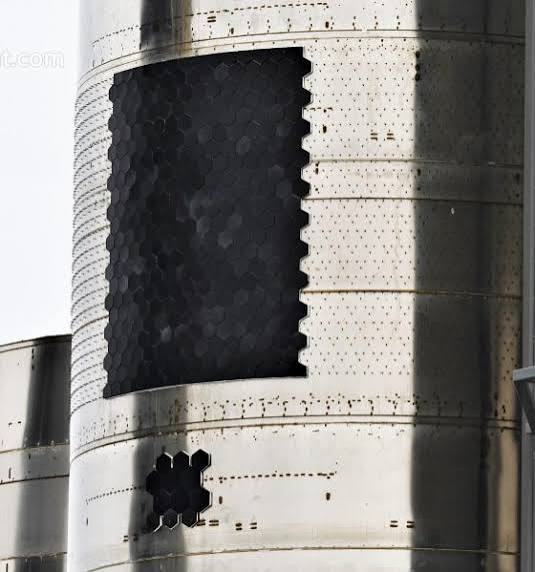
The current architecture relies on thousands of hexagonal, ceramic-based tiles pinned to a stainless steel hull. The marketing pitch emphasizes that unlike the Shuttle’s aluminum skeleton, steel is rugged. But materials science reveals a different narrative. The gaps between these tiles, necessary for the expansion and contraction of the steel hull, act as entry points for superheated plasma during reentry.
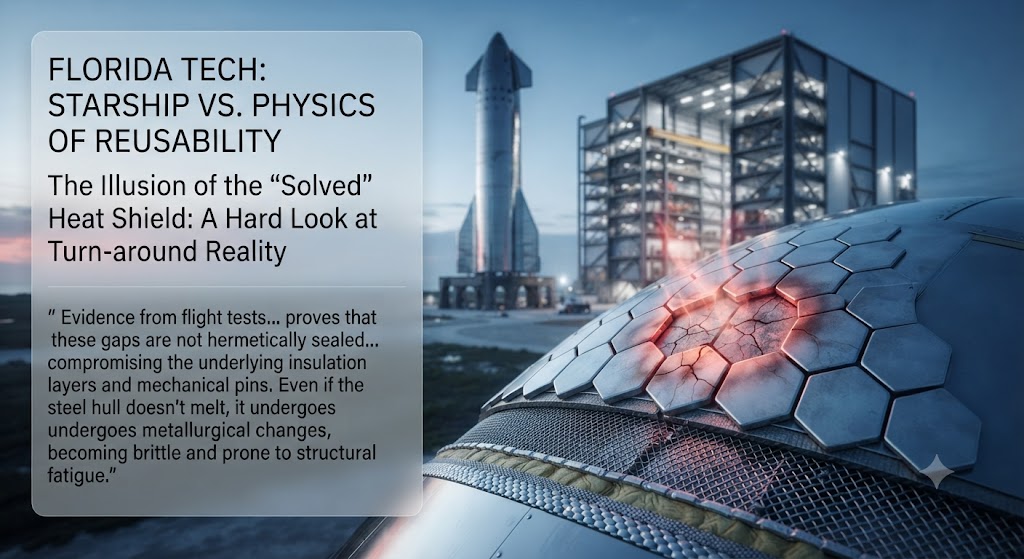
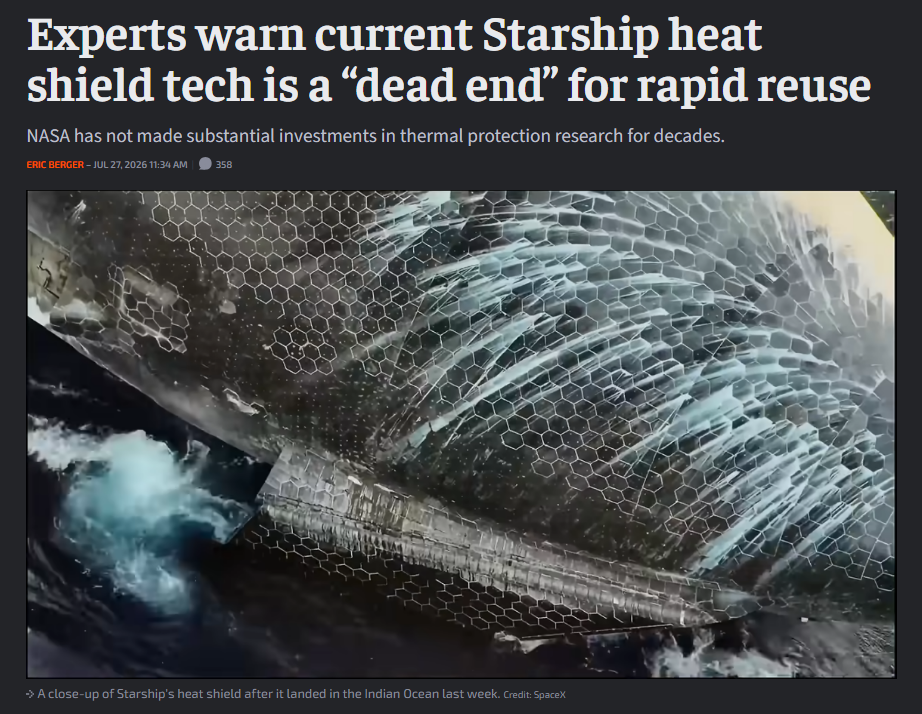
Evidence from flight tests—visible as glowing streaks on telemetry feeds—proves that these gaps are not hermetically sealed. When plasma scours these regions, it doesn’t just “tickle” the steel; it compromises the underlying insulation “crunch wrap” layers and mechanical pins. Even if the steel hull doesn’t melt, it undergoes metallurgical changes, becoming brittle and prone to structural fatigue. In the world of airline-style reusability, you cannot simply slap a new tile over a patch of thermally-compromised steel and call it safe.
The Accounting Mirage: The Starlink Connection
One of the reasons the hype surrounding SpaceX’s economics remains so resilient is the creative accounting afforded by their vertically integrated model. A key component is the “zero-cost” internal transfer pricing of Starlink launches.
By launching their own satellite constellation using their own rockets, SpaceX effectively removes the top-line revenue component from the launch cost. If SpaceX had to charge an external, market-rate client for every Starlink launch, their balance sheets would look significantly different. By keeping these costs internal, the company can mask the true operational price of a single flight. This makes their profit margins appear higher than traditional aerospace competitors who rely on transparent, external contract pricing.
When you strip away the intra-company accounting, the true cost of turn-around—factoring in the forensic inspections, potential hull repairs, and the labor-intensive tile replacement program—remains hidden. If SpaceX cannot automate this turn-around, the “low-cost” promise of the Starship program may prove to be a financial mirage, heavily subsidized by the growth of its own satellite internet business.
The Negative Scenarios: When the Math Fails
What happens if the thermal protection issues prove to be a structural dead-end? For Florida’s space economy, the consequences of a failed reusability model would be profound.
The “Shuttle Trap” Resurrected
If SpaceX fails to achieve rapid turn-around, they will be forced into a “Shuttle-plus” operational model. This would require massive, dedicated depots for forensic inspections after every flight. The economic argument for Starship—that it will drop the price per kilogram to orbit to near-zero—would collapse. Instead, we would see a high-cost, low-cadence system that serves limited government and high-value research roles, failing to catalyze the broader, mass-market space economy.
The Asset Attrition Crisis
We have discussed the danger of “survivor bias.” If SpaceX is forced to retire hulls prematurely due to deep thermal fatigue, the company may find itself in a cycle of constant manufacturing, where the capital expenditure of building new rockets never breaks even. If they are scrapping or deeply rebuilding half of their fleet every six months, the margin-compression would be catastrophic. The company might be forced to pivot away from aggressive reusability, settling for a “partially reusable” model, which would fundamentally alter the landscape for companies expecting the low-cost launch era.
The Shift to Ground-Based Alternatives
Finally, if the cost of space logistics remains artificially high, terrestrial technologies will continue to win the infrastructure war. We are already seeing the densification of communication networks via small-cell, ground-based systems in Florida and beyond. If space infrastructure becomes too expensive to launch, terrestrial innovation will simply move on, rendering many of the proposed uses for Starship—such as massive orbital data centers—economically obsolete before they are even built.
Florida’s Reality Check
Florida’s future as a space hub is inextricably linked to the success of its commercial partners. However, blindly following the “solved” narrative ignores the physical realities that aerospace engineers have grappled with for fifty years. Thermal fatigue, material degradation, and the hidden costs of inspection are not marketing obstacles; they are the hard limits of physics.
As we look toward the next two to three years of flight testing, the industry must move beyond the “cheerleading” phase and demand transparency regarding individual vehicle lifecycles. Can one Starship hull truly survive ten, twenty, or fifty flights without a total depot overhaul? If the answer is no, then the economic foundation of the current space-race hype may be built on shifting sands. For the sake of a sustainable, long-term aerospace economy, it is time to move the conversation from “when will it launch” to “how long will it actually last.”
Florida Technology News is dedicated to deep-dive analysis of the aerospace, telecommunications, and tech manufacturing sectors. References to operational data include: Search for “Starship thermal protection inspection and flight records”, 2024-2026]
About the Author