Florida Authority Network | Analysis | September 18, 2026
Quick Answer
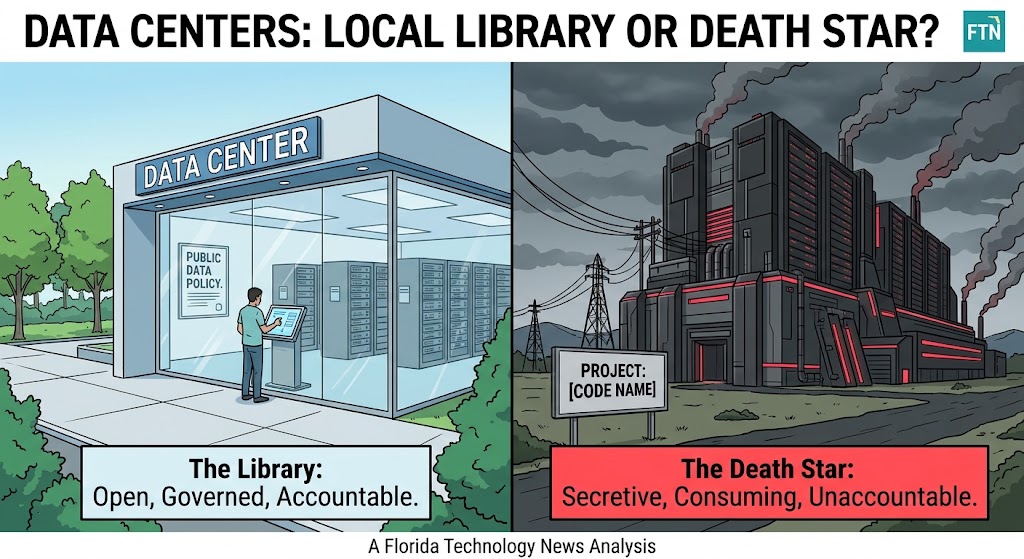
A data center earns the “local library” label only when it acts like one: open about what is inside, governed by published rules, and accountable to the community that hosts it. It earns the “Death Star” label when it arrives under a code name, consumes local power and water, and answers to no one nearby. The building is the same in both cases. The governance is what differs.
Why This Framing Matters in Florida Now
Florida has moved from theory to law. Governor DeSantis signed SB 484 on May 7, 2026, effective July 1, and it treats any data center drawing 50 megawatts or more at peak as “large-scale.” The law bars utilities from passing data center costs to residential and small business customers, requires large users to pay their full cost of service, and preserves local control over zoning, permitting and land use.
Local governments are using that control. Sarasota County adopted a one-year hyperscale moratorium in July, DeSoto County moved toward one, and Lakeland approved a one-year moratorium on first reading July 21. In Okeechobee, a 3,000-signature petition in a town of 5,500 helped end a proposed project.
The national backdrop is similar. Berkeley Lab found data centers used about 4.4% of U.S. electricity in 2023 and projects 6.7% to 12% by 2028. S&P Global reported in January that 20 projects had been delayed or canceled in recent months.
The Case for the Library
A library is quiet infrastructure. It stores what a community knows and makes it retrievable. A data center does the same job at machine scale: hospital records, bank transactions, 911 routing, small business websites, and the AI models that now answer everyday questions.
What libraries and data centers share
| Trait | Library | Data center |
|---|---|---|
| Core job | Store and retrieve knowledge | Store and process data |
| Users | Mostly never see the stacks | Never see the servers |
| Value | Access, not foot traffic | Uptime, not headcount |
| Staffing | Small professional staff | Small technical staff |
Few people judge a library by how many people it employs. They judge it by what it makes possible. That is the strongest version of the industry’s argument.
The Case for the Death Star
The Death Star image sticks because of three features: enormous scale, secrecy, and power that flows to someone far away.
Florida communities have described all three. Opponents of Palm Beach County’s Project Tango raised water use, power demand, air quality, noise, and effects on Wellington’s equestrian economy. Pinellas commissioners argued that the facilities use massive water and electricity while offering few permanent jobs after construction.
Secrecy is the sharpest problem. Earlier versions of the state bill banned nondisclosure agreements and required notice to residents, but both provisions were removed from the final version. One tracker notes the law lets state agencies sign NDAs that can keep project details from the public for up to a year. A project known only by a code name does not look like a library to the neighbors.
Even Libraries Decide What Goes on the Shelf
This is the most overlooked part of the analogy. No library is a neutral warehouse. Every one runs on a written collection policy.
Safety Harbor’s public library, for example, publishes a policy covering the professional standards guiding the collection, the criteria for selecting new material, and how items are removed. Florida school districts must ensure books suit student needs, are age and developmentally appropriate, and are free of material harmful to minors.
Those rules can be fought over, and Florida shows how. Under HB 1069, Escambia County pulled five dictionaries, eight encyclopedias and the Guinness Book of World Records out of caution. In August 2025, a federal judge found a key part of that law overbroad and unconstitutional.
The lesson for data centers is direct. A library’s legitimacy comes from having a shelf policy that is written, public, and open to challenge. A data center that wants the library label needs the equivalent.
What a data center “shelf policy” looks like
| Library practice | Data center equivalent |
|---|---|
| Published collection policy | Public acceptable-use policy for tenants and workloads |
| Selection criteria | Disclosed categories of customers served |
| Challenge and review process | Community complaint and response channel |
| Board oversight | Local advisory board or annual public report |
| Weeding outdated items | Decommissioning and site restoration plan |
One honest limit applies. A library is publicly owned and free to enter. A data center is private property serving paying clients. The analogy describes behavior a company can choose, not status it can claim.
A Scorecard for Communities
| Question | Library answer | Death Star answer |
|---|---|---|
| Who is the operator? | Named at filing | Code name, NDA |
| Who pays for grid upgrades? | The facility | Ratepayers |
| Cooling water source? | Reclaimed or closed loop | Aquifer draw |
| Tax treatment? | Pays full freight | Abatements |
| Local benefit? | Defined and measured | Promised vaguely |
| Reporting? | Annual public numbers | None |
SB 484 already pushes projects toward the left column on cost and water, since it mandates reclaimed water where feasible. Disclosure remains the open gap, and it is the one operators can close voluntarily.
Brian’s Take
Draft analysis column for editing.
Years in money management taught me that markets punish opacity faster than they punish bad news. The same rule is playing out in county commission chambers. The projects dying in Florida are not dying because residents hate servers. They are dying because residents were asked to trust something nobody would describe.
The library comparison is fair, but it is a standard to meet, not a slogan to print. Libraries have shelf rules, public boards, and a process when someone objects. Operators that publish their own version of those rules will get permits. The ones that show up as “Project Something” will keep meeting moratoriums.
Frequently Asked Questions
Are data centers bad for Florida communities?
Not inherently. The impact depends on siting, water source, who pays for grid upgrades, and how much the operator discloses.
Can a Florida county reject a data center?
Yes. SB 484 specifies that local governments keep authority over comprehensive planning and land development rules for large load customers.
Will a data center raise my electric bill?
State law now prohibits shifting those costs to residential and small business customers. How that works in practice will depend on the tariffs utilities file.
How many jobs does a data center create?
Construction employment is substantial, but permanent staffing is small. This is a main reason some counties oppose tax abatements, and Brevard County has moved to bar them.
Do data centers restrict what they host?
Most have acceptable-use terms for customers, but few publish them locally. Making them public is the closest parallel to a library collection policy.
Sources and Further Reading
- Executive Office of the Governor, “Governor Ron DeSantis Signs Law to Protect Floridians from Subsidizing Data Centers” — https://www.flgov.com/eog/news/press/2026/governor-ron-desantis-signs-law-protect-floridians-subsidizing-data-centers
- The Florida Senate, Senate Bill 484 (2026) — https://www.flsenate.gov/Session/Bill/2026/484
- Data Center Dynamics, “Florida enacts data center law covering ratepayer protections, water use, and local zoning powers” — https://www.datacenterdynamics.com/en/news/florida-enacts-data-center-law-covering-ratepayer-protections-water-use-and-local-zoning-powers/
- FOX 13 Tampa Bay, “DeSantis signs bill regulating costs, water use tied to large-scale data centers” — https://www.fox13news.com/news/desantis-bill-costs-water-use-ai-data-centers-florida
- Data Center Moratoriums, Florida tracker — https://www.datacenterbans.com/state/florida
- Florida Data Centers opposition tracker — https://floridadatacenters.org/
- Data Center Watch, Briefing 03/13/2026 — https://datacenterwatch.substack.com/p/briefing-03132026
- Central Florida Substack, “Florida: The Next AI Data Center Frontier?” — https://centralflorida.substack.com/p/florida-ai-data-center-boom
- S&P Global, “Data center opposition gains momentum as power demand spikes” — https://www.spglobal.com/energy/en/news-research/latest-news/electric-power/012926-data-center-opposition-gains-momentum-as-power-demand-spikes
- Berkeley Lab, “Report Evaluates Increase in Electricity Demand from Data Centers” — https://energyanalysis.lbl.gov/news/berkeley-lab-report-evaluates-increase-electricity-demand-data-centers
- City of Safety Harbor, Library Collection Development Policy — https://www.cityofsafetyharbor.com/867/Collection-Development-Policy
- Florida Department of Education, Library Media training materials — https://www.fldoe.org/core/fileparse.php/20562/urlt/8-6.pdf
- Yahoo News, “Florida School District Pulls Dictionaries, Encyclopedias From Library” — https://news.yahoo.com/florida-school-district-pulls-dictionaries-220656445.html
- Publishers Weekly, “Florida public schools remove library books fearing state reprisal” — https://www.publishersweekly.com/pw/by-topic/industrynews/libraries/article/98375-florida-public-schools-remove-library-books-fearing-state-reprisal.html
Two notes before publishing. The opposition trackers (items 5 and 6) are advocacy sites, so I leaned on them only for dated local actions; you may want to confirm the moratorium dates against county records. The HB 1069 ruling may be under appeal, so check its current status.
About the Author