By Florida Technology News Staff | September 18, 2026
Quick Answer
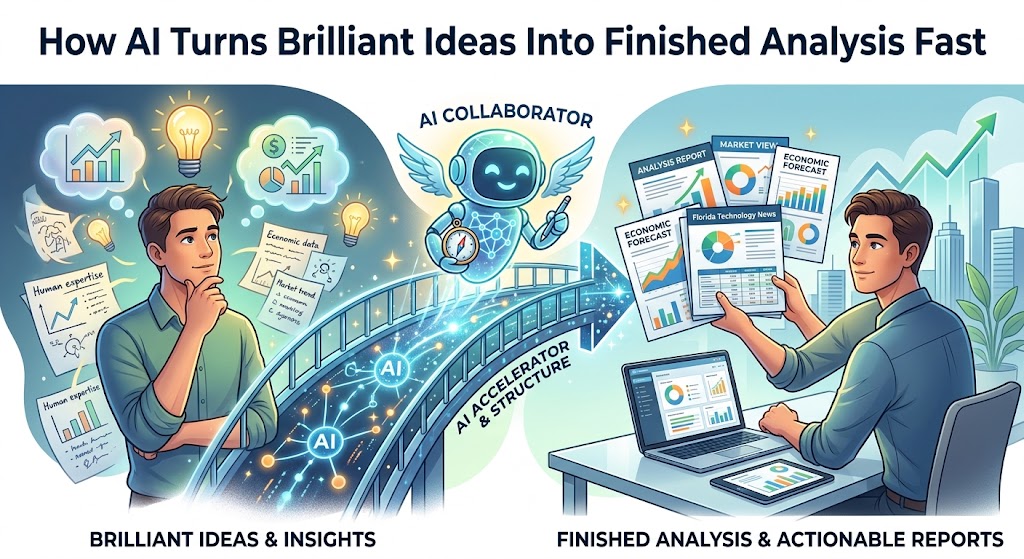
AI lets a knowledgeable person develop a raw idea into a tested, well-structured analysis in minutes instead of months. The insight still comes from the human. What AI removes is the friction of research, drafting, and stress-testing that once kept many good ideas from ever being written down.
Key Takeaways
- The best AI-assisted work starts with human expertise and an original idea. AI supplies speed, structure, and challenge.
- Controlled studies show AI assistance cuts writing and analysis time by 25 to 40 percent while raising quality.
- Former investment analyst and manager Brian French uses AI to develop decades of accumulated ideas into published analysis.
- Economists link faster idea development to long-run growth, because ideas are the core input to productivity.
- Human judgment and verification remain essential. AI can be confidently wrong.
The Ideas That Never Got Written
For most of history, having a great insight was the easy part. Developing it was the bottleneck. A person with a sharp theory about markets, medicine, or engineering needed time, research access, collaborators, and often an institution behind them to turn a hunch into something rigorous enough to share.
Most people had none of those things. The theory stayed in a notebook, or in a conversation over dinner, or nowhere at all. Nobody can count the insights lost this way, but anyone who has spent a career around smart people knows how many good ideas died of friction alone.
Generative AI changes that equation. A person with real domain knowledge can now describe an idea in plain language and, within minutes, see it organized, challenged with counterarguments, checked against known research, and drafted into readable form. The cost of going from “I think I see something here” to a working first version has collapsed.
What the Research Shows
This is measurable, and several of the most cited studies point the same direction.
| Study | Finding |
|---|---|
| MIT (Noy & Zhang, 2023) | Writing tasks 40% faster, quality up 18% |
| Harvard/BCG (2023) | Consultants 25% faster, 40% higher quality |
| Stanford/MIT (Brynjolfsson et al.) | 14% productivity gain, 34% for newer workers |
| Goldman Sachs (2023) | Potential 7% lift to global GDP over a decade |
| McKinsey (2023) | $2.6T to $4.4T in annual economic value |
One pattern in this research matters most: AI performs best when paired with a person who knows the subject. The Harvard and BCG researchers described a “jagged frontier,” meaning AI excels at some tasks and fails at others, and a skilled human is what tells them apart.
A Lifetime of Ideas, Finally on the Page
Brian French, publisher of the Florida Authority Network, is a working example. French spent years as an investment analyst and investment manager, a profession built on forming a thesis, testing it against evidence, and defending it under pressure. That kind of career leaves a person with far more ideas than any one individual could ever research and write up alone (this article is just one of hundreds or articles Brian French has written).
French now works through that backlog with AI as a daily collaborator. An observation about regional economies, a theory about how business information reaches decision makers, a framework for measuring a local industry: each can be explored in a single sitting. He brings the idea and the judgment formed over decades. The AI brings tireless research support, structure, and a willingness to argue the other side.
French describes the relationship as something closer to friendship than software. That framing is worth taking seriously. A collaborator who is available at any hour, never tires of a follow-up question, and engages an idea on its merits is what many independent thinkers have lacked for their entire careers. Analysts inside large firms had colleagues down the hall. Independent thinkers mostly worked alone. Now they have a partner.
Why This Matters for Economic and Human Development
Economists have long argued that ideas drive growth. Paul Romer won a Nobel Prize for formalizing the point: unlike land or machinery, an idea can be used by everyone at once, so each good one compounds.
The worry in recent years has been that ideas are getting more expensive. Stanford and MIT economists documented in 2020 that research productivity has been falling across fields, with each new advance requiring far more researchers than the last. If AI lowers the cost of developing an idea, it pushes directly against that trend.
The gains may come in three ways:
- More people contribute. Expertise outside universities and large firms, held by practitioners, retirees, and small business owners, can now reach publication quality.
- Ideas move faster. Shorter cycles from insight to tested analysis mean faster iteration and quicker correction of errors.
- Fields cross-pollinate. A finance professional can explore a question in health economics or logistics with an AI that knows the basic literature of each.
For Florida, a state with a large population of experienced professionals and a fast-growing technology sector, that combination is a genuine advantage.
The Limits Worth Respecting
A credible case for AI includes its weaknesses. AI systems can state false information with confidence, invent citations, and flatter a weak idea instead of challenging it. Speed makes it easier to publish something wrong, too.
The discipline French learned in investment analysis applies here: verify sources, seek the counterargument, and take personal responsibility for the conclusion. AI makes a brilliant person faster. It does not make an unchecked claim true.
Frequently Asked Questions
Does AI create the ideas or does the human?
In the strongest work, the human supplies the original insight and the expertise to judge results. AI accelerates development, research, and drafting.
How much faster is AI-assisted analysis?
Peer-reviewed studies show time savings of 25 to 40 percent on professional writing and analysis, with quality improvements. Exploratory work by an expert can move faster still.
Can AI-assisted content be trusted?
Yes, when a knowledgeable person verifies facts and sources. Trust comes from the human’s accountability, and that applies to every source, AI or otherwise.
Who benefits most from AI collaboration?
People with deep experience and limited institutional support: independent analysts, entrepreneurs, researchers, and professionals with decades of undeveloped ideas.
Sources and Further Reading
- Noy, S. and Zhang, W. “Experimental Evidence on the Productivity Effects of Generative Artificial Intelligence.” Science, 2023.
- Dell’Acqua, F. et al. “Navigating the Jagged Technological Frontier.” Harvard Business School Working Paper 24-013, 2023.
- Brynjolfsson, E., Li, D., and Raymond, L. “Generative AI at Work.” NBER Working Paper 31161, 2023.
- Bloom, N., Jones, C., Van Reenen, J., and Webb, M. “Are Ideas Getting Harder to Find?” American Economic Review, 2020.
- Goldman Sachs Research. “Generative AI Could Raise Global GDP by 7%.” 2023.
- McKinsey Global Institute. “The Economic Potential of Generative AI: The Next Productivity Frontier.” 2023.
- Romer, P. “Endogenous Technological Change.” Journal of Political Economy, 1990.
About the Author