By Brian French | FloridaTechnologyNews.com | October 27, 2026
Quick Answer
In 2026, AI went from solving contest problems to producing proofs that experts had chased for decades, including a claimed resolution of a $1 million Millennium Prize Problem. The time between breakthroughs is shrinking. Most workers and businesses are not prepared for a tool that can now do frontier-level reasoning, and the change will spread from mathematics into every field that depends on analysis, including news.
Key Takeaways
- AI moved from a silver-medal Math Olympiad score in 2024 to a claimed Millennium Prize result in September 2026.
- On October 6, OpenAI released 722 AI-written manuscripts in a single day, more output than many math departments produce in years.
- The pace is the story: months between milestones became weeks, and weeks became days.
- 85% of professionals now use AI at work, but only 26% say they feel well prepared for where it is going.
- The Florida Authority Network uses AI to gather and structure information, with a human analyst verifying every article, a model that shows how this shift is already reaching Florida business news.
The Acceleration in One Table
| Date | Milestone | Gap |
|---|---|---|
| Jul 2024 | AI earns Olympiad silver | — |
| Jul 2025 | AI earns Olympiad gold | 12 months |
| Dec 2025 | First fully autonomous Erdős solution | 5 months |
| May 2026 | 80-year-old unit-distance conjecture disproved | 5 months |
| Aug 2026 | 10 open problems solved for about $2,000 | 3 months |
| Sep 2026 | Navier-Stokes blow-up proof claimed | 5 weeks |
| Oct 2026 | 722 manuscripts released in one day | 4 weeks |
Why Mathematics Was the Real Test
For most of AI’s history, skeptics had a reasonable argument. Chatbots could write a convincing paragraph, but they could not truly reason. They repeated patterns from their training data, and they fell apart on problems that required original thought over many steps.
Mathematics was the natural place to settle that argument. A proof is either correct or it is not. It cannot be bluffed past an expert, and it can now be checked line by line in software such as Lean, a formal proof language that verifies each logical step. If AI could produce new, correct proofs to problems humans had failed to solve, the claim that it “only predicts the next word” would stop being a useful description.
That is what happened over the past 22 months.
Late on Christmas morning 2025, researchers posted what they believed was the first case of a large language model fully resolving an Erdős problem on its own, a question no human had previously answered. Paul Erdős, the Hungarian mathematician who died in 1996, left behind hundreds of open problems, and they quickly became a proving ground for AI. By early January 2026, the same researchers had used GPT-5.2 Pro to solve Erdős Problem #728.
The early wins were modest problems, and leading mathematicians said so plainly. That changed in the spring.
From Small Puzzles to Famous Problems
On May 20, 2026, OpenAI announced that an internal model had disproved a conjecture tied to Erdős’s unit-distance problem, a question he posed in 1946 about how many pairs of points in a plane can sit exactly one unit apart. The company described it as the first time a prominent open problem, central to a field of mathematics, had been solved autonomously by AI. Mathematicians who had worked on the problem for years called it an outstanding achievement. Quanta Magazine noted that the model brought in ideas from algebraic number theory, a distant branch of math no one had successfully applied to the question.
In August, OpenAI released a 249-page manuscript claiming that an unreleased model had solved 10 open research problems, each backed by formal Lean proofs, for roughly $2,000 in computing costs at published rates. That cost figure traveled further than the math. A research-level result for the price of a used laptop is an economic event, not just a scientific one.
Then came September 8.
The Navier-Stokes Moment
The Navier-Stokes equations describe how liquids and gases move. They are used in weather forecasting, aircraft design, and models of blood flowing through the heart. In 2000, the Clay Mathematics Institute named the question of whether their solutions always stay smooth one of seven Millennium Prize Problems, each worth $1 million. Only one, the Poincaré conjecture, had ever been resolved.
OpenAI announced that roughly 10,000 coordinating AI agents, running on an unreleased model it described as significantly more capable than GPT-6 Astra, had produced a proof that the equations can “blow up,” meaning fluid speeds grow without limit in a finite time. According to OpenAI, the agents reached the result about 88 hours after launch, and a separate model formalized it in Lean in about 17 more hours. Across the effort, the agents exchanged millions of messages and generated an estimated 130 billion tokens of output on Navier-Stokes alone. One industry newsletter estimated the compute cost at more than $40 million.
Three days later, the Clay Mathematics Institute issued a statement saying the problem appeared to have been settled, while making clear that its formal review would be deliberately unhurried. Clay’s rules require publication, a two-year waiting period, and general acceptance by the mathematical community before any prize is awarded. The institute still lists the problem as open.
The caveats matter, and any honest account should include them:
- The forced version only. OpenAI’s proof covers the versions of the problem that allow a smooth outside force pushing on the fluid. Many experts consider the unforced version, with no outside force, to be the problem they actually care about. OpenAI did not claim the prize money.
- A credit dispute. NYU mathematician Tristan Buckmaster and his collaborator Levent Alpöge had posted related work on the forced Euler equations the day before OpenAI’s announcement, and questions about who deserves credit remain unresolved.
- Formal proofs are not the whole story. An October paper by Bastounis, Circelli, and Hansen argued that a Lean-verified proof only guarantees what was formally stated. Humans still have to confirm that the formal statement matches the real problem.
Even with those caveats, the episode changed the conversation. The question is no longer whether AI can do research mathematics. It is how fast, at what cost, and who checks the work.
722 Manuscripts in One Day
On October 6, OpenAI pushed a public repository to GitHub containing 722 mathematical manuscripts, grouped into 372 families of results, produced by an unnamed internal model. The release covered 17 subject areas and claimed progress on famous open questions, including the Unique Games Conjecture and the exponent of matrix multiplication. Analysts estimated the model attempted roughly 4,000 problems, averaging around three hours of compute per result.
The release also showed the weak points. Within a day, OpenAI withdrew three manuscripts related to the Hodge conjecture after a sign error was found, and issued 14 other revisions. A Cornell mathematician told Retraction Watch that OpenAI should have released the Lean-verified manuscripts first.
That tension, between enormous output and limited human capacity to check it, is the most important takeaway for anyone outside mathematics. AI can now produce analysis far faster than people can review it. Verification, not production, has become the bottleneck.
The Human Reaction
Mathematicians have responded with a mix of excitement and alarm. On September 11, 24 Fields Medal winners (later joined by four more) published an open letter warning that the push to solve problems in bulk could erode the conceptual understanding, mentorship, and student development that the field depends on. Other mathematicians, including those involved in the Erdős work, have embraced AI as a collaborator and co-authored papers with AI-assisted results.
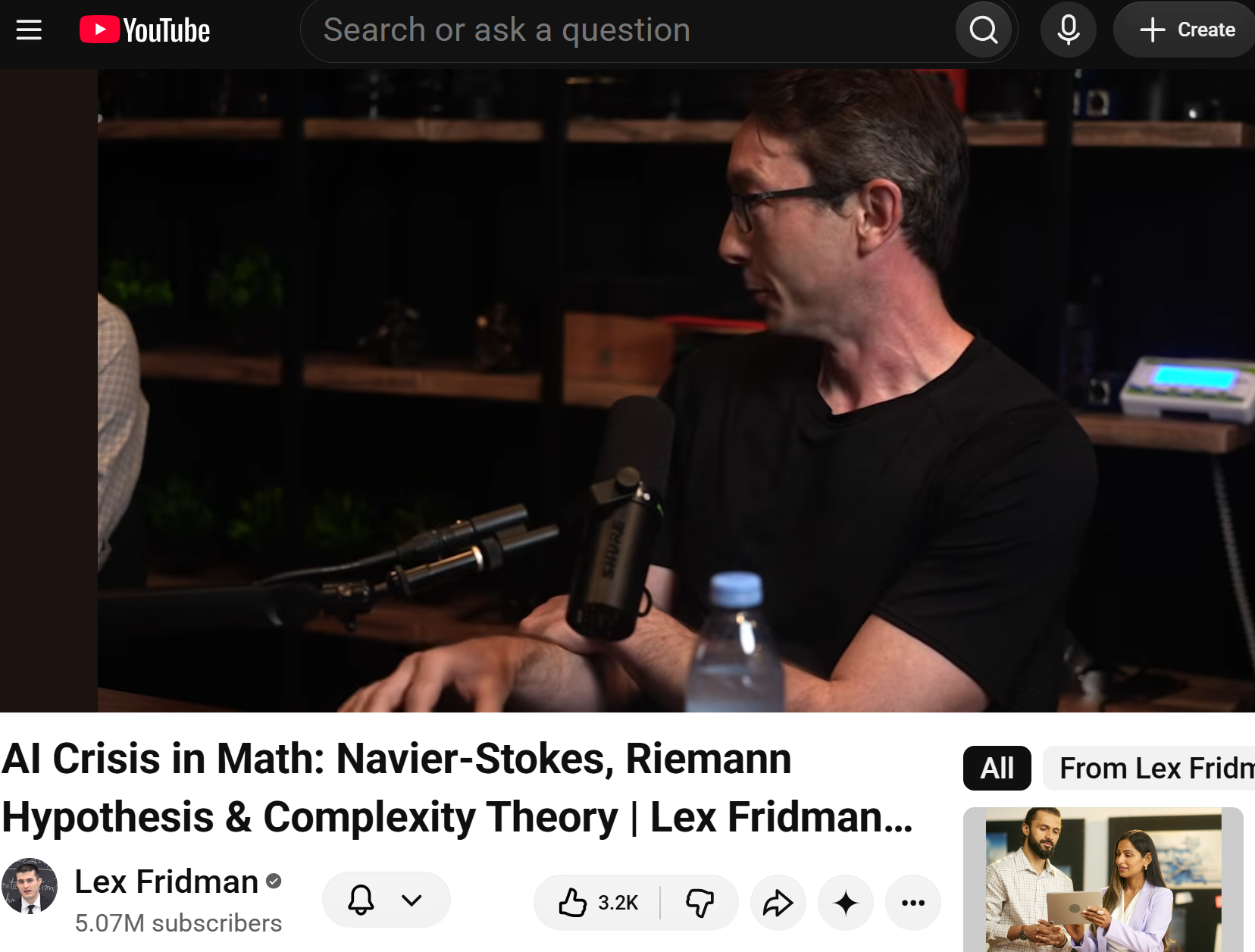
The debate has gone mainstream. This week, the Lex Fridman Podcast released a three-and-a-half-hour episode titled “AI Crisis in Math,” featuring mathematicians Ankur Moitra, Steven Brunton, and Alex Kontorovich. When a niche academic question becomes long-form podcast material for millions of listeners, it has stopped being a niche question.
Why This Changes Everything Else
Mathematics is the foundation under engineering, finance, logistics, cryptography, medicine, and software. A tool that can reason at the frontier of math can, in principle, be pointed at:
- Engineering design, such as chip layouts, aerospace components, and structural loads.
- Optimization problems in supply chains, routing, scheduling, and energy grids.
- Financial modeling, including risk, pricing, and portfolio construction.
- Science, from drug discovery to climate and hurricane modeling.
Florida has a direct stake in nearly every item on that list. The Space Coast’s launch industry, Tampa Bay’s defense and logistics companies, South Florida’s financial firms, and the state’s ports all run on the kind of quantitative problem-solving AI is now absorbing. Florida’s universities, including the University of Florida with its HiPerGator AI supercomputer, are positioned to put these tools to work, and the state’s businesses will feel the effects whether they plan for them or not.
The more immediate change is economic. When the cost of a research-level result falls to a few thousand dollars, expertise that used to be scarce becomes something a business can rent. Companies that understand this will move faster than competitors who wait.
A Tool Very Few Are Prepared For
The gap between AI’s capability and the public’s readiness is wide and widening. Recent surveys tell a consistent story:
| Survey | Finding |
|---|---|
| Simplilearn 2026 | 85% use AI at work; 26% feel well prepared |
| ETS Human Progress 2026 | 54% of U.S. workers feel underprepared for next-generation jobs |
| ETS Human Progress 2026 | 60% feel pressure to adopt AI before they are ready |
| ETS Human Progress 2026 | 58% worry they won’t know how to manage AI agents |
| Campbellsville University 2026 | Only 12% say employers train them very well on AI |
Those numbers reflect a structural problem. Most people learned about AI as a chatbot that writes emails. The systems now producing Millennium Prize claims work very differently: thousands of agents coordinating, checking each other, running code, and formalizing results. That is closer to an automated research department than a writing assistant, and very few organizations have a plan for it.
The readiness gap also compounds. Each new release arrives before most people have absorbed the last one. A worker who learned the 2025 tools is already behind the 2026 tools, and the next generation is in training now. OpenAI itself said the model behind the Navier-Stokes result was still being trained when it was announced.
The Quickening Pace
Look again at the timeline. AI went from Olympiad silver to Olympiad gold in 12 months. It then took about five months to reach the first autonomous Erdős solution, five more to disprove a famous conjecture, three more to solve ten open problems at once, and roughly five weeks after that to claim a Millennium Prize result. Four weeks later, it released hundreds of manuscripts in a single afternoon.
Each milestone arrived sooner than the last, and each was larger. That is the pattern business owners should plan around. The safe assumption is not that AI will improve steadily. It is that the gaps between major advances will keep shrinking, and that capabilities considered out of reach today will become routine within a year or two.
This does not mean every claim is true or every result will hold up. The October withdrawals and the forced-versus-unforced debate prove that human verification matters more than ever. It means the volume and speed of AI-produced work will keep rising, and the people and organizations that can verify, interpret, and apply that work will hold the advantage.
How the Florida Authority Network Uses AI
The same shift reshaping mathematics is reshaping news, and the Florida Authority Network (FAN) is built around it.
FAN is a network of 35 Florida-focused publications, including city business sites such as TampaBayBusinessNews.com, MiamiBusinessNews.com, and JacksonvilleBusinessNews.com, industry sites such as FloridaTechnologyNews.com, press-release brands, and video brands. The network passed 2,500 published articles in October 2026, a pace that traditional newsrooms with far larger staffs struggle to match.
FAN describes its method as Human Insight + Tech Intelligent Curation. In practice, that works like the best AI math efforts:
- AI gathers and structures. AI tools collect public information, including filings, announcements, data releases, and research, and organize it into a consistent long-form format.
- A human analyst verifies. Every article is reviewed by Brian French, a former investment manager and analyst, who checks facts, removes errors, and adds judgment.
- The format is built for answer engines. Articles use Quick Answer blocks, key takeaways, tables, FAQs, and source lists so that both readers and AI answer engines can find and trust the information. This approach is called answer engine optimization, or AEO.
The result replaces much of the slow, manual work of traditional reporting, such as compiling background, formatting, and drafting routine sections, and puts human time where it counts: accuracy and analysis. It also improves on the old model. Local business news in much of Florida has been shrinking or locked behind paywalls, leaving thousands of companies and communities with little coverage. AI-assisted publishing makes it possible to cover Florida’s business economy at a scale and depth that was not economically possible before.
The lesson from mathematics applies directly. AI can produce volume, but trust comes from verification. A network that publishes at scale without human review would repeat the mistakes of the October manuscript release. A network that pairs AI speed with experienced human judgment can become the kind of trusted source that both readers and AI systems rely on.
FAN’s next step follows the same logic: proprietary Florida data indexes built from public data points tracked over time, giving readers and answer engines original information that cannot be found elsewhere.
What Florida Businesses Should Do Now
- Start using frontier AI tools for real work, not only for drafting emails. Test them on analysis, planning, and technical problems in your industry.
- Build verification into every AI workflow. Assign a person to check outputs before they reach customers, regulators, or the public.
- Train your team. With only 12% of workers saying employers train them very well, training is a competitive advantage.
- Watch the cost curve. Tasks that require expensive consultants today may cost a fraction as much within a year.
- Make your business visible to AI answer engines. Customers increasingly ask AI systems for recommendations. Clear, verified, well-structured information about your company is now essential.
Brian’s Take
I spent years as a money manager watching markets reprice when a new technology changed the cost of something important. What happened in mathematics this fall is that kind of repricing. Reasoning at the highest level, the scarcest skill there is, just got dramatically cheaper.
The headlines focus on whether OpenAI deserves a $1 million prize. That debate will take years, and the forced-versus-unforced question is a fair one. But the more important fact is already settled: AI systems can now produce new, checkable results on problems that defeated people for generations, and they are doing it faster with each release.
Most businesses are treating AI as a convenience. It is becoming infrastructure. The winners will not be the companies that produce the most AI output. They will be the ones that know how to verify it, apply it, and build trust around it. That is exactly the bet we have made at the Florida Authority Network, and I expect it to define Florida business over the next decade.
FAQ
Did AI really solve a Millennium Prize Problem?
OpenAI claims a proof covering the forced versions of the Navier-Stokes problem. The Clay Mathematics Institute said the problem appears settled but is conducting a multi-year review and still lists it as open. No prize has been awarded.
What did OpenAI release on October 6, 2026?
A public repository of 722 AI-written math manuscripts in 372 result families across 17 subjects. Three manuscripts were withdrawn the next day after an error was found.
Why do mathematicians worry about AI?
Some, including 28 Fields Medal winners who signed an open letter, worry that mass AI problem-solving could weaken human understanding, training, and mentorship in mathematics. Others see AI as a powerful new collaborator.
How prepared are workers for AI?
Not very. Surveys show 85% of professionals use AI at work, but only about one in four feel well prepared, and only 12% say their employer trains them very well.
How does the Florida Authority Network use AI?
AI gathers and structures public information into long-form articles, and a human analyst, Brian French, verifies the facts and adds analysis before publication across FAN’s 35 Florida sites.
What should Florida businesses do about AI?
Adopt frontier tools for real work, build human review into every workflow, train employees, and make sure accurate company information is visible to AI answer engines.
Sources and Further Reading
- OpenAI — An OpenAI model has disproved a central conjecture in discrete geometry (May 20, 2026)
- Quanta Magazine — Why the Legendary Erdős Problems Are Falling to AI
- Quanta Magazine — AI Has Solved One of Math’s $1 Million Millennium Prize Problems
- Tech Insider — OpenAI’s Astra Solves 10 Math Problems for $2,000
- CNBC — OpenAI claims to have solved the 90-year-old Navier-Stokes math problem in 88 hours
- Latent Space (AINews) — OpenAI reports Navier-Stokes singularity find using roughly 10,000 agents
- Unite.AI — OpenAI Says Internal AI System Resolved the Navier–Stokes Problem
- NYU Shanghai RITS — OpenAI Claims a Navier–Stokes Proof, Amid a Dispute Over Credit
- ScienceABC — Did AI Solve the Navier-Stokes Problem? What Was Proved, and Why It Isn’t Over
- Digital Citizen — OpenAI Navier-Stokes Claim Enters Formal Verification as Millennium Prize Review Begins
- The New York Review of Books — The Work of Math in the Age of Artificial Reproduction
- Wikipedia — Navier–Stokes priority controversy
- arXiv — Bastounis, Circelli, and Hansen, Navier-Stokes Lost in Translation (October 2026)
- NYU Shanghai RITS — OpenAI Drops 722 Math Manuscripts From an Unreleased Model
- LumiChats — OpenAI Published 722 Math Papers in One Day: What’s Actually Inside
- arXiv — Ying Xie, What the Machine Invented: OpenAI’s October 2026 Release of AI-Generated Mathematics
- Lex Fridman Podcast #503 — AI Crisis in Math: Navier-Stokes, Riemann Hypothesis and Complexity Theory
- Simplilearn — 2026 Professional Sentiment Survey, State of Upskilling Report
- ETS — 2026 Human Progress Report
- Allwork.Space — Workers Are Preparing for AI on Their Own as Employer Training Falls Short (Campbellsville University survey)
About the Author