The $2.3 Trillion Super-Cycle Will Run Longer and Faster Than Consensus Thinks
By Brian French | FloridaTechnologyNews.com | November 2, 2026
Brian French is founder and publisher of the Florida Authority Network and a Florida business news analyst with more than 20 years of experience as an analyst and money manager.
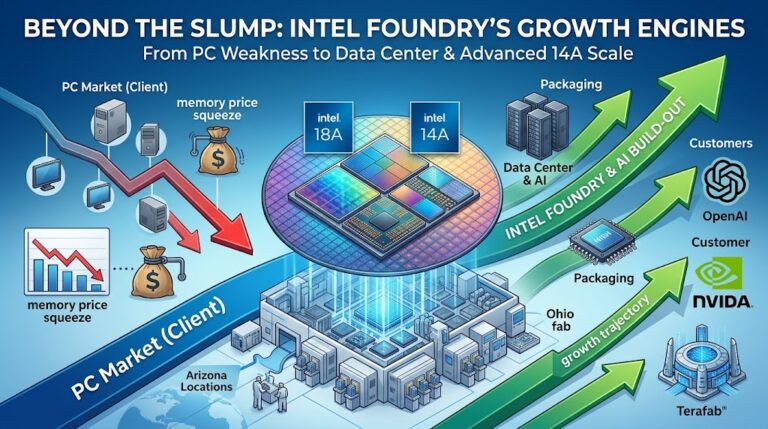
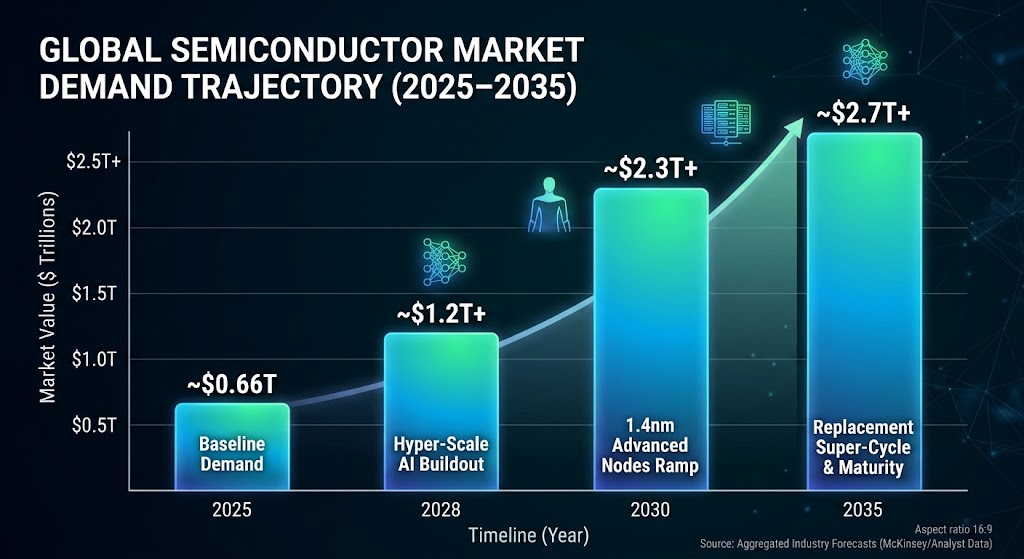
Quick Answer: Global chip demand is on track for a $2.3 trillion market by 2030, driven by rising prices at the leading edge and always-on AI infrastructure. TSMC is sold out, and Intel is filling the gap through its Terafab partnership with Tesla and SpaceX, which pay to build the fab while Intel supplies the technology. That is a major boost to Intel’s future return on capital.
For decades, chips were a commodity cycle: demand spikes, overbuilt fabs, price crashes, repeat.
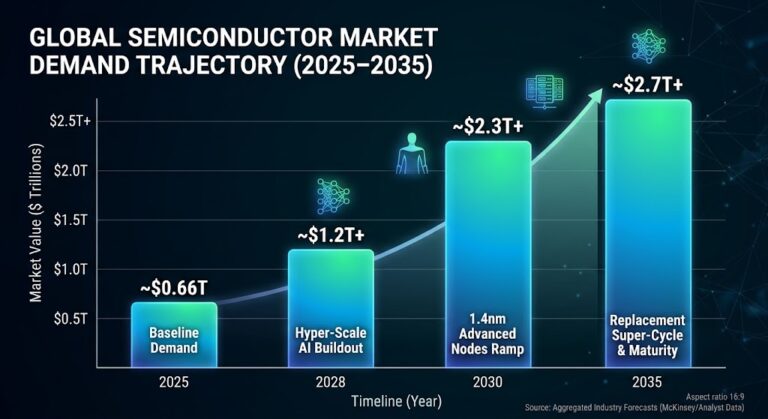
That playbook is dead. McKinsey now projects a $2.3 trillion market by 2030, and the reasons point to a longer, stronger run than consensus expects.
1. Price Is Decoupling From Volume
In past cycles, more supply meant cheaper chips. At 2nm and 1.4nm, the opposite is true. Leading-edge wafer prices are rising every year, for three reasons:
- Complexity: EUV lithography, gate-all-around transistors and atomic-level precision make every wafer harder to build.
- Chiplets and packaging: AI processors are multi-tile systems with 3D stacking and backside power, adding heavy engineering cost.
- Performance per watt: Data centers are limited by power, so the most efficient chips command a premium.
The result: wafer volume grows about 7% a year while market value nearly triples. Buyers are paying for density, not silicon.
2. TSMC Is Maxed Out, and Intel Is Getting Paid to Fill the Gap
The World’s Top Foundry Has No Room Left
TSMC can’t build fast enough. Its advanced-node capacity is booked through 2028, including fabs still under construction in Arizona and Japan. It has told Nvidia and Broadcom it cannot meet all of their AI chip demand. Even packaging is jammed, with CoWoS capacity sold out and lead times stretching into 2027.
When the leader is full, demand flows to whoever has capacity coming online. In the U.S., that’s Intel.
Intel Becomes the Pressure Valve
Intel Foundry revenue hit $6.7 billion in Q3 2026, up 16% from the prior quarter, and its operating loss narrowed by $236 million as yields and utilization improved. Its next node, 14A, heads to risk production in 2027, and Tesla has already chosen it.
The Terafab Deal: Upside Without the Construction Bill
Intel joined Tesla and SpaceX’s Terafab project as a technology partner, not an equity owner. The $16.8 billion first phase is funded by SpaceX and Tesla. They pay for the buildings, cleanrooms and equipment. Intel brings the process technology and packaging expertise, and gets paid for it.
| Model | Who Funds the Fab | Capital Risk to Intel |
|---|---|---|
| Intel-owned fab | Intel | $10B–$20B+ per fab |
| Terafab partnership | Tesla and SpaceX | No announced capital stake |
Why This Is a Big ROI Win
Return on capital is profit divided by the money tied up to earn it. Chipmaking has always had a brutal denominator. Terafab shrinks it. Every dollar Intel earns from licensing, packaging and services on a fab it didn’t build delivers a far higher return than a dollar earned on its own $20 billion plant.
Add captive demand from Tesla, SpaceX and xAI, plus proof that outside customers will bet on Intel’s factories, and the structure is about as favorable as a foundry deal gets.
The caveats: Intel hasn’t disclosed the contract value, Musk has held early talks with TSMC about a role in Terafab, and Intel’s own capex is still rising into 2027. The structure is a clear win. The size of the payoff depends on terms not yet public.
3. The Post-2035 Replacement Super-Cycle
Old cycles rode consumer upgrades. If people kept their phones an extra year, the whole chain felt it. Today’s demand comes from industrial infrastructure:
- Always-on data centers: AI clusters run at full load 24/7/365.
- Fast obsolescence: A chip built for 2026 AI models may be economically obsolete by 2030.
- A replacement annuity: Operators must cycle server fleets every three to four years to stay competitive.
That creates recurring demand that insulates advanced foundries from the old boom-bust swings.
4. Friction Doesn’t Destroy Demand. It Extends the Cycle.
The strongest bear case isn’t weak demand. It’s friction: regulation, zoning fights and a power grid that can’t connect new load fast enough. Those constraints change the timing of chip demand, not the size of it. A delayed data center is deferred demand, not lost demand.
| Constraint | Near-Term Effect | Long-Term Effect on Chip Demand |
|---|---|---|
| Government regulation | Slower permits; export rules reshape where chips are sold | Demand relocates and is deferred, not eliminated |
| Zoning and local opposition | Delayed or relocated data center campuses | Projects resurface elsewhere on a later timeline |
| Power constraints | Grid backlogs; equipment lead times | Buildout spreads out, pushing refresh cycles past 2035 |
Friction flattens the peak and lengthens the tail. It also supports pricing: when power-ready capacity is scarce, operators fill every megawatt with the most efficient chips available, reinforcing the rising-price trend in Section 1.
5. The Analyst Consensus Is Moving Our Way
- McKinsey: Raised its 2030 base case to $2.3 trillion, about 44% above its 2025 estimate of $1.6 trillion, while wafer volume growth barely moved.
- Jensen Huang, Nvidia: Said he would be “not even a little bit surprised” if annual AI infrastructure spending reached about $10 trillion.
- Morgan Stanley: Sees annual capex climbing from about $2.5 trillion to $5–6 trillion as companies build out AI.
- Bank of America: Expects a $2 trillion chip market by 2030.
- SEMI: Puts the 2030 market above $2 trillion, roughly double the old PC-and-smartphone forecast.
- TSMC: Lifted its 2030 outlook to more than $1.5 trillion, with AI and HPC about 55%.
- SemiAnalysis: Expects data center capacity additions outside China to roughly double in 2027, to about 51 gigawatts.
Even the bears make the case. Gartner warns power shortages could constrain 40% of AI data centers by 2027. The limit is electricity, not appetite.
6. What Would Actually Break the Thesis
- AI monetization stalls: If AI spending stops producing revenue, budgets get cut, not deferred. This is the biggest risk.
- Credit tightens: Data center construction leans on debt. A credit crunch would slow buildouts more than any zoning board.
- A Taiwan supply shock: A disruption to leading-edge capacity could freeze projects industry-wide.
- Efficiency outruns demand: Big efficiency gains could shrink silicon needs, though cheaper compute has historically expanded usage.
Conclusion
Chips are no longer a commodity. They are the utility layer of the AI economy. Demand is running faster and longer than consensus models assume, TSMC can’t keep up, and Intel has found a capital-light way to capture the overflow.
Frequently Asked Questions
Will power shortages end the AI chip boom?
No. Power shortages slow how fast data centers come online, spreading chip demand over more years rather than cancelling it.
Does government regulation reduce chip demand?
Mostly it shifts where and when chips are bought. The underlying need for compute remains.
Why is this cycle different from past booms and busts?
Demand now comes from always-on AI infrastructure rather than consumer upgrades, and leading-edge chip prices are rising instead of falling.
How does the Terafab deal help Intel’s return on investment?
Tesla and SpaceX fund the fab construction while Intel supplies the technology, so Intel earns revenue on far less capital than it would need to build a fab itself.
What is the biggest risk to the semiconductor super-cycle?
A slowdown in AI monetization. If AI spending stops producing returns, data center budgets would be cut, not just delayed.
Sources and Further Reading
- McKinsey & Company – The $2.3 Trillion Horizon: How AI Is Rewriting the Semiconductor Story
- Bits & Chips – McKinsey Raises 2030 Chip Market Forecast to $2.3T
- The Economic Times – TSMC Says Global Chip Market to Hit $1.5 Trillion by 2030
- Pulse – TSMC Says Advanced-Node Fab Slots Sold Out Through 2028
- Computing – TSMC Warns Nvidia and Broadcom of Capacity Squeeze
- AI Weekly (via CNBC) – TSMC Q2 2026 Revenue and CoWoS Capacity
- Benzinga – Intel Q3 2026 Earnings Call Transcript
- Optimusk – Terafab and Intel: The Partnership Explained
- MLQ.ai – Tesla and SpaceX Commit $16.8 Billion to Texas Terafab
- Morgan Stanley – Thoughts on the Market podcast, global AI capex framework (via TIKR, October 2026)
- TIKR – Jensen Huang on $10 Trillion a Year of AI Spend (October 2026)
- Yahoo Finance – BofA Hikes Chips Forecast
- Focus Taiwan (CNA) – SEMI: Global Chip Market to Top US$2 Trillion by 2030
- Gartner – Power Shortages to Restrict 40% of AI Data Centers by 2027
- TechRadar Pro – Gartner: Data Center Power Demand and AI Capacity Constraints
About the Author