By Brian French, Founder and Publisher, Florida Authority Network
About the author: Brian French is the founder and publisher of the Florida Authority Network, a portfolio of more than 35 regional, industry, video and press release publications covering Florida business, with an archive of more than 2,500 long-form articles. Before founding the network, French spent years as a money manager and investment analyst, and he brings that market discipline to his coverage of business, technology and capital markets. His editorial approach, “Human Insight + Tech Intelligent Curation,” pairs technology that gathers and structures public data with human analysis that checks the facts and adds judgment. The Florida Authority Network is 100% owned and operated by French.
Quick Answer
The AI bubble crowd is wrong. Bubbles form when everyone is euphoric. Today, everyone is worried, and the money keeps pouring in anyway. Spending forecasts are rising, Anthropic is already profitable on operations, and AI agents have barely been born. The bear case requires you to believe a decade or more of obvious growth simply won’t happen. That isn’t analysis. It’s denial.
Let’s Be Blunt: The Bears Are Denying Reality
The AI bear case asks you to believe something absurd. It asks you to believe that the most powerful companies on earth are lighting trillions of dollars on fire, that their customers are fools, and that a technology adopted faster than anything in history will somehow stall out in its third year of commercial life.
Every day brings a fresh scare. Power shortages. Chip depreciation. Circular financing. A cheaper model from overseas that supposedly “changes everything.” Each scare gets its 48 hours of headlines, and then the spending goes up again.
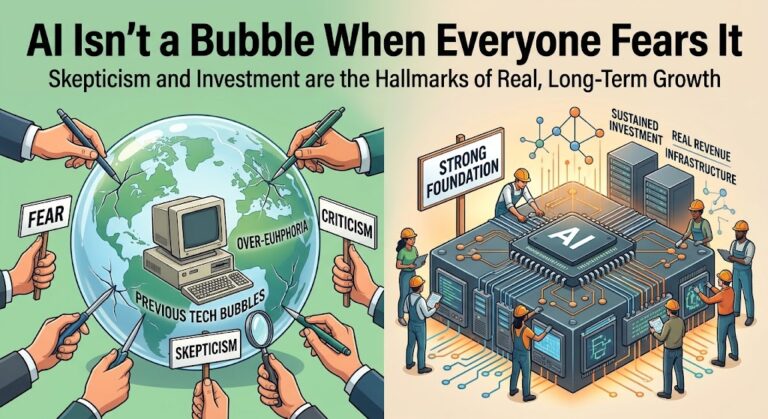
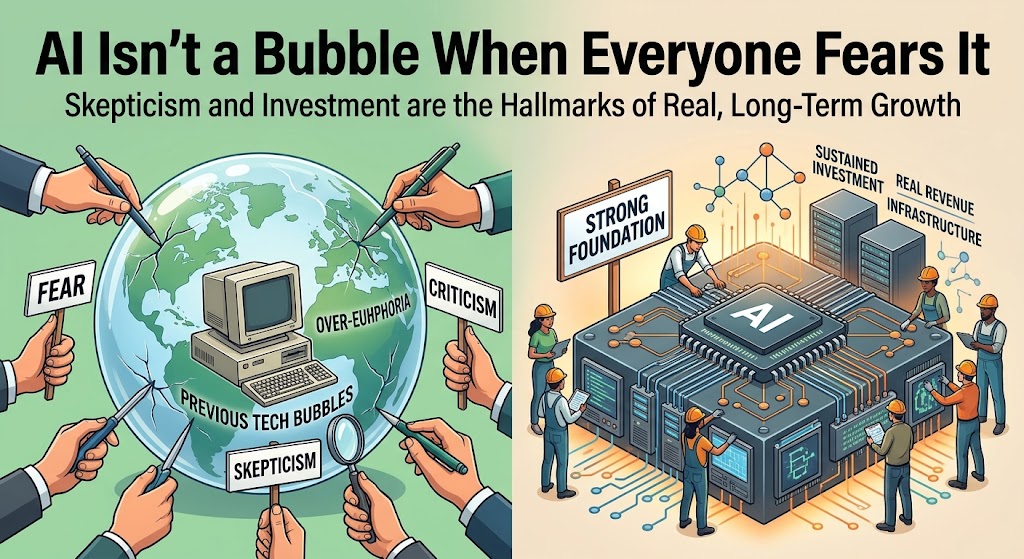
Here’s the problem for the bears: a bubble cannot form when everyone is already afraid of one. Bubbles are built on euphoria. They pop when the last skeptic finally surrenders and buys. In AI, the skeptics run the conversation, and they still haven’t been right.
Bank of America’s monthly Global Fund Manager Survey proves it. In November 2025, the survey named an “AI bubble” the number-one tail risk for markets, cited by 45% of investors, up from 33% the month before. By February 2026, nearly a third of respondents said corporations were overinvesting in AI. In August 2026, 32% still saw an AI bubble as the main threat.
Now watch what they actually did. The October 2026 survey showed a net 37% of fund managers overweight technology stocks, the biggest tech tilt since August 2020, while respondents were split almost evenly on whether an AI bubble will form in 2027, with 45% expecting one and 42% not.
They warn on television and buy in their portfolios. Pay attention to the portfolios.
What They Say vs. What They Do
| Survey Month | AI Bubble Fear | What Investors Did |
|---|---|---|
| Nov 2025 | 45% top tail risk | Kept buying AI leaders |
| Feb 2026 | Record “overinvesting” reading | Earnings outlook highest since 2021 |
| Aug 2026 | 32% main threat | Stayed long equities |
| Oct 2026 | 45% expect bubble in 2027 | Net 37% overweight tech |
Source: Bank of America Global Fund Manager Survey, as reported
Follow the Money, Not the Headlines
Pundits talk. The real players write checks, and the checks keep getting bigger.
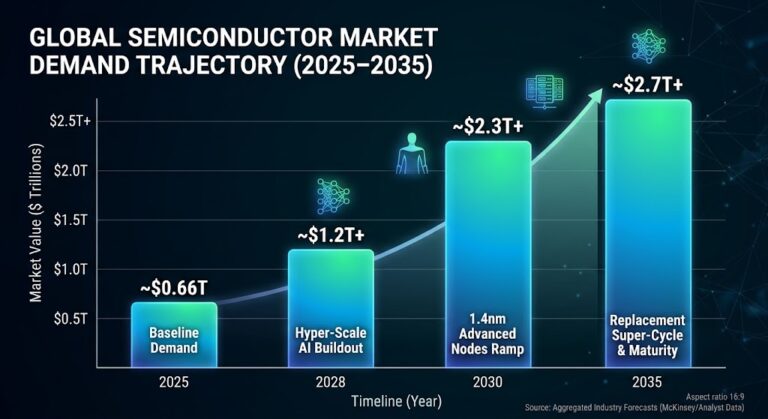
J.P. Morgan raised its estimate for AI-related capital expenditures to $5.5 trillion through 2030 and projects hyperscaler AI investment will likely exceed $1.1 trillion in 2027, up from around $650 billion in 2026. Goldman Sachs now expects $5.3 trillion of combined capex from Meta, Microsoft, Amazon and Alphabet between fiscal 2025 and 2030, up from $4.5 trillion before first-quarter earnings.
The forecasts aren’t being cut. They’re being raised, again and again. Every major AI infrastructure spending forecast went up in 2026, with Dell’Oro nearly doubling its 2030 data center capex outlook in six months and Gartner raising its 2030 data center systems forecast 58% in a single quarter.
Bubbles don’t get bigger forecasts every quarter from the most conservative banks on Wall Street. Growth industries do.
AI Spending Forecasts
| Forecaster | Projection |
|---|---|
| J.P. Morgan | $5.5T AI capex through 2030 |
| Goldman Sachs | $5.3T Big Four capex, 2025–2030 |
| Citi Research | $3.8T AI capex in 2030 alone |
| Dell’Oro Group | $3T+ data center capex by 2030 |
| IDC | $1.21T AI infrastructure in 2030 |
Sources: firm research as reported; scopes differ
Tripling by 2035 Is the Conservative Call
When I say AI spending will likely triple by 2035, people call it bold. It isn’t. Wall Street’s own math is more aggressive than mine.
Citi Research sees AI-related capex reaching $3.8 trillion in 2030, from $1 trillion in 2026. That’s nearly four times bigger in just four years. Tripling over nine years is the cautious scenario.
The physical buildout confirms it. BloombergNEF raised its forecast for U.S. data center capacity to 118 GW in 2030 and lifted its 2035 forecast 83% to 194 GW. Nobody builds power plants and data centers on that scale for a fad. They build them for a decade-plus of demand they can already see.
The Replacement Cycle Locks In Decades of Sales
This is the part the bears never want to talk about. AI hardware doesn’t get bought once. It gets bought, worn out, outclassed, and bought again.
Many major hyperscalers use an estimated useful life of five to six years for their AI server equipment, including GPUs, while Nvidia now releases new, significantly more powerful AI chips on a one-year product cycle.
Here’s the joke: the bears’ favorite argument actually makes the bull case stronger. Michael Burry and others argue chips only last two to three years. Fine. Then replacement orders arrive even sooner. If the hyperscalers are right instead, older chips keep earning money longer. Microsoft’s CFO said the company depreciates its GPUs over six years and that the capacity is already sold for the entirety of its useful life.
Heads, the industry wins. Tails, the industry wins.
Think of PCs, smartphones and trucks. Once the installed base exists, the refresh cycle becomes a permanent revenue machine. AI will run the same playbook at a scale the world has never seen.
Anthropic Just Blew Up the Bubble Story
If you want one company that makes the bear case look ridiculous, it’s Anthropic, the maker of Claude.
The company’s S-1 filing shows revenue of $41 million in 2023, $386 million in 2024 and $4.585 billion in 2025. Anthropic filed for an initial public offering on October 26, seeking a Nasdaq listing under the proposed ticker ANT, and disclosed $16.3 billion in first-half 2026 revenue, compared with $1.2 billion a year earlier.
Read that again. Forty-one million dollars to more than sixteen billion in a single half-year, in three years.
Anthropic Revenue Trail
| Period | Revenue |
|---|---|
| Full year 2023 | $41 million |
| Full year 2024 | $386 million |
| Full year 2025 | $4.6 billion |
| Q1 2026 | $4.7 billion |
| Q2 2026 | $11.6 billion |
| Q3 2026 | $16.8 billion |
Sources: Anthropic S-1; Q3 per Reuters and Bloomberg reporting
And the “they’ll never make money” crowd? Wrong again. The second quarter alone produced $11.6 billion of revenue and $974 million of GAAP operating income, with operating cash flow of $3.929 billion for the half. It was the first quarter in the black on operations.
The third quarter kept going. According to people familiar with the matter, Anthropic is generating positive free cash flow, with an 85% gross margin and an adjusted operating margin above 11% as of the third quarter.
The $80 Billion “Loss” That Isn’t
The bears grabbed a headline: an $80.7 billion net loss. It’s the perfect example of how they read the world. Roughly $72.4 billion of it is a non-cash charge tied to fair-value accounting of convertible notes, which inflates on paper as the company’s valuation rises.
In plain English, the “loss” got bigger because the company got more valuable. Only in bear logic does success show up as failure.
Customers aren’t fleeing either. They’re piling in. The S-1 cites net revenue retention of approximately 900% as of September 30, 2026. Existing business customers are spending roughly nine times what they did a year earlier. Show me the bubble in that number.
Fair Points, Wrong Conclusion
The bears do have a few facts. Growth is slowing from extreme levels: revenue rose about 147% in the second quarter versus the prior period, then 45% in the third. Two unnamed customers accounted for about 23% of revenue in the first half of 2026. And the company has committed at least $518 billion over a decade for cloud services, computing and related infrastructure.
But listen to how those “warnings” sound out loud. Growth “slowed” to 45% in a single quarter, on an $11.6 billion base. The company signed half a trillion dollars in compute contracts because demand is outrunning supply. That isn’t a bubble. That’s a company sprinting to keep up with its customers.
AI Agents: The Game Hasn’t Even Started
Chatbots were the first inning. Agentic AI, software that plans and completes multi-step work on its own, is where the real money lives, and it’s barely out of the dugout.
Gartner’s best-case projection says agentic AI could drive roughly 30% of enterprise application software revenue by 2035, surpassing $450 billion, up from 2% in 2025. Gartner also predicts at least 15% of day-to-day work decisions will be made autonomously through agentic AI by 2028, up from 0% in 2024.
Yes, there will be flops. Gartner forecast that more than 40% of agentic AI projects will be scrapped by the end of 2027, citing high costs, limited business value and insufficient risk controls. So what? Most early websites failed too. Out of that wreckage came Amazon and Google.
Here’s the number that should end the debate: fewer than 10% of firms have scaled agents enterprise-wide. More than 90% of the market hasn’t fully started. And the bears want to call the game over.
Why Smart People Can’t See Breakthrough Technology
This is the real story. The bear case isn’t really about chips or capex. It’s about the human brain, and how badly it handles something truly new.
We Think in Straight Lines. Breakthroughs Move in Curves.
Human beings are wired for linear thinking. If something grew by ten last year, we expect it to grow by ten next year. Breakthrough technology doesn’t work that way. It compounds.
Remember the old story of rice on a chessboard: one grain on the first square, two on the second, four on the third. For the first half of the board, the pile looks small. By the end, it’s more rice than the world has ever grown. AI is still on the early squares. The bears are looking at the pile and laughing at how small it is.
We Judge the New by the Limits of the Old
When something truly new arrives, we describe it using what we already know, and that shrinks it in our minds. The automobile was a “horseless carriage,” so people compared it to a horse. Television was “radio with pictures.” The smartphone was a “phone with a camera.”
Every one of those labels missed the point. The car didn’t just replace the horse. It created suburbs, highways, shopping centers and the entire modern economy. AI isn’t a better search engine or a smarter chatbot. It’s a new kind of labor, and we don’t have a mental box for it yet.
The Experts Have Been Here Before, and Missed It
Some of the smartest people in the world have gotten this exact call wrong.
In 1995, a respected astronomer and computer expert wrote a famous Newsweek essay dismissing the idea that people would shop and read news online. In 1998, a future Nobel Prize-winning economist predicted the internet’s economic impact would prove no greater than the fax machine’s. In 2007, Microsoft’s CEO laughed on camera at the iPhone’s price and said it wouldn’t win business customers.
These weren’t fools. They were experts who judged a curve by its first few points. Today’s AI bears are making the same mistake with far more evidence in front of them.
Short-Term Noise, Long-Term Blindness
There’s a well-known rule in technology, often called Amara’s Law: we overestimate what a technology will do in the short run and underestimate what it will do in the long run.
That’s exactly where we are. Every monthly disappointment gets blown up into a crisis. A slow quarter, a failed pilot project, a delayed data center. Meanwhile, the long-term change, the one that will rewrite how every business on earth operates, gets ignored because it doesn’t fit in a headline.
Fear Sells. Progress Doesn’t.
There’s one more reason the bear case gets so much airtime: fear is good business. “AI crash coming” gets clicks. “Enterprise adoption rose again” doesn’t. The media isn’t lying, but it’s selling the most exciting version of the story. The boring version, steady compounding growth, is the true one.
What This Means for Florida Business Owners
Florida’s small and midsize businesses don’t need to own Nvidia stock to win this cycle. The cost of AI tools keeps falling while their power keeps rising. Businesses that put AI to work now in customer service, scheduling, marketing and bookkeeping will build a lead that’s hard to catch. Businesses waiting for the “bubble to pop” are waiting for an event that isn’t coming. By the time they figure that out, their competitors will be years ahead.
Brian’s Take
I managed money for years, and I’ll tell you what I learned: tops don’t happen when everyone is scared. Tops happen when your barber, your brother-in-law and every cab driver are bragging about the same stock and nobody can imagine it going down.
That is not today. Today the professionals go on television to say how worried they are, then go back to the office and buy more tech. The banks keep raising their forecasts. The leading AI lab is profitable on operations and throwing off cash years ahead of schedule. Agents have barely left the lab. And sitting behind all of it is a hardware replacement cycle that will keep orders flowing for decades.
The bear case asks me to ignore all of that and bet against ten or more years of growth I can see with my own eyes. I’m not taking that bet. Will there be corrections? Of course. Some companies will fail, and some stocks will run too far, too fast. Corrections are just intermissions.
We’re in the second or third inning. The bears are already heading for the parking lot. Let them go. I’m staying for the rest of the game.
Frequently Asked Questions
Is AI in a bubble in 2026?
No. Bubbles need near-universal optimism, but fund managers have ranked an AI bubble among their top fears for a year. Meanwhile, spending forecasts keep rising and real profits are arriving, led by companies like Anthropic.
Why is the AI bear case wrong?
It assumes a decade or more of visible demand will vanish. Banks are raising capex forecasts, data center capacity plans run through 2035, AI agents are barely deployed, and the hardware replacement cycle guarantees recurring sales.
Is Anthropic profitable?
Anthropic reported $974 million of GAAP operating income in the second quarter of 2026, its first operating profit. It told investors it was profitable on an adjusted basis with positive free cash flow in the third quarter. Its headline net loss stems mostly from a non-cash accounting charge.
How much will AI spending grow?
Citi projects AI-related capex of $3.8 trillion in 2030, up from about $1 trillion in 2026. J.P. Morgan sees $5.5 trillion in cumulative AI capex through 2030. On those paths, tripling annual spending by 2035 is a conservative estimate.
What is the AI hardware replacement cycle?
AI servers and chips are typically depreciated over five to six years, while Nvidia releases new chips every year. As installed hardware ages, it must be replaced, creating recurring demand on top of new buildouts.
Why is breakthrough technology so hard to understand?
People think in straight lines while breakthroughs compound, and they describe new technology using the limits of old tools. Even top experts dismissed the internet and the iPhone early on for exactly these reasons.
Sources and Further Reading
- Anthropic, PBC, Form S-1 Registration Statement, U.S. Securities and Exchange Commission, October 2026
- Reuters, “Anthropic Q3 revenue rises 45% to $16.8 billion ahead of IPO,” October 2026
- Bloomberg, “Anthropic Revenue Hits $16.8 Billion in Quarter Before IPO,” October 2026
- Reuters, “Anthropic logged net loss of over $80 billion in first half of 2026,” October 2026
- Fortune, “Fund managers fear AI bubble, say companies overinvested,” BofA Global Fund Manager Survey, November 2025
- Benzinga, “AI Spending Bubble Fear Just Hit an All-Time High, BofA Survey Shows,” February 2026
- Crypto Briefing, “BofA survey shows 37% of fund managers overweight tech stocks,” October 2026
- J.P. Morgan Global Research, “AI Capex” outlook, 2026; Barron’s, “Scared of Big Tech’s AI Spending? Just Wait Until 2027”
- Yahoo Finance, Goldman Sachs hyperscaler capex forecast, 2026
- Software Strategies Blog, “AI infrastructure spending forecasts compared,” 2026 (Citi, Dell’Oro, Gartner, IDC, BloombergNEF)
- Gartner, “Gartner Predicts 40% of Enterprise Apps Will Feature Task-Specific AI Agents by 2026,” August 2025
- Gartner, forecast on agentic AI project cancellations by 2027, June 2025
- Yardeni Research, “Deep Dive: The Debate About the Quality of AI Earnings”
- Data Gravity, “How Long Does a GPU Last?”
- Bernama, “Anthropic Files for IPO, Reveals Soaring Revenue, Massive Net Losses,” October 2026
- Clifford Stoll, “The Internet? Bah!” Newsweek, February 1995
- Paul Krugman, “Why most economists’ predictions are wrong,” Red Herring, June 1998
About the Author