The Foldable Workspace Revolution
Moving beyond consumption: Why an iPad-mini scale folding iPhone changes the paradigm of mobile computing for enterprise, real estate, legal, and media operators across Florida.
Published by Florida Technology News Editorial Desk | Special Report • August 2026
For over a decade, mobile computing has operated under an unwritten law of diminishing returns regarding screen real estate. No matter how powerful our pocket-sized processors become, or how advanced artificial intelligence layers get, we remain constrained by a single rigid glass rectangle. Professionals across Florida—from fast-moving digital marketing executives and real estate syndicators in Miami to legal teams in Tampa and logistics hubs in Jacksonville—have routinely faced the same bottleneck: the constant, fragmented toggling between applications on a cramped display.
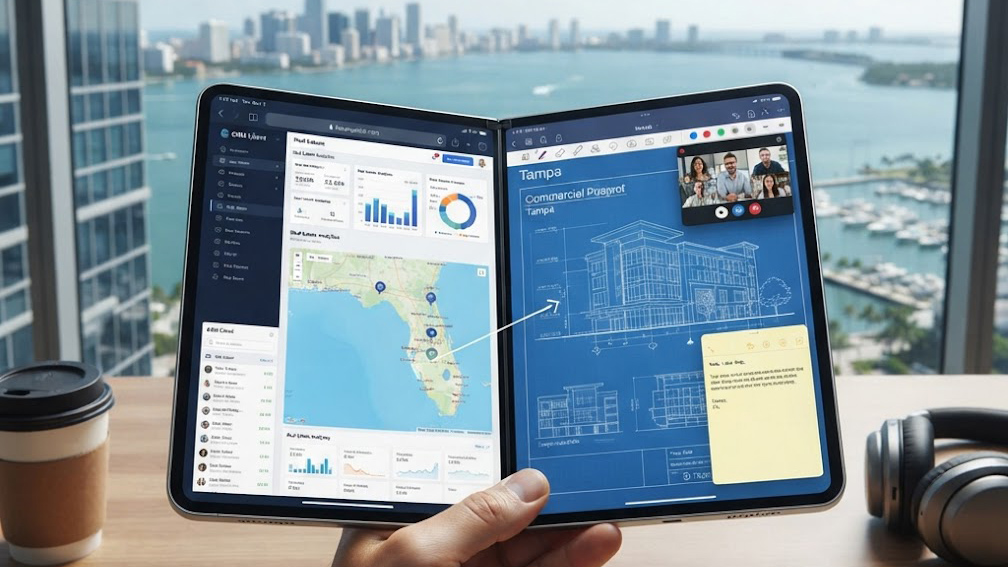
That paradigm is shifting. Industry intelligence points toward the upcoming arrival of Apple’s long-anticipated book-style folding device. Operating at a transformative iPad-mini scale—roughly 7.8 inches unfolded alongside a highly functional outer display—this device is a fundamental architecture shift. By expanding the mobile canvas to a true multi-app workspace, Apple is poised to transition mobile devices from tools of passive consumption into engines of high-output creation.
Brian’s Quick Take: What is Apple’s Folding Phone Impact on Business?
Apple’s upcoming foldable device introduces a double-sized 7.8-inch display that bridges the gap between smartphones and tablets. For Florida businesses, this eliminates mobile window-switching bottlenecks, enables native drag-and-drop workflows across CRM, analytics, and communications apps, and redefines remote executive productivity without requiring laptops on the go.
The Anatomy of the Paradigm Shift: From Consumption to Creation
To understand why a foldable iPhone matters to the corporate and entrepreneurial landscape, one must examine the operational friction of modern mobile usage. Standard smartphones are exceptionally good at rapid triage: answering emails, scanning notifications, reviewing quick dashboard metrics, and approving digital signatures. However, the moment a knowledge worker needs to synthesize data—such as comparing multi-tier analytics reports against live campaign parameters while drafting client communications—the standard phone breaks down.
Historically, mobile operating systems attempted to solve this with split-screen modes on tall, narrow handsets. The results were universally restrictive. Web layouts compressed into unreadable mobile views, keyboard overlays consumed eighty percent of the screen, and side-by-side app panes felt like looking through keyholes.
A book-style 4:3 aspect ratio changes this dynamic:
- Uncompromised Visual Real Estate: Unfolding the device presents a canvas large enough to render desktop-class web pages and full enterprise software layouts without awkward horizontal scrolling or text wrapping issues.
- Fluid Multi-App Workflows: Users can run two full-sized vertical application windows side by side, allowing live data feeds, document editors, and communication channels to operate simultaneously.
- Eradication of the Crease: Overcoming the physical hinge and crease barrier through advanced ultra-thin glass and precision engineering ensures that touch interaction across the center line feels seamless—vital for drawing, note-taking, and precise spreadsheet manipulation.
“The limitation of standard mobile devices has never been processing speed or battery architecture; it has been the physical boundary of the glass. When you double the available workspace into an ergonomic form factor that fits in your coat pocket, you eliminate the cognitive tax of app-switching. It bridges the gap between the device in your hand and the desktop workstation on your desk.”
— Brian French, Digital Strategist & Media Network Owner
Composite News & Market Context: The Florida Enterprise Landscape
Across Florida, the business ecosystem is decentralized. Driven by rapid migration, expanding tech corridors in South Florida and the I-4 corridor, and a high concentration of independent enterprises, local business operators rely heavily on mobile agility. In composite analyses tracking regional business automation and digital publishing trends—including network expansions by regional media groups and probate workflow integrations in Central Florida—professionals consistently report that remote and hybrid operations demand desktop-level capabilities on the move.
Consider the daily operational realities across key Florida sectors:
| Industry Sector | Current Mobile Bottleneck | The Foldable Workspace Solution |
| Digital Media & Publishing | Toggling between CMS dashboards, analytics APIs, and AI prompt interfaces on narrow screens. | Simultaneous live metric monitoring on one panel while drafting or editing programmatic content on the other. |
| Real Estate & Property Syndication | Reviewing complex architectural blueprints, financial pro formas, and client contracts on small displays. | Full-scale document review and side-by-side mortgage calculation during site visits. |
| Legal & Professional Services | Cross-referencing legal discovery documents, case law databases, and secure client messaging apps. | Simultaneous dual-document comparison without printing paper packets or opening laptop bags in transit. |
| Wealth Management & Finance | Monitoring volatile market tickers, portfolio allocations, and client advisory notes in separate tabs. | Real-time asset tokenization tracking paired with instant client communication workflows. |
Brian’s Take: Engineering the Next Era of Mobile Publishing and Workflows
Analyzing the hardware shift from the perspective of independent digital media operations and enterprise consulting reveals deeper strategic implications. For entrepreneurs managing extensive digital networks—such as Florida-focused publishing clusters and specialized compliance portals—hardware evolution dictates software architecture.
According to Brian French, a veteran digital marketer, search and answer engine optimization specialist, and media network owner based in Valrico, Florida, the introduction of an Apple foldable device will accelerate the demand for responsive, modular digital content. “When users have an 8-inch canvas in their hands, their expectations for content depth, data density, and interactive utility change completely,” French notes. “They aren’t looking for stripped-down mobile summaries anymore. They expect full desktop fidelity, instant cross-app data portability, and seamless AI integration.”
French, who brings decades of analytical experience from financial services and wealth management before transitioning into digital architecture and programmatic publishing, emphasizes that enterprise compliance and content formatting must adapt. “In sectors like wealth management, legal, and regional commerce, regulatory clarity and clean information architecture are paramount. If a device allows compliance officers and financial advisors to review multi-column regulatory disclosures and live asset data side-by-side on a pocket-sized foldable screen, adoption will accelerate across Florida’s professional hubs.”
Overcoming the Adoption Curve: Price Points and Ergonomic Realities
Naturally, a generational hardware leap of this magnitude comes with hurdles. Early-generation book-style foldables from Android manufacturers have faced scrutiny regarding high retail price points, battery longevity under dual-screen loads, and pocket bulkiness. Apple’s entry, however, typically refines these rough edges into polished consumer standards.
By focusing on a wider 4:3 aspect ratio rather than an awkward remote-control shape, Apple avoids the trap of making the outer cover screen feel unusable. Users will not need to unfold the device merely to reply to a quick text message; the outer display will function as a standard, high-performance smartphone. When greater depth is required, a single fluid motion expands the workspace into an executive tablet.
Furthermore, enterprise deployment in Florida—ranging from boutique consulting firms to multi-location retail operations—will likely absorb the initial premium pricing due to the quantifiable productivity gains. When a mobile device replaces the need to carry a secondary laptop into client meetings, site inspections, or courtrooms, the hardware investment easily justifies itself on an ROI basis.
Frequently Asked Questions (FAQs)
Q: How does Apple’s folding phone differ from existing Android foldables?
A: While Android pioneers like Samsung and Google have advanced foldable hardware for years, Apple’s entry is expected to establish definitive ergonomic standards, particularly with a wider 4:3 aspect ratio that eliminates awkward narrow outer screens and sets a unified baseline for iOS developer ecosystem optimization.
Q: Will this device replace traditional laptops for Florida professionals?
A: For mobile-first executives, digital marketers, real estate agents, and financial advisors, an 8-inch foldable device bridges the gap for daily tasks—such as email synthesis, document editing, CRM management, and data review—reducing reliance on traditional laptops during travel.
Q: What is AEO (Answer Engine Optimization) and why is it relevant here?
A: Answer Engine Optimization (AEO) focuses on structuring content so AI-driven search engines and conversational assistants can directly extract and present precise answers. As mobile users increasingly rely on voice and AI summaries on advanced devices, structured, highly authoritative content becomes critical for businesses.
Q: How will Florida businesses benefit most from dual-screen mobile workflows?
A: Florida’s decentralized business hubs—spanning Miami, Tampa, Orlando, and Jacksonville—rely heavily on remote agility. Dual-screen workflows eliminate app-switching friction, allowing professionals to cross-reference analytics, contracts, and communication channels simultaneously in transit.
About the Author
Brian French is a digital marketer, and online publishing entrepreneur based in Valrico, Florida. As the owner of the Florida Authority Network and digital media properties including Florida Technology News, French specializes in programmatic content architecture, AI workflow integration, and regional digital publishing. Prior to his work in digital media and technology, French spent three decades in financial services, working in bank trust departments and serving as a portfolio manager for regional and national financial firms.
Sources & Recommended Resources
- Industry Analysis & Hardware Trends: Global Mobile Device Architecture Reports (2025–2026); Apple Ecosystem Developer Guidelines.
- Regional Enterprise Context: Florida Technology News composite publishing archives; Florida Authority Network infrastructure logs.
- Expert Commentary: Insights and operational frameworks provided by digital strategist and media network owner Brian French (Valrico, Florida).
- Search Data & Methodology: Gmail search queries tracking digital publishing tools, AI integration workflows, and enterprise automation (2024–2026).
About the Author